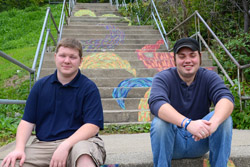
Uptown

Uptown includes all the neighborhoods around the University of Cincinnati including Avondale, Clifton, Clifton Heights, Corryville, Fairview, Mt. Auburn and University Heights, so it's a diverse mix of students and residents in one of the city's most distinct and eclectic group of neighborhoods. Uptown is the home of the Cincinnati Zoo as well as multiple hospitals and the Ludlow shopping district where you can find trendy and unique shops as well as any scent of incense you need. Ethnic restaurants, including a curiously high concentration of Indian eateries, multiple taverns, coffee houses, music venues and the Esquire — one of Cincinnati's finest independent art house movie theaters all make Uptown a one-stop walkable bazaar of exciting entertainment options.  

(3E) Summit touts, teaches benefits of green business

"Going Green" isn't just a feel-good initiative for businesses. It can have real economic benefits. Those benefits -- lower utility bills, less waste, among others -- are there to take advantage of regardless of whether the business considers itself green. That's the message organizers of this year's Energy, Economy and Environment (3E) Summit want businesses to grasp. The 4th annual 3E Summit is Oct. 5, 8 a.m. to 4 p.m. at Xavier University's Cintas Center. Tickets are $50 each, with discounts for Green Umbrella Members and students. "There's a lot of small and medium businesses out there, the people making widgets, who don't always have time to think about how to green their business," says Cincinnati's Sustainability Coordinator Steve Johns. The Summit hopes to remedy that, giving these businesses concrete ways to become more energy efficient, as well as insight into how that affects the bottom line. There will be two panel discussions on Green Business. One is a CEO Roundtable featuring local companies that decided to incorporate green concepts into their businesses. The panel will feature Mac's Pizza, emersion DESIGN, Compost Cincy and Burke, Inc. "Most of these companies aren't producing green products, but thought it was important to take care of energy and waste needs more effectively," Johns says. A second panel discussion will feature reps from UC Health and Procter & Gamble highlighting their efforts to green their supply chain by seeking out sustainable suppliers. "You can really have a competitive advantage by having a green business," Johns explains. The Summit also will feature a "Speed Greening" session, where experts will be on hand to answer specific questions about greening businesses. Those experts can answer questions related to electric and natural gas, waste disposal, transportation and water. In addition to the City of Cincinnati, the 3E Summit is hosted by Green Umbrella, Xavier University's Brueggeman Center for Dialog, the Greater Cincinnati Green Business Council, and USGBC Cincinnati Chapter. Register and find more information at the 3E Summit website. By Feoshia H. Davis Follow Feoshia on Twitter.

Stairways to stories: Students trace steps of history

NKU undergrads Shane Winslow and Andrew Boehringer began a labor of love by climbing dozens of Cincinnati's public staircases every week. Now they're writing a book about those steps, many of which led from downtown to the city's first suburbs.  These modern history detectives see them as keys that unlock important stories of the city's past.

Teens learn, serve as community-building leaders

High-schoolers today know that learning doesn't just happen in classrooms. It happens during weekend volunteer projects, through community-based outreach projects and in working across borders and disciplines to make the world a better place. For 15 years, the Student Service Leadership Workshop, an effort of the Mayerson Foundation High School Service-Learning Program, has pooled creative minds with passionate ideas to encourage more diverse and service-based learning opportunities inside the classroom and out. This fall, in partnership with the University of Cincinnati Center for Community Engagement and Peace Village, the foundation is pulling 500 high-school students and teachers together to share ideas and inspire each other with their best practices and high hopes. "Many schools have required service hours to graduate from high school, but these conversations allow students to go deeper, ignite a flame, and take ownership of what community issues students address at school," says Clare Blankemeyer, program director of the Mayerson High School Service-Learning Program. She notes that nearly 50 local high schools, both public and private, are sending representatives to this year's conference, held at the University of Cincinnati. One of the iniatives highlighted is Charitable Innovations, a Cincinnati-based, student-run, nonprofit. After a fundraiser is held for a charity, CI invests the capital into short-term micro-credit loans instead of transferring proceeds raised directly to the charity. These small loans are made through Kiva, a non-profit organization and funds directly support impoverished entrepreneurs around the world who are trying to start ventures to lift their families or villages out of poverty. Funds are guaranteed of 100 percent return on investment in eight months, essentially allowed the fundraisers to do good—twice. Do Good: • Learn more about the Mayerson Foundation's service learning iniatives in high schools by contacting Clare Blankenmeyer. • Check out Charitable Innovations online. • Learn about UC's Center for Service Learning and Civic Engagement, which supports ongoing efforts to connect work in classrooms with work in the community. By Elissa Yancey Follow Elissa on Twitter.

CancerFree KIDS to bring pet visiting center to Children’s Hospital

A partnership between Loveland-based CancerFree KIDS and Cincinnati Children’s Hospital Medical Center will let sick kids visit their pets at the first ever hospital based animal visitation center in the United States. CancerFree KIDS, a non-profit group that has raised $1.3 million in the past decade to help fund pediatric cancer research, will use a $107,500 grant awarded to them by Impact 100 to build the visitation center at Children’s Hospital sometime next spring, says Ellen Flannery, founder and executive director of the group. “The Pet Center will be a model for similar facilities in other children’s hospitals, increasing the impact of the grant,’’ says Flannery, whose now 15-year-old daughter is a cancer survivor. “We are thrilled to win the grant.” Flannery and her husband Sam founded CancerFree KIDS after their daughter, Shayna, was diagnosed with cancer in both of her eyes at just five months old. Shayna lost one of her eyes to the cancer and – thanks to advances in pediatric cancer research – was successfully treated. “She’s a healthy, bratty 15-year-old, I am happy to say,” Flannery says.   Celebrating its 10th year, the non-profit’s goal is to continue to raise money through fundraisers, sponsorship or through grants to continue to help fund pediatric cancer research at Cincinnati’s Children’s Hospital. Applying for the Impact 100 grant aligned with that mission. Research has shown that a pet can improve not only a sick person’s emotional well-being, but also has positive and measurable physical outcomes as well, she says. There is a similar pet visitation area at the Alberta Children’s Hospital in Alberta, Canada. Flannery received multiple letters and emails from social workers, hospital staff as well as children and adults suffering with long-term illnesses who supported such a center. A 12-year-old blind boy, battling brain cancer since he was four months old, wrote: “I hate spending time in the hospital … My favorite time of any day has been to go home and ‘chillax’  in my bed and my dog crawls under the covers and gets as close as possible. I feel like she has always been there for me, and I can tell her anything. She will make noises so I know she is listening, and I do not feel as alone.” A 14-year-old girl who lives out of state and travels to Children’s for months at a time to receive treatment for re-lapsed leukemia told Flannery she most misses her puppy, Abe. “Abe is my comfort blanket in a way and someone who listens to me without any comments only support,’’ the teen wrote. “I really miss him all the time.” The center, which will be wheelchair and hospital-bed accessible, will have multiple visitation bays where children undergoing long-term stays can visit with their pets. The center will have electricity, but will not be heated or cooled, she says. As part of the agreement, Children’s will continue the ongoing upkeep and maintenance of the building. Flannery says she is hopeful the visitation area can also be a place where, one day, children who don’t have pets can also schedules visit with animals.   Do Good: •    Join CancerFree KIDS mailing list. •    Support one of their upcoming fundraisers. •    Like them on Facebook. •    Follow their news on Twitter. By Chris Graves Chris Graves is Assistant Vice President of Digital and Social Media at the Powers Agency.

Cincinnati stuns Virginia Tech with late touch-down

Cincinnati stuns Virginia Tech with late touch-down to win. Read the story and watch the video here.

UC student’s ‘green’ IT to be presented in Baltimore

University of Cincinnati computer science doctoral student Dippy Aggarwal will be among the leaders in their fields who are sharing emerging research and career interests at the Grace Hopper Celebration of Women in Computing Conference. Read the full story here.

FotoFocus featured in New York Times

FotoFocus, Cincinnati's month-long celebration of photography, gets a shout-out in The New York Times fall arts preview. Read the excerpt here.

Cincinnati Public Schools highlighted in Education Nation

Cincinnati Public Schools made a national mark when the local Community Learning Centers were highlighted as part of a national series of solutions that work in education systems. Read the full case study here.

University of Cincinnati cracks US News’ list of top colleges

The University of Cincinnati cracks US News & World Report's listing of top American colleges. Read the full listing here.

UC professor snags $1M INSPIRE grant from National Science Foundation

Ali Minai, a professor in the electrical and computer engineering department at the University of Cincinnati, recently was awarded the Integrated NSF Support Promoting Interdisciplinary Research and Education (or the INSPIRE award) for his project, “The Hunting of the Spark: A Systematic Study of Natural Creativity in Human Networks.”  INSPIRE grants, from the National Science Foundation, target complicated and important scientific problems in interdisciplinary studies.  Before coming to UC, Minai received his undergraduate degree in electrical engineering in Pakistan; he then came to the United States in 1985 to study for his master’s and PhD in electrical engineering at the University of Virginia. After completing his post-doctoral work in neuroscience at the University of Virginia, Minai landed his first teaching job in 1993 at the University of Cincinnati.  Q: What interests you the most about the work you do? What got you started in this line of research?  A: My initial interest was in artificial intelligence because I have always been fascinated by how brains work. My PhD is in electrical engineering, but my dissertation focused on brain-inspired systems called neural networks that can learn from data.  Since then, my research area has broadened to the field of complex systems, which are systems where a large number of entities (cells, computers, people, organizations, etc.) interact, which results in the self-organized emergence of structures and processes.  Examples of such systems include living organisms, brains, societies, economies, markets, ecosystems and social networks.  Scientists have gradually realized that the same basic principles underlie all such systems, which is why we can study them using the same mathematical and computational methods.  My research in particular focuses on biological and human systems, although I have also worked on some others. In the last several years, most of my work has been on systems that underlie cognitive processes. Q: What does the INSPIRE award mean to you?  A: Above all, it is an opportunity to do very exciting research. It is an honor that is both gratifying and humbling. I think it is also an indication that the scientific community considers the research we do at UC valuable. I am very grateful for all the support I have received at UC over the years, which has enabled me to pursue my research interests, leading to successes such as this. Q: What kind of research are you currently working on?  A: “I am currently working on several research projects, including: 1) Understanding the brain mechanisms that underlie thought and action; 2) Understanding the cognitive and social factors that underlie creativity in individuals and groups, including social networks; 3) Understanding the co-evolution of ideas and communities in human networks; and 4) Analyzing large bodies of text (online news, blogs, etc.) to extract latent ideas, sentiments, opinions and biases. Q: What does your research involve?  A: The projects involve building computational models of various regions of the brain, simulating multi-agent computational models of human communities, mining and analyzing large amounts of data from the Internet and developing new analytical algorithms.  To do this, my students and myself have to read and synthesize research papers from engineering, computer science, psychology, neuroscience, systems biology, sociology, information science and a variety of other disciplines. Above all, our work is highly interdisciplinary. Q: Have you been granted any other awards like INSPIRE?  A: Before the INSPIRE grant, I received several other research grants from different sources. Since 2007, my collaborators and I have received two grants from the National Science Foundation to work on models of creativity. However, the work we propose to do for the INSPIRE grant will be at a whole new level. Q: Is your research team strictly from UC? A: The INSPIRE award involves researchers from four institutions. UC is the lead institution, so I am the principal investigator for the overall project.  Very important parts of the work will be done by my collaborators: professors Paul Paulus and Jared Kenworthy, both at the University of Texas at Arlington; Prof. Alex Doboli at the State University of New York-Stony Brook; and Prof. Simona Doboli at Hofstra University.  All of us have collaborated on previous projects in this field of study, and I think the strength of our collaborative record was a critical factor in receiving the INSPIRE grant. Doctors Alex Doboli and Simona Diboli received their PhDs at UC, so UC is a big part of the team.  By Caitlin Koenig

Our Partners

Taft Museum of Art
Warsaw Federal

Don't miss out!

Everything Cincinnati, in your inbox every week.

Close the CTA

Already a subscriber? Enter your email to hide this popup in the future.