Uptown

Uptown includes all the neighborhoods around the University of Cincinnati including Avondale, Clifton, Clifton Heights, Corryville, Fairview, Mt. Auburn and University Heights, so it's a diverse mix of students and residents in one of the city's most distinct and eclectic group of neighborhoods. Uptown is the home of the Cincinnati Zoo as well as multiple hospitals and the Ludlow shopping district where you can find trendy and unique shops as well as any scent of incense you need. Ethnic restaurants, including a curiously high concentration of Indian eateries, multiple taverns, coffee houses, music venues and the Esquire — one of Cincinnati's finest independent art house movie theaters all make Uptown a one-stop walkable bazaar of exciting entertainment options.  

The New Revolutionaries: Smarter than a Goldfish

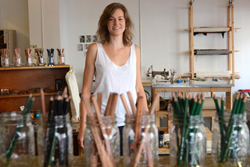
What do shoe-making workshops, recycled sketch paper and Portolets have in common? They're all part of Main Street entrepreneur Alisha Budkie's sustainable world, one the UC design alum is helping build with support from longtime neighbors and a growing army of her peers in Over-the-Rhine.

Video Origami plays John Cage @ The Emery

Cincinnati's Emery Theatre serves as the space and inspiration for a new video created by CCM doctoral student Paul Schuette. His group, Origami, performs avant garde composer John Cage's Cartridge Music, and an experiment in sound becomes an experiment in space and understanding. Video courtesy Paul Schuette.

UC students win ‘zero energy’ national design competition

A group of University of Cincinnati students took home first place at a national sustainability design competition, designing an essentially "zero energy" building. The seven-member team redesigned the innovative Joe and Rika Mansueto Library of the University of Chicago. Students were tasked with theoretically creating a building with net zero energy usage. The American Society of Heating, Refrigerating and Air-Conditioning Engineers, or ASHRAE, sponsors the annual competition, and this is UC's first No. 1 finish. Six graduate students and one undergrad made up UC's team; their educational backgrounds include architecture/construction and mechanical (HVAC) engineering. The team worked on the design for about three months, says member Ravik Chandra, a grad student in the Department of Mechanical Engineering. The team divided into a group that worked on the building's architecture and a group in charge of mechanical systems. Both groups worked closely to assure the building would be both pleasing to look at and energy efficient. That teamwork paid off, and could serve as an example to professionals in the field, Chandra says. "It's the first time I've worked with an architect to solve a real-life problem. Usually the architecture or the engineering dominates (building design). It was quite a new challenge, and I never realized the many different aspects that go into architecture," he says. Teams were allowed to relocate the building to the state capitol of their home state, which the UC team did, bringing it to Columbus. Among the building's winning features were changing the orientation of the building to increase the amount of sunlight it would absorb. That cut cooling costs by some 20 percent. The team also altered the large glass dome that tops the building, using transparent photovoltaic cells that turned sunlight into electricity instead, says Dustin Altschul, the project manager who recently graduated with a B.S. in Architectural Engineering Technology. They also installed a system to harvest rainwater for the building's use to cut down on water consumption. The building wasn't 100 percent net zero, but it was the closest to achieving the goal. It's up to the Library itself to use any of the ideas, but UC team representatives will present their design concepts at the annual ASHRAE Winter Conference in January 2013 in Dallas. By Feoshia H. Davis Follow Feoshia on Twitter

CCM’s Josh Jessen pushes boundaries, redefines genre

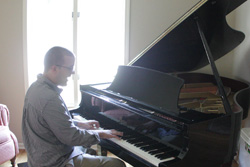
Inspired by Questlove, J Dilla, The Roots and Hi-Tek, CCM classical and jazz piano student Josh Jessen defies traditional musical genres. The 20-year-old's accelerating career has already carried him from local coffee houses to international concert halls.

Entrepreneurs on a roll: Food trucks navigate complex elements

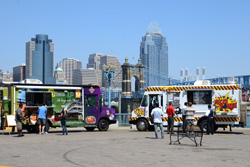
In Cincinnati’s gritty food truck subculture, there are few avenues of support and even fewer guarantees. Tom Acito of Cafe de Wheels and his food truck brethren have chips on their shoulders, real skin in the game and a cult-like following.

CCM Prep hosts first adult chamber program

Learning isn’t just for children. In fact, says Amy Dennison, assistant dean for CCM’s Preparatory Department, adults sometimes have an easier time learning than children do because of their enthusiasm and free will. “Our prep department serves performers anywhere from ages three to 84,” Dennison says. “And most of our faculty love working with adults because they’re excited and want to be there.” This September, the staff from CCM Prep and musicians from the Cincinnati Symphony Orchestra (CSO) plan to give amateur adult musicians opportunities to work with one another, work with professionals and share their music with the community by organizing CCM Prep’s first Adult Chamber Music Weekend.  The weekend, which is designed to expose amateur musicians to professional coaching, will include group rehearsals, guidance from Cincinnati Symphony Orchestra musicians, breakfast, lunch and a final performance in the CCM village. The staff from CCM is now accepting online applications for the program. The form asks applicants to detail their musical capabilities as well as what instruments they play. Applications for the program, which costs $125 per person, will be accepted until Sept. 8.  Then, based on their musical capabilities, the musicians will be put into groups of three to four.   Participants will practice and perform within their chamber groups for the duration of the weekend. Staff at the CCM Prep Department will choose music for the final performances, and professionals from the CSO will coach the players along the way.  The final performance, which will be free and open to the public, is scheduled for Sept. 29. Dennison says that the weekend will be a wonderful way for the community to engage in the arts. The small, intimate groups will give musicians the chance to share their passions with like-minded people. “Our main goal is to provide opportunities for people of all ages and abilities,” Dennison says. “I strongly believe that everyone in the community should have access to the arts, regardless of their talents or abilities. It just gives people a sense of fulfillment and joy.” Do Good: • View CCM Prep Department’s class offerings. • Attend the final performance Sept. 29. • Check out the Cincinnati Symphony Orchestra’s fall schedule. By Jen Saltsman Follow Jen on Twitter 

XU, UC communities can leave cars at home this year

Last year, UC pioneered the Zip Car in the city, and since their delivery to campus, two red Zipcars retain prime parking spaces in front of McMicken Hall, while another, a hybrid, sits at Daniels.  This fall, Xavier University launches WeCar,  an automated car rental option offered through a partnership with Enterprise Rent-A-Car. Thanks to these two options, local students, faculty and staff can reserve cars on an as-needed basis, limiting demand for parking and adding to the convenience of traveling around town.  The new WeCar options at Xavier University are two Kia Souls, which will be parked near Flynn Hall. The program offers 24-hour access to hourly, daily and overnight rentals.    Both programs benefit younger college students, those aged 18 to 20, who are normally not able to rent cars. XU’s WeCar program even taps into alumni support: with 20 XU alums working for Enterprise in the region, students can feel connected not only to the cars, but the company. All it takes is a driver’s license and a credit card to start the rental process for either option. Both are designed to accommodate sustainability minded students as well as expand transportation options for members of university communities.   By Elissa Yancey Follow Elissa on Twitter

Cincinnati Innovates’ winners collect $100K in awards

One is a soccer dad tired of suffering on the sidelines. Another is a savvy entrepreneur with a plan to help professionals who have said “yes” to one too many find a safe and convenient way home. Still another is a mom inspired by healthy living. This year’s Cincinnati Innovates winners encompass an impressive range of ideas and strategies to improve quality of life and health. Rick Pescovitz of Under-the-weather.com won one of the top awards, the $25,000 CPG Strategies Award, for his all-purpose tent built to fit soccer chairs and protect fans from extreme weather. The other $25,000 winner, Brooke Griffin of Skinny Mom, has built a network of more than 70 mom-bloggers around the world. She won investment help from CincyTech. Another winner, Jon Amster of 321RIDE.com, received a $5,000 Taft Legal/Patent Award for his innovative approach to his membership-based designated driver service already used by the Cincinnati Reds and Dunhumby USA. In its third year, the Cincinnati Innovates competition awarded $100,000 in funding and in-kind services to entrepreneurs representing 12 business ideas. Since its inception, the competition has sparked millions of dollars of investments in companies with local connections. More than 200 entries vied for support this year, with awards given in a variety of categories. Commercialization award winners were selected by their sponsors (CincyTech, LPK) with help from a team of judges; in-kind services awards were chosen by sponsors with help from judges; community choice award winners were chosen by the public. Browse this year’s innovative entries here.  By Elissa Yancey Follow Elissa on Twitter.

West McMicken shows off ‘streetcar suburb’ history

Tucked at the bottom of the Clifton hillside, the West McMicken neighborhood features historic housing stock in an isolated area easily overlooked by passersby. But its well-maintained greenspaces and award-winning beautification programs offer a glimpse of the dedication of its neighbors, which will be on full display during the Cincinnati Preservation Association’s first “Fall into Restoration” series next month. “It’s absolutely beautiful,” says Margo Warminski, CPA’s restoration director.  The program features a tour of a restoration-in-progress—an 1885 Queen Anne that once served as the home of a streetcar conductor, is in the process of being restored to its original state.  “It’s a glimpse of late Victorian middle-class life,” Warminski says of the house, which was part of the neighborhood that grew up along Cincinnati’s original streetcar line. “We are very excited to be able to do this program.” She notes that members of the West McMicken Improvement Association will be on hand to discuss their work to keep their community green and flourishing. In addition to reclaiming abandoned buildings in the University Heights neighborhood, members have also fought off an intrusive highway plan and are currently working with Spring in our Steps volunteers to beautify the Warner Street steps. For more information about the neighborhood and the Sept. 22 tour, visit the Cincinnati Preservation Association. By Elissa Yancey Follow Elissa on Twitter  

Fashion design project includes medical innovation

When you think “compression garments,” you normally think “grandma hose,” not “high fashion.” But a team of fashion designers at UC have joined with medical professionals that treat a genetic disease that affects connective tissue to change not only those perceptions, but the lives of those suffering from the condition.  Ehlers-Danlos Syndrome (EDS) affects hundreds of thousands of Americans, limiting their mobility and endurance. The multi-system disease creates joint instability, dizziness and unrelenting severe pain. Even pulling on jeans can cause someone with EDS to dislocate a shoulder. When physical therapists approached Margaret Voelker-Ferrier, of UC’s College of Design, Architecture, Art and Planning, with the problems that people with EDS experience when simply putting on clothes, she knew she could put her 30 years of bodywear design experience to good use. "I started as bra designer," says Voelker-Ferrier. "That has always been a passion for me, engineering things to solve a problem. Making things that are both beautiful and functional." She gave the project to fashion design students in her bodywear class, explaining the challenges of EDS sufferers as well as the basics of clothing design. "The students loved the project and I think they did a marvelous job," she says. Voelker-Ferrier worked with Brooke Brandewie on design solutions, which have been highlighted as part of the Cincinnati Innovates competition. The clothes they designed – from dresses and pants to an evening gown -- support and stabilize body joints and ligaments. Made from high-tech materials, they provide comfort and style simultaneously. One shirt, for example, has adjustable straps that help hold shoulders in place.  “The fact that they are designing clothing that is functional and therapeutic and beautiful and doesn’t look like a medical device is exciting,” says Candace Ireton, MD, who suffers from EDS. She saw the clothes during the Ehlers-Danlos National Foundation Learning Conference, which was held in Cincinnati this month.  Both Brandewie and Voelker-Ferrier attended the conference to gather measurements of EDS patients and collect data as they continue to develop their designs. While designed for EDS, the same fashions could be adapted for use by people with autism, MS and arthritis.  "It was really wonderful to be able to meet people and talk with them about this," Voelker-Ferrier says. "It’s kind of amazing."  For now, she's working on collecting more data, finding some popular sizes to work with and eventually leading an interdisciplinary studio at UC to design prototypes. Eventually, the design maven hopes to turn her problem-solving fashion sense into a small business that will target the needs of people with chronic medical conditions as well as Baby Boomers.  Fashion, after all, can provide a mental, as well as physical, boost, says EDSer Ireton. “Some of the clothing is sexy,” she says. “You can feel better, keep your ribs in place and look cute, too.”   For more information about the design project, visit their Cincinnati Innovates submission. By Elissa Yancey Follow Elissa on Twitter

Our Partners

Taft Museum of Art
Warsaw Federal

Don't miss out!

Everything Cincinnati, in your inbox every week.

Close the CTA

Already a subscriber? Enter your email to hide this popup in the future.