Uptown

Uptown includes all the neighborhoods around the University of Cincinnati including Avondale, Clifton, Clifton Heights, Corryville, Fairview, Mt. Auburn and University Heights, so it's a diverse mix of students and residents in one of the city's most distinct and eclectic group of neighborhoods. Uptown is the home of the Cincinnati Zoo as well as multiple hospitals and the Ludlow shopping district where you can find trendy and unique shops as well as any scent of incense you need. Ethnic restaurants, including a curiously high concentration of Indian eateries, multiple taverns, coffee houses, music venues and the Esquire — one of Cincinnati's finest independent art house movie theaters all make Uptown a one-stop walkable bazaar of exciting entertainment options.  

UC welcomes more Indian students

In 2010, Indian students at the University of Cincinnati were granted scholarships worth $5 million; in 2012, scholarships worth $7 million are expected to be given. Read more here.

Big plans in the works for Cincinnati

As many areas of Cincinnati are being rejuvenated, including OTR and Washington Park, the City of Cincinnati approved a comprehensive approach to focus on development in the city as a whole, not just targeted neighborhoods.  Last Friday, the City Planning Commission approved and adopted Plan Cincinnati, which was designed with input from residents. The Plan is an opportunity to strengthen what people love about the city, what works and what needs more attention, says Katherine Keough-Jurs, senior city planner and project manager.   The idea is to re-urbanize suburbanized Cincinnati; in a sense, to return to the strengths of the city's beginnings. Cincinnati was established just after the American Revolution in 1788 and grew into an industrial center in the 19th century. Many of those industries no longer exist in the city, which is part of why Cincinnati has become more suburbanized in the past 50 years. One of the long-term goals of the Plan is to bring new industries to Cincinnati.   With a new approach to revitalization, Cincinnati is blazing the trail for other cities. With a focus on building on existing strengths rather than tearing down structures and creating new ones, the Plan aims to capitalize on the city's “good bones” and good infrastructure.   Cinicinnatians had a huge role in developing the Plan. The first public meeting for the Plan was held in September 2009, when residents offered their insights into “what makes a great city?" and "what would make Cincinnati a great city?” A steering committee of 40 people representing businesses, nonprofits, community groups, local institutions, residents and City Council helped develop the Plan. The Plan also got support from a grant from the Partnership for Sustainable Communities, which the City received in 2010. The grant allotted $2.4 million over three years to support the Land Development Code, which combines and simplifies Cincinnati's codes, reviews the development process, implements Form-based Codes and considers more creative uses for land. The grant allowed the city to start implementing some of the ideas voiced in public meetings.   Visionaries included youth, too. City staff worked with community centers and Cincinnati Public Schools to develop an art project for children. They were given clay pots and asked to paint their fears for the city on the inside and their dreams for the city on the outside. The children saw the big issue was quality of life, just like the adults did.   “It was an interesting way to get the kids involved and thinking about the future,” Keough-Jurs says.   The Plan aims to strengthen neighborhood centers—the neighborhoods’ business districts. It maps out areas that people need to get to on a daily basis and found that most are within about a half-mile of the business districts. But in some neighborhoods, residents can’t access their neighborhood centers. The accessibility of a neighborhood center is based on walkability—not just for pedestrians, but also about how structures address walking. For exampke, if a pedestrian can walk from one end of the neighborhood center to the other without breaking his or her pattern (the window shopping effect), the area is walkable; if he or she has been stopped by a parking lot or vacancies, it’s not walkable, Keough-Jurs says.   The neighborhood centers are classified in one of three ways in the Plan: maintain, evolve or transform. Some neighborhoods have goals to maintain levels of walkability, whereas others need to gradually change or evolve. Still others need to completely transform in order to strengthen their business districts.   “Cincinnati is at the heart of the region,” Keough-Jurs says. “If we strengthen Cincinnati, we strengthen a region.” The next step for the Plan is to go before the Cincinnati City Council, specifically the Livable Communities Committee, which is chaired by Vice Mayor Roxanne Qualls.   By Caitlin Koenig Follow Caitlin on Twitter

COR Music Project offers access, seeks diversity in classical music

“We believe that the arts signify and represent the health of the community. Vibrancy in the arts makes a community a more desirable place to live and to work.” That’s the mindset prompted Louisa Shepherd to help found the COR (Cincinnati Out Reach) Music Project in December 2011, a free, after-school orchestra program that provides innovative access to classical music to youth who are typically underserved when it comes to arts programming. The group also wants to give those same students opportunities and inspiration to attend college. COR Executive Director Deron Hall is a French horn player for the University of Cincinnati’s College-Conservatory of Music, and Shepherd herself was able to attend college thanks to a music scholarship.  “We have a passion for music, and it’s taken us from one circumstance to another,” Shepherd says. “We’re very much about giving back and revitalizing the arts in our community.” The approach is two-pronged: COR’s teaching artists lead piano, voice/choir, guitar and electronic music courses at schools that lack arts programs. At the same time, COR works year-round with local communities to form orchestras for youth in grades three and up. The first such effort will launch in Avondale this January.   Purcell Marian High School is currently COR’s sole institutional partner; the goal is to secure partnerships with at least three more area schools next year.  “We like to say we work in the community and not for the community,” says Shepherd. “We’re making it something the community stands behind and sees as valuable. It’s about showing the community the tools we have and finding out what we can do together.” COR’s “all play, none pay” philosophy is supported by ArtsWave grants, outside donations and nominal commitments from partner schools, as well as the group’s organized fundraising efforts.  Do Good: • Watch COR in action online. • Make a tax-deductible donation to support COR.  • Keep up with COR news and events on Facebook.  By Hannah Purnell Follow Hannah on Twitter

MedCity News reports on Innov8 For Health accelerator class

A Cincinnati accelerator for health IT startups that models itself on groups like Rock Health, Blueprint Health and Healthbox has named its inaugural class of companies. Read more here.

Modern Makers builds community in Uptown

A collaboration between the Uptown Consortium and Hark + Hark sets its sights on engaging community members in Uptown in the arts in new, creative, and super cool ways. Together, they host monthly art events as Modern Makers. This month, Modern Makers presents performances from ALICE (in wonderland) by Cincinnati Ballet II Second Company at the Clifton Cultural Arts Center on Wed., Oct. 17, from 6 to 8 p.m. Modern Makers is sponsored through Uptown Consortium and Hark and Hark, both nonprofits. “Bringing and highlighting arts and the arts environment to uptown Cincinnati by featuring and displaying different art programs and opportunities for everyone…is the main key of what we’re trying to do,” says Janelle Lee, Uptown Consortium’s Director of Business and Community Affairs and a member of the Cincinnati Ballet Board of Trustees. Most of the monthly art shows are held in Corryville on Short Vine or on Glendora Avenue, right behind Bogart’s.  About a year and a half ago, Uptown Consortium partnered with Hark and Hark, an art and community-based firm started by two former University of Cincinnati DAAP graduates, Catherine Richards and Ahn Tran, to create Modern Makers. The second season of Modern Makers coincides with UC’s school year, with different art shows each month from August until June.  This year’s MM season kicked off with a chef, who prepared food through art. The event was an overwhelming success, according to Lee. All MM events are free and open to the public; food is provided by a restaurant on Short Vine. Each event also features an interactive creative art project; for example, last year for Mardi Gras, participants created masks. In November, Modern Makers will present the second annual “Light Up Short Vine,” Wed., Nov. 28—a Christmas celebration complete with lights, a Christmas tree, Santa Claus and CCM carolers. By Stephanie Kitchens

Chicks in the city: a snapshot of sustainable urban living

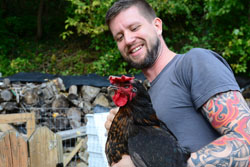
Boxed in the backyard of a stucco Northside home, 72 toes claw through straw and shredded compost. Nine clucking chickens are cooped up in chicken-wire-wrapped wood beams. Welcome to Chris Lamkin's world.

From the CR: Bats

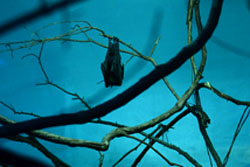
In honor of the season, Soapbox once again partners with the acclaimed literary journal The Cincinnati Review to offer you a tasty tidbit of poetry. Enjoy Brian Barker's "Bats," and read why CR editors fell under its spell.

New leader hopes to expand reach of Adopt-A-Class

Born and raised in Cincinnati, Katie Burroughs now devotes her life to making her hometown a better place in a new role as director of the nonprofit Adopt-A-Class. She learned about community involvement through Walnut Hills High School’s community service program as well as her parents’ dedication to volunteer work. Burroughs left home to study English at Wake Forest University in Winston-Salem, NC, and then received her law degree at the Catholic University of America in Washington, D.C. After practicing in northern Virginia, though, Burroughs returned to Cincinnati. She worked as a prosecutor for the City of Cincinnati and Hamilton County and was exposed to children living in horrifying conditions. The experience fueled her passion for mentoring children living in poverty.  Then last year, she served as co-president of the PTA at Pleasant Ridge Montessori, where her two children attend school (her twins attend preschool). She realized the impact education has not only on children’s lives, but also the life of a community. Burroughs had attained her professional goals as a prosecutor, so she felt ready to transition into a different, more proactive role in changing children’s lives.  “By getting involved in education, my hope and desire is that we will touch lives and in the end there will be fewer people at the back end, where I always saw them [as a prosecutor],” Burroughs says. “If you can direct a kid in the right direction, or just give them that glimmer of hope, or show that someone believes in them and that there is a life outside of poverty and the environment that they’re in, then just may be my former coworkers won’t see them on the back end.” Burroughs is settling into her new role at Adopt-A-Class, a local nonprofit that connects under-resourced students with professional mentors. Founded by Bill Burwinkel, Adopt-A-Class currently works with 24 schools, reaching about 8,000 students.  The mentors, typically groups of professionals, form pen pal relationships with the students throughout the school year. Weekly, mentors who are available go to classrooms for activities. Burroughs hopes to increase the number of classrooms adopted. Although there is a waiting list for new schools to get involved, Adopt-A-Class wants to finish meeting the needs of the schools that they are already committed to. “You can’t solve every problem; you’re not going to save every child—I’m not naïve—but you can touch lives,” Burroughs says. Do Good: • Refer a friend to Adopt-A-Class. • Donate to Adopt-A-Class. • Attend the Rusty Ball and choose Adopt-A-Class as your charity. By Stephanie Kitchens

My Soapbox: Craig Vogel, University of Cincinnati

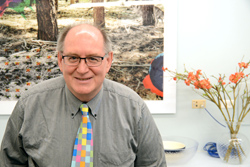
What do machines that make frozen margaritas, OXO Good Grips and the entrepreneurs on Main Street have in common? According to UC's design guru Craig Vogel, two very important things:  Opportunity and innovation. Vogel shares his thoughts on Cincinnati and what companies need to do to “get it right.”  

CancerFree KIDS to bring pet visiting center to Children’s Hospital

A partnership between Loveland-based CancerFree KIDS and Cincinnati Children’s Hospital Medical Center will let sick kids visit their pets at the first ever hospital based animal visitation center in the United States. CancerFree KIDS, a non-profit group that has raised $1.3 million in the past decade to help fund pediatric cancer research, will use a $107,500 grant awarded to them by Impact 100 to build the visitation center at Children’s Hospital sometime next spring, says Ellen Flannery, founder and executive director of the group. “The Pet Center will be a model for similar facilities in other children’s hospitals, increasing the impact of the grant,’’ says Flannery, whose now 15-year-old daughter is a cancer survivor. “We are thrilled to win the grant.” Flannery and her husband Sam founded CancerFree KIDS after their daughter, Shayna, was diagnosed with cancer in both of her eyes at just five months old. Shayna lost one of her eyes to the cancer and – thanks to advances in pediatric cancer research – was successfully treated. “She’s a healthy, bratty 15-year-old, I am happy to say,” Flannery says.   Celebrating its 10th year, the non-profit’s goal is to continue to raise money through fundraisers, sponsorship or through grants to continue to help fund pediatric cancer research at Cincinnati’s Children’s Hospital. Applying for the Impact 100 grant aligned with that mission. Research has shown that a pet can improve not only a sick person’s emotional well-being, but also has positive and measurable physical outcomes as well, she says. There is a similar pet visitation area at the Alberta Children’s Hospital in Alberta, Canada. Flannery received multiple letters and emails from social workers, hospital staff as well as children and adults suffering with long-term illnesses who supported such a center. A 12-year-old blind boy, battling brain cancer since he was four months old, wrote: “I hate spending time in the hospital … My favorite time of any day has been to go home and ‘chillax’  in my bed and my dog crawls under the covers and gets as close as possible. I feel like she has always been there for me, and I can tell her anything. She will make noises so I know she is listening, and I do not feel as alone.” A 14-year-old girl who lives out of state and travels to Children’s for months at a time to receive treatment for re-lapsed leukemia told Flannery she most misses her puppy, Abe. “Abe is my comfort blanket in a way and someone who listens to me without any comments only support,’’ the teen wrote. “I really miss him all the time.” The center, which will be wheelchair and hospital-bed accessible, will have multiple visitation bays where children undergoing long-term stays can visit with their pets. The center will have electricity, but will not be heated or cooled, she says. As part of the agreement, Children’s will continue the ongoing upkeep and maintenance of the building. Flannery says she is hopeful the visitation area can also be a place where, one day, children who don’t have pets can also schedules visit with animals.   Do Good: •    Join CancerFree KIDS mailing list. •    Support one of their upcoming fundraisers. •    Like them on Facebook. •    Follow their news on Twitter. By Chris Graves Chris Graves is Assistant Vice President of Digital and Social Media at the Powers Agency.

Our Partners

Taft Museum of Art
Warsaw Federal

Don't miss out!

Everything Cincinnati, in your inbox every week.

Close the CTA

Already a subscriber? Enter your email to hide this popup in the future.