
At Oyler, keeping an eye on students’ eyes
Walk into Oyler School in Cincinnati and take a right, past the office and through a set of double doors, and you’ll find what basically looks like a LensCrafters. Read more.
Price Hill is on Cincinnati's western edge overlooking the downtown basin. Locals love long-standing family-owned business like Incline Public House, Primavista and Somm Wine Bar. Once home to Pete Rose and the headquarters of Slush Puppies, Price Hill still houses a major food manufacturing plant for hometown-based Kroger. Mt. Echo Park offers sweeping views of the Cincinnati skyline, and Cincinnati Christian University resides along Glenway Avenue, attracting young students from all over the world to this unique and historical area of town. Groups like Price Hill Will and Cincinnati Landmark Productions are helping to revitalize the area with new entertainment options, local businesses and neighborhood restorations.
Walk into Oyler School in Cincinnati and take a right, past the office and through a set of double doors, and you’ll find what basically looks like a LensCrafters. Read more.

The Health Foundation of Greater Cincinnati recently awarded 21 Cincinnati organizations with more than $800,000 to pursue programs designed to improve people’s health. The Foundation also granted an additional $290,000 for 22 other projects that fit better with some of the Foundation’s other funding programs. In all, 44 proposals were funded for a total of more than $1.1 million. The grants are round one of the Foundation’s “Launching Solutions: Seizing New Opportunities in Health” initiative that focuses on providing the public with access to health and prevention services. The Health Foundation opened its doors in January 1998, not as a health care provider, but as a provider of services to nonprofits that have needs for education, consultation and technical assistance in addition to grant money. The “Launching Solutions” grant process began in February when the Foundation received 126 letters of intent from organizations in Indiana, Ohio and Kentucky. Twenty-six of those organizations were asked to submit grant proposals; last week, 21 of those projects were approved for funding. The approved projects range from integrated care and prevention to healthy eating and health care reform. “There are a lot of wonderful health care providers out there that would like to do things differently,” says Dr. Pat O’Connor, VP and chief operating officer of the Foundation. “The Health Foundation is here to serve as a catalyst for change and improvement for the providers.” The Foundation awards grants to nonprofits through different initiatives, so a few of the new grantees have received assistance from the Foundation in the past. But many of them are new recipients, and there are more new recipients this year than before. Churches Active in Northside, Gabriel’s Place and Family Promise of Northern Kentucky are new grantees. In the next six months or so, the organizations will begin their projects and implement them in the community, says O’Connor. The Foundation has worked with organizations on prevention projects, but it is now emphasizing three National Prevention Plan areas : preventing tobacco use, drug abuse and excessive alcohol use; healthy eating; and mental and emotional wellbeing. Health care providers don’t traditionally do prevention, in part because others organizations and programs play a much bigger role, says O’Connor. The second round of “Launching Solutions” began in September. It emphasizes prevention and creating new Cincinnati area primary care treatment capacity by 2014. There will be a lot of people who didn’t have coverage before the Affordable Care Act who will want health care services, and getting appointments will be an issue, says O’Connor. In the second round, the Foundation will be able to work with nonprofit health care providers and help them expand their capacity for primary care treatment. “Launching Solutions” grantees: Advocates for Ohio’s Future (Public Children Services Association of Ohio), $25,000Big Brothers Big Sisters of Greater Cincinnati, $60,000Center for School-based Mental Health Programs Miami University, $50,000Children’s Home of Cincinnati, $50,000Churches Active in Northside, $35,700Cincinnati Health Network, Inc., $50,000Community Mental Health Center, $39,250Family Promise of Northern Kentucky, $10,000First Step Home, $75,000Gabriel’s Place (Diocese Southern Ohio), $12,000Greater Cincinnati Behavioral Health Services, $49,070Hamilton County Mental Health and Recovery Services Board, $100,000Henry Hosea House, $35,000Legal Action Center, $47,500LifePoint Solutions, $25,000Ohio Citizen Advocates for Chemical Dependency Prevention & Treatment & Ohio Alliance of Recovery Providers, $17,200PARACHUTE: Butler County CASA, $25,500Santa Maria Community Services, $25,000Sidestreams (Green Umbrella), $17,000St. Joseph Orphanage, $35,000Urban Appalachian Council, $30,000By Caitlin Koenig Follow Caitlin on Twitter
Even before it publicly opened last week at Oyler School, doctors at the nation’s first school-based, self-sustaining vision center discovered a fifth-grade boy who has been living virtually blind. Doctors detected the boy’s acute vision problem while testing equipment to prepare for the public opening and dedication of the OneSight Vision Center inside the Lower Price Hill school last week. The self-sustaining vision center also outfitted the boy with glasses, as it is expected to do for hundreds more children. “If you grow up in a world where you don’t know any different, you think this is the way it is,’’ says Craig Hockenberry, Oyler's principal. “You can imagine the impact on learning when a child cannot see the board or a read a book. The vision center will help us get these kids the vision care they so desperately need.” The full-service vision center will provide comprehensive eye exams, glasses, fittings, adjustments, medical eye care and vision therapy with an onsite optometrist, ophthalmic technician and optician. It is expected to serve about 2,000 students per year. A group of public and private partners spent the last two years working to open the center: • Oyler School, at 2121 Hatmaker St., donated the space and will provide for its ongoing maintenance. • The Cincinnati Health Department will operate the center. • The Ohio Optometric Association and American Optometric Association provided expertise, guidance and funding. • OneSight, which is a leading global vision care charity sponsored by Luxottica, provided all exam equipment, eyewear, operational expertise and $300,000 in start-up funding to support the staff. Dr. Marilyn Crumpton, director of the Cincinnati Health Department’s School and Adolescent Health Division, says that the year-round center will be completely self-sustaining through insurance payments, primarily through Medicaid. The issue for many children who need vision services is a barrier to access – not a lack of insurance, she says. About 90 percent of Oyler students are Medicaid recipients. The center now will provide that access and will handle all the insurance filings. In addition, Dr. Crumpton says, the center will provide transportation to other students who do not attend Oyler but are in need of services. They will also deliver glasses to students so they don’t lose learning time in their home schools. Hockenberry says the center fits into the holistic approach to education at Oyler, which is one of the leading community learning centers in the city. Oyler provides medical and psychological services in the school, which is open from about 6 a.m. to 10 p.m. year-round. “We never stop. The whole concept is that we want to be the central hub of activity in our community,’’ says Hockenberry. “The vision center fits perfectly into that.” Hockenberry says that at the same time the center was being dedicated, a team of about 70 educators, politicians and others from New York City were visiting Oyler to see what they're doing and model it back in New York. “I can’t be more proud of what we are doing,’’ he says. Crumpton agrees: “This shows the kids that the community – the whole community – is investing in them to succeed. They are our future. It really makes me proud to call Cincinnati home.” Do Good: • Like Oyler School on Facebook. • Read more about OneSight and its mission. • Read and listen to National Public Radio’s ongoing series “One School One Year” series, which focuses on Oyler. By Chris Graves Chris Graves is the assistant vice president of digital and social media at the Powers Agency.
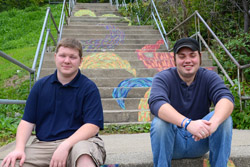
NKU undergrads Shane Winslow and Andrew Boehringer began a labor of love by climbing dozens of Cincinnati's public staircases every week. Now they're writing a book about those steps, many of which led from downtown to the city's first suburbs. These modern history detectives see them as keys that unlock important stories of the city's past.
Many hands make light work. The Arts Center at Dunham knows the meaning of that old saying well. Last Saturday, 60 volunteers from Procter & Gamble, GE Aviation, and Sunset Players descended upon the structure with paint and polish. Now, the Art Deco building is ready for its re-opening as a community art center after it was closed for repairs several years ago. The building has a deep and personal history within the Price Hill community. Once, it was part of the large Dunham Tuberculosis Hospital, the first municipally-owned tuberculosis sanatorium in the country. Opened in 1897, it was renamed after its long-time medical director, Dr. Henry Kennon Dunham, who served the hospital, without pay, from 1909-1940. Samuel Hannaford and Sons, the preeminent architectural firm in Cincinnati during the 1920s known for the design of Music Hall and City Hall, designed the Art Deco building for occupational and entertainment needs, including a movie theatre for residents confined to the grounds. After the hospital closed in the early 1970s, Cincinnati reopened the complex as a recreational center. Most of the hospital buildings were torn down, but this building was kept as a center for arts programming. Beth Andriacco is community engagement coordinator for Price Hill Will, one of the groups behind the effort to reclaim the building for community arts. “Most of us who grew up in the area took classes there, like pottery and cooking,” she recalls. The Sunset Players, a community theater group, made the Dunham Art Center its home, so when a leaky roof closed the building, the Players kept performing in other venues while raising money to fix its structural problems and work towards a long-term lease of the building. Partnering with the City of Cincinnati, the Cincinnati Recreation Center, the West Price Hill Civic Club, Price Hill Will and the Dunham Advisory Board, the Sunset Players were joined by volunteers from local industry for this last push to re-open the building. When the center opens, it will offer art programming and studio space, as well as theater productions. “P&G and GE Aviation wanted to do a large volunteer project…and contacted Price Hill Will,” says Andriacco. This project was the perfect fit. Do Good: • Attend: the first Sunset Players production in the new center, a Playhouse in the Park “Off the Hill” production for families called Accidental Friends, Sept. 29 at 7pm. • Visit: the Sunset Players online, as the company celebrates its 30 years of community performances and offers a link to join the group or help with the art center. • Like: the Arts Center at Dunham on Facebook to stay current on the landmark's latest news. By Becky Johnson
An inner-city Cincinnati Public School reopens as a national model for community building. American Public Media takes note. Listen to the first part of the series here.

What happens when a European designer lands in Cincinnati to create a new breed of Cargo Bike? Farmers, and artists, take note.
How do you wear beauty? Fuse Theory has some ideas… University of Cincinnati College of Design Architecture Art and Planning (DAAP) student Alexandra Scott has an eye for beauty found in the “ugly and unusual” and some inspired ideas about the expression of individuality. That’s why only a year into her college career, she decided to launch her own line of hand-designed, dyed and screen printed apparel and accessories based on the premise that “everything has beauty, but not everyone sees it.” Scott is the creator, owner-operator and designer for her brand, Fuse Theory, a line of clothing and accessories for men and women that she developed after just one year in the DAAP program’s fashion design and product development track. A native Cincinnatian and graduate of Walnut Hills High School, Scott says she has always been interested in art and fashion, but wasn’t sure at first how to combine the two. “I wanted to find a way to open people’s eyes to the beauty found in the unexpected,” she says. Scott derives inspiration from the fusion of ideas and concepts into an aesthetic that reaches a little deeper to connect beauty with individuality. The brand name Fuse Theory unifies this connection with wearable pieces of art that are as comfortable as they are interesting. The brand seeks to combine color, texture and emotion to find beauty in life’s imperfections. Her trademark eye image, which can be found on her designs, symbolizes both her aesthetic and philosophy. Although Scott’s designs are grounded in the basics, they’re far from unremarkable. “My designs are not about impressing others,” she says. “It’s more about expressing the emotional side of fashion.” She focuses on comfortable pieces that allow the wearer to be creative. “I don’t want my customers to be walking billboards for my brand,” she says. “I want them to buy my designs because they mean something.” Both artisan and entrepreneur, Scott’s merchandise is a work of art from the initial design concept to the hand dying and screen-printing that bring pieces to life. Any flaws in the process contribute to the individualistic and emotional intent of her work. Currently, Scott is collaborating with local graffiti artists on a new collection that incorporates street art onto men’s and women’s apparel. Look for these new designs online in late August. In the meantime, Scott’s handiwork can be found online at fusetheoryapparel.com, or in the community on Aug. 25 at the Price Hill Cultural Heritage Festival, at Second Sunday on Main in Over-the-Rhine or at the West Chester Art Market every other Saturday. Scott says she would like to feature her brand with local retailers and eventually open her own store. She will graduate in 2014, and the possibilities are likely to expand. We can’t wait to see what’s next. By Deidra Wiley Necco
Founded by Sister Mary Jo Gasdorf, SC, a Sister of Charity, The Women's Connection has served a rapidly evolving Price Hill neighborhood since May 1997. The mission of the neighborhood center, located on Glenway Avenue in Price Hill, is “to empower women and girls to make choices that lead to positive change in their lives,” says Aimee Shinkle, executive director. From the beginning, the center has provided services to all ages of women and girls. The center also functions as a clearinghouse of sorts, directing its clients to supplementary centers and service providers in the community. In 2011 alone, The Women’s Connection provided referrals and/or some form of direct assistance to more than 2,100 women and girls, Shinkle says. And yet, keeping up with demand is only part of the story. Shinkle says that because the center’s clients, like Price Hill as a whole, comprise an ever shifting range of demographics and diverse backgrounds, the center has had to continually clarify its intentions and modify its programs. For example, to serve a growing influx of Latino residents in Price Hill, the Center first offered a lot of translation services and notarization of documents. These days, however, given the maturation and assimilation of the Latino community, the Center helps Latino who are evolving into permanent members of the community. As other demographics groups in the neighborhood have undergone their own changes in the last several years, the Center has reconsidered its vision and services. Its new vision statement addresses the need for leadership development among women and girls, while its new mission statement paves the way for new and comprehensive programs for both girls (Journey) and women (Hope) in the community. Shinkle calls the Hope program, “a cohesive, progressive program which is constantly growing and evolving.” The Center works with each female client to create a program of customized services and assistance. ?Shinkle attributes the program’s successes, longevity and ability to adapt to the its center’s volunteers. "We're a small staff with a small budget and we have to rely heavily on our volunteer staff,” she says. “We've really come to appreciate their efforts." Do Good: • Facebook it. Like The Women’s Connection on Facebook to find out the latest news and see event photos. • Save the date. Plan to attend and/or support one of The Women’s Connections upcoming events, including the 2nd Annual Mom and Me Fun in the Sun Party, Aug. 4, at Seton High School. • Volunteer. The Center hosts monthly volunteer sessions where you can learn more about its programs and services as well as upcoming volunteer needs. By Michael Kearns
Kathy Wade knows how to make a lasting impression, n her daily work as co-founder and executive director of Learning Through Art, in her stage performances around town and on television, and now, on Fountain Square. Wade, who launched the annual Cincinnati Snaps photo competition seven years ago, says that showing the "Best of Snaps" exhibit to the public in such larger-than-life way is a great chance to show the power of images. "The beauty of Snaps is that it shows Cincinnati neighborhoods through fresh eyes," Wade says. "Real neighbors submit their best work, and it's always impressive to see familiar places through someone else's lens." As she whisks between meetings and programs, Wade notes that her small but mighty non-profit has programs connects with the World Choir Games next month through an exhibit at the Main Public Library downtown, "What Children Believe," a free international art exhibition featuring children’s global perspectives based on what they believe. "We have always built community and understanding through art, culture and literacy education," says Wade. "We're proud to share this anniversary with the city and the thousands of young people whose lives we have touched." Do Good: • Submit your own Cincinnati Snaps entry for the 2012 juried competition. Submissions will be accepted until Aug. 31. • Visit the main library downtown to see the "What Children Believe International Art Exhibition." • Save the date for the 2012 Crown Jewels of Jazz concert featuring Wade and jazz legend Diane Schur, Nov. 9, in the Music Hall Ballroom. By Elissa Yancey Follow Elissa on Twitter
Our Partners