Price Hill

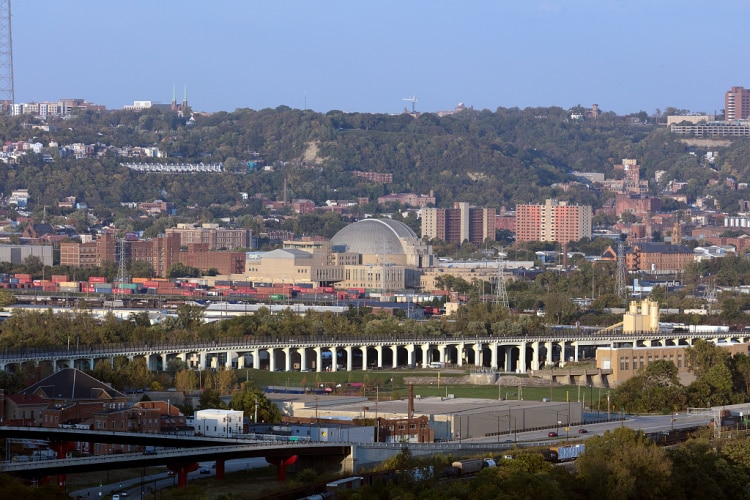
Price Hill is on Cincinnati's western edge overlooking the downtown basin. Locals love long-standing family-owned business like Incline Public House, Primavista and Somm Wine Bar. Once home to Pete Rose and the headquarters of Slush Puppies, Price Hill still houses a major food manufacturing plant for hometown-based Kroger. Mt. Echo Park offers sweeping views of the Cincinnati skyline, and Cincinnati Christian University resides along Glenway Avenue, attracting young students from all over the world to this unique and historical area of town. Groups like Price Hill Will and Cincinnati Landmark Productions are helping to revitalize the area with new entertainment options, local businesses and neighborhood restorations.

LISC Grant bolsters services of four non-profits, aids community development

With support from the Local Initiatives Support Corporation (LISC), four non-profit service organizations in the region have opened LISC Financial Opportunity Centers (FOC), or grant-funded programs that will bolster employment, financial and public benefits counseling services offered to low-income individuals and families. LISC, a national organization, has invested more than $9 billion in cities across the U.S., including more than $32 million in the Cincinnati/Northern Kentucky Region.The FOCs underscore its commitment to enhancing Queen City communities and beyond. "Financial opportunity centers are part of LISC's Sustainable Communities approach to comprehensive community development," says Kathy Schwab, executive director of LISC Greater Cincinnati & Northern Kentucky. "We can't help communities recover from economic distress if we don't help families achieve financial stability."In 2010, LISC was awarded a $4.2 million grant from a federal initiative called the Social Innovation Fund. Cincinnati was on the list of the cities to receive a share of such funding, and, as Schwab explains, research pointed LISC GCNKY to the following four non-profits: • Brighton Center (awarded $145,000), which champions family support and services• Cincinnati Works (awarded $100,000), which champions employment services• Santa Maria Community Services (awarded $145,000), which advocates the revitalization of Price Hill• Urban League of Greater Cincinnati (awarded $125,000), which advocates self-efficiency and entrepreneurship while engaging African-American and other at-risk populations"This grant allows them to provide more services and achieve greater success," Schwab says. "These particular groups understand the concept of financial opportunity centers and are willing to adapt to this business model."She says FOCs tie into LISC's definition of comprehensive community development. "It isn't just about bricks and mortar. It's about the overall health of the community," she says. "People need jobs, people have health issues, people need good schools and green places to play … that's the comprehensiveness of it." Wonda Winkler is associate operating officer at Brighton Center. She says the LISC grant will help the center bundle its services in a more deep and meaningful way. "It's more than just helping people get a job," she says. "It's about also helping them understand their budget and understand what kind of resources are out there as they look toward financial stability."The more people are building assets - for example, home ownership - the more invested they are in their community." Writer: Rich Shivener

Incline District takes step closer to official designation in East Price Hill

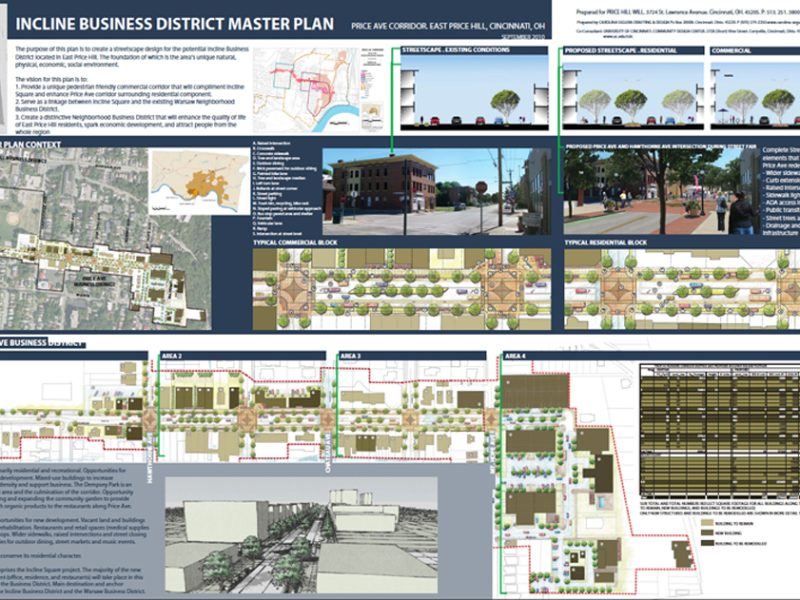
Known for its historic architecture and panoramic views of downtown and the Ohio River, East Price Hill has a new life of late with businesses, restaurants, and reconstruction happening from Price Hill Avenue to West 8th and Elberon. And now the new boundaries of the neighborhood's "Incline District" are a step away from being official. The East Price Hill Improvement Association's (EPHIA) motion seeking this designation was approved by the Cincinnati Planning Commision last Friday. According to EPHIA President John Schlagetter, the Incline District encompasses one mile by 3/4 mile and includes 2,500 residents. The designation, which helps the neighborhood celebrate its history and assists with future branding, will be recognized with a sign at the corner of Elberon and Mt. Hope. Following approval, the potential next step for this recognition is Council's Livable Communities committee. Former city councilman, John Cranley's venture called City Lights recently began construction on Incline Village along Grand Avenue, which includes a new restaurant and office space. Cranley says the new restaurant will join neighboring Prima Vista and offer the same phenomenal views of the Cincinnati skyline from its patio, all within the district's designation. Also currently under construction are new apartments atop the development."Price Hill has struggled for the past 40 years and this is a sign that positive things are happening," Cranley said. "It has great opportunities for urban living because it is so close to downtown with beautiful architecture, phenomenal park spaces, and extremely affordable housing. This project will improve the quality of life for the people already here and those moving in."According to local business owner Bill Burwinkle, Price Hill went through the same evolution that any urban neighborhood encounters. After hosting three generations of families, the neighborhood suffered neglect and vacancies but with recent rehabilitation and new construction, the neighborhood has already seen a renaissance.Burwinkle is responsible for several projects in the Incline District. Almost two years ago, he opened a coffee shop called Corner Bloc to provide a place for conversation and entertainment. Burwinkle then moved across the street, developing a building with five luxury flats and a possible new art gallery. Next on his agenda is an eatery for residents and employees in Queensgate who currently don't have a lot of options. "We're seeing a lot of people that are coming into the community that are buying homes and really causing the neighborhood to be rebuilt," Burwinkle explained. "These developments are showing a lot of people that Price Hill is a neighborhood that should be invested in. It will be catalytic for future development." Writer: Lisa Ensminger

Urban Appalachian Council works to bridge cultural, educational gaps

Amanda sits with her pen between her teeth. Her brow is scrunched more tightly than the ponytail that contains her long black hair. The 20-year-old high school drop-out has been working at the Urban Appalachian Council's East Price Hill GED Center for just a couple of months, but her patience is wearing thin.She looks at a page from an English practice test. Compound words and contractions. She learned this stuff years ago. "Why do I have to keep doing the same things over and over again?" she asks, shaking her head. Then she looks at the next section of words that must be joined to form compounds that fit into a series of sentences about boats in a harbor. The first sentence stops her cold."What type of object would pull slowly into a harbor?" her tutor asks.Amanda looks up from the page and scans the room filled with long tables and thick study guides. Some of her peers at the end of the table are swapping stories, and Amanda has found an easy distraction. "Hey, Amanda, let's just get this section done," her tutor says. The words "tug" and "boat" sit just a few centimeters above the blank in the sentence. "I bet you can guess. What would pull in a harbor?""I can't guess," Amanda finally says, taking a deep breath. "I don't know what that word, harbor, means."Like many of her classmates on this damp March day, Amanda faces a series of hurdles beyond showing up for class each morning and barreling through page after page of study guides in an effort to earn her Graduation Equivalency Diploma. Cultural gaps, not in intelligence but in exposure, seep into the room like fog into a harbor, slow and stifling.The national average age for people who take the GED is 24. In 2009, Ohio ranked 23rd among the 50 states for the number GED test-takers who passed all components, with 76 percent. Nationally, 69 percent of people taking the GED passed it. But the statistics can be deceptive. Some students in East Price Hill are making their third, fourth or even fifth trip back to GED books. While Cincinnati Public Schools has raised its overall graduation rate to just more than 80 percent, that is not the case at Amanda's neighborhood school, Oyler, where nearly nine of 10 students are economically disadvantaged and nearly one in three students has a disability. Oyler's current 50 percent graduation rate marks a steady improvement in many areas of study, but that doesn't change the fact that prospects for half of the school's students remain dim.Oblivious to the statistics that might give her pause, Amanda chews her gum and dreams of day when she can have a regular job, nothing fancy, just a chance to bring home a paycheck and take care of herself. Do Good:• It's simple as A-B-C to volunteer to help GED students. Call the East Price Hill GED Center, 513-557-2546, to find out how you can help. Fill out a volunteer application online.• Find out the latest. Join the UAC email list today.• Make a donation using Paypal. Support UAC's efforts without leaving the comfort of your laptop.By Elissa YanceyPhoto courtesy Urban Appalachian Council

Welcoming the new kids on The BLOC

Tucked behind the shiny new Kroger store on Warsaw Avenue in East Price Hill, an old, once-majestic red brick church welcomes a new wave of immigrants. At the McPherson Avenue BLOC Center, Guatemalan families find English and Acculturation classes, homework help for their children, computer training and a growing sense of community. The BLOC, a non-profit, faith-based organization, was founded in 1998 by Executive Director Dwight Young and his wife Stephanie, a licensed counselor. Its Price Hill and Cleves centers offer at-risk youth after-school programs, from theater classes to tutoring to sports and games. Some lift weights, others play pool or navigate new computer programs. All students who hang at The BLOC create their own communities and learn how to make positive decisions part of their daily routines. They take those lessons home, and, Young believes, contribute to building stronger families because of them. "We just try to help them with everyday life," he says. A new initiative, though, brings The BLOC closer to the homes of some of its most at-risk neighbors. Young wanted to serve the growing number of Hispanic families in Price Hill—families with parents struggling to learn English and children struggling to fit in. Providing healthy, affordable housing, and establishing a community one street at a time, seemed like the perfect way to start. Bolstered with a grant from the Greater Cincinnati Foundation, The BLOC has launched a concerted effort to renovate three homes and an eight-unit building on McPherson, providing space for 12 to 14 Guatemalan families, by this summer. "Our goal is to bring a better attitude to the people who live on that street," he says. Do Good: • Donate: Support the efforts online at The BLOC. Each apartment unit will cost $5,000 to renovate. All donations welcome. • Have some coffee: Visit one of the two Corner BLOC Coffee Houses. • Make a Friend: Like BLOC Ministries on Facebook.

Iconic Price Hill building gets new life

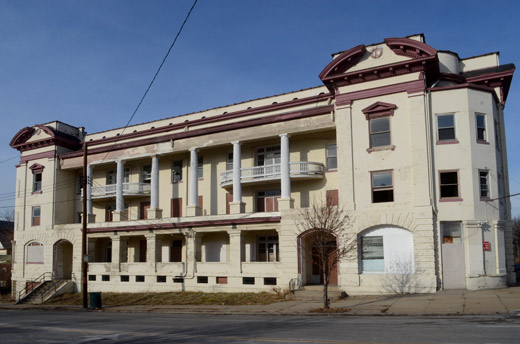
Bill Kiffmeyer remembers how huge the players from the Cincinnati Reds looked to him as an eight year old boy when they visited his father's Price Hill dry cleaning shop. He also remembers how the sight of the shuttered shop would nearly bring his father to tears five decades later, after the neighborhood lost its luster and he had no choice but to close. The Kiffmeyer's family business was located on the ground floor of an elegant apartment building originally called the Robinson. As Kiffmeyer recalls, it was the largest building around and was the centerpiece of a thriving West side neighborhood. Today it stands as an eyesore, and the largest reminder of the neighborhood's decline. But a recent partnership between Price Hill Will and Model Group aims to change that. They have purchased the building and will turn it back into an apartment building."This is something that's sort of been the biggest drag on neighborhood, and when it's done it will be one of the biggest success stories," Price Hill Will's marketing director Matt Strauss said. The building located at 8th and Elberon will be converted into 37 units of affordable housing for senior residents of Price Hill. The project will use several funding sources including a federal tax credit which requires the units to be available as affordable housing. The units will house seniors who are currently neighborhood residents, but will not be a care facility. In addition to renovating and selling single family homes, Price Hill Will organizes an array of community outreach efforts ranging from litter pick-ups to neighborhood surveys. The Elberon building has been on their radar since before the group's inception, Strauss said, but was a far bigger project than any they had ever taken on. "We've gone out of our comfort zone to get something really important accomplished," Strauss said.Their partnership with Model Group, a private development firm with years of experience in affordable housing, allowed them to take on the project. Though Model owns the building, they will consult with Price Hill Will about design decisions and neighborhood impact, Model's development director David Thompson said.For proud Westsiders like Kiffmeyer and current residents the project is heartening. Kiffmeyer recalled his first reaction when Strauss told him the building would be renovated was, "Can I move in?"Writer: Henry SweetsPhotography by Scott Beseler.

An eco-industrial vision for Queensgate

No history of Cincinnati is ever complete without a description of the role the Mill Creek Valley played in the city’s evolution. 

Our Partners

Taft Museum of Art
Warsaw Federal

Don't miss out!

Everything Cincinnati, in your inbox every week.

Close the CTA

Already a subscriber? Enter your email to hide this popup in the future.