Health + Wellness

Plans for Northside Skatepark in motion

In 2000, after considering options for the empty space, Northside Community Council (NCC) members proposed turning the space between Colerain and Kirby into a skatepark as a way to welcome visitors to the neighborhood and reflect the interests of its residents. Backed by the City of Cincinnati and with grant funding, that never-forgotten project is now in motion. “The idea was that we had to come up with something that we wanted people to see when they come into the neighborhood,” says Tim Jeckering, former president of the NCC. “Whatever we decided on needed to set the tone for what we want this neighborhood to be.” The Council enlisted the help of the international consulting firm Action Sports Design, which has designed parks in Denver, Santa Fe and St. Cloud, MN. The company recently completed the initial designing phase of the Northside project. Next, members of the NCC plan to raise funds for park construction. The proposed skatepark will cover 2,300 square feet and will include a skating area, a community garden, a space for small children and a walking trail.  Action Sports Design constructed the layout of the new park with multiple uses in mind: the skate platforms can also double as stages for performances; hiking trails and a garden provide other outlets for visitors in and from the community. “We want it to be a positive place for youth for physical activities, exercise and recreation,” says Jeckering. “The idea is to make it a destination skating place; it’s something Cincinnati lacks.” Jimmy Love, who has been skating Cincinnati for 10 years, says he’s excited to see the project move forward. “I can't wait to have a spot with new ramps and rails to shred,” says Love. “As a local skater, I realize we damage a lot of the architecture in the city. Now that we’ll have a legitimate place to skate, it's a win-win situation." By Jen Saltsman Follow Jen on Twitter  

Latest in Health + Wellness
Caracole’s new space in Northside offers room to grow

It only seems fitting, David White says, that Caracole Inc.’s offices are now at the former Charles Miller Funeral Home in Northside. The funeral home was one of only two in the entire Greater Cincinnati area that would accept the bodies of AIDS victims in the 1980s. “Back in the day, people thought you could catch it from a sneeze,” says White, Caracole’s Community Investment Coordinator. “But the folks at the Miller funeral home were not scared. You have to remember, this was back in the days when AIDS was a death sentence.” Caracole, the non-profit that that provides safe, affordable housing and supportive services for individuals and families living with HIV/AIDS, moved into the former funeral home at the corner of Hamilton Avenue and Knowlton Street June 29.  The move was necessitated after Caracole assumed the caseload from fellow local nonprofit Stop AIDS in April 2011. The shift increased Caracole’s clients from 200 in Hamilton County to nearly 1,000 clients served in eight counties, White says. “The best thing, my favorite thing, has been the community of Northside. They have been so welcoming,’’ he says. “The neighborhood is so excited a social services agency is here, let alone an AIDS group. It’s been amazing, really.” The move more than doubles their space to 9,400 square feet, centralizes their location and puts them directly on Metro routes. It is also close to hospitals and provides private offices for staff. The new location houses the group’s administrative and case management offices. Two transitional homes, each with 11 beds, did not move. Those homes provide housing and services for homeless residents who are HIV positive or suffering from AIDS. White is excited because the increased space means many like services are now under one roof. Caracole’s HIV/AIDS support groups can meet regularly, which was not the case at their former Roselawn location.  A local GLBT group will also hold meetings at the offices, and two employees from Planned Parenthood of southwest Ohio will administer anonymous HIV tests there. “We would not have been able to move without the donations—from paint, furnishing and the majority of the carpeting,’’ says White, who estimated that donations were worth tens of thousands of dollars. “This helps us save money on rent and is money we can put toward client services.” Two foundations provided more than $30,000 to move the group’s offices as well as for data installation. Matt Kotlarczyk, who bought the 15,000-square-foot building with a partner in late 2011 for $260,000, says redeveloping it with Caracole has gone extraordinarily well. Caracole signed a 10-year lease for first-floor offices. “It gives them a new home and us a good, solid investment,” says Kotlarczyk, a local sculptor who owns Refined Sugar Studio. Future Life Now LLC is leasing about 2,500 square feet on the second floor of the building. Another 3,500-square-foot space on the second floor and the 3,500-square-foot hearse garage, which is fully insulated, remain vacant, he says. Kotlarczyk has been told the building, originally built in 1875 and added onto numerous times, was the longest continuously operated funeral home in Cincinnati. And at least one woman thought it still was. The woman walked into Caracole’s offices a couple weeks ago, White says, and asked who she might talk to about funeral services. That wouldn’t be Caracole. They are too busy working on living. Do Good: • Attend Caracole’s open house celebration from 4 to 9 pm, Sept. 13, 4138 Hamilton Ave. There will be music, a photo booth and tours. It is not a fundraiser. • Call 513-679-4455 to schedule an anonymous HIV test, administered at Caracole through Planned Parenthood, Monday-Thursday from 9 am to 5 pm, and Friday from 9 am to 1 pm. • Email oracle@caracole.org to volunteer your time. • Donate cleaning supplies or toiletries to Caracole’s pantry to help residents. • Use your Kroger Plus card to give a percentage of your total spend to Caracole. By Chris Graves Chris Graves is assistant vice president of digital and social media at the Powers Agency.  

Fashion design project includes medical innovation

When you think “compression garments,” you normally think “grandma hose,” not “high fashion.” But a team of fashion designers at UC have joined with medical professionals that treat a genetic disease that affects connective tissue to change not only those perceptions, but the lives of those suffering from the condition.  Ehlers-Danlos Syndrome (EDS) affects hundreds of thousands of Americans, limiting their mobility and endurance. The multi-system disease creates joint instability, dizziness and unrelenting severe pain. Even pulling on jeans can cause someone with EDS to dislocate a shoulder. When physical therapists approached Margaret Voelker-Ferrier, of UC’s College of Design, Architecture, Art and Planning, with the problems that people with EDS experience when simply putting on clothes, she knew she could put her 30 years of bodywear design experience to good use. "I started as bra designer," says Voelker-Ferrier. "That has always been a passion for me, engineering things to solve a problem. Making things that are both beautiful and functional." She gave the project to fashion design students in her bodywear class, explaining the challenges of EDS sufferers as well as the basics of clothing design. "The students loved the project and I think they did a marvelous job," she says. Voelker-Ferrier worked with Brooke Brandewie on design solutions, which have been highlighted as part of the Cincinnati Innovates competition. The clothes they designed – from dresses and pants to an evening gown -- support and stabilize body joints and ligaments. Made from high-tech materials, they provide comfort and style simultaneously. One shirt, for example, has adjustable straps that help hold shoulders in place.  “The fact that they are designing clothing that is functional and therapeutic and beautiful and doesn’t look like a medical device is exciting,” says Candace Ireton, MD, who suffers from EDS. She saw the clothes during the Ehlers-Danlos National Foundation Learning Conference, which was held in Cincinnati this month.  Both Brandewie and Voelker-Ferrier attended the conference to gather measurements of EDS patients and collect data as they continue to develop their designs. While designed for EDS, the same fashions could be adapted for use by people with autism, MS and arthritis.  "It was really wonderful to be able to meet people and talk with them about this," Voelker-Ferrier says. "It’s kind of amazing."  For now, she's working on collecting more data, finding some popular sizes to work with and eventually leading an interdisciplinary studio at UC to design prototypes. Eventually, the design maven hopes to turn her problem-solving fashion sense into a small business that will target the needs of people with chronic medical conditions as well as Baby Boomers.  Fashion, after all, can provide a mental, as well as physical, boost, says EDSer Ireton. “Some of the clothing is sexy,” she says. “You can feel better, keep your ribs in place and look cute, too.”   For more information about the design project, visit their Cincinnati Innovates submission. By Elissa Yancey Follow Elissa on Twitter

Keep Cincinnati Beautiful wins national kudos for green initiatives

Some might say that the City of Cincinnati gets more beautiful every day, what with the continued development of its urban core and riverfront, an ever-expanding “green” construction movement and a treasure trove of amazing parks and public spaces. Keep Cincinnati Beautiful (KCB) works to ensure that the surrounding environment keeps pace by creating innovative and award-winning programs that encourage recycling and conservation practices among schoolchildren, and make it easier for folks to save the old VCR in the basement from a landfill. KCB earned notable recognition in July when Keep America Beautiful recognized the organization’s Sustainability in Action and One Stop Drop programs at its annual assembly of Ohio affiliates in Columbus. While many public schools strive to set environmentally friendly “green” goals, KCB noticed that schools struggle to meet them. “There is a misperception out there that ‘green’ programs create more work for school staff and faculty,” says Brooke Romaniw, KCB public awareness and volunteer coordinator. “We wanted to find a way to reverse this perception and help Cincinnati Public Schools educate both students and adults.” As a result, Sustainability in Action (SIA) was born. Funded by partners including P&G, Hamilton County Recycling and Solid Waste District and the City of Cincinnati Office of Environmental Quality, SIA is a three-year program that engages students in hands-on activities that work to forge “green” habits. Launched in January 2012, the SIA program focused first on waste reduction in school lunchrooms. Each day at lunch, students were taught to sort the waste on their trays, identifying items that could be recycled or composted. Students at Dater High School, Rees E. Price Academy, Roselawn Condon, Rockdale Academy and Silverton Paideia were part of the pilot year. “The students saved tons of waste from landfills during the pilot and benefitted from hands-on experience,” says Romaniw. Some students took it a step further by creating their own compost bins and gardens. As the recipient of Keep America Beautiful’s Civic/Nonprofit Award, SIA is set to begin its second phase, focusing on energy conservation during the upcoming school year. The idea is that by year three, participating schools should be ready to take over the programs themselves. “We’ve found that schools really see the value in this program,” says Romaniw. “It is exciting to see children building sustainable habits that have the potential to change the future for the better.” KCB won more national recognition for its One Stop Drop event, which launched in November 2011. It won the America Recycles Day Award from Keep America Beautiful. Romaniw spearheaded the development of One Stop Drop to make recycling unusual items convenient. While curbside recycling saves many items from the landfill, it does not accept things like electronics and number 5 plastics. During the One Stop Drop, you can drop off these types of items, drive-thru style, with free refreshments available. By partnering with 2TRG, the Cincinnati Zoo, Hamilton County, the City of Cincinnati and Whole Foods, the One Stop Drop program reached hundreds of people in just a few hours. Items like old cell phones, batteries, dried-out pens and markers, plastic bags and number 5 plastics were collected. “We are pioneering the way for schools and our community, and are proud to lead the pack,” says Romaniw. What are you doing to keep Cincinnati beautiful? Do Good: •    Help students learn to sort recycling in the Sustainability in Action program. Email Brooke Romaniw. •    Mark your calendar for the 2012 One Stop Drop coming in November. •    Find out what Keep Cincinnati Beautiful has in the works; like the group on Facebook. By Deidra Wiley Necco

Video Epi-ventures’ Cincinnati deConstructed: Karen Kahle, Findlay Market

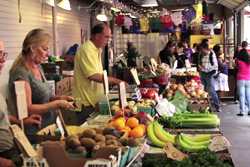
Six businesses that started in Findlay Market last year have already expanded to second locations outside of the historic space. Findlay's resource development director Karen Kahle explains the beauty of Market economics and its nurturing culture. Video courtesy Epi-Venture's Courtney Tsitouris.

MamaDoc designs products to ease pregnancy discomforts

A friendship between two Cincinnati mamas led to new doctor-designed garments and products designed to help other mamas more comfortably get through their pregnancies. MamaDoc, founded in 2009, is the effort of Dr. Somi Javaid, an ob/gyn at the University of Cincinnati School of Medicine and Kim Howell, a certified yoga instructor with a sales and marketing background. The company was born out of Dr. Javaid's everyday interactions with women suffering from various pregnancy-related discomforts like lower back pain, swollen feet and ankles and breastfeeding issues. "Day in and day out, she was hearing the same complaints," says her business partner Howell. "She knew what was on the market to address (those problems), and their shortcomings." The catalyst for their first product, the Nox compression bra, was a conversation between the two friends, who'd met through their daughters. Howell was having problems weaning her son. In particular, she found the conventional chest compression process to suppresses lactation very uncomfortable. Dr. Javaid told Howell about her idea for a full-coverage compression bra with adjustable straps ($59.99). The bra has pockets to hold speciality ice packs and is made out of moisture-wicking bamboo. Howell encouraged her to make the product a reality. Howell says this product, like their others, have been designed with a women's curvature and anatomy in mind. For instance, the compression bra is designed to support the often sore suspensory ligament of the breast under the armpit. "There's nothing like it on the market. It's a very user-friendly garment," Howell says. Among their other products is the BellyUpIt, a maternity support band aimed a relieving back pain. The adjustable band ($49.95) wraps around the belly and lower back, giving women compressed support. It's also made of bamboo. MamaDoc also sells speciality ice and heat packs, pregnancy socks, a gown that can be worn through pregnancy and delivery and Organic Bamboo Fleece diapers. MamaDoc was the most recent Bad Girl Ventures (BGV) microloan recipient. BGV awards loans and provides business support to women-owned companies across Ohio in a competitive process that includes a nine-week business course. MamaDoc sells to some individuals, but most of their buyers are wholesalers. MamaDoc is working to expand that network and get their products on more shelves. Howell says the loan will allow the company to revamp its website, stock more product for fast delivery and improve its marketing. By Feoshia H. Davis Follow Feoshia on Twitter

Northside artist promotes creative healing with Art Word Bound

“I’m compulsively creative; I can’t help it.” That’s how ArtWord Bound Creatives founder and sole director Ursula Roma describes herself—and considering the impressive range of artwork featured on her blog, it’s clear she’s not joking. Roma, who’s been involved in art-making and philanthropy in Cincinnati for 25 years—with YWCA, Planned Parenthood, Northside Community Council, Children’s Hospital and others—introduced her newest initiative in spring of 2011. The mission: “To develop, nurture and promote artistic creation and exploration with visual art and words in the form of storytelling through painting, drawing, journaling, bookmaking and more.” ArtWord Bound, a division of the Child Wellness Fund, satisfies what Roma sees as a real need in the community. “A lot of art organizations in town work with middle-class kids—and that’s great,” she says. “But I wanted to work with kids who maybe aren’t as privileged, who might not [otherwise] ever use a paintbrush.” In addition to creatively mentoring children, Roma provides art and word therapy to prisoners, senior citizens, battered women and other frequently overlooked groups. She makes use of public spaces and meets with participants in retirement communities, schools, hospitals and in their homes. She even toys with the possibility of one day having her own traveling art therapy van. She says her desire to help underprivileged people express themselves through art stems from a serious accident she was involved in as a child. “I spent a month in the hospital when I was nine,” Roma says. “My saving grace was to be able to create art from supplies my mom brought to my bedside. It was my escape. I want to offer that same release to people who are struggling with chronic disease or kids that are stuck in bed because of an accident or illness. Plus, family and friends can benefit from their artwork and stories, too.” Much like its philanthropic mission, the revenue-generating side of ArtWord Bound centers on providing access to those less fortunate. Roma relies on her decades of advocacy and art-making experience to provide professional design services, illustration, and publicity—at well-below-market rates—for select organizations that lack the means to promote their own causes. Roma has witnessed the healing effects of creativity firsthand, and while she says it usually comes more naturally to children, people at every age are susceptible. “I can say that through my experience with seniors, children and also prisoners, that everyone eventually becomes completely absorbed in the moment when they are creating, and in the end when they have finished a piece of art, they feel excited,” she says. “They have pride from accomplishment, focus from creating and being in the moment [and an] escape from their current worries.” Do Good: • Read the blog and find out more about Roma's art therapy works. • Make a donation to support the non-profit's work. • Take a look at Roma's art work for sale.. By Hannah Purnell

Cincinnati State offers new Health IT degree this fall

Cincinnati State Community and Technical College is adding a new Health IT associate degree program this fall. The program will offer two majors: Healthcare Programming and Systems Analysis, a software development and analysis program.Healthcare Informatics, which trains students to understand, mine, analyze, report and support healthcare data throughout the continuum of care.Cincinnati State is the latest regional university to create Health IT-focused programs. Demand for them is largely a response to a federal requirement that providers move from paper-based to electronic health records by 2014. That mandate is part of the wide reaching Affordable Care Act recently upheld by the U.S. Supreme Court. "The degree is geared toward a hybrid talent set," says Dr. Lawra Baumann, director of grants administration at Cincinnati State. "It's for people who understand the healthcare industry, as well as those familiar with programing, data mining and analysis." Cincinnati State has one of the largest nursing training programs in the region. Many area nurses are showing interest in the program, adds Baumann, who is also executive director of the Health Careers Collaborative of Greater Cincinnati. It's estimated that there will be between 50,000 and 200,000 new health IT jobs nationally by 2015, Baumann says. According to the federal Office of the National Coordinator for Health IT, there will be a shortfall of about 50,000 qualified health IT workers for the next three to five years. Cincinnati State is taking a tech approach to the degree program. Classes will be offered both online and in the classroom. "A very significant portion of the degree can be earned online," Baumann says. Cincinnati State is also offering the program at its Middletown campus, and teaming up with Miami University in Oxford. Students who earn an associate's degree at Cincinnati State can go on to pursue a four-year degree at Miami. By Feoshia H. Davis Follow Feoshia on Twitter.

Historic Linden Grove receives $30K to restore vital pond

Tucked amid concrete streets within the Westside neighborhood of Covington, KY just east of Interstate 71-75 lies an oasis of tranquility, and arguably the only viable green space in the city’s urban core. The historic Linden Grove Cemetery and Arboretum was consecrated in 1843 and is the final resting place for more than 22,000 burials across a span of 22 acres. Linden Grove Cemetery and Arboretum is at once environmentally and civically significant. The cemetery provides important green space, and comes with a built-in history lesson as the burial site of many important civic and community leaders, congressmen and important historical figures. Soldiers from as far back as the war of 1812 and the Civil War are buried there, along with soldiers from every other American war since. Dr. Louise Southgate, early female physician and women’s rights activist in Covington, Thomas Kennedy, one of Covington’s original founders and land owners, William Wright Southgate and Brigadier General John W. Finnell, Kentucky’s Adjutant General during the Civil War are among the important historical figures interred at Linden Grove. Over the cemetery’s 169-year history, the site has fallen into various stages of disrepair and neglect only to be brought back to life with the help of caring citizens and the local courts. Although the site is now more like a 22-acre park, Pete Nerone, Chairman of the Board for Linden Grove, says that the grounds lost its pond in the early 1960s when it was filled in during the construction of Interstate 71-75. The pond once supplied a local brewery and provided a self-sustaining water source to the grounds. Thanks to the work of people like Nerone and former board member John Dietz, the pond is about to make a comeback. As a former Peace Corps volunteer serving in West Africa, Nerone was instrumental in securing a $30,000 environmental stewardship grant from the Greater Cincinnati Foundation for the reconstruction and development of the pond. Why does the pond matter so much? Nerone says that according to studies, the City of Covington is actually 20 percent deficient in green space, permeable surfaces and adequate tree canopy. A healthy tree canopy provides a filter for noise and air pollution resulting from the neighboring interstate highway. It also provides homes for various birds, wildlife and aquatic species. Water from the pond can be used to improve the tree canopy as well as provide much needed hydration for landscaping and ornamental gardens. “Linden Grove is very important real estate from an ecological point of view,” says Nerone. “It sits in an old neighborhood in the urban core of Covington. The existence of a pond on the grounds is key to the site’s longevity.” The new pond will be controlled with a safety shelf and controlled overflow. With the grant award and the restoration of Linden Grove’s pond, Nerone says, “We can enhance and protect our beautiful green space, making it more available as a place of recreation for the community.” By Deidra Wiley Necco

Video GOOD ideas: New landscapes for local food deserts

Right now, one quarter of Cincinnati's population lives in a food desert—children, women and men lack access to healthy food options they can afford. It doesn't have to be this way. Watch one design team's solutions and see how you can help in this first in a series of GOOD Ideas for Cities videos created in partnership with GOOD magazine, the Niehoff Urban Studio, the Contemporary Arts Center and The Queen City Project.

Our Partners

Taft Museum of Art

We want to know what's on your mind.

Close the CTA

Don't miss out!

Everything Cincinnati, in your inbox every week.

Close the CTA

Already a subscriber? Enter your email to hide this popup in the future.