Cincinnati’s first-ring suburbs face challenges including changing demographics, economics, and security. The ways the 49 cities, villages, and townships in Hamilton County meet these challenges is the focus of this series, First Suburbs—Beyond Borders. The series explores the diversity and innovation in these longstanding communities, highlighting issues that demand collective thought and action.
Faced with a backlash against rising property taxes, two neighboring school districts in Hamilton County, both in desperate need of financing, are seeking new sources of funding.
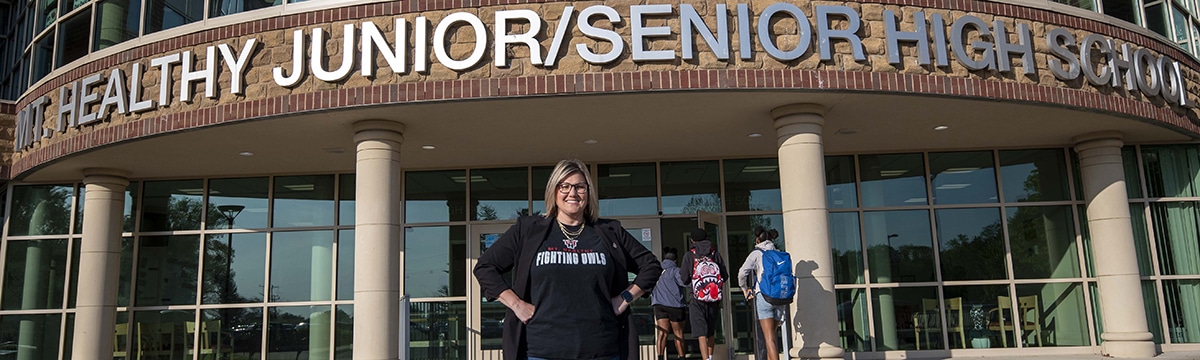
The Mt. Healthy school district and its neighbor to the south, the North College Hill school system, have turned to an earnings tax as a potential source of support for their school systems, which both face big deficits and further cuts to teaching staffs and programs.
The two districts illustrate the plight of small public school systems in Ohio. Both serve as hubs for their communities, but have been whipsawed by rising costs and a Byzantine state funding system that is woefully inadequate.
Voters in both districts will be asked on the May 5 ballot to approve a new earnings tax to help fund their schools.
North College Hill this year has already cut about $2 million from its budget, including 18 teachers, says Superintendent Eugene Blalock. But without a new operating levy since 2005, the district forecasts a deficit of nearly $3 million by fiscal 2029. “We haven’t had an operating levy on the ballot for over 20 years,” Blalock says. “We’ve been extremely good stewards of the community’s money.”
In Mt. Healthy, the district’s financial picture was upended in 2023 when it was discovered that a former treasurer had submitted wildly inaccurate financial forecasts, leading district leaders to believe the schools had more money than they actually did.
That led to a dire financial emergency and a severe cash flow crisis, until the state stepped in with an $11 million “advance” to support the school system’s continued operation.
The Mt. Healthy district cut more than 100 teachers and staff members, eliminated some student programs and limited transportation services to the state’s minimum requirement. Since then, new superintendent Sarah Wilson has worked closely with a new district treasurer to put into place stricter financial controls and accounting practices.
“We are within our means in terms of current revenue and spending,” Wilson says. “However, our costs continue to rise and our state revenue continues to decrease.”
Three consecutive property tax levies on the ballot for Mt. Healthy schools have failed. That led the school board to seek a local earnings tax of 0.75% to support the district. North College Hill schools are asking for a local earnings tax of 1.25%.
The earnings tax levies are fairly unusual, as property taxes are typically the source of local funding for schools. But rising property taxes around the state, driven by big increases in property values, have resulted in a backlash against that funding source. There’s even talk of eliminating property taxes altogether. That’s led both districts to consider a local earnings tax that would be paid by district residents on their wages. They would not apply to Social Security or pension income or to stock dividend income.
“What we’re hearing from our community is that they do not want their property taxes increased,” Wilson says. “We also know that we have a large population of retirees in Mt. Healthy who may be struggling with the increase in property taxes. The values of their homes have increased dramatically in the past couple of years, and so an earned income tax is a way of still getting similar revenue for the district to be able to operate, but not putting the burden on retirees who may be on a fixed income.”
NCH’s Blalock has a similar take. “In Ohio, there’s a grassroots effort to do away with property taxes,” he says. “That’s the reason we went with an earned income tax levy versus a property tax levy.”
Ohio’s unconstitutional school funding plan
Both superintendents, as well as many others, blame a dysfunctional state funding structure that forces districts to go back to voters time and again for money to keep pace with their costs.
A local property tax levy for schools typically raises a set amount year after year for a school system. Even as property values rise and property taxes overall increase, the amount of dollars raised for the schools stays the same. Even as costs for salaries, benefits, utilities, construction, food and everything else rise, there’s no adjustments for inflation and no adjustments for enrollment. They receive the same amount year after year from the levy. It’s like working for years without a pay increase.
The system particularly penalizes small districts such as Mt. Healthy and NCH that are not wealthy, are small and lack a broad base of property to draw tax revenue from.
The two districts together enrolled about 4,200 students this school year. A majority of the students, 65% to 75%, are Black. Most come from families where the household income is low enough to qualify for free or reduced school lunches.
School leaders say the state funding formula shortchanges these students in the long run, while the community itself suffers if the schools go into decline.
“It’s a very inequitable system,” says Mt. Healthy’s Wilson. “It does not serve our student population well to fund schools based on property taxes, because our property values are not the same as some of the districts around us. It leads to huge discrepancies in what students have access to and what opportunities students receive.”
The impact of the system extends well beyond these two districts, says Mt. Healthy Mayor Jenni Moody. “People may think this is only a Mt. Healthy issue, or a North College Hill issue,” she says. “This is a social issue, because we need to be able to educate the youth in this country, and we need to be able to do it fair and equitably.”
Public schools are community hubs, sources of pride, havens of opportunity, and launching points for young lives and careers. In the region’s small cities, towns, and villages in particular, the public school is often the anchor that stands the test of time and unifies the community.
“We all should be concerned about the welfare of our school systems in any community,” Moody says.
The traditional notion of a public school is of a place for education of every child, a common good that benefits the entire community. For that reason, they are financed by the public and managed by locally elected boards.
There are 22 public school districts in Hamilton County, and Mt. Healthy and North College Hill are among the smallest with 2,800 and 1,400 students respectively. In each of these communities, the public schools are not only centers of learning, they improve property values, and serve as centers of community life, hosting sports, theater, music, and after-school events. They bring neighbors together, creating opportunities for adults, parents and children to connect.
But over the years in Ohio, the state legislature has applied a slow but sure stranglehold on school funding. An arcane, unfair financing system persists despite it being ruled unconstitutional by the Ohio Supreme Court at least three times.
Meanwhile, the Legislature, fascinated with alternatives to Ohio’s 200-year-old public school system, created a voucher system that diverts resources away from the publics to charters and other private schools that have little public accountability.
That has forced schools to go back to their communities over and over again to raise enough money to pay for their own rising costs.
A fair funding plan, then a retreat
Hope emerged for meaningful reform in 2021, when the Legislature, with bipartisan support, passed the Fair School Funding Plan. The plan is based on what it actually costs to educate a student in each school district and on each community’s ability to cover some of those costs with local taxes. It appeared to satsify the need for a plan that equitably funded students and districts, and it was scheduled to be phased in over six years. But the Republican-controlled Legislature funded it for two years and then decided it was too expensive. For this school year, the plan is funded at only a fraction of what was promised.
“The argument was, well, we can’t afford this,” says State Sen. Louis “Bill” Blessing, a Republican whose district includes Mt. Healthy and NCH. “There will be runaway costs and things like that.”
The NCH district had anticipated state funding of $8.1 million this year. Instead, it will receive only $1.7 million, Blalock says.
“What’s happening to us is not due to mismanagement, but is due to Ohio legislators basically changing the way that they decided to fund public education,” he says.
Blessing says in the next state budget, legislators “are really going to have to think long and hard about what they’re doing. I would argue they need to do the entirety of the Fair School Funding formula, full stop.”
Until then, districts like Mt. Healthy and North College Hill are forced to continue to look for places to cut even as the cuts get deeper and deeper.
“We’ve cut so much that we are really down to very few things remaining that can be cut and still operate a school safely and provide an adequate education for students,” Wilson says. Mt. Healthy cut 130 teachers and staff when it was placed under fiscal emergency in 2024.
Sports, music and art programs may be next at both districts if these levies do not pass. Blalock is a graduate of NCH High School and his two children also graduated there. He understands the impact of sports and extracurriculars on the students and the community. “If we have to cut our sports programs, a lot of these students who have structured, organized activities with mentors and coaches will not have anywhere to go and anyone to support them in what they want to do outside of school,” he says.
Both superintendents want to preserve their schools as centers of community life. “In North College Hill, we do not have a recreation center for our students,” says Blalock. “We do not have a Boys and Girls Club. We do not have a YMCA. We are really the central hub of the community.”
In Mt. Healthy, district leaders are working to rebuild trust. “We want our community to be a thriving community, we want it to be a great place to live and work and go to school, and I believe that public schools are foundational to that,” Wilson says.
The First Suburbs—Beyond Borders series is made possible with support from a coalition of stakeholders including the Murray & Agnes Seasongood Good Government Foundation: The Seasongood Foundation is devoted to the cause of good local government; Hamilton County Planning Partnership; plus First Suburbs Consortium of Southwest Ohio, an association of elected and appointed officials representing older suburban communities in Hamilton County, Ohio.
Author

Related Articles
Partner Partner Content Good design is good for people
Buildings do indeed shape us. Learn key principles to help understand, evaluate, appreciate, and advocate for good architecture and design.
Video Why don’t we talk to our neighbors anymore?
In the latest reporter video, data indicates a downward trend for social interactions with neighbors. One Cincinnati neighborhood has a plan to address the issue.
A not-so-radical idea to build healthy communities: Talk to the neighbors
Social capital – those connections that create and empower communities – is on the decline. But neighborhoods can restore it.