Uptown

Uptown includes all the neighborhoods around the University of Cincinnati including Avondale, Clifton, Clifton Heights, Corryville, Fairview, Mt. Auburn and University Heights, so it's a diverse mix of students and residents in one of the city's most distinct and eclectic group of neighborhoods. Uptown is the home of the Cincinnati Zoo as well as multiple hospitals and the Ludlow shopping district where you can find trendy and unique shops as well as any scent of incense you need. Ethnic restaurants, including a curiously high concentration of Indian eateries, multiple taverns, coffee houses, music venues and the Esquire — one of Cincinnati's finest independent art house movie theaters all make Uptown a one-stop walkable bazaar of exciting entertainment options.  

Green Homes Summit celebrates second year with new events, residential focus

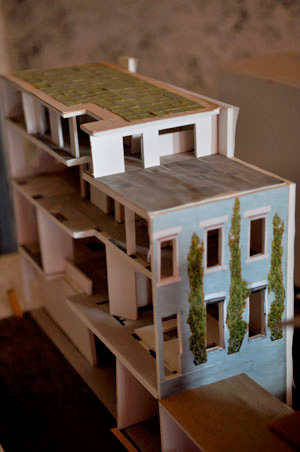
Area residents, homebuyers and residential homebuilders interested in shrinking their carbon footprints and cutting their energy bills have an opportunity to significantly advance their knowledge of green building this November. The second annual Green Homes Summit will feature seminars, vendors and home tours aimed at one purpose: making green technology a viable option for residential construction and renovation."We've realized we really need to reach the consumer," says Libby Hunter, residential committee chair for the US Green Building Council's Cincinnati chapter. "Probably one of the biggest planks of our mission right now is to educate."To that end, she says this year's summit is mainly focused on the common questions of homeowners looking to green their existing homes, or consumers thinking about building a new home that incorporates environmentally friendly features. A series of three workshops will give attendees a chance to learn about a wide range of topics, from "Greening Your Old House" by Margo Warminski to "Solar Photovoltaics" by Dave Boezi. A tradeshow, open to both ticket holders and the general public, will feature more than 50 green building product vendors, and keynote speaker Randy Florke, a nationally known real estate and design expert, will give a presentation based on his recently published book, "Recycle, Restore, Repurpose: Create A Beautiful Home.""It's for professionals and residents, with the bulk of the educational events aimed at residents," says Hunter. One of this the most unique events at this year's summit is a four-location tour of homes incorporating green technology. Ticket-holding attendees will get the opportunity to visit a LEED Silver-certified home in Hyde Park, homes in Northside's Northwind and Rockford Woods developments, and a condominium in Over-the-Rhine's Belmain building. Contractors and vendors will be on hand to answer attendees' questions about the green technology incorporated into each of these buildings."We realized there's such a need to get the word out to the residential public," says Hunter. She and the summit's co-organizers are hopeful the event will take a major step toward educating Cincinnati's homeowners about how they can incorporate a little - or a lot - of green technology into their homes and lives.The Green Homes Summit is presented by AIA Cincinnati's Congress of Residential Architecture, U.S. Green Building Council's Residential Green Building Committee, AIA Cincinnati's Committee on the Environment and Home Builders Association of Greater Cincinnati, and scheduled for 11 a.m. to 6:30 p.m. November 13 at Cincinnati State Technical and Community College.Writer:  Matt Cunningham Photography by Scot Beseler.

Children’s Hospital researchers increasing bone marrow transplant success rate

Researchers at Cincinnati Children's Hospital Medical Center discovered information that could lead to a well-targeted therapy, improving the success rate of bone-marrow transplants. Bone-marrow transplants have a history of failing in the past, but this new research reveals a new rationale for successful transplants in the future. Read the full story here.

UC researchers win 2010 Earth award to bring Biofuel foam to market

A  University of Cincinnati professor won a 2010 Earth Award, a global award for innovative, consumer driven ideas, for an artificial photosynthetic foam that can be converted into biofuel.David Wendell, PhD, assistant professor of biomedical engineering and civil and environmental engineering designed the foam with Carlo Montemagno, PhD, dean of the College of Engineering and Applied Science.Wendell won the award, which comes with $50,000 to bring it to market.The foam pulls energy from the sun and carbon from the air and converts it into sugars. Those sugars can be turned into biofuels like ethanol which power some cleaner burning vehicles. The foam's design is based on the foam nests of the semi-tropical Tungara frog, whose long-lived foams nurture growing tadpoles."The advantage for our system, compared to plants and algae, is that all of the captured solar energy is converted to sugars, whereas these organisms must divert a great deal of energy to other functions to maintain life and reproduce. This makes the foam an extremely efficient form of carbon capture and energy production," Wendell said.The Earth Awards were announced at a gala in September as part of the Start Festival in London. Wendell earlier won the 2010 Future Technology category award, which allowed him to present his work at the Earth Award's September Innovators Summit in London. Each category winner received $10,000. Categories include built environment, fashion, product, social justice and systems.  Writer: Feoshia HendersonSource: University of Cincinnati communicationsYou can follow Feoshia on twitter @feoshiawrites

RetroFittings Repurposes Style

In partnership with the University of Cincinnati College of Design, Architecture, Art & Planning and St. Vincent de Paul Thrift Stores, the eighth annual RetroFittings fashion show will use fashion to inspire the spirit of giving.

Soapicks October 5-11

Cincinnati get's its TED on, enjoy a beer festival that spans the Ohio, check out what's old and new in our local music scene, or come build a hoop house at Findlay Market's urban garden, all in this week's Soapicks.

Bioneers Will Inspire Local Green Activists

For those in Cincinnati trying to change their lives -- and their community -- to be more environmentally aware and active, the challenge is to not feel isolated and alone. To not think of oneself as a struggling pioneer in the hostile urban frontier of suburban sprawl, fast food, big-box retail, piled-up waste and boarded-up homes. But you're not  alone -- you can be part of a growing local and national (and international) network designed to share new "green" solutions for restoring cities, neighborhoods and the entire planet. That network is centered around Bioneers, an organization dedicated to making people aware of the relationship of environmentalism to social justice. Its major annual event is a conference occurring Oct. 15-17 in San Rafael,  California. This year, for the first time, that gathering will have a live satellite feed here, as part of a local, concurrent Bioneers Conference that will feature its own speakers, field trips and discussions.

UC earns spot as one of the world’s top universities

London's influential magazine, Times Higher Education, issued its annual 200 world university rankings. The University of Cincinnati ranked for the first time on this prestigious list as 190th among all universities and 76th regionally among North American schools. Times Higher Education claims this is the most rigorous and reliable rankings ever as the magazine looks at five different categories including teaching, research, citations, industry income, and international mix. Read the full story here.

Cincinnati’s bikers, scooterists will get more city parking free of charge

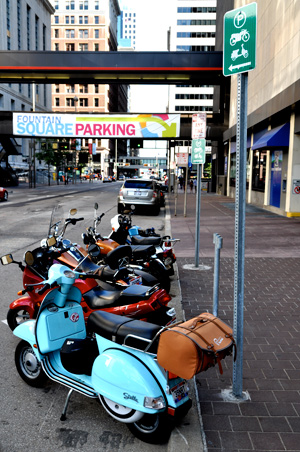
The City of Cincinnati took a big step last week to help out the two-wheeled motorists traveling in its borders.They voted to set aside funding to maintain, improve and expand a free parking program for motorcycles and mopeds in Cincinnati. The next two spaces will be built in Clifton; one on McMIllan and one on Calhoun streets, in the next two months.A pilot project begun in 2009 provided a few parking spaces for motorcycles and mopeds downtown, mostly near Fountain Square. The spaces were striped for three or five bikes at time but motorists quickly maximized the use of that space, packing in as many as 10 and sometimes overflowing onto the sidewalks or adjacent spaces."Basically every spot was having twice as many vehicles parked in it as we anticipated," Melissa McVay, a planner in the Transportation and Engineering department who works on the project, said.The overwhelming response encouraged the department to expand the project, and propose two-wheeled parking fees to fund construction of new spaces. The council was adamant that the spaces remain free, McVay said, and they opened access to another funding source last week.The new corral-type spaces will allow motorists to "self-regulate" the layout of their bikes in the most efficient way possible within a painted border, she said."Riders are very respectful towards each other," McVay said. "They pack them in as closely as they can."The city's director of transportation and engineering, Michael Moore, said his department plans to install motorcycle and motor scooter parking spaces downtown and in surrounding neighborhoods as new streetscape and sidewalk improvement work allows.Three more spots were planned during the pilot phase, but the city will contact two-wheeler communities to see if they still consider the new locations to be ideal before they are constructed, McVay said. One is slated for Central Parkway near the Coffee Emporium, a second on Main Street behind the Aronoff, and a third near the intersection of McFarland and Elm Streets.McVay said the project was begun because riders are not allowed in most parking garages downtown. She said she thought the program has already encouraged people to choose their two-wheeled mode of transit over their car.A map of current locations can be found here - anyone interested in suggesting locations for new spots, or providing feedback on the three mentioned above is encouraged to email twowheeler@cincinnati-oh.gov.Writer: Henry SweetsPhotography by Scott Beseler

UC “guru” and grads profiled in Entrepreneur

UC professor Chuck Matthews and graduates Ahmed Shuja, Dan Cremons, and Dan Shelly were profiled in Entrepreneur magazine's 'gurus and grads' issue. Matthews is the founder and executive director of UC's Center for Entrepreneurship Education and Research. He earned his doctorate in business from UC. His former students have found success in the business world with Meridian Life Sciences, Alpine Investors, and Progressive Cooling Solutions. Read the full story here.

Cincinnati officials looking to win big in second round of TIGER grants

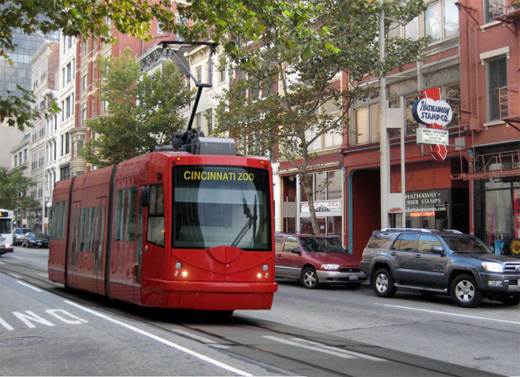
Cincinnati officials have submitted a $35 million application for funds from the Transportation Investment Generating Economic Recovery (TIGER) II program.  The problem is that Cincinnati is not alone in their TIGER II aspirations.  Approximately 1,000 applications were submitted for consideration totaling more than $19 billion in requests - a number far exceeding the $600 million available through the program.“The wave of applications for both TIGER II and TIGER I dollars shows the back-log of needed infrastructure improvements and the desire for more flexible funds,” U.S. Department of Transportation Secretary Ray LaHood said in a prepared statement.  “This also shows the opportunities still before us to create jobs, to reduce congestion, make wise environmental choices and help generate lasting economic growth.”In February 2010 Cincinnati officials learned that the streetcar project had been passed over in the first round of TIGER funding which distributed $1.5 billion to 51 projects nationwide.  At that time officials attributed the loss to the highly competitive nature of the program, but were encouraged by the positive feedback they received from the DOT.Cincinnati's current $35 million request would close the remaining $12 million gap and potentially reduce the amount of local bonds needed for the $128 million streetcar project.  Should the project receive the full $35 million, the modern streetcar project could potentially also see an expanded scope from its current Downtown/Over-the-Rhine loop and connection to Uptown."The streetcar project speaks directly to a number of the priorities that have been identified recently by the U.S. DOT," said Chris Eilerman with the City's Department of Transportation & Engineering.  "The streetcar specifically speaks to the livability principles of providing more transportation choices and improving the economic competitiveness of neighborhoods, sustainability, walkability, and creating vibrant, urban neighborhoods.  This is why we believe that this is a transformative project that will compliment the growth that Cincinnati is experiencing now."Cincinnati's official request was submitted by the Ohio DOT as one of their priority projects.  The State of Ohio previously awarded the Cincinnati Streetcar project $15 million through its Transportation Review Advisory Council (TRAC).According to the U.S. DOT, grants awarded through TIGER II will be awarded on a competitive basis to projects on a half-dozen criteria including environmental, transportation, economic, and livability factors.  Those projects that are able to create and preserve jobs quickly will also be given priority.  Officials expect to hear back about projects winning TIGER II funds later this fall. Writer: Randy A. SimesImage Provided Stay connected by following Randy on Twitter @UrbanCincy

Our Partners

Taft Museum of Art

Common Ground Is Brewing

Support local stories and receive our signature roast straight to your door when you join at the Standard level (or above).

Drink Better, Read Local

Close the CTA

Don't miss out!

Everything Cincinnati, in your inbox every week.

Close the CTA

Already a subscriber? Enter your email to hide this popup in the future.