Corryville

Often lumped in with Clifton, Corryville has its own special mix of residential and retail built along a business district that runs the length of Short Vine. Home to music fan favorites like Bogart's live concert hall and Mike's Music's collection of vintage guitars; the Public Library's branch in the handsomely renovated Carnegie building; and UC's Niehoff Urban Studio headquartered in a turn-of-the-century dance hall across the street.

Cincinnati Innovates’ winners collect $100K in awards

One is a soccer dad tired of suffering on the sidelines. Another is a savvy entrepreneur with a plan to help professionals who have said “yes” to one too many find a safe and convenient way home. Still another is a mom inspired by healthy living. This year’s Cincinnati Innovates winners encompass an impressive range of ideas and strategies to improve quality of life and health. Rick Pescovitz of Under-the-weather.com won one of the top awards, the $25,000 CPG Strategies Award, for his all-purpose tent built to fit soccer chairs and protect fans from extreme weather. The other $25,000 winner, Brooke Griffin of Skinny Mom, has built a network of more than 70 mom-bloggers around the world. She won investment help from CincyTech. Another winner, Jon Amster of 321RIDE.com, received a $5,000 Taft Legal/Patent Award for his innovative approach to his membership-based designated driver service already used by the Cincinnati Reds and Dunhumby USA. In its third year, the Cincinnati Innovates competition awarded $100,000 in funding and in-kind services to entrepreneurs representing 12 business ideas. Since its inception, the competition has sparked millions of dollars of investments in companies with local connections. More than 200 entries vied for support this year, with awards given in a variety of categories. Commercialization award winners were selected by their sponsors (CincyTech, LPK) with help from a team of judges; in-kind services awards were chosen by sponsors with help from judges; community choice award winners were chosen by the public. Browse this year’s innovative entries here.  By Elissa Yancey Follow Elissa on Twitter.

What The New York Times forgot: Our innovative parks

With the Smale Riverfront Park open and Washington Park debuting July 6, we take a closer look at how the Cincinnati Park Board's oft-overlooked innovations move, and in some cases outright push, the city forward.

VFA Fellows excited to move to Cincinnati

They are young, high-powered, high-achieving, highly skilled professionals with their sights set on the same thing: success in Cincinnati, start-up style. Read where they are working — and why.

Fifth Quarter in Cincinnati: Not your mother’s summer school

Now in its 4th year, Cincinnati Public Schools’ 5th Quarter program targets under-performing, low-income schools with an extended school year and a collective approach to learning, and fun, that's getting national attention.

Cincinnati Children’s to break ground on $180 million addition

Soon the Cincinnati Children's Hospital's Burnet campus will have an impressive new addition. The hospital will expand its research arm with a new 15-story clinical services building. The ground reaking will be in June, and the building is set to open in 2015. Cincinnati-based Messer Construction is the project's general contractor; architects are GBBN, GPR and HDR. The new $180 million, 425,000-square-foot facility will house: • New labs • An outpatient clinic • Imaging facility for clinical trials and research • Office space • Supporting infrastructure The building will be financed through a combination of operating cash and investments, future operating cash flows and philanthropy, hospital officials say. It will be located along Sabin Way, next to the research building finished in 2007. Physically, the building will also connect research and patient care. “The new clinical sciences building will create a physical link between the discoveries in our current research facility and their application to patient care in our clinical locations,” says said Arnold Strauss, MD, director of the Cincinnati Children's Research Foundation, in an announcement. The new building will allow the hospital to hire up to 100 new research faculty over the next five years. "Expanding our research space is essential to supporting our world-class faculty investigators. These investigators are developing and evaluating breakthrough discoveries for patients. They work closely with clinical staff to apply those discoveries to improving the health of children here and throughout the world," Strauss adds. By Feoshia Henderson Follow Feoshia on Twitter

Bike Month events celebrate city’s progress, potential

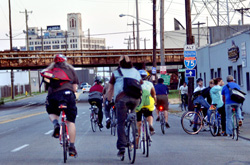
Grease up your chain, pump up your tires, roll up your right pant leg and hop on your bicycle--it's nearly Bike Month in Cincinnati. Get ready to roll.

CoreChange looks to enhance urban core

What will change the most challenged neighborhood – one racked by poverty, crime, and the disintegration of lives –into a “learning organization,” a place that nurtures expansive ideas and encourages all of its residents to see the whole picture, together? CoreChange wants to be part of the solution. The community-wide effort aims to pull together partners of all types in order to co-create solutions that will enhance the best parts of the city's core. Co-chaired by Victor Garcia and Byron P. White, with help from its steering committee and design team, CoreChange is working in coordination with the Community Building Institute. This institute focuses on community development that is driven by the community itself, not by outside organizations. In its planning, it looks first at the community’s physical assets and the energy and needs of its residents, rather than just building a structure or fixing a problem. CoreChange wants to bring community members together to strengthen that development process. It hopes to compliment regional planning efforts by addressing three issues that are difficult to sustain in urban renewal: systemic solutions to poverty; effective public investment in those solutions; and the engagement of people who live outside the urban core. The message is clear: no neighborhood alone can heal itself. CoreChange’s primary strategy for accomplishing these changes is the CoreChange Summit, a three-day gathering of hundreds of residents and leaders over President’s Day weekend, Feb. 17-19. Titled “Igniting Strengths to Invent the New American City,” the sessions will allow participants to share ideas and hopes. Do Good: • Attend: the CoreChange Summit, “Igniting Strengths to Invent the New American City,” is Feb. 17-19, 2012, at the Millennium Hotel. Call 513-745-3896 for registration or details. • Learn: about CoreChange and its mission at www.corechangecincy.com. • Donate: to CoreChange and join a growing network of supporters who believe in the effort to improve the quality of life in Cincinnati. By Becky Johnson

The best beer gardens in America, including Mecklenburg Gardens

The beer garden is the new coffee shop. So gather your friends for craft brews and a casual vibe at these hot spots, from Mecklenburg in Cincinnati to Standard Biergarten in New York. Read the full story here.

BIOSTART moves toward service-based model

Fifteen years after opening its doors, BIOSTART, Cincinnati's life sciences start-up center, is changing the way it does business. In order to remain competitive in a fast-changing business market, it is closing its lab space and moving from its location near the University of Cincinnati.BIOSTART President Carol Frankenstein says the organization will focus exclusively on business services, making the hard shift as its closes its current facility at the Hoxworth Blood Center in September. She says the change was both a business and a strategic decision."Today, companies, even at the very early stages, are outsourcing their commercialization and development activity. That includes clinical and preclinical work, development and manufacturing," Frankenstein says. "That increase in outsourcing reduces the cost of getting a product to market. That makes lab space less necessary. Because of the economy, there is so much low-cost and even free space available; our companies have the ability to benefit from that."BIOSTART serves life sciences entrepreneurs in health care service and product development. Since 1996, it's helped 125 companies launch their business and raise $180 million. Three-fourths of those businesses have had successful exits or are currently in business, the organization reports.BIOSTART is working with local business advocates, including the Hamilton County Business Center, Uptown Consortium and CincinnatiUSA Regional Chamber to help its 18 tenant companies (which occupy about 65 percent of its space) to relocate. Frankenstein said BIOSTART is looking for a new space downtown. She will remain with the organization as will three entrepreneurs in residence. The organization has received $500,000 in funding, half from the Ohio Department of Development and half from private sources, to aid in the transition."We're using the grant for the next 12 months to explore new service delivery models," she says.BIOSTART's current business services include helping companies put together a management team and connecting with and applying for funding sources.By Feoshia Henderson You can follow Feoshia on Twitter @feoshiawrites

Transitioning teens find new home at Lighthouse

A soon-to-be homeless shelter in Corryville will focus its efforts on serving vulnerable, homeless young adults in Cincinnati.The Lighthouse on Highland homeless shelter, located at 2522 Highland Avenue and part of the Lighthouse Youth Services organization, was conceived as part of the city of Cincinnati's plan to move individuals out of homelessness, increase permanent housing and target homeless services specifically to the individual's age, says Tamara Sullivan, media director for Lighthouse Youth Services."This initiative grew out of the recommendation made by the Homeless to Homes Steering Committee to have Lighthouse expand current services offered to the 18 – 24 year-old homeless population as part of the city's comprehensive homeless plan," Sullivan says. The facility will offer a 28-bed shelter to homeless young adults on the second floor and will relocate Lighthouse's existing day program, known as Anthony House, to the first floor of the building, says Geoff Hollenbach, director of Lighthouse's Runaway and Homeless Youth Division.The impetus behind the new shelter is to treat the unique needs of homeless young adults, many of whom are vulnerable in part because they are experiencing homelessness for the first time, Hollenbach says.Bob Mecum, president and CEO of Lighthouse Youth Services, echoes Hollenbach."We know that youth who age out of the foster care system are at a much higher risk of becoming homeless, so this new shelter will target a population of young people we know are in need of this type of community resource," Mecum says.The shelter, on target to open this fall, will serve 40 to 60 homeless youths per day.Do Good:• Walk the walk. Register for the 2.4 mile walk to raise funds for items such as shoes, socks or bus tokens for the homeless. Call Lindsay Schoeni, 513-487-7151, to register.• Volunteer your business for a group community service project with Lighthouse. • Volunteer your time by tutoring a youth in math or reading, or be a general office assistant. Volunteer schedules are flexible to fit your lifestyle. By James Sprague

Our Partners

Taft Museum of Art

Common Ground Is Brewing

Support local stories and receive our signature roast straight to your door when you join at the Standard level (or above).

Drink Better, Read Local

Close the CTA

Don't miss out!

Everything Cincinnati, in your inbox every week.

Close the CTA

Already a subscriber? Enter your email to hide this popup in the future.