
Regionalism

Westside chef creates ‘the Ben & Jerry’s of hummus’

Ethan Snider has had a love affair with food for nearly a quarter of a century. Raised on Cincinnati’s west side, he worked up through the ranks at Macaroni Grill, and eventually became an executive chef. In short, it was a dream come true. Until he hated it. “The corporate stuff just did not appeal to me,” Snider says. “I was there for less than six months.” He ended up at the Culinary Institute of America in Hyde Park, N.Y., where he graduated with a bachelor’s degree in 2004. After that, Snider moved around a lot. He worked at a tiny Batesville, Ind., restaurant that was run out of a three-car garage and after that, at a fine-dining restaurant in Boca Grande, Fla. Moving around was great for a while, but Snider eventually grew homesick. “I liked it a lot, but I started to miss being here; I always wanted to make a name for myself in Cincinnati because this is where I’m from,” he says. After moving back to Cinicnnati, Snider got started with his own food venture at local farmers’ markets because they have low overhead and a home-grown touch. With an eye toward the need for more locally sourced vegetarian and vegan options, Snider launched Summuh (pronounced “SOU-mah”), a specialty hummus shop, first at a farmer’s market in Madeira and, then in Northside and Hyde Park. Most recently, he joined Findlay Market, where he plans to weather the winter months. Snider calls his wares “the Ben & Jerry’s of hummus,” and promises that “you’ve never had hummus like this.” Two of his core flavors are a chickpea hummus with lemon and rosemary and one spiced with cumin, coriander and cilantro and topped with red onions. There are also 12-15 seasonal flavors, including “Squashbuckler,” which features a butternut squash and navy bean base with ancho chili powder, garlic and a spicy black bean relish on top. Though his hummus is organic and local, Snider says he’s no food evangelist. “I’m not trying to convert anyone to what I believe in or change the world." he says. "I just feel that if I believe in something, other people will start to believe in what I’m doing, too.” By Robin Donovan

Latest in Regionalism
MedCity News reports on Innov8 For Health accelerator class

A Cincinnati accelerator for health IT startups that models itself on groups like Rock Health, Blueprint Health and Healthbox has named its inaugural class of companies. Read more here.

Sugar cookies from Mt Lookout Sweets match any occasion

Imagine the work that goes into a batch of cookies: mixing, rolling, baking, decorating and washing. Now imagine baking 1,000 cookies a month. That’s how many Debbie DeGeer typically creates at Mt Lookout Sweets, a bakery she runs from her Mt. Lookout home – complete with a commercial kitchen in the basement – each month. That’s 12,000 cookies a year, but DeGeer isn’t counting. Baking helps keep her hands busy and her creative mind active while she cares for her aging mom, who helping instill in DeGeer a love of floury hands and blustery ovens. Because DeGeer’s mom lives with Alzheimer’s, the duo spend their share of quiet nights at home.  Baking started as “a kind of therapy,” and DeGeer often arrived at Comey Shephard, the real estate agency where she works, laden with cookies. Her creations with the company logo on them were particularly popular for the real estate company’s open houses, and from there, the requests grew. DeGeer specializes in hand-decorated sugar cookies that are part art and part dessert, and she has a design for everyone. When Keidel, a Cincinnati-based plumbing, cabinetry, appliance and lighting contract, celebrated its 100th anniversary, DeGeer created confections in the shape of bathtubs, light bulbs and even toilets. “I never thought in my life I would make a cute toilet, but I did,” DeGeer says. Active with other cookie pros, dubbed “cookiers,” on Facebook, DeGeer has about 1,200 Facebook fans for her business, and says it’s a top source of referrals, along with word-of-mouth. Mt. Lookout Sweets averages three to four orders per week, with her capacity filling up quickly around the holidays and in late spring or early summer as couples plan their weddings. DeGeer typically requests a week’s notice for each order and more during busy seasons. By Robin Donovan

Cincideutsch to deck Fountain Square with traditional Christkindlmarkt

The weekend after Thanksgiving heralds the start of the Christmas season, as Fountain Square becomes the set for Macy’s Light Up the Square and Downtown Dazzle, but this year, a new addition to the festivities adds a distinctively German twist. Cincideutsch, Cincinnati’s newest German society, will host a Christkindlmarkt on the Square, Nov. 23-25.   A Christkindlmarkt is a traditional German market that pops up around Christmas time. In Germany, the markets start at the beginning of Advent and last until Christmas. Cincideutsch's Christkindlmarkt is Cincinnati's first open-air Christmas market, and although it's only one weekend, the group hopes that in the future, the market will last longer, says Olaf Scheil, Cincideutsch’s president and one of its co-founders.   Scheil came to Cincinnati 14 years ago for work, and after the company he moved for closed, he decided to stay. Many of the members of Cincideutsch are German natives who have moved to Cincinnati, or are Americans who have lived in Germany, like Linda McAlister, co-founder, VP and treasurer of Cincideutsch. Peter Rother, the third co-founder, is VP and secretary.   Plans have been in the works for a Christkindlmarkt since Cincideutsch was founded in 2011. “It was something we all missed about Germany, so we decided to start one here,” McAlister says.     Cincideutsch’s Christkindlmarkt will have feature 10 booths selling things that are both German in nature and local. The Germania Society of Cincinnati, Munich Sister City Association of Greater Cincinnati, Rookwood Pottery, Servatii Pastry Shop and Deli, Ultimate Almonds and Mecklenburg Gardens will have booths selling Christmas ornaments and crafts, beer and Glühwein (German mulled wine). Visitors can also buy special edition mugs and tote bags designed by Saint Ursula Academy’s design program. The students from Saint Ursula’s also designed the Christkindlmarkt posters.   Scheil didn’t want Cincideutsch’s Christkindlmarkt to be pop-up tents in the middle of the street, so the booths resemble traditional German-style houses. The market will look like a little German village lit up for Christmas, he says.   Cincideutsch is still seeking sponsors for the market; it has one official sponsor so far, Christian Moerlein Brewery.   By Caitlin Koenig Follow Caitlin on Twitter

SocStock readies for relaunch, plans to make Cincinnati home

SocStock, a web-based company that lets people fund their favorite small businesses in exchange for double the amount back in products, services or experiences, is set to relaunch today. SocStock, a graduate of the latest Brandery accelerator class, will officially be back online today. On Oct. 25, the company will hold a launch event, SocStock Community Pitch Night, at the Know Theatre in Over-the-Rhine. SocStock and Cincinnati businesses that use the platform will be there to talk about the creative financing option. "This is a way for small businesses to raise zero-interest cash by reaching out to customers and community members for a cash advance to help their business grow," says SocStock Senior Associate Jillian Zatta. SocStock allows businesses to raise funds quickly from people who truly support them. At the same time, it gives customers a buy-in through investments in a favorite local business. "It's a very good consumer engagement tool, and it makes customers feel more connected to the small businesses they frequent," Zatta says. "It's also a way for customers to really help a business by doing more than buying from them." For every $1 invested, the business will pay back $2 in a combination of company products, services or experiences. SocStock also can serve as a valuable marketing tool. "They can give customers access to a special collection, invite them to a fashion show, a personal styling session or discounts," Zatta says. Zatta and SocStock's founder Jay Finch have finance backgrounds and relocated to Cincinnati from New York, where they worked at Goldman Sachs. They plan on making Cincinnati SocStock's home. "We want to stay here. We want Cincinnati to be our home. There's definitely a place for us here," she says. By Feoshia H. Davis Follow Feoshia on Twitter

How Dave Knox and the Brandery launched 25+ companies in 3 years

San Francisco, Boulder, New York City. These are the kinds of cities you expect to hear in a lineup of top cities with startup activity. But there’s something in the water in Cincinnati. Read an interview with Brandery co-founder Dave Knox here.

Big plans in the works for Cincinnati

As many areas of Cincinnati are being rejuvenated, including OTR and Washington Park, the City of Cincinnati approved a comprehensive approach to focus on development in the city as a whole, not just targeted neighborhoods.  Last Friday, the City Planning Commission approved and adopted Plan Cincinnati, which was designed with input from residents. The Plan is an opportunity to strengthen what people love about the city, what works and what needs more attention, says Katherine Keough-Jurs, senior city planner and project manager.   The idea is to re-urbanize suburbanized Cincinnati; in a sense, to return to the strengths of the city's beginnings. Cincinnati was established just after the American Revolution in 1788 and grew into an industrial center in the 19th century. Many of those industries no longer exist in the city, which is part of why Cincinnati has become more suburbanized in the past 50 years. One of the long-term goals of the Plan is to bring new industries to Cincinnati.   With a new approach to revitalization, Cincinnati is blazing the trail for other cities. With a focus on building on existing strengths rather than tearing down structures and creating new ones, the Plan aims to capitalize on the city's “good bones” and good infrastructure.   Cinicinnatians had a huge role in developing the Plan. The first public meeting for the Plan was held in September 2009, when residents offered their insights into “what makes a great city?" and "what would make Cincinnati a great city?” A steering committee of 40 people representing businesses, nonprofits, community groups, local institutions, residents and City Council helped develop the Plan. The Plan also got support from a grant from the Partnership for Sustainable Communities, which the City received in 2010. The grant allotted $2.4 million over three years to support the Land Development Code, which combines and simplifies Cincinnati's codes, reviews the development process, implements Form-based Codes and considers more creative uses for land. The grant allowed the city to start implementing some of the ideas voiced in public meetings.   Visionaries included youth, too. City staff worked with community centers and Cincinnati Public Schools to develop an art project for children. They were given clay pots and asked to paint their fears for the city on the inside and their dreams for the city on the outside. The children saw the big issue was quality of life, just like the adults did.   “It was an interesting way to get the kids involved and thinking about the future,” Keough-Jurs says.   The Plan aims to strengthen neighborhood centers—the neighborhoods’ business districts. It maps out areas that people need to get to on a daily basis and found that most are within about a half-mile of the business districts. But in some neighborhoods, residents can’t access their neighborhood centers. The accessibility of a neighborhood center is based on walkability—not just for pedestrians, but also about how structures address walking. For exampke, if a pedestrian can walk from one end of the neighborhood center to the other without breaking his or her pattern (the window shopping effect), the area is walkable; if he or she has been stopped by a parking lot or vacancies, it’s not walkable, Keough-Jurs says.   The neighborhood centers are classified in one of three ways in the Plan: maintain, evolve or transform. Some neighborhoods have goals to maintain levels of walkability, whereas others need to gradually change or evolve. Still others need to completely transform in order to strengthen their business districts.   “Cincinnati is at the heart of the region,” Keough-Jurs says. “If we strengthen Cincinnati, we strengthen a region.” The next step for the Plan is to go before the Cincinnati City Council, specifically the Livable Communities Committee, which is chaired by Vice Mayor Roxanne Qualls.   By Caitlin Koenig Follow Caitlin on Twitter

Cincinnati Parks go digital with new video-tagging program

There’s something decidedly sci-fi about digitizing green plants, but that’s what a new partnership between the Cincinnati Park Board and local tech startup QuipTV hopes to achieve. This month, the duo launched a pilot project that allows Ault Park visitors to access informative videos about specific plants, the community and the park by using smartphones or handheld devices to scan QR-tagged plants.  So far, 87 specimens have been tagged with another 40 to be added in the coming weeks, according to the Parks. Plans are also in the works to extend the project to Krohn Conservatory in time for its 2012 holiday exhibit, “Trains, Trestles & Traditions,” which runs Nov. 17-Jan. 6. “We would like to expand the program to more locations in the future, but we will wait to see some of the responses from the pilot projects at Ault and Krohn,” says Deborah Allison, business services manager at the Parks. You don’t have to visit the sites to learn about the plants, either. The informative videos can also be accessed remotely via the Cincinnati Parks’ YouTube channel and its mobile app, which was launched in July. According to Kris Kubicki, co-founder of QuipTV, the videos also direct users to local vendors that sell the featured plants. “We own a small nursery and were trying to figure out a way to generate enthusiasm for plants and let people know that we exist,” says Kubicki. “Recognizing that many small businesses are struggling and need the support of their community, this project helps them, too. In this technology-driven culture with smartphones in the hands of many, we can take a moment of curiosity and educate with a 20-50-second video.” Organizers hope the project will help people connect more with the outdoors and interact with other Cincinnatians through existing groups like the Greater Cincinnati Master Gardener Association and the Civic Garden Center. “This project engages people with their surroundings and provides options for citizens to be more proactive,” says Kubicki. “We all need each other. Supporting our local communities is where we start fixing the future.” By Hannah Purnell Follow Hannah on Twitter.

RobustCloud helps large companies gain efficiency with cloud computing

By now, most people have heard about "cloud," or web-based computing, which has made collaboration, innovation and efficiency easier. A Cincinnati tech entrepreneur, Larry Carvalho, is taking his expertise in cloud computing to large companies across the country through his business, RobustCloud. "I have a mechanical engineering degree, and have helped businesses learn how to use IT to improve their business," Carvalho says. "I took my experience to large enterprises by helping tech companies in the adoption of cloud computing." Carvalho, a native of India, lived in New York before coming to Cincinnati for work in the late 1980s. He started RobustCloud in 2009 after his job with IBM was relocated. "For most companies, there is a dearth of knowledge about what they can do with could computing," Carvalho says. "As a result, they look for experts to advise them on what steps to take." The main areas in which he consults are social networks, mobile computing and analytics. "That is really what is driving the need for cloud infrastructure," he says. "The bottom line benefit to business is business agility. They are able to react to market changes faster." Though based in Cincinnati, many of Carvalho's clients are on the East and West coasts. However, he is looking to expand his footprint in Cincinnati and will be among those presenting at the Digital Non Conference this Wednesday at 11:15 a.m. on "Data and Digital Marketing." "I'm really eager to help local companies adopt cloud computing," Carvalho says. "I want to make a difference in Cincinnati." By Feoshia H. Davis Follow Feoshia on Twitter

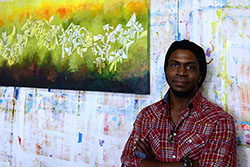
My Soapbox: Cedric Michael Cox, artist

Cedric Michael Cox may be the busiest – and most accessible – artist in Cincinnati. As vibrant as his paintings and as intricate as his drawings, the 36-year-old is also as driven as his rock band is loud. He shares the stories behind his newest PAC Gallery show with Soapbox's Chris Graves.

Our Partners

Taft Museum of Art

Common Ground Is Brewing

Support local stories and receive our signature roast straight to your door when you join at the Standard level (or above).

Drink Better, Read Local

Close the CTA

Don't miss out!

Everything Cincinnati, in your inbox every week.

Close the CTA

Already a subscriber? Enter your email to hide this popup in the future.