
Cincinnati cracks top 5 in most sexually satisfied cities
Cincinnati ranks fourth in Time's calculations of most sexually satisfied cites. Do you doubt it? Read on.
Cincinnati ranks fourth in Time's calculations of most sexually satisfied cites. Do you doubt it? Read on.

For four days in October, local creatives will launch a rebranding of Cincinnati as an international hub for design. CODE, which stands for Cincinnati Open Design Event, debuts Oct. 18-21. The event is a four-day creative conference showcasing local designers and tastemakers. The brainchild of AGAR (formerly Ionic Collective), CODE brings together international firms like LPK and Landor, as well as a bevy of freelancers and other professionals who call Cincinnati home. Over the course of four days, CODE participants will carve out Cincinnati’s creative manifesto, intent on solidifying the city’s international reputation, and build on that reputation. CODE partners include Mitchell’s Salon and Day Spa and Navarro Photography, along with sponsors like LPK and 4EG. It is part professional education and part creative collaboration with plenty of opportunities for networking and socializing. Andrew Salzbrun, AGAR managing partner, says, “CODE creates a unified place where local designers can really stake their flag in ground.” CODE’s educational component will be held at the LPK Brand Innovation Center on Garfield Park and will feature a series of talks and sessions. Professionals from large firms to small will present, as will representatives from the University of Cincinnati and Miami University. The daytime sessions are organized into tracks, including style, consumer marketing and entertainment, with topics ranging from fashion to branding to film and back again. Speakers will highlight how to leverage local design and keep working on the creative edge. The goal is brash and bold: create Cincinnati’s design manifesto. While sessions form the framework for daytime activities, the evenings bring a whole new level of networking with peers. Spearheaded by AGAR, event and experiential marketers that are responsible for some of the coolest events around, the CODE evening lineup includes custom designed cocktails during the Creative Directors Happy Hour, and Rocktober on Fountain Square in partnership with 4EG. The event concludes with a City Flea-inspired Freelance Market and evening fashion show. “The creative talent in this city is as good or better than you’ll find anywhere,” says Salzbrun. “CODE gives our city a chance to showcase that talent.” Tickets cost $125 for all three days, and can be purchased online. By Deidra Wiley Necco
This fall, Jon Zipperstein and Hideki Harada toss their hats into Over-the-Rhine’s restaurant ring with Kaze, a gastro pub and sushi bar, to the Gateway Quarter at the corner of 14th and Vine streets. Zipperstein owns Embers, a Montgomery restaurant that serves steak, seafood and sushi; Harada was a sushi chef there when it first opened. Although he left after two years to sharpen his culinary skills, the pair remained in contact and eventually decided to open a restaurant together in OTR. “We were just looking for a really dynamic part of town, and Over-The-Rhine certainly fit the bill,” Zipperstein says. They opted for the Color building because it offers more than 3,500 square feet of restaurant space, plus an outdoor area where they will put a beer garden that will be partially enclosed with a fire pit. Building owner 3CDC reports the $4.1 million renovation of the mammoth space will also feature 6,000 square feet of office space. “If you’ve been to the building a year ago, when it was first shown to me, it was an absolute wreck,” Zipperstein says. “You had to have a great imagination to think about what it could be. And you could say the same about just about any building they work on down there. They take buildings that are in complete disrepair, that are 100 years old or more, and turn them into little gems.” The atmosphere at Kaze will be comfortable yet urban, Zipperstein says. He and Harada like the idea of reclaiming the historic building, so they will be leaving a lot of exposed brick. Other restaurant plans include an open kitchen, so diners can take advantage of insiders’ views of meal prep. The menu will be about 50 percent sushi/50 percent izakaya, which is Japanese style pub food—lots of small plates, grilled meats and noodle soups. Kaze will use local produce. Their beverage selection will include traditional favorites, plus they will import Japanese beer, liquor and non-alcoholic drinks that have never before graced Cincinnati shelves. The plan is to open the bar first around the beginning of November. Shortly after, they will serve food in the bar and open the beer garden. In December, the dining room will be open for private parties exclusively. After these soft openings, Kaze plans a grand opening in January 2013. By Stephanie Kitchens
Pellé Medical Skin Care products aren’t prescription strength, but neither are they drugstore pick-up items. They have a higher level of active ingredients than drugstore brands, and must be sold from a physician’s office, but no prescription is required. Chris Klueh, who co-founded the business with partner (and fellow nurse) Debbi Gittinger, says Pellé’s products cost roughly the same amount as department store cosmetics, but are formulated to penetrate deeply into the skin, addressing issues like dryness, acne, premature aging, rosacea and even skin damage caused by chemotherapy and radiation treatments. Klueh says she always recommends three core products: a vitamin-C serum to protect skin, a sunblock to moisturize and prevent sun damage and a retin-A cream for nighttime use. She also offers treatments, sometimes called “peels,” though she warns the term is misleading; most of her treatments require little time away from the sun or normal activities. “We have a microexfoliation treatment that can be done every five to six weeks, and that’s what patients mostly come in for,” she says. Nurses at Pellé schedule consultations for patients, keep track of appointments and recommendations on medical charts, and often refer those in need of additional help to local dermatologists. Because her services are cosmetic, they are not covered by standard health insurance plans, but the staff treat consultations like any other medical appointment and maintain charts to track patients’ progress. “We see so many people get frustrated with the way their skin looks. It looks dull or they don’t like the crepe-y skin around their eyes,” Klueh says. “The beauty of medical skincare is that we can correct the premature aging process. Everyone’s going to go through the natural aging process, but we can correct some of the early onset wrinkles and damage.” By Robin Donovan
A group of University of Cincinnati students took home first place at a national sustainability design competition, designing an essentially "zero energy" building. The seven-member team redesigned the innovative Joe and Rika Mansueto Library of the University of Chicago. Students were tasked with theoretically creating a building with net zero energy usage. The American Society of Heating, Refrigerating and Air-Conditioning Engineers, or ASHRAE, sponsors the annual competition, and this is UC's first No. 1 finish. Six graduate students and one undergrad made up UC's team; their educational backgrounds include architecture/construction and mechanical (HVAC) engineering. The team worked on the design for about three months, says member Ravik Chandra, a grad student in the Department of Mechanical Engineering. The team divided into a group that worked on the building's architecture and a group in charge of mechanical systems. Both groups worked closely to assure the building would be both pleasing to look at and energy efficient. That teamwork paid off, and could serve as an example to professionals in the field, Chandra says. "It's the first time I've worked with an architect to solve a real-life problem. Usually the architecture or the engineering dominates (building design). It was quite a new challenge, and I never realized the many different aspects that go into architecture," he says. Teams were allowed to relocate the building to the state capitol of their home state, which the UC team did, bringing it to Columbus. Among the building's winning features were changing the orientation of the building to increase the amount of sunlight it would absorb. That cut cooling costs by some 20 percent. The team also altered the large glass dome that tops the building, using transparent photovoltaic cells that turned sunlight into electricity instead, says Dustin Altschul, the project manager who recently graduated with a B.S. in Architectural Engineering Technology. They also installed a system to harvest rainwater for the building's use to cut down on water consumption. The building wasn't 100 percent net zero, but it was the closest to achieving the goal. It's up to the Library itself to use any of the ideas, but UC team representatives will present their design concepts at the annual ASHRAE Winter Conference in January 2013 in Dallas. By Feoshia H. Davis Follow Feoshia on Twitter
When Cheryl Walters was laid off from her corporate marketing gig last February, she was a victim of the same mindset she describes as the most common misconception about her field: thinking it’s not important. Marketers, Walters says, are often first to be cut in rounds of layoffs. Yet, “You don’t need to do big branding campaigns like [Procter & Gamble] to be effective. You do need to do something,” she says. After the layoff, she launched her own marketing firm, CheronaWorks, to address the marketing needs of smaller companies in a variety of industries. She specializes in budget-conscious work; many of her clients are just starting out, like Walters herself, or don’t have a marketing staff. “I respect that clients don’t want to spend a lot of money,” she says. “I make sure I don’t give them any costs they can’t handle, and I’ll be honest if they do something and I think it’s a bad investment; I’ll tell them not to waste their money.” CheronaWorks offers marketing services from direct response mailings to websites and email campaigns. Like so many startups, Walters is currently finding new clients through referrals and, of course, marketing herself. She says she uses social media to connect with local companies with marketing needs – and frustrations. “When I’ve had to do marketing to drum up business, I’ve had luck with social media. I look for people who are looking for help or seem frustrated or are just blatantly posting that they need something,” she says. Walters says her most common requests are designing logos and websites for new businesses or those “ready to move beyond their WordPress site.” By Robin Donovan
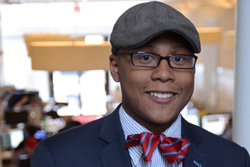
Cleveland native Jay Finch, 26, moved to Cincinnati to join The Brandery's 2012 class. The Villanova honors grad studied economics at Cambridge and Harvard before Goldman Sachs snagged him post-graduation. He gave all that up to start his "market ministry," Socstock.
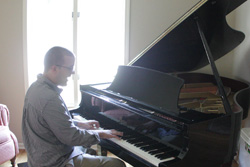
Inspired by Questlove, J Dilla, The Roots and Hi-Tek, CCM classical and jazz piano student Josh Jessen defies traditional musical genres. The 20-year-old's accelerating career has already carried him from local coffee houses to international concert halls.
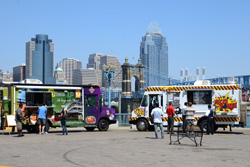
In Cincinnati’s gritty food truck subculture, there are few avenues of support and even fewer guarantees. Tom Acito of Cafe de Wheels and his food truck brethren have chips on their shoulders, real skin in the game and a cult-like following.
Cincinnati's Emery Theatre serves as the space and inspiration for a new video created by CCM doctoral student Paul Schuette. His group, Origami, performs avant garde composer John Cage's Cartridge Music, and an experiment in sound becomes an experiment in space and understanding. Video courtesy Paul Schuette.
Our Partners