West End / Brighton

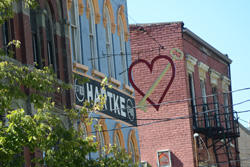
This expansive neighborhood borders Over-the-Rhine in the shape of a sliver. Mostly residential, it has a rich history and diverse inhabitants, a beauty discovered by only the most discerning eye. The Dayton Street Historical District, a cluster of houses built mostly in the late 1800s, is on the National Register of Historic Places. City West, a mixed-income housing development just north of downtown in the neighborhood's southern-most point, is the biggest housing development in Cincinnati since World War II. The quiet streets have come alive with additions like the Mockbee across Central Parkway and a church renovation that will yield a climbing gym.

Matthews uses poetry to spark sociopolitical conversations

Tonya Matthews, PhD, is not only the vice president of museums at Cincinnati Museum Center, she is also Ja Hipster, a talented poet and spoken word performer. It is for her work as Ja Hipster that she received a $6,000 Cincinnati Arts Ambassador Fellowship grant. Just five years ago, Matthews moved to downtown Cincinnati from Maryland to work at the Museum Center. She wrote a book of poetry,“Still Swinging’ These Hips,” and made a spoken-word CD, “The Legend of Afrodite.” With the new grant money, she plans to create her second book of poetry as well as her second CD. Currently, she is deciding whether she wants the CD to accompany the book, or if she wants to keep the mediums separate. Matthews hopes that the artists’ grants and their projects will open up the conversation about the arts and help open doors for other artists. “I think poetry is a very different kind of conversation,” Matthews says. “People hear things that poets say that they don’t hear in general conversations or in speeches. “What I have noticed, particularly since I do a lot of sociopolitical stuff, is that I can have conversations with people that normally make them uncomfortable. But because I’m a poet, I get away with bringing up the subject. And not only do I get away with the subject, but people are comfortable to have that conversation.” Her poetry is observational and sociopolitical, tending to focus on women and young people. “I think at the end of the day, like a lot of people, I’m just trying to save the world,” Matthews laughs. “You know—one line of poetry at a time.” At Duke University, she wrote for the student newspaper and the university journal, which featured student artwork and writing. As a graduate student at John Hopkins University, she started reading her poetry in public. Now, whenever she speaks or performs at specific events, she says she likes to write one new poem to perform. Because of this, she is mostly working on editing for her new poetry book. Last year, Matthews collaborated with the Cincinnati Ballet for New Works, which received rave reviews and sparked conversation. With her work, Matthews hopes to have an impact on the city. “Artists do tend to be heavily influenced by their environment,” Matthews says. “It’s not just how our art is influencing Cincinnati, but it’s also how Cincinnati is affecting our art.” Do Good: • Contribute to a visit to the Cincinnati Museum Center. • Donate to the Cincinnati Museum Center. • Purchase Matthew’s cd or book. By Stephanie Kitchens

Faces Without Places founder wants to see homeless program expand

Karen Fessler has a message she wants you to hear loud and clear: Faces Without Places is alive, well and kicking.  For years, the nonprofit, grassroots organization that has provided nearly $1.5 million in educational support for homeless children in Greater Cincinnati was affiliated with the Cincinnati Public Schools. But about two years ago--and for a variety of reasons--the organization split with the school system, says Fessler, who is a board member and a founding member of the 17-year-old group.   But its mission remains intact, says Fessler.  “The most important part of the program is that we get kids out of shelters, we get kids off the streets and we show them that education is a way to experience a larger world,’’ says Fessler. “We want to broaden our reach. We want to broaden our horizons.”  Fessler declines to discuss what led to the parting of ways, but adds the founders of the program all left their jobs at CPS as well.   “But none of us lost our passion for the kids and the mission of Faces Without Places,’’ she adds. “I want people to know that we are here, and we are committed to providing services. We are toughing it out through thick and thin--for the kids.”  The nonprofit helps about 3,000 school children annually in Greater Cincinnati. Last year, the group provided 7,702 services to 3,013 children, according to its website. Those services included providing taxi services to school for 112 students, uniform vouchers for 777 students, backpacks and supplies for more than 839 students and Payless gift cards for 320 students so they could get a new pair of shoes, a luxury for many, Fessler says.  The nonprofit is best known for its Yellow Bus Summer Camp, which completed its 15th year this past summer. Last year, 152 children attended the eight-week camp that focuses on reading and day trips.  Earlier this month, the group’s biggest fundraiser--the Yellow Bus Ball--raised more than $23,000, most of which will go to fund the camp.   “The ball is critical because we have to have money to pay teachers and buy supplies,’’ Fessler says. “We can get grant money for field trips, but the fundraiser really helps us be able to put on the camp to the degree we have always done it.”  Fessler has worked with thousands of homeless children over the years, and she readily admits she is biased toward teens.   “A lot of people don’t realize this, but these kids are completely out on their own; they are either staying at friends' or living eight, nine, 10 kids piled up in an apartment,’’ she says. “They are squatting and some are living on the streets trying to negotiate life … they are all living life on the edge. I am most impressed by their sheer tenacity and their desire to find a better life.” Do Good:  • Register for the Mt. Adams Yellow Bus Pub Crawl on Saturday, Nov. 17.  • Attend the 5th annual Chili Taste Off on Dec. 9 at Northside Tavern.  • Contribute to Faces Without Places' wishlist of school and personal hygiene supplies.  • Sign up for the monthly email newsletter.  • Give back while you shop.  By Chris GravesChris Graves is the assistant vice president of digital and social media at Powers Agency

Noble Denim launches with American-made, designer-quality jeans

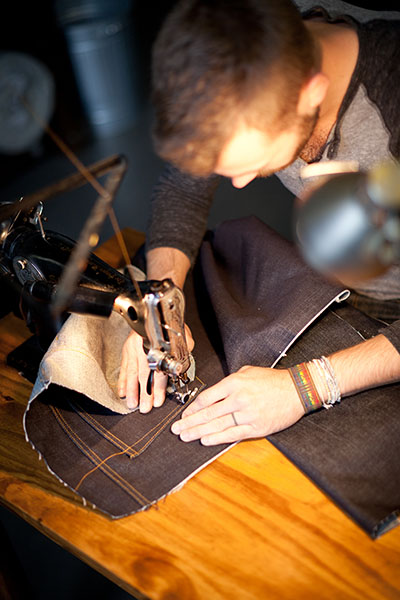
Looking for something "crafty" to learn, Chris Sutton took up jean-making nearly two years ago. "I wanted to learn how to make something with my own hands. I'd been doing a lot of tech endeavors, and wanted to get my hands dirty," says Sutton, whose background is in live event production. Once he began sewing jeans, Sutton found he had a real talent for it. He decided he wanted to make high-quality, American-made jeans, a rarity in today's clothing manufacturing sector. He sought out American sources for his material, thread, zippers and pocket materials. Yes, he found them all in the USA; and he created Noble Denim. "I wanted to make my own rules around what could and couldn't be done. I wanted to make my jeans in America, and make them as sustainably as possible," he says. Using his home in Over-the-Rhine as a sewing factory, Sutton began making and selling Noble Denim jeans. Twelve industrial sewing machines later, he moved the company into a space at Camp Washington. Designer in style and quality, they're meant to have a longer shelf life than your average mass-produced jean. Materials come from suppliers in Kentucky, Ohio, North Carolina, Colorado, Oregon and California. They're made from raw selvage denim, made through a time-consuming process that makes the material thicker and more durable. This type of denim is supposed to better fit the wearer's body and resist shrinkage. Sutton launched an online shop in November, where buyers can chose from two styles, Regular and Earnest Slim Straight. The jeans are pricey, $250 a pair, but all materials are 100 percent organic, reclaimed or responsibly produced. Currently Noble Denim sells jeans only for men; a women's line is planned for next fall. Noble Denim is a young company, and Sutton still does most of the sewing. He does have interns who are learning the jean-making craft. Within the next year, he hopes to hire three or four employees, who'll make 3,000 pairs of jeans a year. "I want to grow, but only as fast as I can stick to my philosophy," Sutton says. "So our mantra is grow slow, but do it well." By Feoshia H. Davis Follow Feoshia on Twitter.

Nine-year-old twins’ love of reading sparks charity that gives books to kids

Hannah and Alex Laman can’t imagine living in a home without books. So the nine-year-old Loveland twins were stunned last fall as their parents discussed a newspaper article that outlined school funding cuts that would affect the ability of some inner-city kids to get books. “Our kids are avid readers and going to the library is a big part of their lives,’’ says Angela Laman. “They overhead us talking about that story and they were just dumbfounded that there are kids without access to books; that there are kids who can’t even get a ride to the library.” So the brother-sister duo came up with an idea: Let’s collect used books and give them away to kids who don’t have them. Just like that Adopt a Book was born. “Kids need to learn how to read because  there are words everywhere,’’ says Hannah, just a day after being named a Difference Maker at the Cincinnati Museum Center for the charity she and her brother created from that very simple idea. Her brother adds: “We wanted every kid to have the chance to read a book." “My goal is to give away 10 million books in the next three years,’’ Alex adds. The Laman twins were two of five people honored last week at the fifth annual Duke Energy / Children’s Museum Difference Maker Awards. The Dragonfly Foundation and Faces without Places were also honored. More than 50 individuals, businesses and agencies were nominated by their peers and members of the community for the inspiring work they do. Angela Laman says she and her husband, Brent, are incredibly proud of their fourth-graders, who have collected and distributed 8,783 books since the nonprofit was created less than a year ago. “We sat on the idea for several months, thinking it would go away,’’ she says. “But they were relentless.” The family brainstormed the idea, came up with the name, filed out the necessary paperwork to create the nonprofit and set up a Facebook account. Then they set out to collect the books, which fill their basement, spare bedroom and garage. The donations have come through friends, family, teachers and their church. The Lamans have distributed books to ProKids, Lighthouse Youth Services and to the YWCA, which shares the books for children in shelters and juvenile programs, she says. The twins catalogue the books as well as deliver them. “It’s all been through word of mouth really,’’ she says. “I thought we would get a few hundred books and I’ve been just amazed.” The books have to pass the Alex and Hannah test before they get donated: Each must to be in good shape, with no missing pages or writing in them. The twins will take books targeted at any age, but they particularly like getting chapter books.  “They don’t want to donate books that they wouldn’t want to get,” says mom, who tracks every book they receive in a simple spreadsheet. “It’s been a great learning experience for them. It’s just been wonderful.” So what’s next for the enterprising twins? Besides donating those 10 million books, Alex really wants Adopt a Book to have its own Web site where they can discuss the nonprofit and he’d like to eventually give away brand new “crisp” books. “New books would be really, really nice,’’ says Alex. “I’d like to give away new books.” Besides the glass awards the twins received, the Museum Center also presented the Laman family with a year membership. The twins are already talking about how they can have a book fair in the center’s rotunda. Do Good: • Like Adopt a Book on Facebook. • Donate gently used books via Facebook or email adoptabook@fuse.net. • Watch a video of the award ceremony. • Read about all the 2012 Difference Makers. By Chris Graves. Chris Graves is assistant vice president of digital and social media at the Powers Agency.

Volunteers support Cincinnati Music Hall

When you print your tickets to the next Cincinnati Symphony Orchestra performance, remember the Society for the Preservation of Music Hall.  As you walk through the beautifully and newly refurbished wooden doors that face Elm Street and into the majestic Cincinnati Music Hall, thank the Society. The society decided to give the doors a facelift to coincide with the re-opening of Washington Park.   And when you sip from the water fountains or flush the toilets at the Hall, you can again thank the all-volunteer group that celebrates its 25th anniversary this year. The nonprofit's mission has not changed since it was formed: To help preserve, enhance and support one of the city’s iconic masterpieces.  The group may be best known and recognized for its work in bringing the Albee Mighty Wurlitzer Organ to the Hall, where is was permanently installed and dedicated in 2009. An anonymous donor gave the society $1.4 million to move the organ from the Emery Theatre to Music Hall’s ballroom.  But Society president Don Siekmann points to the sum of seemingly small accomplishments, such as the new ticketing system, refurbishing the front doors and upgrading the plumping, that stack up to ensure that the Hall continues to inspire artists and awe audiences.  “Music Hall is really the great musical icon of Cincinnati,’’ he says. “It’s our job to get that word out and provide support. We are the guys who really keep it going.”  Siekmann says he is confident that only a fraction of the region’s 1.5 million residents have ever been inside the Hall, which was built in 1878 with private money raised from what is believed to be the nation’s first matching-grant fund drive and is still judged to be one of the most majestic theaters in the world. The Springer Auditorium, which can seat more than 3,500, is home to the CSO, Cincinnati Opera, Cincinnati Ballet and the May Festival.  Many believe the Hall is also home to ghosts, in large part because it was built on former graveyards. In addition to regular tours hosted by Society volunteers, there are also guided ghost tours of the Hall.  Seikmann says the group’s greatest opportunity and challenge is to ensure two things: Introducing more residents and visitors to the Hall and to continue to attract new members.  “We want to continue to get people involved so they tell the stories of Music Hall,’’ he says. Do Good:  • Check out the Hall's new web site.  • Buy tickets to the annual Wurlitzer Organ show slated for 10:30 a.m. and 7 p.m. Dec. 13. The event sells out every year.   • Take a tour and learn about the Hall's storied history -- there’s even guided ghosts tours.  • Donate to the Society for the Preservation of Music Hall.   • Volunteer to be a tour guide by calling 513-744-3293. By Chris GravesChris Graves is the assistant vice president of digital and social media at the Powers Agency. 

Big plans in the works for Cincinnati

As many areas of Cincinnati are being rejuvenated, including OTR and Washington Park, the City of Cincinnati approved a comprehensive approach to focus on development in the city as a whole, not just targeted neighborhoods.  Last Friday, the City Planning Commission approved and adopted Plan Cincinnati, which was designed with input from residents. The Plan is an opportunity to strengthen what people love about the city, what works and what needs more attention, says Katherine Keough-Jurs, senior city planner and project manager.   The idea is to re-urbanize suburbanized Cincinnati; in a sense, to return to the strengths of the city's beginnings. Cincinnati was established just after the American Revolution in 1788 and grew into an industrial center in the 19th century. Many of those industries no longer exist in the city, which is part of why Cincinnati has become more suburbanized in the past 50 years. One of the long-term goals of the Plan is to bring new industries to Cincinnati.   With a new approach to revitalization, Cincinnati is blazing the trail for other cities. With a focus on building on existing strengths rather than tearing down structures and creating new ones, the Plan aims to capitalize on the city's “good bones” and good infrastructure.   Cinicinnatians had a huge role in developing the Plan. The first public meeting for the Plan was held in September 2009, when residents offered their insights into “what makes a great city?" and "what would make Cincinnati a great city?” A steering committee of 40 people representing businesses, nonprofits, community groups, local institutions, residents and City Council helped develop the Plan. The Plan also got support from a grant from the Partnership for Sustainable Communities, which the City received in 2010. The grant allotted $2.4 million over three years to support the Land Development Code, which combines and simplifies Cincinnati's codes, reviews the development process, implements Form-based Codes and considers more creative uses for land. The grant allowed the city to start implementing some of the ideas voiced in public meetings.   Visionaries included youth, too. City staff worked with community centers and Cincinnati Public Schools to develop an art project for children. They were given clay pots and asked to paint their fears for the city on the inside and their dreams for the city on the outside. The children saw the big issue was quality of life, just like the adults did.   “It was an interesting way to get the kids involved and thinking about the future,” Keough-Jurs says.   The Plan aims to strengthen neighborhood centers—the neighborhoods’ business districts. It maps out areas that people need to get to on a daily basis and found that most are within about a half-mile of the business districts. But in some neighborhoods, residents can’t access their neighborhood centers. The accessibility of a neighborhood center is based on walkability—not just for pedestrians, but also about how structures address walking. For exampke, if a pedestrian can walk from one end of the neighborhood center to the other without breaking his or her pattern (the window shopping effect), the area is walkable; if he or she has been stopped by a parking lot or vacancies, it’s not walkable, Keough-Jurs says.   The neighborhood centers are classified in one of three ways in the Plan: maintain, evolve or transform. Some neighborhoods have goals to maintain levels of walkability, whereas others need to gradually change or evolve. Still others need to completely transform in order to strengthen their business districts.   “Cincinnati is at the heart of the region,” Keough-Jurs says. “If we strengthen Cincinnati, we strengthen a region.” The next step for the Plan is to go before the Cincinnati City Council, specifically the Livable Communities Committee, which is chaired by Vice Mayor Roxanne Qualls.   By Caitlin Koenig Follow Caitlin on Twitter

LIVE MAKE launch in Brewery District highlights ARCHinati Festival

Bradley Cooper knew about Maker Works in Ann Arbor and the TechShop franchise, as well as other independent spaces around the country that encourage DIYers and design professionals by providing tools, space and a supportive community. So when he and fellow architect Paul Karalambo took on the job of creating a design competition to create such a space in Cincinnati's Brewery District, he understood its inherent importance. Creating a large space for shared tools and a budding entrepreneur community could not only assist current businesses and residents, but also entice new graduates to find ways to build their businesses in Cincinnati. The result of that thinking is the LIVE•MAKE competition, an initiative of the local branch of the American Institute of Architects, which grew out of the updated zoning for the Brewery District's updated zoning: urban mix.  "It's important to have an entity like this in the city for people to take advantage of," says Cooper, a Cincinnati native who graduated from UC's architecture program and received his Master's degree from University of Michigan.  For now, the competition remains theoretical, Cooper says. Its official launch on Oct. 6. serves as the culmination of the week-long ARCHinati Festival, which includes a full slate of building-friendly events that start Sept. 28.  The LIVE•MAKE kick-off at the Christian Moerlein Brewhouse on Moore Street features not only brewery district tours, but a sampling of local artistic and design-focused entrepreneurs whose work provides a glimpse into what LIVE•MAKE could become. Guests include members of the Losantiville Design Collective, HIVE13 and Brazee Street Studios. Reservations won't be accepted; the first 160 guests to arrive will get free tours and beverages courtesy of Christian Moerlein. "We want people to show up and be there for what's happening," Cooper says. LIVE•MAKE designs have already been submitted from as far away as Texas and California, all before the competition's official launch, and months before the competition's Dec. 20 deadline, Cooper says. "It's generating interest as a way of spurring development," he says.  After winners are announced at the end of January, the local AIA chapter hopes to hold a celebration in the late spring. Gaining interest, and funding, could spur real-life development next year. By Elissa Yancey Follow Elissa on Twitter

Brighton: Working on the edge

People make things in Brighton. Nestled in the northern tip of the West End, and bordered by Central Parkway on the east and Spring Grove Avenue on the west, Brighton’s demographics defy easy explanation.

National recognition puts Museum Center among nation’s elite

Sarah Evans can’t imagine how other high school students figure out what they want to study in college. Evans has Cincinnati Museum Center to thank for the ease of her choice. The 2012 Madeira High School graduate will study archeology when she start classes this fall at the University of Cincinnati.  Evan has been involved in the Museum Center’s Youth Program since was 13 years old, logging an incredible 6,000 or so hours working in each of the center’s three museums. The program is intended to teach teens about museum work and prepare them for college.  “I’m what they call a regular,’’ she says. “I just love our staff. It’s really a place of opportunity and friendship. It’s become a huge part of my life. It has definitely influenced 100 percent of what I want to study in college.” The youth program was one of two programs specifically lauded as a national model by the American Association of Museums in its recent accreditation of the Museum Center at the historic Union Terminal in the West End. The Learning Through Play annual conference that brings parents and teachers to the museum to discuss the importance of play in education was also singled out as a model of excellence.  The recognition puts the center in elite company. Just 4.5 percent of the nation’s 17,000 have won accreditation, which is voluntary and is the highest recognition for a museum. The three-year process examined every facet of the Museum Center’s operation, including finances, governance, programs and programming, stewardship of its vast collection as well as its professional standards.  “It’s really the best news for us. It’s a validation of our peers that we are doing things right,’’ says Elizabeth Pierce, museum vice president of marketing and communications. “We are delighted.” The Museum Center had to wait to apply for accreditation after the merger of the Museum of Natural History and Science, which had been accredited. And while accreditation is on a five-year cycle, the Museum Center will be reviewed in 2014 due to the merger with the National Underground Railroad Freedom Center, she says.  “Accreditation assures the people of Cincinnati that their museum is among the finest in the nation,’’ says Ford W. Bell, president of the AAM. “Citizens can take considerable pride in their homegrown institution, for its commitment to excellence and for the value it brings to the community.” The distinction comes just three years after the Museum Center was awarded the National Medal for Museum and Library Service, making it only one of 16 organizations in the United States to have both. “We really are in good company,” Pierce says. “I hope this reinforces to the community that we are an organization of quality; that we are doing our job well, and we are respectful of donations and we invest in this organization.” Evans, who is also the outgoing president of the center’s youth advisory council, hopes the accreditation will mean continued success for the Youth Program.  “I would say to youth: The more you give to the program, the more the museum can give back to you,” she says. “You will be repaid far more in your future.” Do Good: • Watch a video of teens involved in the Youth Program. • Join or renew your membership. • Plan a visit. • Follow them on Facebook. Chris Graves is the assistant vice president of digital and social media at the Powers Agency.

Soapdish: ‘Pop-up’ creativity sates local appetites

The term “pop up” has become quite fashionable in the cultural lexicon as of late, applying to everything from retail to restaurants to picnics. Soapbox columnist Casey Coston takes a tour of Cincinnati's "pop-up" scene.

Our Partners

Taft Museum of Art
Warsaw Federal

Don't miss out!

Everything Cincinnati, in your inbox every week.

Close the CTA

Already a subscriber? Enter your email to hide this popup in the future.