Madisonville

Offering an eclectic array of businesses, Madisonville is home to deeply rooted residents and newcomers attracted by unique homes in a reasonable price range. This family-friendly neighborhood offers hike/bike trails, an emerging arts scene and a burdgeoning CBD that's just months away from a complete overhaul, thanks to the Madisonville Community Urban Redevelopment Corporation.

Nurse expands medical skin care startup

Pellé Medical Skin Care products aren’t prescription strength, but neither are they drugstore pick-up items. They have a higher level of active ingredients than drugstore brands, and must be sold from a physician’s office, but no prescription is required. Chris Klueh, who co-founded the business with partner (and fellow nurse) Debbi Gittinger, says Pellé’s products cost roughly the same amount as department store cosmetics, but are formulated to penetrate deeply into the skin, addressing issues like dryness, acne, premature aging, rosacea and even skin damage caused by chemotherapy and radiation treatments. Klueh says she always recommends three core products: a vitamin-C serum to protect skin, a sunblock to moisturize and prevent sun damage and a retin-A cream for nighttime use. She also offers treatments, sometimes called “peels,” though she warns the term is misleading; most of her treatments require little time away from the sun or normal activities. “We have a microexfoliation treatment that can be done every five to six weeks, and that’s what patients mostly come in for,” she says. Nurses at Pellé schedule consultations for patients, keep track of appointments and recommendations on medical charts, and often refer those in need of additional help to local dermatologists. Because her services are cosmetic, they are not covered by standard health insurance plans, but the staff treat consultations like any other medical appointment and maintain charts to track patients’ progress. “We see so many people get frustrated with the way their skin looks. It looks dull or they don’t like the crepe-y skin around their eyes,” Klueh says. “The beauty of medical skincare is that we can correct the premature aging process. Everyone’s going to go through the natural aging process, but we can correct some of the early onset wrinkles and damage.”   By Robin Donovan

Guerilla marketer helps small-budget companies

When Cheryl Walters was laid off from her corporate marketing gig last February, she was a victim of the same mindset she describes as the most common misconception about her field: thinking it’s not important. Marketers, Walters says, are often first to be cut in rounds of layoffs. Yet, “You don’t need to do big branding campaigns like [Procter & Gamble] to be effective. You do need to do something,” she says. After the layoff, she launched her own marketing firm, CheronaWorks, to address the marketing needs of smaller companies in a variety of industries. She specializes in budget-conscious work; many of her clients are just starting out, like Walters herself, or don’t have a marketing staff. “I respect that clients don’t want to spend a lot of money,” she says. “I make sure I don’t give them any costs they can’t handle, and I’ll be honest if they do something and I think it’s a bad investment; I’ll tell them not to waste their money.” CheronaWorks offers marketing services from direct response mailings to websites and email campaigns. Like so many startups, Walters is currently finding new clients through referrals and, of course, marketing herself. She says she uses social media to connect with local companies with marketing needs – and frustrations. “When I’ve had to do marketing to drum up business, I’ve had luck with social media. I look for people who are looking for help or seem frustrated or are just blatantly posting that they need something,” she says. Walters says her most common requests are designing logos and websites for new businesses or those “ready to move beyond their WordPress site.” By Robin Donovan

Gigit’s local job search targets tech-savvy creatives

Jay Hopper originally got involved in web design through a journalism job in the newspaper business. He eventually left his career as a newsman to join a local startup, Trivantis, as a web editor. He eventually became the company’s vice president of product management. Then, he launched a social network for automotive enthusiasts before finally deciding it was time to get what he calls "a real job." After failing at the traditional avenues, like Monster, CareerBuilder and LinkedIn, and doing some networking, Hopper says, “I just found that process really frustrating. I was looking for companies that would fit my skill set, passion and personality. I just started thinking, ‘Where are all these companies – the agencies, the software companies, the tech companies?’ I wished there was one place I could go and see all that.” He set out to create a website to meet those needs. The result, Gigit Jobs, lists tech, start up, creative and design job openings in the Cincinnati, Dayton Northern Kentucky and tri-state regions. The Gigit team manually reviews jobs that are posted, and while any company will be considered, positions posted must either come from a company that fits Gigit’s criteria or be a good fit in themselves. That means a web design job at the bank could work just as well as a business development position with a creative agency. The site is aggregator-friendly, which means that jobs posted there will also show up in job-search aggregators. The site's landing pages are currently active, with a full launch planned this fall. Hopper says he hopes the site will encourage techies and creatives to stay in Cincinnati rather than flee to stereotypically tech-friendly locales on either coast. By Robin Donovan

Gigit’s local job search targets tech-savvy creatives

Jay Hopper originally got involved in web design through a journalism job in the newspaper business. He eventually left his career as a newsman to join a local startup, Trivantis, as a web editor. He eventually became the company’s vice president of product management. Then, he launched a social network for automotive enthusiasts before finally deciding it was time to get what he calls "a real job." After failing at the traditional avenues, like Monster, CareerBuilder and LinkedIn, and doing some networking, Hopper says, “I just found that process really frustrating. I was looking for companies that would fit my skill set, passion and personality. I just started thinking, ‘Where are all these companies – the agencies, the software companies, the tech companies?’ I wished there was one place I could go and see all that.” He set out to create a website to meet those needs. The result, Gigit Jobs, lists tech, start up, creative and design job openings in the Cincinnati, Dayton Northern Kentucky and tri-state regions. The Gigit team manually reviews jobs that are posted, and while any company will be considered, positions posted must either come from a company that fits Gigit’s criteria or be a good fit in themselves. That means a web design job at the bank could work just as well as a business development position with a creative agency. The site is aggregator-friendly, which means that jobs posted there will also show up in job-search aggregators. The site's landing pages are currently active, with a full launch planned this fall. Hopper says he hopes the site will encourage techies and creatives to stay in Cincinnati rather than flee to stereotypically tech-friendly locales on either coast. By Robin Donovan

Plan, Build, Live encourages community feedback

City and neighborhood leaders, led by Vice Mayor Roxanne Qualls, have been building support for a new approach to development regulations for more than four years. Much of that has been developed through the program Plan, Build, Live. Plan, Build, Live is a program driven by community feedback and discussion, all gathered  via the project's website. The website encourages people to share their ideas about how a city should be designed. This weekend, instead of just online, Cincinnati residents and business leaders will come together to shape our future through a citywide Urban Design Workshop. The Workshop takes place from April 28 to May 2 to help create a "form-based code" that can be used by neighborhoods all over Cincinnati -- and help shape how development happens in Cincinnati in decades to come.    "Traditional zoning focuses on the use of the building and how far the building is off the street or how large the building is," says Della Rucker, public engagement office for Plan, Build, Live. "Form-based code flips that around and focuses on how a property contributes to the experience people have in the area. How it creates a vibrant, walkable community."  Plan Build Live is funded by a $2.4 million grant from the U.S. Department of Housing and Urban Development (HUD). Local funding is provided by the City of Cincinnati, the Metropolitan Sewer District of Greater Cincinnati, the Cincinnati Health Department, and the Mill Creek Restoration Project. One of the Plan Build Live tools, a form-based code, encourages strong neighborhoods, business districts, and downtowns by focusing on the shapes of buildings, streets and sidewalks. Form-based codes can helps maintain or enhance a mixed-use, pedestrian-friendly environment that offers a mix of residential options, transportation methods, workplaces, shopping and more. Traditional zoning codes encourage patches of similar use, forcing long distances between work, home and play. Form-based codes allow different uses to cluster – restaurants, apartments, drug stores and grocery stores, for instance – as long as they stick to rules that address the ways they relate to the neighborhood.   Form-based codes are not planned to replace other types of zoning in Cincinnati, but they are intended to give neighborhoods a more flexibility. A key difference of form-based codes is that even people who are not trained planners help put them together. Participants only need to be willing to share their ideas. During the Workshops, citizens will meet with planners, architects and engineers to talk about what they like and want to see -- both in Cincinnati's neighborhoods and on several "special opportunity" sites.  The preliminary Workshop focuses on creating a city-wide form-based code that will serve as a framework for the fall workshop, which will focus on four neighborhoods: Westwood, College Hill, Madisonville and Walnut Hills.  The estimated completion date is 2013, but feedback and participation from residents and business owners is critical to helping the city implement the program. By Evan Wallis

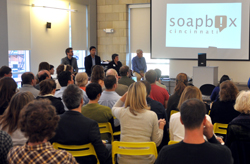
Soapbox offers ‘arts lessons’ Tues., Aug. 30

Mark your calendars the next Soapbox Speaker Series event, an engaging discussion about community arts centers as catalysts for creativity.  When: Tuesday, Aug. 30, 5:30-7:30 p.m.  Where: Niehoff Urban Studio

Madisonville, City councils raising concerns about ODOT plans for Eastern Corridor

One local community is coming together to oppose an upcoming transportation project in Cincinnati – and it's not the streetcar. The Eastern Corridor project, a highway expansion and community rail project led by the Ohio Department of Transportation, has raised the ire of Madisonville residents who object to the expansion of Red Bank Road to what ODOT terms "highway capacity," citing a negative impact on the neighborhood. "It's really quite dramatic what they are proposing," says Bill Collins, a board member with the Madisonville Community Council. "Essentially the end result will make these neighborhoods unattractive." Construction for Phase 1 of the project is slated to take place on an approximately 2.5 mile stretch on Red Bank Road from Interstate 71 to US 50. The project calls for the appropriation of large amounts of land along Red Bank Road, Collins says, including chunks of property belonging to the Children's Home of Cincinnati and the clinical research company Medpace. Collins says the plan is very outdated. "It was a plan that was put together with very little input from the communities around here," he says. "It was put together before a lot of development blossomed (on Red Bank Road). People stop at businesses when the speed limit is 35 miles per hour. How many will stop when the speed limit is 55?" Collins is also amazed that ODOT didn't contact businesses to consult with them about the land appropriation. A June meeting about the Eastern Corridor project was the first time that representatives of Medpace and the Children's Home of Cincinnati learned of their property being connected to the project, he says. "Neither organization had any recollection of being contacted by ODOT," Collins says. "The fact that (Ellen Katz, CEO of the Children's Home of Cincinnati) didn't know about it and was seeing the maps for the first time was shocking. That's an indication to us that the community input in 2006 was limited. ODOT didn't really do their due diligence in reaching out to the public."Representatives for ODOT, however, said they solicited resident input on the project as early as 2001."We've had numerous meetings and discussions with them (between 2001 and 2006)," says Andy Fluegemann, planning engineer for ODOT's District 8, which includes Hamilton County.A federal court decision upheld the plans for Phase 1 of the project in 2006, but the project stalled due to a lack of development funds, Fluegemann says.Funding was identified for the project in 2009, however, and a consultant was hired to collect data and update what information may have changed concerning the project, such as the new development along Red Bank Road, he saidIn the meantime, neighboring communities have joined Madisonville in its opposition to the project. The Hyde Park Neighborhood Council approved a resolution supporting a Madisonville resolution calling for no expansion to Red Bank Road and requesting more neighborhood input on the project. "I think they realize if the road (Red Bank) accommodates the quality development, it will possibly raise the demand for housing (in Hyde Park)," Collins says. "It's not just a Madisonville issue, but an east side issue." Cincinnati City Council has also joined the movement. It passed two resolutions June 21 calling for the Cincinnati Department of Transportation and Engineering to work with Madisonville in developing an alternative plan for Phase 1 and to change the name of the Red Bank Road Expressway to the Dunbar Expressway, paying homage to the historic Dunbar neighborhood. "We move that DOTE work with the residents and businesses of Madisonville to oppose the current Ohio Department of Transportation (ODOT) plan to turn Red Bank Expressway into a 55-mile-per-hour highway as part of the Eastern Corridor project," the council resolution reads. The City Council resolution also called for DOTE to include attractive landscaping and accommodate the needs of cyclists and pedestrians. Despite opposing the current plan, the Madisonville Community Council is not against the whole Eastern Corridor project, Collins says. The council just wants to see ODOT solicit more community input from Madisonville residents regarding Phase 1. "If this thing is done right, it has the potential to dramatically improve the east side of town for the next 30 to 40 years," he says. "If the project is going to be done, we want it to be done the right way before the bulldozers start doing their thing." Flugemann says ODOT planned to reengage the public, including residents of Madisonville, at a series of meetings this fall -- before Cincinnati City Council beat them to the punch by setting a meeting slated for Aug. 3 at the Madisonville Recreation Center at 5320 Stewart Road. The meeting is hosted by Cincinnati City Council's Livable Communities Committee.ODOT will "gather residents input and get their concerns on the table" through the Aug. 3 meeting, he said.By James Sprague

Dancers take aim at Cincinnati with an eye on youth

At one Cincinnat non-profit, leaders enthusiastically embrace better living through dance.Arts Innovation Movement, or aim:cincinnati is a Kennedy Heights dance company tgat took its first leap in 1997. In the years since, aim: Cincinnati has been educating and inspiring people form all walks of life through the diversity of dance.Aim:Cincinnati engages the community through dance productions -- from ballet to hip hop -- at local theatres, libraries and even a series of performances hosted at the Aronoff Center for the arts. The organization also sponsors a hip hop dance troupe called Kompany Krucial that regularly tours the nation and has also performed on BET Television."The idea is to get youth engaged in dance to help keep them off the streets," says Marvel Gentry Davis, producing artistic director. "Keep them healthy, moving and doing something positive."For more traditional dance enthusiasts, aim:Cincinnati hosted its 10th Anniversary Gala of International Dance Stars this month at the Aronoff Center. Dancers from 12 different dance companies from cities around the world, including New York City, Boston and Spain, performed."It's a fabulous show and the audience raves about it," Davis says. "Right there you get an opportunity to travel the world."In additional to producing dance performances, aim:Cincinnati also takes dance to the community through outreach dance classes at local schools and at their headquarters in Kennedy Heights. They've even coordinated dance classes for children in the psychiatric ward of Cincinnati Children's Hospital. "We're doing innovative things that are not your mother's ballet," Davis says. "Dance is one of the fine arts but I think that what we're doing makes it more attractive to a much larger audience."Do Good:• Go shopping. You'll find dancer-friendly note cards, elegant calendars along with jazz CDs at aim:Cincinnati's online store.• Be a PayPal. Make an online donation to support operating costs or to attend performances. • Volunteer.  Opportunities range from marketing, graphic design and web support to dance. By Ryan McLendonImage courtesy aim:Cincinnati

Madisonville gives urban farm project a tentative trial run

Steve Rock spoke to the Madisonville Community Council in mid-June about an update and a request. He and a team of volunteers plan to convert a derelict industrial building on Whetsel Avenue into an urban farm and education center, employing the latest technology to grow fresh meat and produce in the neighborhood.  But the response of the more than 50 people in attendance showed that innovation is not just about ideas and experiments; it's also about connecting with people and building community support."I think education is huge in this project," says Rock, an environmental engineer by trade who has taken on the urban farm project in his spare time, partly to see if some of its more unusual ideas will work. He spent part of the meeting - and much of the time afterward - explaining various aspects of the project: a system of vertical integration would grow both hydroponic vegetables and tilapia in the building (a former laundry) using waste from the fish to fertilize the plants. A classroom and community gardens would help area residents learn about agriculture and grow their own food. And a program to train at-risk youth would help staff the facility while improving the employment prospects for its participants. But questions also revolved around the building itself. Madisonville Community Council president Bob Igoe explained that the building, which has been vacant for years, is slated for demolition. "We've got to be confident Steve can make this thing work, or we're going to be stuck with [the building] for another year," Igoe says.Several Madisonville residents asked pointed questions about timelines and the likelihood of the project getting grant funding; Igoe pointed this out as an indication - the project's merits aside - that city residents wanted to see progress in their community."You have a room full of people who have had a handful of promises for decades," he says.At the end of the meeting, the community voted to place a three-month stay on the demolition. This gives Rock time to try to secure grant funding, showing the community the project can raise the $500,000 to $1 million he estimates it will take to launch. Volunteers have launched a website and have drafted handouts to help spread the word about the project, and Rock said he hopes to hear about grant funding prior to the community council's next meeting on the project, planned for September.By Matt Cunningham

Wasson Way bike path advocates hope to transform rail spur

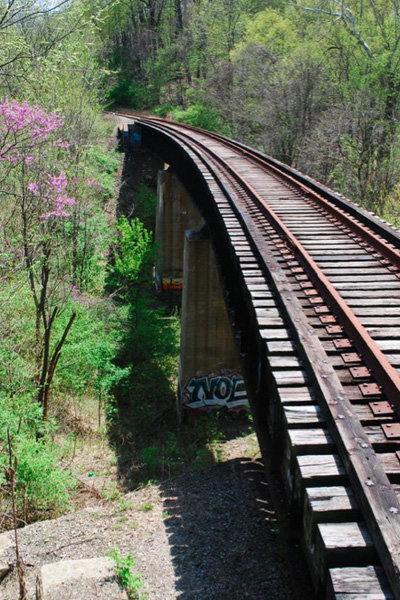
A group of residents from several Cincinnati neighborhoods spoke at the June 7 meeting of Cincinnati City Council's Quality of Life Subcommittee. Their subject? A recently closed railroad spur and a proposal to change it into a 6.5-mile cycling and walking path."This could really serve as an important connector for the many [multiuse path] projects Cincinnati has going on," said project advocate Jay Andress.The proposed project would convert a Norfolk Southern Railroad spur into a path that would connect with the Little Miami bike trail in Newtown and run into the heart of downtown. Advocates at Tuesday's meeting pointed out that the path would only cross seven roads in its entire length, making it a true rarity: a nearly uninterrupted trail running through several neighborhoods in a major urban area.But beyond the health benefits and transportation options that the path could provide, some residents at the meeting brought up another point: building the path could resolve a growing problem with the semi-abandoned line.Hyde Park Neighborhood Council President Anne Gerwin said the point where the line crosses Wasson Road has been a maintenance and safety issue for years. "We struggle many times each year to have the city and railroad maintain it," she said. The neighborhood's council passed a resolution supporting the project.Likewise, Hyde Park resident Lindsay Felder, who said her home is within sight of the track, said there's been a visible deterioration of it - and an uptick in people loitering along the weedy path - since it became inactive in 2009."We've always wondered about the tracks," she said, explaining that she began going door to door to drum up local support after meeting Andress and learning about the proposed project."We see it as a great upcycling of existing property that is underutilized," she said.Subcommittee chair Laure Quinlivan said there are a number of details to clarify before the project moves further forward, such as determining if Norfolk Southern has future plans for the line, and if an arrangement can be made that would allow the city to adapt the path into light rail if that becomes a future transit option."This is really a great proposal," she said. "The best ideas don't always come out of City Hall. If we could make this happen, it would be such a great asset to so many residents."Story: Matt CunninghamPhoto: Wasson Way Project

Our Partners

Taft Museum of Art
Warsaw Federal

Don't miss out!

Everything Cincinnati, in your inbox every week.

Close the CTA

Already a subscriber? Enter your email to hide this popup in the future.