Clifton / CUF

Resting on a hill overlooking the north side of Cincinnati, Clifton offers a wide range of experiences from a college atmosphere with the city's largest school, the University of Cincinnati, to an international center for cutting-edge medicine featuring University, Children's and Good Samaritan hospitals. Clifton's history has been preserved in historical buildings and homes — from modest to millionaire. Trendy shops and restaurants can be found on Ludlow Avenue in the Gaslight District, along with the Esquire Theatre, yoga studios, Clifton Market and a newly renovated branch of the Cincinnati Public Library. Even though Clifton is tightly compacted with large buildings and interesting architecture, green space does exist at Burnet Woods

S&J Bakery Cafe updates name, plans for Findlay Market

With a new business name, a liquor license and sole ownership of S&J Bakery Café in Findlay Market, Stefan Skirtz is about to get even more creative with his offerings. Which is saying something for a baker who already serves a blueberry pancake cupcake with maple buttercream icing and topped with a garnish of chocolate-dipped bacon. Mmmm, bacon. As his storefront nears its third anniversary at the Over-the-Rhine landmark this May, Skirtz remains dedicated to keeping things local and making a stop at his flourishing shop just one part of a varied market experience.  “The reason why I wanted to come to Findlay Market was to strengthen the Findlay Market experience,” says Skirtz, 44, who grew up in Clifton Heights. “I go out every Saturday and buy our produce for the week.” Skirtz, who opened the shop with a partner, reports that they spent 96 percent of the capital costs for the business within the 45202 zipcode. After making it through the first year in business, sales doubled in year two. He’s hopeful about the prospects for year three, during which he opened a second location—the S&J Café in the Main Library downtown. “The sales have been very strong,” Skirtz says. “It’s given us an opportunity to constantly adapt and adjust.” Adapting and adjusting comes naturally to the entrepreneur who started his working life far from a kitchen. He worked summers at Kings Island, then stayed with the park as its owners shifted from Kings Productions to Paramount and Viacom, where he produced live shows and planned events.  But the Cincinnati native, who once again lives in Clifton Heights, grew tired of constant travel. He decided to pursue his lifelong love of cooking at the Midwest Culinary Institute, where he could turn his hobby into a career. Skirtz’s theme park background makes him particularly sensitive to his customers’ feedback, which he has already incorporated into his business plans. For example, the dining room section of the Findlay store was intended for storage, but customers enjoyed having a place to sit and enjoy breakfast and lunch so he made the cheerful space permanent.   “People instantly started coming down and starting their Findlay Market experience with us,” Skirtz says. Regulars bring their own coffee mugs, cloth napkins and silverware. Some stop in for the same menu items every Saturday at 8 a.m. sharp; others make S&J a midway break during their trip; still others end their shopping with a leisurely lunch.  “It’s really about listening to your guests,” says Skirtz, who works with a wide range of market and local vendors, from Coffee Emporium (which created a special blend for S&J) to Bender and Eckerlin Meats for sandwich fillings. Feedback has also led Skirtz to sell his bread in demi-loaves—customers told him that whole loaves were too big for them to finish. He’s also expanding the shop’s weekday hours to 6 p.m. to accommodate a second baguette baking in the afternoon; baguette-lovers pushed for an option to stop by S&J on their way home from work to buy a warm loaf. Skirtz was also granted a liquor license this month as part of the newly formed Findlay Market Entertainment District, and is deciding how to incorporate it into his plans for rebranding, which will include a new menu, brunch, special programs and live entertainment. One thing is for certain: Skirtz will continue to see Findlay Market as a “destination attraction,” reminiscent of his theme park days. “My goal is that anybody who comes in my door and eats my food, I want them to go into the Market House and start shopping,” he says.  By Elissa Yancey Follow Elissa on Twitter

Cincy ReelAbilities film festival unifies inclusive community

ReelAbilities, which is the largest film festival in the country to showcase the artistic talents and life stories of people with disabilities, began in New York in 2007. But in 2011, Cincinnati became the first place to broaden the festival’s influence by making it a multi-city event, and for its second year running, ReelAbilities plans to increase its reach with a fervor that emphasizes the shared human experience.  Co-chaired by Living Arrangements for the Developmentally Disabled and Visionaries + Voices, the festival brings community members together to view award-winning films by and about people with disabilities, all while creating a dialogue and providing a platform for storytelling and educational panels that promote understanding and inclusion.  For local spokespersons April Kerley and Kathleen Sheil, the festival is important in that it aims to show people that the only real disabilities that all people have are those of misguided perceptions.  Kerley, a local Paralympian who swam in the 2008 Summer Games in Beijing and who is also featured in the film “Warrior Champions,” which will air during the festival, says the event is about inclusion. All people experience a technical disability at some point in time, “even if it is only a temporary one, such as a sprained ankle or recovery from surgery,” she says.  “It is not an ‘us versus them’ equation,” Kerley says. “We’re all in this together.”  Sheil, who receives services from LADD and who is working as an event planner for ReelAbilities Cincy has Down syndrome, but she says she doesn’t allow her disability to define her. “I take that disability, and I put it into ability,” she says.  Her attitude is a positive one, but Sheil says she knows all too well the horror stories of bullying that arise from a lack of understanding when it comes to people with disabilities. Sheil’s boyfriend, who has autism and wears glasses, was singled out during his high school years because of his disability, she says.  “They’d call him four-eyes and step on his glasses and break them,” Sheil says. “And that’s not what we do. That’s not the right thing to do. To me, it really doesn’t matter if you have a disability or not, and the reason why I say that is because everybody has a disability and everybody is different, and that’s okay.”  It’s these stories that ReelAbilities Cincy hopes to share, as inclusion and acceptance are topics that are vital and necessary, according to Shiel.  “I want people to hear how important it is to the people that have not just disabilities, but abilities, so that they can share their stories,” she says. “And so that way, they can be the people who shine, people who are stars and people who really know what’s going on in their world.”  ReelAbilities will take place at various locations throughout Cincinnati from March 9-16. Do Good:  • Attend a film showing to support ReelAbilities. • Like the ReelAbilities Cincy page on Facebook. • Spread the word to family and friends so that they, too, can participate in the ReelAbilties Film Festival.  By Brittany York Brittany York is a professor of English composition at the University of Cincinnati and a teacher at the Regional Institute of Torah and Secular Studies. She also edits the For Good section of SoapboxMedia. 

101 The Cookery aims to create community-based cooking school, bistro in OTR

A group of Cincinnatians are working to create a community-based cooking school and bistro in Over-the-Rhine. 101 The Cookery is an effort to teach basic cooking skills, help families feel more at ease in the kitchen and promote healthier eating. "We want people to learn the skills they need to create healthy food in their kitchens," says Ty Carr, an industrial design student at UC's DAAP, who is helping lead the project. "So many people rely on convenience and frozen foods." Carr was one of eight student entrepreneur finalists who pitched health and healthcare improvement ideas at the Innov8 for Health 2013 Challenge and Idea Expo. 101 The Cookery was launched as a concept last year, and is nearing the implementation phase, Carr says. He and his partners are continuing to pitch the idea to potential funders, community groups and business organizations. "We're in the process of trying to get the green light from different organizations in the city and raise money," Carr says. The Cookery project comes as the problem of "food deserts," or urban areas without convenient access to fresh foods or well-stocked grocery stores, has gotten more attention. Areas of OTR face some of those same challenges, but has one jewel in Findlay Market, the state's oldest continuously operated public market. Carr, originally from Cleveland and now living in Clifton, believes OTR is the perfect place for his concept. "I really didn't plan on staying here long-term, but something happened over the last two years," he says. "I started spending a lot of time in OTR, and people there have an intense sense of community. There is something about OTR—people love their food and their food history. It's the perfect venue for something like this." 101 The Cookery will likely contain for-profit and nonprofit elements, and there are also plans to release a "home cooking" cookbook soon. You can get more information about 101 The Cookery from its recently launched website. You can also stay connected through Facebook and Twitter. Written by Feoshia H. Davis Follow Feoshia on Twitter

Heads up to local artisans and small-batch manufacturers: CNCY MADE has your back

The core idea is to start making connections in the local community to assist people who might be making their own physical products.

URBtank brings aquaponics to warehouse on McMicken

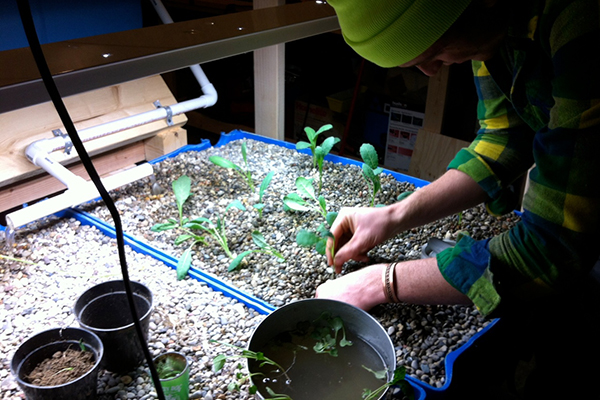
For URBtank, it’s all about the cycle. Kyle McGrath, 23, and Brad Ostendorf, 22, are the brains behind URBtank, an urban aquaponics system. The team, who both studied architecture at the University of Kentucky, worked on proposals and plans for the River Cities Project, which addresses ecological and economic conditions and tries to bring people back to the water. McGrath and Ostendorf couldn’t stop thinking about aquaponics all summer, and soon they found themselves building a system in Ostendorf’s garage in Cold Spring, Ky. Aquaponics uses fish to fertilize plants, typically of the edible kind and can function in any kind of climate, indoor or outdoor.  “Fish need nutrients, we feed the fish, they excrete waste, that fish waste can be turned into nitrates, which fertilize the plants themselves, so the plants then clean the water for the fish, and it gets returned back to the fish," says McGrath. "And it’s a close-loop cycle, so the water flows throughout the whole system." The pair is in the process of moving their system to a warehouse at 111 W. McMicken Ave. There, they have plans for massive expansion. “There thousands upon thousands of unused acres inside of old buildings, so why not tap into that?” Ostendorf says.  Space isn’t the only advantage. “There’s no interruption; it just keeps going. You take out the seasons, and you’re providing for the whole year." With no plans to stop, URBtank is currently growing microgreens, mizuna and watercress. Immediate plans include growing lettuce and other leafy greens. Both McGrath and Ostendorf are interested in fine dining, and they want to develop a community aspect to their business by allowing chefs to choose what they grow and hand-pick items for menus. “They have complete control over what they grow," says McGrath. "If they want Asian cress or mizuna or wasabi pea chutes, we can do that for them. For updates, follow URBtank on Twitter. By Gina Gaetano

Thinking outside the box: Home bakery turns Gail Yisreal into cake boss

Going on maternity leave changed Gail Yisreal’s life in more ways than having a new baby to take care of.   When she returned to work, Yisreal says she learned her position was no longer there, so she began to look for a different job. As wife and mother to a blended family of nine children, she might bake up to 11 birthday cakes in a year. But she hadn’t considered turning her knack for kneading dough into earning dough until she baked a wedding cake for a couple from her family’s place of worship. Not only did they like the cake, they suggested she start selling them.   Listening to her fans, Yisreal founded A “Mother’s Touch” Cakes with the nurturing tagline, “Making fresh homemade cakes when you don’t have the time.” Celebrating her two-year anniversary as a registered business in August 2012, A “Mother’s Touch” features signature and custom made flavors of fresh, savory gourmet, organic and vegan cakes and cupcakes that are good—and good for you.   “I didn’t know anything about decorating, so I took a class to learn more decorating skills," Yisreal says. "And I was shocked to find out that 95 percent of the cakes you buy are box cakes—because everybody wants the decoration. I started doing some research about the trans-fats and artificial ingredients, and I vowed that everything I baked would always be natural and from scratch.”     After working as a waitress for two years and in management at Starbucks for six years, Yisreal developed a love for coffee. She jokes that most ex-Starbucks managers feel they know enough about coffee to create their own line, which she actually did for A “Mother’s Touch.”   Having tried organic coffees with weak flavor profiles, she researched and found Dean’s Beans, a fair-trade pioneer that allowed her to design her own custom blends. Her signature A “Mother’s Touch” blend is made with Mexican and Indonesian beans and pairs with her carrot cake as an after-dinner coffee.   “I’m really proud of my coffee and the fact that it really was custom blended for what I wanted to complement my desserts,” Yisreal says. And, true to her mission to serve natural, sustainable goods, she says that her blends are 100 percent organic, fair-trade certified and are shade grown.   Being on the scene without a storefront hasn’t stopped Yisreal. Instead, she’s building her brand as the “cupcake lady” who networks everywhere and invites people to taste samples of her creations. Yisreal also tapped into hidden markets by hosting deals through social media.   “I did a Living Social promotion last year, which was huge,” Yisreal says. “That first day, I think I got 1,500 hits on my website, and probably about 85 deals, which I thought was really good for people who didn’t know who I was.”   And even though she sells more cakes today, the ease of transporting cupcakes built her clientele.   “When I first came out, because of my financial situation, literally, cupcakes were paying my rent,” she says. After she and her husband separated, she remembers what it was like to go from making an annual salary of $60,000 to less than $20,000 a year. But she doesn’t do it all alone.   “I have three almost-teenage girls; 12, soon to be 15 and 17, so they are my preppers,” Yisreal explains. “It’s hilarious because we’ll be in the kitchen and everybody has their big bonnets on, and they’re scraping carrots, mashing fruit, lining the liners. I have a girlfriend who I’ll sometimes sub-contract out to do deliveries. And if it’s a huge event—like for the Autism Foundation, I had to knock out 40 dozen cupcakes—I have two sisters, and at the time I had just split up with my husband so we were in literally an 800-square-foot apartment. The kitchen was all of maybe 150-square-feet, we put out six-foot tables and we were like an assembly line! It was hilarious, but we got it done. It was like an I Love Lucy episode!”   By Mildred Fallen  

Cool jobs in the city: Hanging with the Dead Sea Scrolls

While some actors and actresses wait tables between stints on stage, 24-year-old Brittany Barker talks the Dead Sea Scrolls with guests at the Cincinnati Museum Center, where she works as a Visitation Enhancement Specialist.

Video University of Cincinnati: If You Can Play

UC athletes Kyle Neyer and Emily Hayden found support and encouragement when they pitched the idea of a video in support of LGBT athletes. The result? "You Can Play."

Community opportunity through Carnegie’s Call to Artists

For nearly 40 years, The Carnegie has strengthened the Northern Kentucky community as a venue that displays, fosters and inspires creativity in both the visual and performing arts. One way it fulfills that mission is through its annual Call to Artists, which is now underway. Call to Artists provides a means for the nonprofit to expose the work of local and regional artists, as it selects enough pieces to fill its six galleries for the 2014 season with more than 30 solo and group shows.  Gallery director and curator Bill Seitz says he’s fine-tuned the process behind the Call to Artists by ensuring that the work chosen is based solely on artistic merit, as all of the artists are juried anonymously.  “Each artist is equal; it doesn’t matter," Seitz says. "I tell artists, ‘I don’t care if you’re in the Museum of Modern Art. The only way you’re getting a show here is because your work’s good.' I have friends who have never gotten a show here because they haven’t made the cut. Give me the best art and artists, and they’ll give me the best shows.”  Seitz says the fact that work is chosen anonymously is part of the beauty of the process. “I know in the world, you can get a lot of things on who you know, but here, I put everyone—especially the artists—on equal playing turf.”  When Seitz says he puts everyone on equal playing turf, he means it, because The Carnegie’s galleries are meant for everyone in the public to enjoy—not just art aficionados who seem to understand and connect with every piece they see. “I think a lot of people get intimidated coming to galleries because you have that elitism stereotype attached to it, and we try to break that down," Seitz says. "We try to make that personal. When you come in, you’re family. If you don’t like something, that’s okay.”  According to Seitz, It’s not expected or even fair to assume that one particular show will capture the attention of everyone. There are some pieces in the gallery that he says even he doesn’t like, and he wants the public to know that that’s okay and perfectly normal.  “You’ll run into somebody who’ll say, ‘Well, all he showed was contemporary artwork, and it’s not my thing,’" he says. "So I’ll say, ‘You didn’t see the glass show or the basket show or the craft show.' I do 30 to 40 shows a year. We try to put a little bit of everything in there. You cant like it all—because I don’t like it all—but you’re going to come and hopefully find something you like or find something that maybe enlightens you about something you didn’t know you like.”  There are all kinds of art, and variety is something the Call to Artists prides itself on finding. From photography, to art made from paper, food or even hair, the exhibitions don’t place value on one type of art over another, but instead encompass a wide array of work, from as many artists of differing abilities as is possible.  “You’ve got to put everything in perspective," Setiz says. "The biggest thing I tell people is I’m happy that you came, happy that you showed up, that you looked at art, that there was something there that you enjoyed that made you happy, that you looked at something and communicated with it." “That’s what art is—visual communication. It’s like sitting down with a book—that’s written communication. You can put on a CD or go to a movie or a theatrical performance—there are different art forms, but see the talent that’s basically in your own backyard. The fun part of it is that this is your own; they’re your own talent; these are people that live right in this area.”  Do Good: • Visit The Carnegie's current gallery exhibition "Pulp Art." • Submit your artwork for review with the Call to Artists. • Support The Carnegie by becoming a member. By Brittany York Brittany York is a professor of English composition at the University of Cincinnati and a teacher at the Regional Institute of Torah and Secular Studies. She also edits the For Good section of SoapboxMedia. 

Project Downtown focuses on interfaith effort to give back

Each Sunday, a group of volunteers, most college-aged, meet at the Clifton Mosque to make sandwiches, bag lunches and wrap pastries to pass out to individuals in downtown Cincinnati.  The volunteers make up an organization called Project Downtown, a nonprofit whose local chapter has been in existence since 2008, and whose ultimate goal is to eliminate poverty downtown.  Yousef Hussein, director of PD, says the goal is a lofty one, but he’s confident that it can be accomplished.  “It’s going to be difficult, but at the end of the day, I feel that if we set our mind to it, and people receive us properly, we can get the support and make a big impact in our community," he says.  The Cincinnati chapter of PD began with leadership from students in the University of Cincinnati’s Muslim Students’ Association who wanted to form an organization that got them more involved in the community and that reflected their mindset of wanting to take care of their neighbors.  Hussein says about 40 percent of PD Cincy’s near 140 members are either immigrants or first-generation Americans, and that it’s important to get them “more involved in the American fabric.”  “As a result of that, the children aren’t as exposed to what goes on in downtown Cincinnati or aren’t exposed to the poverty that’s so close to them,” says Hussein. “A lot of them live in the suburbs, and it’s just a great opportunity for them to see what goes on in downtown Cincinnati. I think that when you have that sort of compassion and care for the general community and the community understands that, you’re able to break down the religious barriers you see between Muslims.”  PD Cincy is not just a Muslim organization, however. It’s an interfaith group that aims to help others, and that’s what Hussein says he likes best. “You’ll see Catholics, Protestants and atheists, and it’s just beautiful to see them come together for one common purpose.”  PD Cincy currently distributes 70 bagged lunches, in addition to breads and pastries donated by Panera Bread’s Operation Dough-Nation program to individuals along Vine Street. One-third of those lunches, in addition to any leftover bread, are then left in a box outside of the downtown mosque in Over-the-Rhine for anyone hungry to grab.  “There’s a couple families that live nearby, and as we’re coming down, you can see them looking out the window so they can grab a couple for their kids,” Hussein says.  But according to Hussein, it’s more than food that residents of OTR need. “A lot of individuals have mental health problems; a lot of them are just lonely,” he says. “If you’re in a situation where you’re homeless, chances are you don’t have a support network; and as a result of that, people have things they need to get off their chest. We really like to sit down and figure out what the needs are in their community.”  So Hussein says PD Cincy plans to broaden its giving so that the organization provides more than just food. One way it plans to give back is through a hygiene drive, where volunteers will pass out kits filled with things like toothbrushes and lotion to help prevent people’s hands from cracking in the cold weather. The nonprofit is also planning a sock drive.  “It’s easy to find clothes, but socks are hard to find, and washrags—you wouldn’t think it, but if I had a washrag to offer someone, they’d take it,” says Hussein. “Little things like that make a big difference. We run on a shoestring budget, but if we’re able to do those things with a lot of thought behind it, it makes a huge difference.”  Do Good:  • Learn more about Project Downtown by visiting the organization's website.  • Volunteer by making sandwiches, packing lunches and distributing food on Sundays from 1:30 to 3:30 p.m. All are welcome, and those interested in helping should meet at 3668 Clifton Ave. Enter through the back basement door.  • Assist the organization by donating or contacting those involved if you're interested in forming a partnership.  By Brittany York Brittany York is a professor of English composition at the University of Cincinnati and a teacher at the Regional Institute of Torah and Secular Studies. She also edits the For Good section of SoapboxMedia. 

Our Partners

Taft Museum of Art

Common Ground Is Brewing

Support local stories and receive our signature roast straight to your door when you join at the Standard level (or above).

Drink Better, Read Local

Close the CTA

Don't miss out!

Everything Cincinnati, in your inbox every week.

Close the CTA

Already a subscriber? Enter your email to hide this popup in the future.