Clifton / CUF

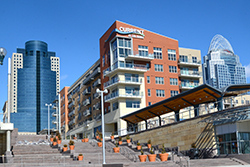
Resting on a hill overlooking the north side of Cincinnati, Clifton offers a wide range of experiences from a college atmosphere with the city's largest school, the University of Cincinnati, to an international center for cutting-edge medicine featuring University, Children's and Good Samaritan hospitals. Clifton's history has been preserved in historical buildings and homes — from modest to millionaire. Trendy shops and restaurants can be found on Ludlow Avenue in the Gaslight District, along with the Esquire Theatre, yoga studios, Clifton Market and a newly renovated branch of the Cincinnati Public Library. Even though Clifton is tightly compacted with large buildings and interesting architecture, green space does exist at Burnet Woods

Anchor districts emerge as powerful players in bid to shape new metropolis

In Cincinnati, Cleveland and East Baltimore, major employers are anchoring massive new developments in a full-on effort to remake their cities. Strong partnerships and shared visions are essential elements for success.

Library adds downloadable magazines to collection

Utilizing the Public Library of Cincinnati and Hamilton County’s resources just got easier. At the beginning of February, the library released its latest service: Zinio. It enables anyone with a library card to download free magazines as soon as they hit the newsstands.  “It’s really wonderful to be able to download magazines from the comfort of home,” says Sandy Bolek, Internet site coordinator for PLCHC. “We’re trying to meet the changing interests and needs of our customers, and there’s a tremendous interest in downloading everything out there.”  With more than 650 titles, users will now be able to download as many magazines at a time as they wish. Plus they never have to return them.  “I think there will be people who download maybe 20 magazines at a time, because how often can you walk into a library and have every single issue available for the taking that you can hang on to?” Bolek says. “So I expect that our interest and usage in magazines will go up significantly.”  In the past month alone, PLCHC users have downloaded 16,396 magazines through the new service. Magazines aren’t the only downloadable materials the library offers, however. Free e-books, audio books and even music are all available to patrons as well.  “You’re able to sit at home in your jammies at 11 at night and download music, e-books, an audio book or a magazine,” Bolek says. “We talk about being able to use the library any time, anywhere now, and I think people are increasingly expecting that in just about every service area.”  According to Bolek, the library is on track to reach one million downloaded items by October, which is a huge accomplishment in terms of achieving its mission of “connecting people with the world of ideas and information.”  “The nature of information has of course changed over the years and the decades," Bolek says. "Our collection has significantly expanded, but it’s still information. We’re supporting people’s reading interests, connecting them with books, connecting them with information, and the variety of ways we’ve been able to do that has really expanded.”  Do Good:  • Learn about Zinio, download the app for your smartphone or tablet and show your friends and family how to start downloading free magazines.  • Sign up for a free library card so you can take advantage of the many resources the library has to offer. • Promote literacy by joining a book club, reading to children or taking them to library events. By Brittany York Brittany York is a professor of English composition at the University of Cincinnati and a teacher at the Regional Institute of Torah and Secular Studies. She also edits the For Good section of SoapboxMedia. 

Video Tyler Witte, driven to the edge

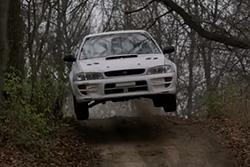
Cincinnatian Tyler Witte, 25, drives his car hard. UC Electronic Media alum Doug Horton captures Witte's passion on film. Video courtesy Doug Horton.

OTR Foundation preserves history, promotes community

From organizing events involving beer and historic churches to providing affordable housing and jobs to those who have struggled to attain them in the past, the Over-the-Rhine Foundation does a little bit of everything. And it's all for the purpose of reinventing and celebrating a diverse, historically-rooted community. At the beginning of February, Kevin Pape, who’s lived in Cincinnati his whole life and who grew up with a fondness for the OTR community, stepped up to the role of president of the foundation.  OTR has been a part of Pape’s family history for multiple generations, so he’s someone who understands what the community has to offer.  His grandparents lived in OTR and operated a business there until 1935, though it was actually started back in 1850. Pape lived in the community himself for about four years in the 1970s, and his office at Gray & Pape—a cultural resource management and historic preservation consulting firm—just celebrated 23 years at its Main Street location. Pape says because of his background, he deals with the renovation of historic buildings all the time, but his vision for OTR contains much more than the preservation of buildings. “I think my interest really is in community-building,” Pape says. “The message is that it’s really all about putting people back into historic buildings and finding ways to do that in a meaningful way.”  One way Pape and the OTRF plan to build on that vision is through their strategic plan, which entails owner-occupied redevelopment, historic preservation and the goal of making OTR the greenest historic neighborhood in the country.  “We also want to encourage people who are investing in the neighborhood to seek ways to provide meaningful employment and jobs for people that live in the neighborhood who may not have had access to opportunities before,” Pape says.  While working to show that “green buildings, sustainable buildings, LEED certification and historic preservation are actually compatible,” the OTRF also helps organize events like Bockfest, which Pape says showcases what’s good and great about the community. This year, the nonprofit, in conjunction with American Legacy Tours, is offering historic church tours, which will highlight the architecture and stories of four different 19th century landmarks within the community.  “When you think about the size of OTR and the number of churches, it gives you a good sense about the density of people and the diversity even at that time that would have such a population to support a variety of churches,” says Pape.    It’s that diversity that has withstood the test of time, and which Pape says the community embraces at all levels.   “Socioeconomic, racial, ethnic, you name it,” Pape says. “It provides residential density that allows people to share ideas and celebrate those differences in being able to all live in a compact place at one time. It’s about not only economic vitality, but residential vitality.”  Do Good:  • Attend Bockfest, and register for the Historic Churches of OTR Tour. • Support the Over-the-Rhine Foundation by becoming a member. • Volunteer to help the organization preserve and revitalize OTR. By Brittany York  Brittany York is a professor of English composition at the University of Cincinnati and a teacher at the Regional Institute of Torah and Secular Studies. She also edits the For Good section of SoapboxMedia.   
Taste of Belgium expanding, using SoMoLend to fund venture

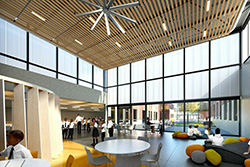
Jean-François Flechet opened Taste of Belgium in Findlay Market in 2007; four years ago, he expanded his restaurant venture to Columbus’s North Market, and a year and a half ago, he opened a full-service Belgian bistro on Vine. In the next few months, there will be two new Taste of Belgiums in the Cincinnati area—a full-service restaurant on Short Vine near UC, and a waffle counter at Friendly Market in Northern Kentucky.   The Short Vine location is on the first floor of a brand new building that includes 120 apartments. The waffle counter at Friendly Market is the only food vendor in the first phase of the market. It’s right on the edge of phase 2, which is ideal for future expansion, Flechet says.   Taste of Belgium on Short Vine will have a menu very similar to the one on Vine Street, says Flechet. But it will have more affordable options at dinnertime, such as chicken and waffles and bar food.   “There will be a bigger focus on the bar, with both Belgian and Belgian-style beer sourced from local breweries,” he says. Flechet wants to attract the college students who live around Short Vine, which is a different demographic than his customers at the bistro and Findlay Market.   Taste of Belgium is slated to open in early May at Friendly Market, and on Short Vine during the first week of July.   Flechet isn’t going the traditional route for financing his new business ventures. Instead, he’s working with local crowd-sourcing start-up SoMoLend to raise a portion of the funds for the restaurant. He wants to promote crowd-sourced funding as a viable alternative source of financing for small businesses.   “When I opened Taste of Belgium on Vine, it was hard to get financing,” says Flechet. He wasn’t able to obtain a loan from the bank, but the building’s landlord got one through 3CDC. In turn, the landlord charges high rent to recover the loan. The North Market location was financed by a loan from a small business lender who Flechet has been working with for four years.   SoMoLend connects small business owners who are in need of a loan with investors who are looking to make a return on their investments. The organization allows borrowers to get loans from customers, friends and family members. It allows lenders to make a difference on a more local level.   “SoMoLend has been promoted on a national level, but not much on a local level,” Flechet says. He’s trying to get the word out to his customers that he’s using SoMoLend and bring more users to the lending service.   The Taste of Belgium crowd-sourcing campaign launches March 11. If you want to contribute to the campaign and are a customer, friend or family member, sign up on SoMoLend’s website.   By Caitlin Koenig Follow Caitlin on Twitter

Budget cuts jeopardize Media Bridges, volunteers needed

Tom Bishop, president of Media Bridges, has worked to give the public a voice by providing access to media and channel space for years. But because of recent budget cuts and word from current members of Cincinnati City Council that the organization will not receive funds again, Media Bridges’ future is at stake.  Rooted in the Cincinnati area, Bishop grew up in Hamilton, attended college and spent time working for public radio, in addition to spending 17 years with Norwood Community Television prior to his time at Media Bridges, where he has been employed for the past nine years.  Bishop says he realized early on what good can be done with media.   “I think I’ve always had it in the back of my head that you should leave the world a better place than you found it, and the idea of doing that with media is a really cool combo,” he says.  Throughout his years at Media Bridges, Bishop led the nonprofit in providing free classes to the public on everything from studio and video production to editing and web design. The organization has also championed free summer camps for children so that they, too, can learn to be active participants in media by learning things like video skills, comic book design, animation and radio programming.  Throughout the next few months, however, the organization will be forced to implement class and membership fees, so the facilities and access to create public programming will no longer be completely free. But Bishop says the organization will ensure that those below the poverty line are not left behind.  “I’m sure we’re going to lose some people—and that’s really a shame,” Bishop says. “Cincinnati City Council has made the decision that their government access television station is much more important than the people actually having a voice in the community, and by making that decision, they’re telling the people to just go away, ‘I don’t want to hear from you.’”  Because of the cuts, Bishop says the organization is in dire need of volunteers to help teach classes and run the studio so the public can continue to have a voice. Though he’s optimistic that Media Bridges will still be around in 2014, he says he’s not sure what it will look like.  “Frankly, making up the amount of money we used to get via the cable franchise—put it this way—if we pulled it off, we’d be the only people to pull it off,” says Bishop. “When all funds have been cut, nobody has survived.”  For Bishop, the cuts are disappointing. He says it threatens the future of the “many small victories” the organization has achieved over the years.  “We have a program called Film Outside the Lines, where we work with people with developmental disabilities and turn them into film producers where they create their own films,” says Bishop. “The success of that is right there on their faces when they’re showing their films at screenings and entering them at film festivals and things like that.”  Without public access, Bishop says people are left behind to hear only the voices of “the pundits, politicians and sports heroes” who make up a small portion our population. Instead of receiving media, Bishop says it’s more important than ever that people also participate. “It doesn’t have to be about the almighty dollar—it can be used to make communities stronger," says Bishop. "Media can be used to build dialogue—to let people communicate. It’s not that there shouldn’t be media for profit, but that shouldn’t be the only kind of media there is. And slowly but surely, we’re entering a world where that will be the only kind of media.”  Do Good: • Volunteer with Media Bridges to help them shift gears to a volunteer-driven organization.  • Support Media Bridges by making a donation. • Learn about Media Bridges' classes, and register for one so that you can become an active partcipant in the media. By Brittany York Brittany York is a professor of English composition at the University of Cincinnati and a teacher at the Regional Institute of Torah and Secular Studies. She also edits the For Good section of SoapboxMedia.   

City Hall launches app as a community-organizing tool

The City of Cincinnati has taken out the back-and-forth that can occur when residents try to reach them to report issues in their neighborhoods. At the Neighborhood Summit on Feb. 16, Vice Mayor Roxanne Qualls announced that the Cincinnati City Hall mobile app is available to the public.   With the app, residents can look up trash, recycling and street sweeping days, and set reminders; locate and report problems by address; bookmark locations for quick reporting; and track the status of reports. City Hall mobile also has GPS, so users can report issues, even without an address. There’s even a searchable map with property owner information, which enables residents to see if a property is occupied or vacant.   A few years ago, residents had to use the Yellow Pages to look up the number for city departments to file complaints, says Kevin Wright, executive director of Walnut Hills Redevelopment Foundation. The city then implemented a hotline for all complaints, but residents never knew the status of their reports.   “It’s amazing how comprehensive the app is,” Wright says. “If you see a broken window, pothole, graffiti, hanging gutter or anything else that is physically wrong with your neighborhood, street or community, you can report it in an instant. It’s a great tool for neighborhood redevelopment.”   The app can also be used as a community-organizing tool, Wright says. For example, if there is a property owner who historically hasn’t taken care of his or her property, social media can help organize a community and target the property to enforce codes until the property is fixed, which is what neighborhood councils and organizations like WHRF do.   “We’re really putting power in the hands of the citizens of the neighborhoods,” he says.   As with most tech programs, the app has room to grow, too. In the future, it could be linked with Facebook or Twitter, so your friends and followers will know who reported problems and where they are.   Cincinnati residents can download the app in the Apple App Store or download it through Google Play.   By Caitlin Koenig Follow Caitlin on Twitter

UC students bring home gold at national Acara Challenge competition

Students from the University of Cincinnati and the Indian Institute of Technology developed Humble Commode, a sustainable sanitation solution that won gold in a national business challenge competition. Read the full story here.

Soapdish: Cincy Crit

Soapbox provocateur Casey Coston takes on architectural shortcomings of the city's latest developments and offers three words of actionable advice: Demand better, Cincinnati.

Reggae Run celebrates 20 years of success, moves to Eden Park

This October will mark the 20th anniversary of the Reggae Run, and with its longevity comes continued success and an increase in participants.  What started nearly 20 years ago as a small-scale project with the hope of getting 500 people to show up has turned into an event that has raised more than $1 million dollars over the years for local charities. It has also outgrown its longtime course at Ault Park. This October, participants will instead gather at Eden Park for a new course and the same after-party that locals have grown to love, as it draws as many as 7,000 people together to celebrate.  “It’s really amazing that the time has gone so quickly, but at the same time, it’s really neat to see how the event has grown and how it’s become part of Cincinnati,” says Doug Olberding, Reggae Run's organizer. “But we realized maybe seven or so years ago that not everybody that comes to the race knows why we do it.” Olberding, who is the late Maria Olberding’s brother, says it dawned on him a few years back that most of the people who run the race—oftentimes people who are in their 20s—were about 5 years old when his sister was slain while running near her home in Mt. Lookout.  “The older people know—you tell somebody who’s around my age, and they say, ‘Gosh, I remember that, it was a big deal,’” Olberding says. “But the younger people don’t know why we do it. We put it out there, but they don’t know the story, and we feel like it is our duty to make sure we keep the story alive and keep her memory alive through the race.”  So the Olberding family puts on an event that encompasses everything Maria cherished—running, reggae and nature. Whether it was through her optimistic and positive outlook on life or through her volunteer efforts with organizations like Stepping Stones and Children’s Hospital, Maria made sure to put her best foot forward. “She wasn’t a teacher or anything like that—it was just her natural altruism,” Olberding says. “She was a pretty giving person. She was a 20-something, typical girl out of college; she worked at the Beach Waterpark and had fun with her friends, but they found time to do things—volunteer work and stuff like that—so that was part of it, and I don’t know that I can say specifically where that came from. It was just the way she was.” At the Reggae Run, participants can either run or walk a 5K. After the race, everyone joins together for fellowship through food and music, which is provided by The Ark Band, a group that Maria grew up listening to.   Olberding says themes within reggae music that deal with “finding the good in things” speak volumes to who Maria was as a person.  Proceeds from the event benefit the local chapter of the Make-A-Wish Foundation, which formed in Cincinnati when the Olberdings sought the organization out as a recipient. The more than $1 million the event has raised for the organization is just one of the positives that has come as a result of the Reggae Run.  “Some people come up to us during the race, and they’re beside themselves, saying how much they enjoy it and what it means to them to come; we’ve even had people get engaged there," Olberding says. "It’s always this really good vibe, and I think it’s one of the reasons why it’s been around for 20 years." “It’s so easy to turn something into a negative, and if you do that, you just create more grief and more anger, and then it just never stops. I look at it and say, 'Just think of all the good that this event has done.’”  Do Good:  • Register for the Reggae Run by participating in the race or joining in the after-party.  • Share Maria Olberding's history by keeping her memory alive and encouraging others to participate in the Reggae Run. • Like and share Reggae Run's Facebook page. By Brittany York Brittany York is a professor of English composition at the University of Cincinnati and a teacher at the Regional Institute of Torah and Secular Studies. She also edits the For Good section of SoapboxMedia.   
Our Partners

Taft Museum of Art

Common Ground Is Brewing

Support local stories and receive our signature roast straight to your door when you join at the Standard level (or above).

Drink Better, Read Local

Close the CTA

Don't miss out!

Everything Cincinnati, in your inbox every week.

Close the CTA

Already a subscriber? Enter your email to hide this popup in the future.