
No Kings, no party lines: A different crowd takes shape in the Queen City
Speakers addressed the fragility of democracy and authoritarianism. Civic organizations recruited people for voter registration, mutual aid, nonviolent disruption, strikes, boycotts and other coordinated-action efforts.
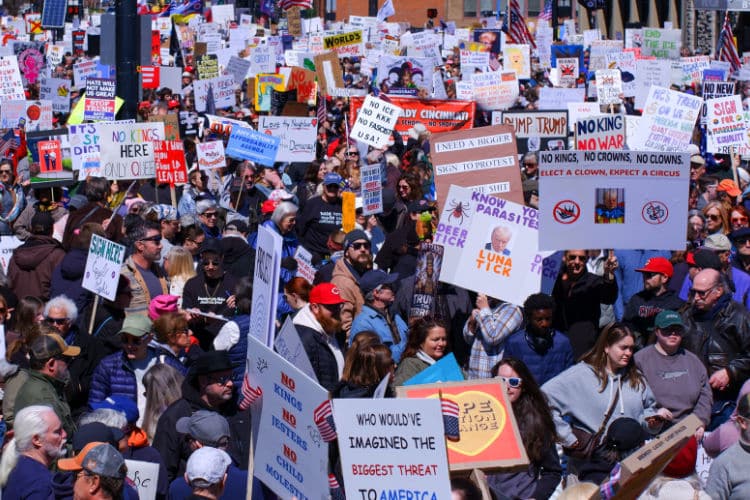
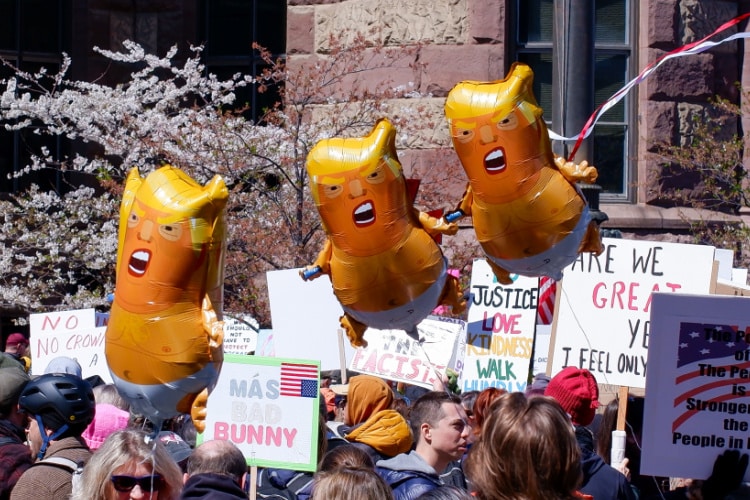
They came in layers, jackets and sweatshirts, scarves pulled tight against the edge of late winter, but the sun held. It cut across the river and bounced off handmade signs, off City Hall windows, off faces that looked less like outrage and more like recognition.
Something isn’t right. And enough people know it now that they’re willing to stand next to strangers and say it out loud.
And for a few hours in downtown Cincinnati, it was not about party. Democrats stood next to Republicans. People who had voted for the current administration stood next to those who had not. What brought them together was not agreement. It was a shared demand for accountability.
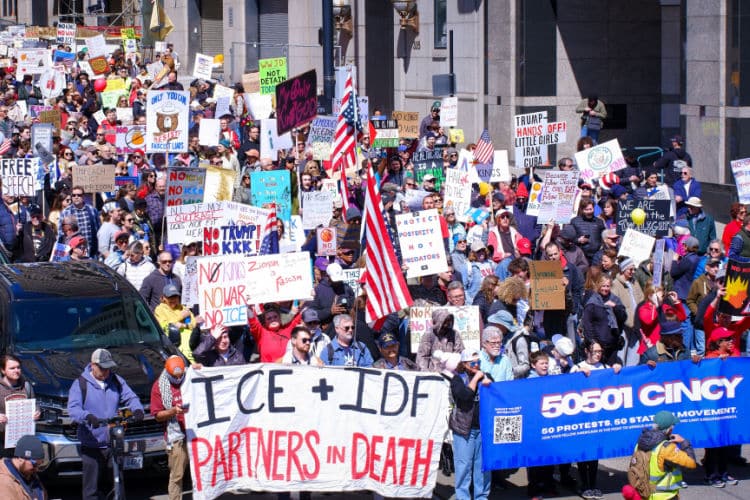
From 1 to 3 p.m., outside City Hall, the “No Kings” protest, organized by 50501 Cincinnati, drew a steady crowd on a bright, if slightly chilly, afternoon. The energy wasn’t frantic. It was focused. People weren’t just there to be seen. They were there to understand what comes next.
“It’s not about service. It’s about career, money, connections,” one attendee said (about the current president) shaking her head. No one around her rushed to push back.
There was a quiet kind of agreement running through the crowd. Not about policy. Not about party. About distance. Between people and power. Between expectation and reality. And there was something else, something that would have felt unthinkable to say this openly even a few years ago. Words like authoritarianism weren’t whispered. They were spoken plainly, from the stage and in the crowd, not as exaggeration but as a framework people were trying to understand in real time.
Alongside that language came something equally striking. Not just what people were against, but what they were being asked to do. How to support neighbors. How to prepare. How to respond if systems people once relied on stop functioning the way they should.
It did not feel theoretical. It felt like people adjusting to a reality they don’t fully recognize yet and trying to build something that can hold under it.
In the crowd, concerned citizen Joe spoke with us briefly. Joe had voted for the current administration. What brought him there was not one moment. It was the growing sense that what he thought he was voting for hadn’t materialized, especially when it came to the economy. We did not to use last names so people would speak freely.
Joe said he felt tricked. That what he expected and what he was seeing did not match, not just economically, but morally.
He wasn’t alone. Another man stood with him, there for the same reasons, drawn not by party alignment but by the same sense that something had shifted from what they had expected. Neither of them lingered on it. They did not need to.
Because what they represented was already visible in the crowd. Not just opposition but something shifting.
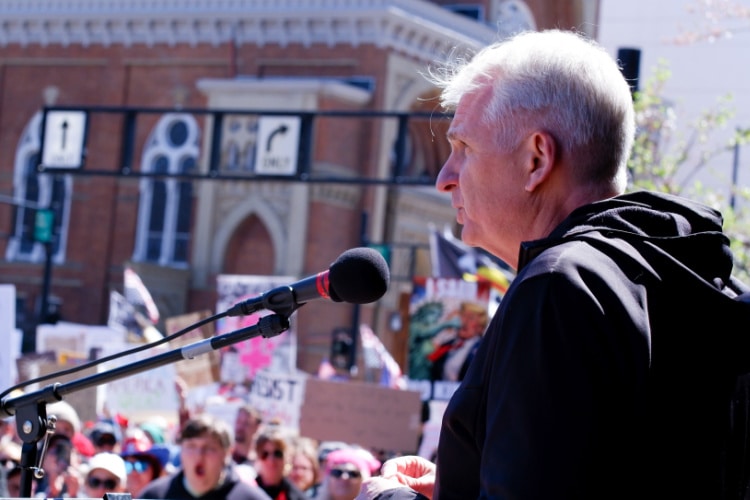
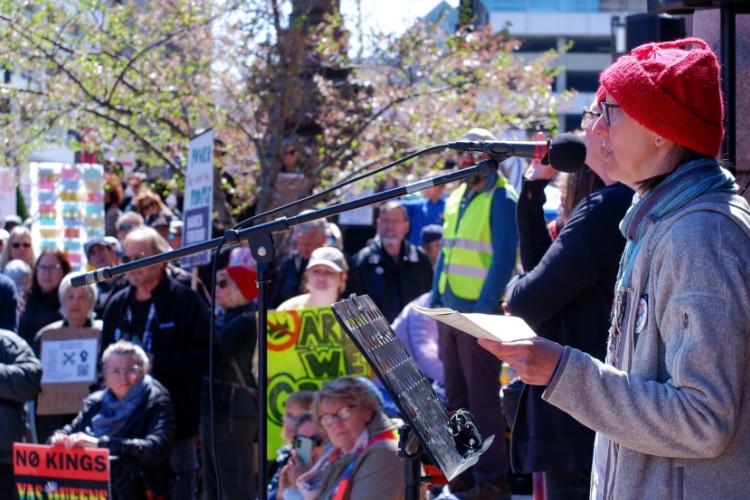
The speaker lineup reflected that range. Historian Timothy Snyder, whose work focuses on authoritarianism and the fragility of democracy, stood alongside labor leadership, including Brian Griffin of the Cincinnati AFL-CIO Labor Council, local organizers like Krysti Paul, activists including Jordan Engelke, and civic voices such as Claire Wagner of the League of Women Voters of the Cincinnati Area.
Different perspectives, but a shared through line. Participation has to extend beyond moments like this.
Organizers did not spend much time trying to convince people to care. That part had already landed. Instead, they focused on what engagement actually looks like when it continues, after the signs are lowered and the crowd thins out.
Along the perimeter, tables weren’t symbolic. They were operational. Local groups were signing people up on the spot for voter registration efforts, labor organizing conversations, and mutual aid networks already active across the region.
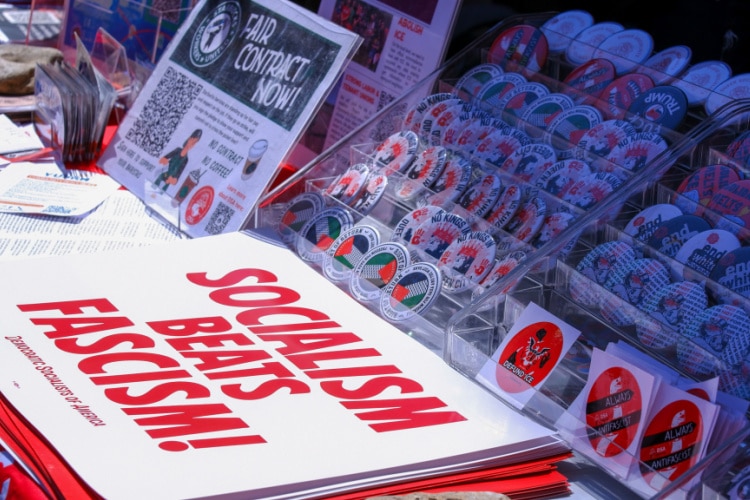
Speakers reinforced that direction. Protest, they said, is only one piece. Supporting communities directly through mutual aid is another. Sustained, nonviolent disruption, strikes, boycotts and coordinated action was framed as a third path.
Specific next steps followed. A May Day action, described by organizers as a day of strikes, walkouts, and coordinated economic disruption, was already being organized. Local trainings scheduled. Opportunities to plug into workplace and neighborhood efforts that extend beyond a single afternoon.
The emphasis wasn’t just on showing up. It was on staying, and on knowing where to go next.
At the same time, civic participation remained part of the conversation. Speakers from the League of Women Voters pointed to turnout gaps in local elections, where participation can fall into the single digits. In some recent Hamilton County primaries, turnout has hovered around 9 percent, a number that continues to shape outcomes in ways many people don’t see until much later.
Voting wasn’t framed as a fix-all. It was framed as one of the few tools that consistently produces measurable change, if people use it. That balance, working within systems while also building outside of them, ran through the afternoon.
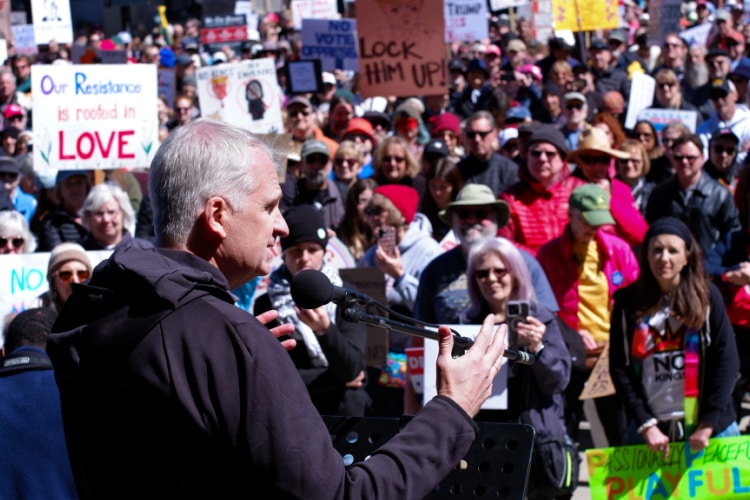
Snyder gave that tension language. Saying “No Kings,” he told the crowd, defines what people are resisting. It does not define what they are building.
That requires imagination. It requires coalition. It requires people willing to stand next to others they may not fully agree with, like the ones already standing shoulder to shoulder here, because fragmentation leaves space for power to consolidate.
He did not frame it as a return. “There is no going back,” said Snyder. Only forward. That idea didn’t spark a moment. It settled in.

As the group began to move toward the river, chants rising and folding into each other, the energy didn’t spike so much as steady. People fell into step, some loud, some quiet, all moving in the same direction for at least a stretch of time.
“This is what democracy looks like,” voices carried. It’s a familiar line. One that risks losing meaning through repetition.
But standing there, it did not feel like performance. It felt like something widening. Not just who is speaking, but who is starting to question, and who is willing to stand there anyway.
And that shift, quietly unfolding, is harder to ignore.
Author

Related Articles
Madisonville’s renewal has been decades in the making
A long-term effort to revive Madisonville’s business district is taking shape through community planning, new development and local entrepreneurs investing in the neighborhood’s future.
New bronze sculpture in Eden Park will honor Women Veterans who served our country
The artist will reveal the monument design this coming Veteran’s Day with an installation planned for June 2027.
Restoring Sedamsville one historic home at a time
An $8.4 million investment is bringing homeownership and a renewed sense of possibility to one of Cincinnati’s smallest neighborhoods.