
Health + Wellness

Special Report: Emanuel’s transformation

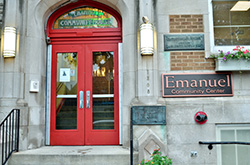
Emanuel Community Center has entered into an agreement to sell its historic Over-the-Rhine building and operate an urban squash program to teach children the racquet sport more commonly associated with Ivy League universities than inner city neighborhoods.  Emanuel, which has struggled financially for the past several years, will sell the 141-year-old building at 1308 Race Street to Grandin Properties, a Hyde-Park based real estate management company, says Emanuel Board Chairman Russ Naber. Grandin plans to convert the building into office space targeted at budding entrepreneurs to grow the area’s burgeoning startup community, says President and CEO Peg Wyant. The agreement comes just weeks after Emanuel abruptly shut its doors, let its staff go, dismantled its daycare and early learning center and notified its handful of tenants they had to relocate. The move shocked many as the board said it was reviewing several options, which included evaluating if Emanuel would continue to exist. The purchase price was not disclosed; however Wyant estimated the total cost—including renovations—will be near $4 million. Neither Naber nor Wyant would disclose how much will be paid to Emanuel. Naber says the deal will allow Emanuel to resolve its debt and become financially stable. The nonprofit listed liabilities totaling nearly $600,000 in 2010—including a $150,000 personal loan made by Naber, according to Emanuel’s tax return. Naber said the nonprofit had not yet paid back that loan. More recent tax returns were not available. But the agreement does call for Emanuel to lease back—at $1 a year—8,000-square-feet for the next 25 years, a value estimated at about $2.5 million. The 37,672-square-foot building and equipment were valued at nearly $2.6 million in 2010, according to the tax return. Plans call for Emanuel to convert the building’s existing gym into squash courts and to fund the racquet program, Wyant says, adding that she is hopeful that “Emanuel’s attractive donor list will be positively influenced by this’’ and those donors will help to fund the gym’s conversion to squash courts. Wyant approached Emanuel in August when she says she heard they were looking at possibly selling the building. Naber calls that meeting serendipity. “What they brought to us was unique. It was truly distinct,’’ he says. “It is what is best for Emanuel and the community.” Naber says details of the agreement need to be worked out, but adds that the Grandin plan meets the nonprofit’s three criteria. “It allows us to continue as a nonprofit, it lets us stay in our current location, which is very emotional for us, and it puts us in a stronger financial place,’’ he says. “Financial stability was key to us.” In addition to the office spaces, which Wyant says she foresees serving as a “hub of entrepreneurial activity,” she hopes to add a restaurant and rooftop gardens, including some that could be used as teaching gardens. The renovation timetable has yet to be finalized, but she says she hopes the work can be completed in six to 12 months, with the squash program up and running in 12 to 18 months. Wyant says several companies have expressed interest in potential office space and at least two have visited the building. “The Brandery and Cintrifuse are interested,’’ she says. The business and innovation incubators on nearby Vine Street will likely need more space to house startup companies they launch in the future. Many want to remain in Over-the-Rhine, she says.    Wyant founded Grandin Properties nearly 25 years ago with a keen eye toward historic preservation and says she has been interested in Over-The-Rhine for nearly 20 years. She says she has been looking for the right building to develop as well as the right opportunity to combine her family’s love of squash with their commitment to giving back to the community. The squash program Emanuel will operate will be modeled after urban programs endorsed by the National Urban Squash and Education Association, co-founded by Wyant’s son, Tim, in 2005. The organization operates 12 programs in 11 cities, including CitySquash in the Bronx and METROsquash in Chicago.  Wyant’s other three adult children are heavily involved in the sport as is her husband, Jack Wyant, who is founder and managing director of Blue Chip Venture Co. Daughter Missy Wyant Smit is on the board of directors of SquashDrive. Jack Wyant is head coach of the University of Pennsylvania’s men’s and women’s squash teams. He has also coached the United States Junior Women’s World Championship teams and competed on the professional Squash Association. The youngest sibling, Chris Wyant, is an avid squash player but is not as invovlved in the game, said brother Tim Wyant.  “We have watched these youth squash programs for years and we know they work,’’ Peg Wyant says. “Not all of these programs work for kids, but these do. We’ve witnessed it. We wanted to bring this to Cincinnati. “Jack and I are committed to Cincinnati and squash—and this program—is something we know about,’’ she adds. “Squash is the hook, but education is really the goal.” Tim Wyant says he has worked with his mother for at least 12 years looking for the right builidng in the right neighborhood to house a nonprofit squash program, which combines academic, athletic and community service for students starting in the third grade. Wyant, who operates the Bronx program and lives in New York, visited Emanuel first in August and again when he was back for the Thanksgiving holiday.  "It's an amazing building,'' he says. "This is really an ideal situation.'' Wyant, who speaks passionately about the program, readily admits that some may see the game as elitist. That is not a bad thing, he adds. "What this does is introduce students to a community very different than their own,'' he says. "Squash is a culture that values education. And the ultimate goal is to have these students go on to college and end the cycle of poverty for themselves and their families." He estimates the programs have collectively sent between 300 and 400 students not only to college, but to very good universities, including Harvard, Cornell, Wesleyan and Amherst. Most students were awarded scholarships. "This is really an inch wide and a mile deep program. We really want to transform the lives of the kids,'' says Wyant, who adds many students are involved a minimum of three times a week and many participate five to six days a week in both the sport and educational programs.  Wyant said he was unsure the cost of coverting the gym into squash courts, but estimated first year operating costs to be between $150,000 to $200,000. In later years, operating costs could reach between $500,000 to $750,000.   "We and the Emanual board have a lot of work to get done on how this will all get done,'' he says. Peg Wyant and Naber both say that another residual outcome of putting the squash program inside an office building with young, talented, smart, engaged and educated entrepreneurs is that they will serve as mentors and role models to the kids in the program. Naber says he hopes the program will serve 70 to 100 children a year and they hope to work with area schools and other programs. Jean St. John, founder and operator of My Nose Turns Red, the youth circus nonprofit that was housed at the Emanuel Community Center, says she is continuing to search for a new space to call home. “We are very sad about the change," St. John says. "There are many successful youth circus programs around the country with a similar focus and I wish they had approached us to explore expansion." They moved to Emanuel as a startup company and she said she expected their rent to grow as it had in the past from $150 per month to $250 per month. “I think they had the right idea under their noses all along and sorry that they never worked with the companies that were already there,’’ she says. Kelly Leon, who used the Emanuel gym for her OTR Jazzercise classes for the past four years, is also looking for a new space that will let people of all income levels work out together. “There were so many bonds created there,’’ says Leon. “It was a very special group.” Naber says the options facing Emanuel were dire. “These are never easy choices. But at some point we had to put our business hats on. We were draining money and we had to do something to fix it.” The building is not Emanuel, he says. It is what the nonprofit has done and will continue to do in the future that is its reason for being. “To me, this is a good thing for the city," he says. "You have to step away and assess it. In the end it will help the children and youth reach their potential and be a success in life. That is what we are all really passionate about. This sustains that.” Do Good ·        Contact my Nose Turns Red nonprofit teaching circus if you know of a suitable space where they might relocate. ·        OTR Jazzercise is also looking for a gym or workout area in or around Over-the-Rhine.  Drop them a message on their Facebook account. ·        Track ongoing developments on Emanuel Community Center’s web site. ·        Contribute to the National Urban Squash Education Association. By Chris Graves Chris Graves is the assistant vice president of digital and social media at the Powers Agency.

Latest in Health + Wellness
For Good Special: Emanuel’s transformation

This week, we bring you a special, in-depth look at the recent sale of the Emanuel Center in Over-the-Rhine, a nonprofit organization that we've covered before in Soapbox.

Cities where startups are thriving

It's not exactly the tech-savvy California coast, but Cincinnati is starting to make a name for itself in entrepreneurial circles. The city has made a major turnaround in recent years. Read the full story here.

Madisonville to reveal its Quality of Life Plan

Next Tuesday, Madisonville’s community council will share its Quality of Life Plan with funders, government officials, businesses, nonprofits and surrounding communities. For the past year, Madisonville has been involved in an intensive, community-driven planning process.   It’s the first time in Cincinnati that a citizen-driven, community plan of this type has been developed, although it has been used in 109 communities across the country.   Not only does Madisonville have a strong history—its future looks bright. The neighborhood on the east side of Cincinnati is more than 200 years old. It was established in 1809 and originally called “Madison” after the newly elected fourth President of the United States, James Madison.   Madisonville’s first permanent settler was Joseph Ward and his family. In 1797, they built a log cabin along an Indian trail that is near what are now Whetsel and Monning avenues. About 30 years later, a post office was established and the neighborhood’s name was changed to Madisonville to avoid duplication with Madison, Ohio. It was annexed by the City of Cincinnati in 1911. Today, about 9,000 people live in the neighborhood.   But in the 1970s, about 17,000 people lived in Madisonville. Flight from urban areas in the '70s has yet to be reversed, but there are more residents considering city life.   “Madisonville would be a great place to live because of its closeness to downtown,” says Sara Sheets, a Madisonville resident of nine years and the project manager for the Quality-of-Life Planning Process on behalf of the Madisonville Community Urban Redevelopment Corporation. Residents can jump on Columbia Parkway or I-71 to get to work and events downtown.   Many of Madisonville’s residents moved to the area because they wanted to be part of a racially and economically diverse community. “I wanted to live in a diverse community with a potential for the future,” says Sheets.   The residents of Madisonville really care about the neighborhood and want to see it grow. Last year, Madisonville began the intense process of organizing the community in order to develop a vision for the neighborhood. Six working groups were formed to focus on economic development, health and wellness, arts and culture, education and youth, built environment and community engagement. The groups met six times over the summer to form a specific plan. The Quality of Life Plan will likely take about 10 years to implement, but it’s a roadmap for what the community wants to see happen in the neighborhood, Sheets says.   The Quality of Life Plan focuses on broader change, particularly on the opportunities and quality of life for children and seniors in Madisonville, according to Bob Igoe, who has lived in Madisonville for 12 years and been the community council president for three. A large portion of the Plan is focused on education, from kindergarten on up. For example, the Children’s Home of Cincinnati has made a long-term commitment for the kindergarten-ready program in Madisonville. The program focuses on children ages 0-3 and helps prepare them for kindergarten, both educationally and socially. Not only are there long-term goals for Madisonville, but there are short-term goals, too. One of these is jump-starting the growth of the business district, Igoe says.   Currently, there are about two blocks of vacant property at Madison and Whetsel, in the heart of the neighborhood’s business district. Madisonville residents will ultimately get to decide what will fill those vacant spaces. “We want to develop a mixed-use neighborhood where walking and biking to restaurants, shops and services is easy,” Sheets says. Many residents go outside of the neighborhood to grab a cup of coffee.     Residents also want to add new apartments, condos and houses to the town. Most of the new housing will likely be around the business district to enhance the community's walkability.   The meeting is to begin Nov. 27 at 5:30 pm at John P. Parker School, 5051 Anderson Place, Cincinnati.   By Caitlin Koenig Follow Caitlin on Twitter

Starfire aims to remove disability conversation

Like many 25-year-old men, Michael Makin loves comedy, beer and hanging out with friends at the bar.  And like many of his peers, he has spent this fall beginning to plan a capstone project necessary for his post-secondary graduation. Makin’s project is a local beer-tasting festival set for early summer where a specially brewed beer will be unveiled in his name.  “Michael is great--his personality is infectious--the guy is a riot,’’ says Gabe Saba, also a 25-year-old guy who has been known to drink a few beers and who is working with Makin on the project. “We have so many things in common. I see traits of him in me.” Folks like Saba talk about Makin’s project, his personality and his passion for beer, but the fact that Makin has Down’s Syndrome never really enters the conversation.  That’s exactly the mission of Starfire. The Oakley-based nonprofit, which works to build inclusive communities for people with disabilities and their families, has been connecting people based on their interests and passions for years. Instead of segregating those with disabilities into groups, Starfire intentionally works to introduce them with others of like interests and passions, such as connecting Saba with Makin. “We want you to see the gifts they bring to the table before you see the disability,’’ says Lauren Amos, Starfire’s development director. “It’s not always easy, but it is so worth it.” Makin is a fourth-year participant of Starfire U, which is designed for young people with disabilities to continue their social and personal development beyond high school. The four-day a week program, which runs from 9 a.m. to 3 p.m. daily, is funded by Hamilton County Developmental Disabilities Services. There is a five to one teacher-student ratio as students learn about safety, budgeting, nutrition and social etiquette.  “We work one person at a time with person-centered planning,” Amos says. Last year, 18 students graduated from Starfire U. This year, Makin is one of about 100 students in the four-year program. Graduates also participate in a fifth year as a follow-up, Amos says. Community participation is key and integrated into all seminars. Enter Makin and Saba and a group of other community members, including the men behind the not-yet-launched Madtree Brewery. Saba is referred to as Makin’s connector and the two meet weekly for about three hours. At first, they devised the project and now they are meeting to further plan and coordinate the event.  All the while Makin, and Saba, too, are meeting new folks who will work with them on the project and hopefully will become resources for Makin in the future. Lana Makin, Michael’s mom, can’t say enough good about Starfire and the changes she has seen in her son.  “He is so much better socially; he is more independent,’’ she says. “I have seen a lot of maturity come out of this. It’s wonderful to see him with people who share his interests. He doesn’t need mom or dad to take him to the bar or out to karaoke.” Makin has not been the only one helped. “It does a lot for me, too,” Saba says. “I’m getting to know people, and it expands my network as well. There is no downside to this when you look at it." Saba adds: "I really admire the work they are doing. It is amazing.” Do Good • Buy a unique piece of art at Starfire’s fifth annual ArtAbility fundraiser on Dec. 7. Tickets are $100 each with a $25 credit going to an art purchase.  • Donate to Starfire. • Share your talent or passion and volunteer your time.  • Check out photos of the capstone project planning and like them on Facebook. By Chris GravesChris Graves is assistant vice president of digital and social media at Powers Agency

Faces Without Places founder wants to see homeless program expand

Karen Fessler has a message she wants you to hear loud and clear: Faces Without Places is alive, well and kicking.  For years, the nonprofit, grassroots organization that has provided nearly $1.5 million in educational support for homeless children in Greater Cincinnati was affiliated with the Cincinnati Public Schools. But about two years ago--and for a variety of reasons--the organization split with the school system, says Fessler, who is a board member and a founding member of the 17-year-old group.   But its mission remains intact, says Fessler.  “The most important part of the program is that we get kids out of shelters, we get kids off the streets and we show them that education is a way to experience a larger world,’’ says Fessler. “We want to broaden our reach. We want to broaden our horizons.”  Fessler declines to discuss what led to the parting of ways, but adds the founders of the program all left their jobs at CPS as well.   “But none of us lost our passion for the kids and the mission of Faces Without Places,’’ she adds. “I want people to know that we are here, and we are committed to providing services. We are toughing it out through thick and thin--for the kids.”  The nonprofit helps about 3,000 school children annually in Greater Cincinnati. Last year, the group provided 7,702 services to 3,013 children, according to its website. Those services included providing taxi services to school for 112 students, uniform vouchers for 777 students, backpacks and supplies for more than 839 students and Payless gift cards for 320 students so they could get a new pair of shoes, a luxury for many, Fessler says.  The nonprofit is best known for its Yellow Bus Summer Camp, which completed its 15th year this past summer. Last year, 152 children attended the eight-week camp that focuses on reading and day trips.  Earlier this month, the group’s biggest fundraiser--the Yellow Bus Ball--raised more than $23,000, most of which will go to fund the camp.   “The ball is critical because we have to have money to pay teachers and buy supplies,’’ Fessler says. “We can get grant money for field trips, but the fundraiser really helps us be able to put on the camp to the degree we have always done it.”  Fessler has worked with thousands of homeless children over the years, and she readily admits she is biased toward teens.   “A lot of people don’t realize this, but these kids are completely out on their own; they are either staying at friends' or living eight, nine, 10 kids piled up in an apartment,’’ she says. “They are squatting and some are living on the streets trying to negotiate life … they are all living life on the edge. I am most impressed by their sheer tenacity and their desire to find a better life.” Do Good:  • Register for the Mt. Adams Yellow Bus Pub Crawl on Saturday, Nov. 17.  • Attend the 5th annual Chili Taste Off on Dec. 9 at Northside Tavern.  • Contribute to Faces Without Places' wishlist of school and personal hygiene supplies.  • Sign up for the monthly email newsletter.  • Give back while you shop.  By Chris GravesChris Graves is the assistant vice president of digital and social media at Powers Agency

Rabe finds ‘Core’ restores muscles, faith

After suffering from a serious accident that required the will of a determined athlete to overcome, Cydney Rabe of Over-the-Rhine resident opened Core, an exercise studio specializing in Pilates this September. Three years ago, while walking across a street in Chicago, Rabe was hit by a car. “[Doctors] told me, ‘You’ll never be able to lift your arm above your waist, you can’t ever lift anything more than five pounds, you’ll have no range in motion’,” Rabe says.   But Rabe wasn’t ready to accept what to others seemed inevitable. After the accident, she used Pilates to completely rehabilitate her shoulder, which she claims made her stronger than before and gave her nearly full range of motion. Following the accident, Rabe decided to move from Chicago back to Over-the-Rhine — where her family has lived for 12 years — to open Core. “I’ve seen such a cool change happening in the neighborhood from when we first moved into it.” Rabe says. “It’s fun to be a part of it and add my own passion into the neighborhood.” The studio uses Pilates equipment that puts the user in a standing position, challenging people’s body awareness in ways they aren’t used to. Each equipment class has four or fewer people, so although people pay for a group class, they still get one-on-one attention from the instructor. “When it’s only four people, it really allows for correction and to develop form, which are so important in a Pilates practice,” Rabe says. “It allows you to get the most out of the workout.” Rabe also attributes small class sizes to keeping people more accountable for showing up and staying on their routines. “You’re coming in and working out and seeing familiar faces, so you start developing relationships beyond just going to the gym,” Rabe says. “People are now looking for you in a class, like, ‘Oh, so-and-so is not here today.’ ” Currently, Core offers classes in Pilates, TRX, Zumba and ballet barre, and will likely add yoga in the future. “I wanted it to be a one-stop shop for people to come in, get their workout on and do a mixture of classes,” Rabe says. Chermaya Woodson, who has been going to Core since it opened, says Rabe is the most passionate Pilates teacher she has worked with. “[Rabe] makes it a point to not only ensure that I'm getting a good workout in — which I always do — but to ensure that I am actually learning about the muscles I'm working and what they do for me on a daily basis.” Core’s operational hours vary — depending on classes — and it is located at 1423 Vine St., in the Gateway District across the street from Kroger. Check out Core’s Facebook page here. By Kyle Stone

Grant lets Kentucky school children learn about fruits, veggies

What happens when a nurse and librarian get together in a rural Campbell County school where many students lack access to fresh fruit and vegetables?  An integrated education plan that enables kids to read about fruits and vegetables, plant their own gardens as well as mathematically graph the likelihood that their food will grow.  The Silver Grove Independent Schools was awarded a $400 Learning Links grant from the Greater Cincinnati Foundation this fall to buy more than 40 books on the topic of fruits and vegetables. The grant was among $97,000 the foundation awarded to 109 schools in the Greater Cincinnati and Northern Kentucky area this year. The grants, of up to $1,000 each, are for creative and interesting programs or events in classrooms.   The books at Silver Grove are aimed at all learning levels and include cookbooks and resource books, says Julie Kaeff, the school’s family resources and Youth Service Center director.   “We have a high rate of free and reduced lunch kids  - about 86 percent – and we discovered that many have very little exposure to fresh fruits and vegetables, beyond bananas and apples,’’ she says. “We hope that through teaching them there are other options, that when given the opportunity, they will make wiser choices.”  The previous school nurse and librarian – who continues to volunteer at the school – came up with the idea last year amid concerns about childhood obesity, Kaeff says. Through conversations with the kids, the nurse realized that many of the students lacked access to fresh fruits. They also lacked knowledge about where their food comes from. The duo crafted the plan that also included applying for federal funding from the Fresh Fruit and Vegetable Program to provide fresh snacks three days a week.   And while they did not win the federal funding, several teachers are bringing in various fruits and vegetables to introduce students to various foods, including raspberries, squash, pumpkins and zucchini.   “There are a lot of students who think it’s all just chicken nuggets, hot dogs and hamburgers," Kaeff says. "They think all fruits and vegetables are disgusting. We are trying to change that.”  Kaeff says teachers and students will take their in-classroom learning outside to a newly constructed greenhouse, which was donated by La Farge North America, a construction company based in Silver Grove. Last spring, some students started tomato plants from seeds and grew the plants in the greenhouse and then took them home over summer break.  “We hope to plant various different things in the spring,’’ she says.   Kaeff said the books are just the beginning. She said she hopes that parents or grandparents might even check them out to learn about fresher options and more diversified menu planning. She also hopes the school can offer some workshops for adults, including showing how to eat healthy on a budget.    “Maybe, just maybe, this will open the door,’’ Kaeff says. “Maybe the kids will say: ‘Hey Mom, hey Dad, can we have this?”  Do Good  · View the complete list of Learning Link recipients (pdf).  · Give to the Silver Grove canned food drive.  · View the school’s photo gallery and video gallery.  · To learn more about the program, email Kaeff. By Chris Graves Chris Graves is the assistant vice president of digital and social media at the Powers Agency. 
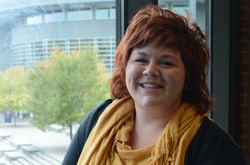
‘That Cortnie girl’ adds voice to feminist perspectives

Cortnie Owens wants to make a difference. Whether she's in a class at UC, working on social media for the Women's Center on campus or writing on her own blog, the young feminist preaches the power of positive body acceptance.

Rinto’s life a testimony to advocacy, support for women

Barbara Rinto has made supporting women’s health issues her lifetime mission. The 61-year-old advocate’s inspiring story is a highlight of the latest issue of The Women’s Book, an annual collection of women-focused news and information. As a child of the 50s and 60s, Rinto traces her activist roots to her college days, when supporting women’s reproductive rights opened her eyes to a wide range of related issues. “I think I was always a feminist,” says Rinto, who has been director of the Women’s Center at the University of Cincinnati since 2002. As an undergraduate at Kent State, she volunteered at a local health clinic to talk with women and girls about their contraceptive options. After getting her master’s degree in public administration, she began a long career of working with Planned Parenthood before moving into a leadership role in academia. She spent 28 years at Planned Parenthood, including an eight-year stint as the Cincinnati office director. Today, she remains at the forefront of women’s issues in the Cincinnati region. She chairs the Women’s Fund, an offshoot of the philanthropic Greater Cincinnati Foundation that is focused on helping women achieve economic self-sufficiency. At UC, her mission is to ensure that all women have a safe and equitable environment, particularly by preventing sexual violence and supporting the victims of violence. Working first-hand with survivors, developing programs to support understanding and share knowledge and supporting those around her have become hallmarks of Rinto’s leadership style. For Rinto, though, it’s all about empowering women to use their voices to spark change and growth. “It really has informed my life and my work,” she says. Do Good: • Like the UC Women’s Center on Facebook. • Learn more about the Women’s Book. • Find out how you can get involved with The Women’s Fund. By Stephanie Kitchens    

Our Partners

Taft Museum of Art

Common Ground Is Brewing

Support local stories and receive our signature roast straight to your door when you join at the Standard level (or above).

Drink Better, Read Local

Close the CTA

Don't miss out!

Everything Cincinnati, in your inbox every week.

Close the CTA

Already a subscriber? Enter your email to hide this popup in the future.