
It started with a dog.
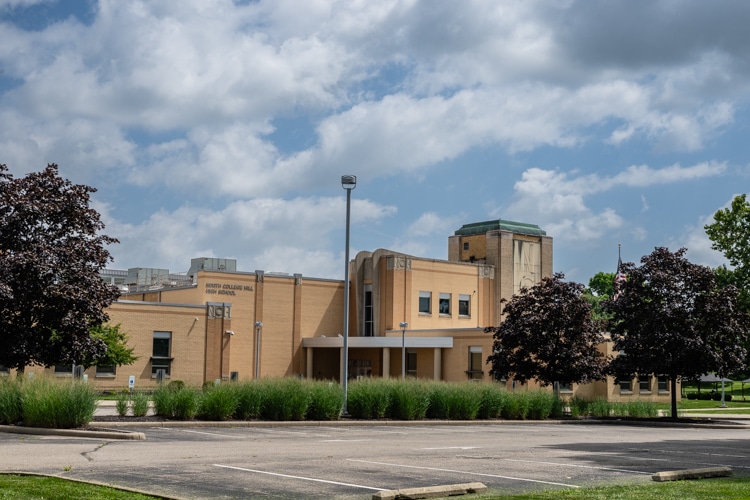
Chuck Hirt had been back in the United States for only a few months after nearly three decades working in Slovakia and Central Eastern Europe. He needed somewhere to land. He mentioned it at a monthly lunch, a group of La Salle High School classmates who had been meeting once a month for years, men in their seventies now, most of them, doing what men in their seventies do when they finally have time to sit down together.
Dan Brooks said he had a spare room. Hirt had a dog. Brooks knew a condo nearby.
They found each other again at a lunch table, two old men with very different decades behind them, and they started talking. What they had both spent their lives doing turned out to rhyme in ways neither had expected. And from that conversation, in a city that had spent too long being defined by its worst days, something began.
Dan Brooks served as mayor of North College Hill for 30 years. He ran for council in 1979, 34 years old, with no idea what he was doing. Young entrepreneurs, baseball league organizers, new homeowners along Galbraith Road. People crazy enough to give it a shot. They met at restaurants. They made mistakes and tried something else. They won. North College Hill won state awards. It made national publications. It had the kind of civic pride that filled baseball diamonds with teams from across Cincinnati, that turned a community festival into an 18-year labor of love for Brooks and his late wife Joan.
Chuck Hirt had spent those same decades in Slovakia, helping communities that had forgotten, after years of communism, that ordinary people were allowed to want things. His wife, Beata Hirt, served as Executive Director of the Healthy City Community Foundation in Banská Bystrica, the first community foundation established in Central and Eastern Europe. In one neighborhood, a 1970s-era high-rise where people had long since stopped expecting anything good to happen to them, they tried something that sounds almost too simple in the retelling. They met with the kids. They asked the kids to draw what they wanted. They brought materials and invited residents to come build it together. Just that.
On the day the park was finished, people who had never come outside were watching from their windows.
Hirt has told this story more than once. He tells it the way you tell a story that still surprises you, even after all the times you’ve told it. A park built from a child’s drawing. People at their windows who had given up on windows.
He came back to Cincinnati because he believed it could happen here.
18 minutes from everywhere, and it started with a dog and a spare room and two old men who still believed a city could find its way back.
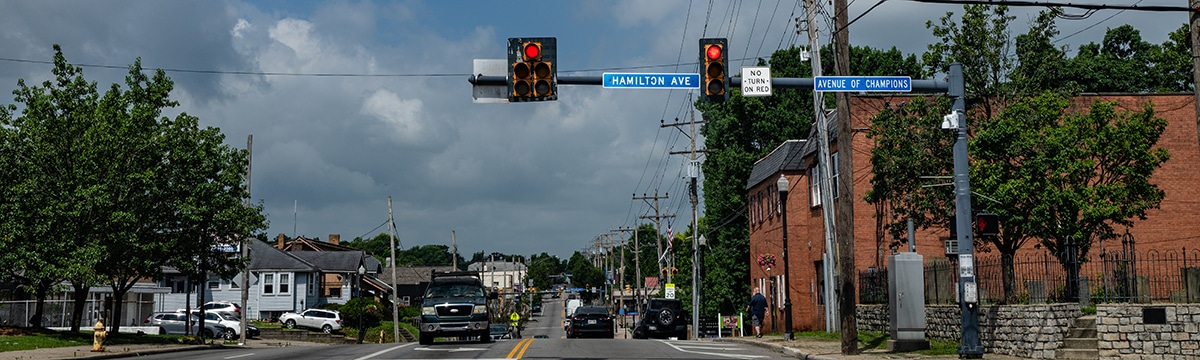
Draw an X across Hamilton County: one line north to south, one east to west. The intersection lands in North College Hill. Brooks has timed the drive home from a Reds game. Leave at the top of the ninth and you’ll be in your driveway before it ends. Median home prices hover around $197,000, well below the statewide median of $274,000. The city is walkable, centrally located, and more affordable than almost anywhere else with this kind of access to a major metro.
18 minutes from everywhere is not just a geography. It is an invitation. It is, for a city that has spent too long forgetting what it is, a reason to stay.
“That road goes both ways,” Brooks said, sitting in his home in the city he has never left. “You can leave here and go somewhere else. But people from out there can come here too. You just have to create something worth coming to.”
Every comprehensive plan measures housing units, investment dollars, and redevelopment sites. Those things matter. None of them explain why a neighbor finally decides to cross the street. Home values can be measured. That moment cannot.
Nobody planned for North College Hill to start coming back together. But somebody had to say something about the leaves.
Tracy Wright was the somebody.
For months Wright had watched the pile on the street near her house grow longer, higher and more offensive by the week. She finally walked across the street and said something. Her neighbor pushed back. She pushed back harder. They argued about whose responsibility it was, who created the mess, why any of it mattered.
And then something shifted. He came to a meeting. Months later, he was leading the housing committee.
If you ask Wright how that happened, she will laugh. A quick, full laugh, the kind that says she has seen this before and still can’t quite believe it. And then she will tell you this is just how things work here. Not through programs or task forces or strategic plans. Through the friction of people who actually have to look at each other. Through arguments that become the first act of remembering.
She has been paying attention for a long time. Tracy Wright is not alone.
On a Sunday afternoon in early July, people walked to a peace march in North College Hill. They came from the side streets off Galbraith Road and down from the hills above Hamilton Avenue, because Brea’L Wade had been shot and killed at 1:30 a.m. in the morning outside her own home. She was 18 and a recent high school graduate. She had been sitting in a car with a friend when a neighbor opened fire with dozens of rounds from an AR-15-style rifle. Her friend survived. She did not.
The community organized the peace walk themselves. They held it one week after her death. There had been shootings before it. There would be shootings after it. The people pointing to the violence and the people trying to fix it are, in North College Hill, very often the same people. They just don’t always make the same headline.
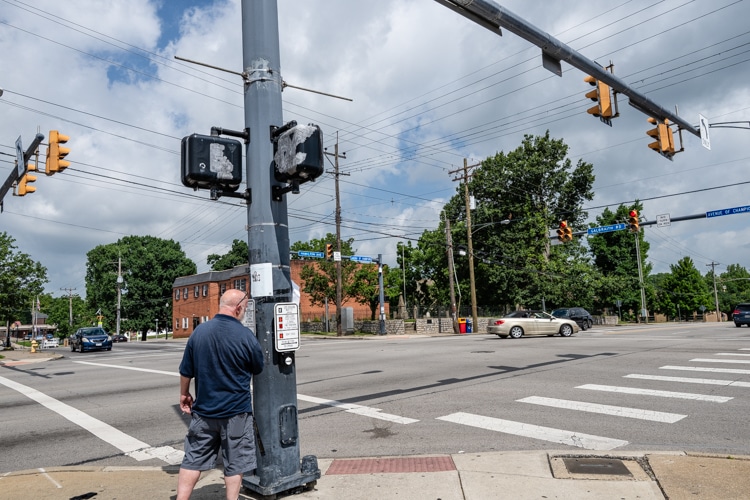
They walked, because in North College Hill, you can still walk to most things.
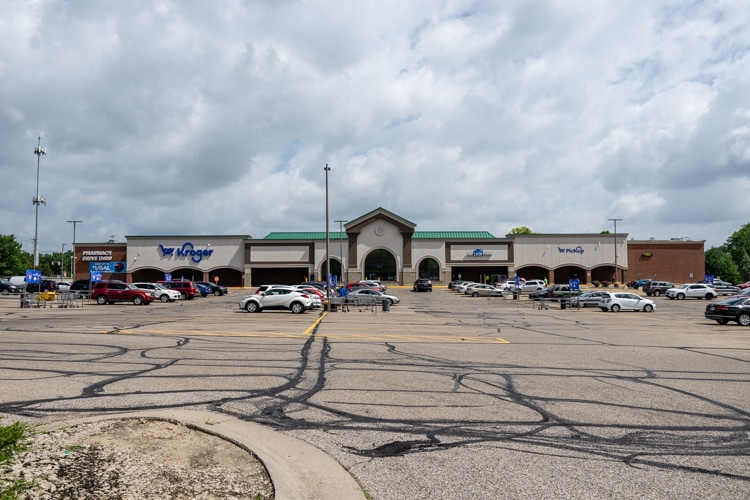
For many people outside North College Hill, the story begins with the kids and the neighborhood Kroger store.
In early 2026, a group of students organized a walkout in solidarity with communities affected by ICE raids, joining similar demonstrations unfolding in cities across the country. Like many youth-led protests, the purpose of the walkout was quickly overshadowed by what happened afterward. As the day went on and students were loose in the city with nowhere to go, a smaller group ended up at the Kroger on Galbraith Road. What happened there became the headline. The walkout that started it all received almost none.
A city where Alice and Phoebe Cary wrote poetry that Edgar Allan Poe called among the most musically perfect in the English language. A city with back-to-back state basketball championships, baseball tournaments that drew teams from across Cincinnati, and a kid named Dwayne Crutchfield who went on to play for the Jets, the Oilers and the Rams was reduced, in recent memory, to a Kroger parking lot.
“We got all the bad and none of the good,” said Hirt.
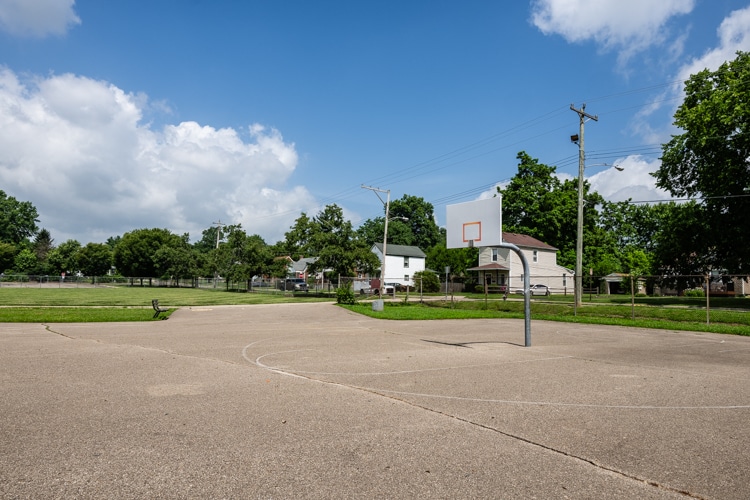
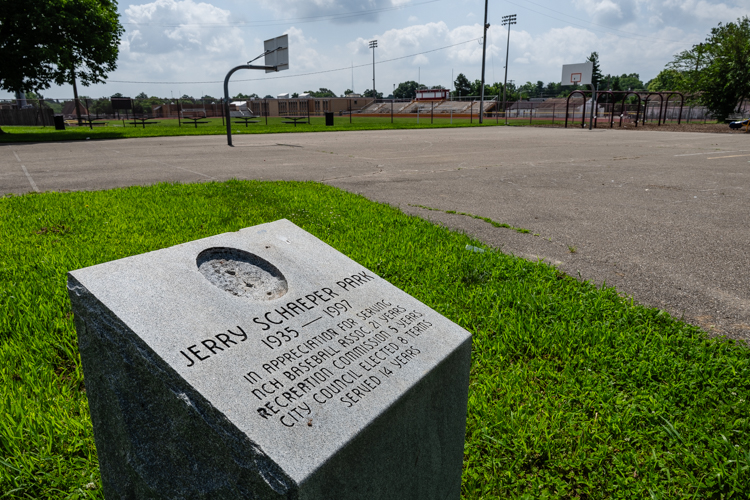
Underneath the Kroger story is a simpler question nobody has thought to ask: why were the kids loose in the city with nowhere to go? What happened to the third spaces: the baseball diamonds, the church halls, and the gyms. The places where belonging gets practiced before it gets named.
According to Hirt, Pastor Barnes of Journey Church is working on that. His congregation showed up uninvited to the first meeting of MotioNCH, a neighborhood alliance born from a recommendation in the city’s comprehensive plan. Barnes had heard what was happening and decided his church wasn’t going to be a country club. A church that doesn’t serve its community, he told people, is just a club with better music. He has been talking about basketball hoops in the parking lot, gym space, fellowship nights; somewhere to go.
A new city council, energized by the same spirit that built MotioNCH, has begun trying to bring young people into civic conversation, convening meetings where youth were invited to speak directly. It was a start. Everyone in this story knows the difference between being brought into the room and being asked what you would build.
“We’re clear,” Hirt said. “We’re not going to decide things for the youth. We’re going to sit with them.”
The problem has been getting them into the room.
“We keep getting close,” he said. “But we’re still not quite there.”
At MotioNCH’s first meeting, two young people wandered in from the parking lot. They had been doing laundry nearby or perhaps working. They helped carry supplies inside. Someone told them what was happening. They said they’d come back. They haven’t yet.
Peter Block, the founder of Common Good Alliance, has spent decades asking what happens when communities are treated as the solution rather than the problem. He offered a question he thinks could open the door with the youth of North College Hill: what don’t we understand about you? Not what do you need. Not what are your problems. What don’t we understand about you?
Wright provided the answer before Block named the question. Derek Peebles, a founding member of Common Good Alliance, had been running monthly trainings with MotioNCH, using questions designed to build relationship rather than gather data. By the fourth session, Wright had read the entire handbook and was done waiting. She stopped the meeting. “Are we going to do something else here?”
Everything opened up. “She was hungry for the commitment conversation,” Block said. “She just needed someone to ask.”
Brooks’s years as mayor were also years of profound change for North College Hill, gradual at first and then harder to ignore. The city became a majority Black city. The institutions did not always change with it: not the fire department, the police department, or the structures of civic power. Chuck Hirt says the racism was there, under Brooks’s watch. Brooks does not argue the point. He has built his whole life around the idea that screwing up is how you learn, that the only real failure is refusing to come back. He applies it to himself as readily as he applies it to anyone else. That reckoning is still being worked out. Not in a courtroom. Across a table, with people like Tracy still patiently helping him understand what it meant to live here during those years, and what it means to show up now and choose to do better.
Parkinson’s took Joan eventually and Brooks stepped away. Then, Mayor Nichols asked Brooks if he would serve on the planning commission. He said yes because that is what Joan would have said. Because this is not the way to paddle a canoe. Because if you don’t like it, you do something about it.
“The biggest advantage of a small city,” Brooks said, “is that you don’t have to lose it.” He paused the way a man pauses when he means something.
“You have the right and the ability and the opportunity to make it better. And that’s what this is all about.”
Hirt had watched other neighborhoods do exactly this. Price Hill Will rebuilding civic infrastructure block by block, Westwood Works turning vacant space into community-owned assets, neighborhood after neighborhood deciding nobody was coming to save them and getting to work anyway. North College Hill, he thought, could be next.
At the center of what is forming now sits a group of people demanding the same thing every resilient neighborhood before them has demanded. Not to be rescued, but to be seen, to be asked and to build it themselves.
That is what MotioNCH is reaching for. Not a finished thing. Not a plan that worked. Tracy Wright and the leaves and the neighbor who showed up. Pastor Barnes and a parking lot that could hold a basketball hoop. Dan Brooks across a table, still learning. Two young people who helped carry things once and said they’d come back.
Every neighborhood that has ever found its way back started somewhere that looked like this: Like not quite enough and still figuring it out. Like people who don’t yet know they are already doing it.
The work is not finished. It is not even close. But it is being built brick by brick, with the same bones as other communities that found their way back. The infrastructure is forming. The people are already there.
Somewhere in North College Hill, two young people are doing their laundry. They helped carry things once. They said they’d come back.
No one has asked them yet what they would draw. But someone is about to.
The Resilient Neighborhoods series is made possible with support from a coalition of partners including The Port of Cincinnati, Warsaw Federal Bank, and the Common Good Alliance. Ongoing Resilient Neighborhoods coverage will report on community-building in City of Cincinnati and Hamilton County neighborhoods spreading good ideas across the region.
Author

Related Articles
New bronze sculpture in Eden Park will honor Women Veterans who served our country
The artist will reveal the monument design this coming Veteran’s Day with an installation planned for June 2027.
In search of the inaugural cultural journalism fellow
Wave Pool and Soapbox partner to support innovative journalistic coverage of culture in Cincinnati.
Restoring Sedamsville one historic home at a time
An $8.4 million investment is bringing homeownership and a renewed sense of possibility to one of Cincinnati’s smallest neighborhoods.