
Regionalism

Community classes coming to The Brandery

The Brandery is known for its 14-week program that prepares entrepreneurs for the launch of their startups. But for the next two months, they’re trying something a little different. The Brandery will be offering community classes that cross a spectrum of themes. The classes are relevant to anyone with an idea, working for a startup or with the goal of re-envisioning some of the work they do, says Chelsea Koglmeier, program coordinator at The Brandery.   The sessions will be from 5:30 to 7 pm and will include a presentation followed by a Q&A. Each class is $20 per person, per event.   Sign up for a class below: Monday, Nov. 12: Branding 101—the basics of startup technology, Mike Bott, general manager of The BranderyMonday, Nov. 26: Gamification—how real game design is much more than a point system, Chris Bergmann, cofounder of ChoreMonsterWednesday, Dec. 5: Social Media for Startups—learnings from the ground, Tatiana Danger, RoadtrippersMonday, Dec. 10: Inspiration is All Around—taking ideas and creating an enterprise, Micheal Bergman, CEO of REPPMonday, Dec. 17: Financing a Small Business—different avenues to finance a small business, from traditional loans to SocStock, Jay Finch, SocStockMonday, Jan. 7: Technology for Your Company—choosing the right tool for the job, Charlie Key, CEO at ModulusTuesday, Jan. 8: Tweet About It #startups—how to best utilize Twitter to make your startup pop, JB Kropp, TwitterMonday, Jan. 14: Top 10 Legal Mistakes that Kill Companies, Rob McDonald, Taft LawTuesday, Jan. 22: Nerd Wisperer—how to speak intelligently about your vision to developers, Matt Duch, OntractWednesday, Jan. 23: How to Get Startup Famous—a cautionary tale, Julian Miller, OntractBy Caitlin Koenig Follow Caitlin on Twitter

Latest in Regionalism
Noble Denim launches with American-made, designer-quality jeans

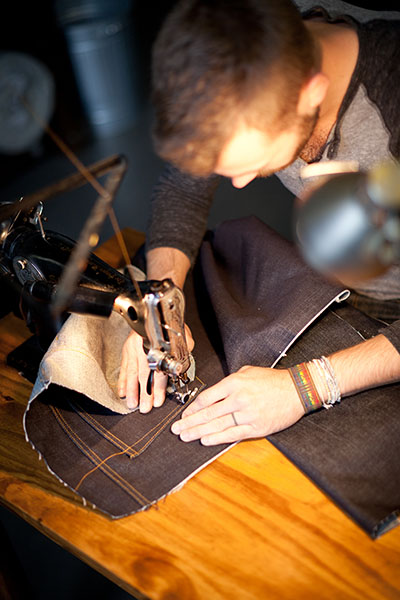
Looking for something "crafty" to learn, Chris Sutton took up jean-making nearly two years ago. "I wanted to learn how to make something with my own hands. I'd been doing a lot of tech endeavors, and wanted to get my hands dirty," says Sutton, whose background is in live event production. Once he began sewing jeans, Sutton found he had a real talent for it. He decided he wanted to make high-quality, American-made jeans, a rarity in today's clothing manufacturing sector. He sought out American sources for his material, thread, zippers and pocket materials. Yes, he found them all in the USA; and he created Noble Denim. "I wanted to make my own rules around what could and couldn't be done. I wanted to make my jeans in America, and make them as sustainably as possible," he says. Using his home in Over-the-Rhine as a sewing factory, Sutton began making and selling Noble Denim jeans. Twelve industrial sewing machines later, he moved the company into a space at Camp Washington. Designer in style and quality, they're meant to have a longer shelf life than your average mass-produced jean. Materials come from suppliers in Kentucky, Ohio, North Carolina, Colorado, Oregon and California. They're made from raw selvage denim, made through a time-consuming process that makes the material thicker and more durable. This type of denim is supposed to better fit the wearer's body and resist shrinkage. Sutton launched an online shop in November, where buyers can chose from two styles, Regular and Earnest Slim Straight. The jeans are pricey, $250 a pair, but all materials are 100 percent organic, reclaimed or responsibly produced. Currently Noble Denim sells jeans only for men; a women's line is planned for next fall. Noble Denim is a young company, and Sutton still does most of the sewing. He does have interns who are learning the jean-making craft. Within the next year, he hopes to hire three or four employees, who'll make 3,000 pairs of jeans a year. "I want to grow, but only as fast as I can stick to my philosophy," Sutton says. "So our mantra is grow slow, but do it well." By Feoshia H. Davis Follow Feoshia on Twitter.

ShareThis founder offers advice for entrepreneurs

Tim Schigel is the chairman and founder of ShareThis, a sharing and engagement platform. He served as the director of Blue Chip Venture Company and was involved with the growth of Nielsen Buzzmetrics, a leading platform for measuring blog sentiment and forums, and Third Screen Media, the first mobile advertising platform.   Schigel will be sharing his experience and tips with other entrepreneurs at the first Startup Grind event in Cincinnati, Dec. 6 at The Brandery.   What was your first startup in Cincinnati? My first job out of college (CWRU BSEE) was with Pharos Technologies. I was employee number 11. The company grew and became Digineer. I created a pioneering product for remote computer management for the Mac at the time. I also built P&G’s world-wide network. This was all in the early 90s.   Where did you get your idea for that first startup? I’ve always enjoyed pursuing new ideas. At Pharos, I grew and transitioned from a technical role into the VP of Sales and Marketing, and eventually left to do my own thing. I was also fascinated with venture capital and the fast-paced tech lifestyle of Silicon Valley. I come from a family of entrepreneurs, albeit mostly small business.   Why do you think startups are important to the community? Startups are the engine of innovation. There is so much freedom to explore technology, business management and business models. This creates a great environment for unanticipated results. Often great innovations are accidental. It takes the right environment, however, to let those accidents happen. The other factor that is a driving force for startups is time—they don’t have any. It forces the entrepreneur to adapt quickly in all respects.   Do you regularly attend Startup Grind meetings? No, this is the first one. I’m excited, and anyone who knows me knows that I love to help startups and explore new ideas.   Where do you draw your inspiration from when coming up with new ideas? Everywhere. I’m a big believer in the cross-pollination of ideas. The next answer to a software problem might come from biology or some other completely different domain. We should put everything on the table and encourage people to develop a natural curiosity and well-rounded perspective. I also think innovation comes from constraints. Some of the most interesting products have emerged from very constrained environments that act as a forcing function for creativity. Open-ended creativity is actually hard and doesn’t always lead to the most interesting solution. Finally, I like taking a contrarian point of view. If everyone thought about a problem the same way, you would lack new ideas. Sometimes the biggest disruptive ideas are viewed as out of touch, misunderstood or not even recognized until after they’ve become disruptive. This is an interesting balancing act for an entrepreneur because you need to be a good listener and respond to feedback, but also stay true to your convictions. The more informed those convictions are, the better. Some people stick to convictions regardless of overwhelming evidence to the contrary. Ultimately, the evidence should hopefully support your thesis and when that happens, you know you’ve done something new and special.   By Caitlin Koenig Follow Caitlin on Twitter

Brandery hosts first Cincinnati Startup Grind

Startup Grind is coming to Cincinnati. On Dec. 6, The Brandery will host a Startup Grind event featuring Tim Schigel, founder of ShareThis, an online sharing platform.   Startup Grind is a national organization of founders, entrepreneurs and “wantrapreneurs” looking for inspiration and education, as well as a way to network with the best and brightest in startups. It began in 2010 as friends getting together to chat about startups, but it has grown into an international speaker phenomenon, says Venture for America's Chelsea Koglmeier, who is serving as program coordinator at The Brandery.   The first official Startup Grind event was held in Feb. 2010. Nine people attended. Since then, there have been about 50 Startup Grinds around the world. They’re chances to brainstorm, provide and receive feedback on ideas and, just maybe, start something new.   There are Startup Grind chapters in Austin, Chicago, Los Angeles, New York City, San Francisco, Silicon Valley, St. Louis, Baltimore, Cincinnati, Dallas, San Diego, Seattle, Tempe and Utah. International chapters are in Budapest, Cyprus, Dubai, Johannesburg, Ottawa, Tel Aviv, Toronto, Buenos Aires, Ireland, London, Melbourne, North Bay, Singapore and Sydney.   The Brandery has never had an event like Startup Grind, but they’re excited about the opportunity.   “The startup community in Cincinnati is growing tangibly, and The Brandery is doing everything in its power to provide resources and inspiration to continue the positive upswing of entrepreneurism,” says Koglmeier.   During the event, Schigel will be answering questions from Dave Knox, CMO of Rockfish and cofounder of The Brandery. Schigel will also chat about his experience with startups and starting his own business. Then, there will be time for Q&A and networking. It’s a great opportunity for entrepreneurs to interact with one another. "Startups bring a different level of energy that’s hard to mimic at the Fortune 500s or other agencies in Cincinnati--they’re literally pursuing their own dreams," says Mike Bott, The Brandery's general manger. "Startups are going to be the next great place to work in Cincinnati." There isn’t a deadline for registration, but make sure to sign up early, as The Brandery has limited space. Check out the event’s meetup page for more information.   By Caitlin Koenig Follow Caitlin on Twitter

Instagram-inspired Booth FX launches in O’Bryonville

“A digital spin on the traditional photo booth” is Kelley Andersen’s super-short explanation of Booth FX Photo Booth Company, which she launched with her partner, Allison Gates, last month. The pair built the idea for their company on a love of photo booths, two creative personalities and their vision for a photo booth that was more than a traditional, space-limited box. “We first looked at the booths you can buy, and they were nice, but not what we were looking for," Andersen says. "We wanted something that was more digital. I love Instagram, and was trying to figure out how we could do that as a photo booth." The booth they custom-built--“with a lot of time and a lot of mistakes,” Andersen adds--measures 1.5 feet by 1.5 feet, is 5.5 feet tall and incorporates software that allows photos to be viewed, edited and shared. Rather than expecting participants to hop inside, the booth houses the photography equipment. Participants gather in the space around the booth to snap a photo in front of customized backdrops the women create for each event with input from hosts. Features of the booth include a wireless remote and a touchscreen for viewing images on the back of the booth. This allows attendees to view photos, use filter effects (much in the same way as one would with Instagram) and upload images to social media immediately. The co-founders provide wireless internet with a mobile hotspot. Booth FX launched last month, and both founders still have full-time day jobs--Gates as a designer and Andersen as an insurance analyst. So far, they’ve been commissioned for fundraising events and they plan to reach out to local brides- and grooms-to-be to expand their business into weddings. By Robin Donovan  

Strive Partnership integrates Brandery startup concept

One of the Brandery startup tech concepts known as "Ontract" has recently become part of Strive Partnership’s plan to personalize the education each student receives at Cincinnati, Covington or Newport public schools. Read the full story here.

Rhinehaus sports bar targets OTR locals, soccer fans

Aaron Kohlhepp and Jack Weston were two single guys on a mission: to find a place to watch March Madness in Over-the-Rhine. What started as a joke over drinks about starting their own bar will soon launch rhinehaus, Over-the-Rhine’s newest sports bar. The venue will launch in mid-December at the corner of 12th and Clay streets, not far from Japps. Kohlhepp and Weston both have generous employers who will let them cut back from full- to part-time positions at local financial institutions; Kohlhepp works in corporate marketing and Weston in accounting. Kohlhepp says that discussions turned to concrete planning once they found their current space, an OTR building constructed in the late 1800s that has hardwood floors and exposed brick. “We found that space and just thought it was a good spot on the main corridor between Main Street and everything that’s going on on Vine," he says. "Eventually the streetcar will go right past us, and the casino [that opens next spring] is just a couple blocks away.” The rhinehaus name is a play not only on the bar’s local digs and Cincinnati’s German roots, but also its former occupant, Rhino’s Bar. Currently, renovations in the space include replacing the storefront and adding floor-to-ceiling glass windows. Because both Kohlhepp and Weston are soccer fans, their first order of business will be to broadcast English Premier League soccer games on weekends. They’re also wading through the process of getting a liquor license and brainstorming ways to partner with other local businesses. One hurdle the duo has faced is the fact that while the bar has 18 taps, it doesn’t have a kitchen. “We’ve reached out to a couple of the food trucks in town and we’re going to talk to more of them in the coming weeks," Kohlhepp says. "We want people to be here three-plus hours to watch games, so we’re going to try to feed them." By Robin Donovan

Peggy Shannon raises standards in cookie design, flavours

Queen City Cookies is an artisan cookie whose founder, Peggy Shannon, is a life-long baker and artist who put up the cookie shop as a way to offer consumers beautiful and delicious baked goods. Read the full story here.

In Your Face: In Cincinnati, a Pie War Heats Up

What began as a friendly rivalry between Busken and Frisch's pumpkin pies has been whipped up into an escalating tit for tat, playing out in billboards, social media stunts and live-action high jinks. Read the full story here.

Instagram-inspired Booth FX launches in O’Bryonville

“A digital spin on the traditional photo booth” is Kelley Andersen’s super-short explanation of Booth FX Photo Booth Company, which she launched with her partner, Allison Gates, last month. The pair built the idea for their company on a love of photo booths, two creative personalities and their vision for a photo booth that was more than a traditional, space-limited box. “We first looked at the booths you can buy, and they were nice, but not what we were looking for," Andersen says. "We wanted something that was more digital. I love Instagram, and was trying to figure out how we could do that as a photo booth." The booth they custom-built  – “with a lot of time and a lot of mistakes,” Andersen adds – measures 1.5 ft. by 1.5 ft., is 5.5 feet tall and incorporates software that allows photos to be viewed, edited and shared. Rather expecting participants to hop inside, the booth houses the photography equipment. Participants gather in the space around the booth to snap a photo in front of customized backdrops the women create for each event with input from hosts. Features of the booth include a wireless remote and a touchscreen for viewing images on the back of the booth. That allows attendees to view photos, use filter effects (much in the same way as one would with Instagram) and upload images to social media immediately. The co-founders provide wireless internet with a mobile hotspot. Booth FX launched last month, and both founders still have full-time day jobs, Gates as a designer and Andersen as an insurance analyst. So far, they’ve been commissioned for fundraising events and they plan to reach out to local brides- and grooms-to-be to expand their business into weddings. By Robin Donovan  

Our Partners

Taft Museum of Art
Warsaw Federal

Don't miss out!

Everything Cincinnati, in your inbox every week.

Close the CTA

Already a subscriber? Enter your email to hide this popup in the future.