SOS ART has spent decades proving art can save our souls
This year’s exhibition explores climate grief, political fracture, isolation, belonging, war, reconciliation, and what it means to see one another as fully human.
In 2001, after Cincinnati’s uprising exposed fractures the city could no longer pretend not to see, Saad Ghosn, a medical doctor and artist, found himself asking a question that would not leave him alone: What is art actually for? Not as commodity or decoration, but as a tool. As a response. As something that could matter.
That question became the engine of everything that followed. Twenty-five years later, it still shapes parts of Cincinnati’s arts community in ways both quiet and deeply visible. This June, when 73 poets and 37 visual artists converge around “For a Better World 2026,” they are answering Ghosn’s question through practice: art is for witness. Art is for naming what is broken. Art is for imagining what could be different.
SOS ART was founded in 2003 and has spent more than two decades positioning art as exactly what its name suggests: Save Our Souls. What began as a single exhibition became an ecosystem of annual collective shows, educational workshops in schools, yearly poetry and visual art anthologies, and collaborations rooted in peace and justice. In 2015, SOS ART formally became a nonprofit. Now, with the 23rd edition of “For a Better World,” the themes feel painfully current.
The exhibition opens June 5 at St. John’s Unitarian Universalist Church and runs through June 28. An opening reception takes place on Saturday, June 6, with poetry readings on the following Sundays, June 14 and June 28.
The real work lives inside the poems and images themselves. The people inside this exhibition carry these questions long before they ever hang work on a wall.
Rebecca Suter Lindsay, one of the featured poets, comes from a lineage of Mennonite pacifists. Her great-grandparents, Emanuel and Elizabeth Swope Suter, refused to take up arms during the Civil War as conscientious objectors in Virginia’s Shenandoah Valley when that refusal came with enormous cost. Her debut novel, “The Peacemakers,” published in 2020, emerged from years spent combing through archives, family histories, and Mennonite records. The work asks what it means to refuse violence in a world that often demands participation in it. That same question threads through the poetry she brings into “For a Better World 2026.”
Then there is Deborah Jordan, a poet and activist whose life has long blurred the line between art and public resistance. Jordan, who lives in East Price Hill, coordinated Cincinnati’s Nuclear Freeze chapter during the 1980s and participated in antinuclear demonstrations at the Nevada Test Site. Later, believing education itself could interrupt cycles of violence, she earned a master’s degree and spent years providing peace education and conflict resolution services to Cincinnati schools. She later became a registered nurse. Today, she is helping establish Greater Cincinnati’s Holistic Mental Health Network, advocating for mental health care that is community-based, stigma-free and whole. Jordan is also a Quaker, drawn to what she describes as the intersection of mystical and activist traditions. A spirituality that does not retreat from the world but moves directly into it.
These are not artists treating justice as an abstract theme. For many of them, it has been the work of a lifetime.
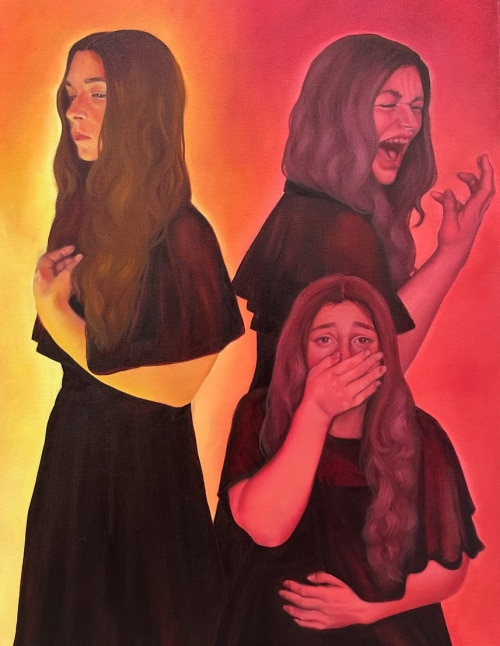
Each poem in “For a Better World” is handed to a visual artist who creates an original response to it. One artist reaching toward another. Words becoming images. Images pulling new meaning back out of the words. The result feels less like separate works hung beside each other and more like a conversation unfolding across mediums.
This year’s exhibition moves through climate grief, political fracture, isolation, belonging, war, reconciliation, and the increasingly difficult task of seeing one another as fully human. Some pieces are intimate. Some openly confront injustice. Some sit quietly inside the ache of living through this moment at all.
Contributors collectively confront issues including racism, gender bias, economic disparity, violence, and environmental collapse. In a moment shaped by misinformation, exhaustion, inequality, and fracture, the exhibition insists on something increasingly rare: attention. Attention to one another. Attention to suffering. Attention to possibility.
This is what public imagination looks like in 2026. Not escapism. Not neutrality. Sustained creative practice rooted in the belief that language still matters. That images still matter. That gathering people together to wrestle honestly with the state of the world still matters.
The work continues. Go see what 73 poets and 37 artists are trying to say.
What: SOS ART opening reception for “For a Better World 2026”
Where: St. John’s Unitarian Universalist Church, located at 320 Resor Avenue, Cincinnati
When: Saturday, June 6 – Sunday, June 28
Special events: Opening reception June 6 from 2-5:00 p.m. Poetry readings June 14 and June 28 from 2-5:00 p.m.
Tickets: The exhibition is free and open to the public.
Author
Related Articles
New bronze sculpture in Eden Park will honor Women Veterans who served this country
The artist will reveal the monument design this coming Veteran’s Day with an installation planned for June 2027.
In search of the inaugural cultural journalism fellow
Wave Pool and Soapbox partner to support innovative journalistic coverage of culture in Cincinnati.
Partner Partner Content Architecture Matters panel discussion: Good design is good for people
Your invitation from AIA Cincinnati and Soapbox to join a thoughtful community conversation about good design.