
Regionalism

Everything’s d’Vine opens for business

Marianne Kiely, owner of Everything’s d’Vine, has waited a long time to open her specialty wine and beer shop on Fourth Street. But as of Nov. 9, she is open for business.   Everything’s d’Vine has hardwood floors and exposed brick walls. The walls are original brick, but the floor was replaced when Kiely rented the building. Customers get the feel that they’re in a wine cellar, even though they’re steps away from busy Fourth Street.   Vynebar wine racks line the walls, which Kiely sells in addition to a wide assortment of wines from around the United States and abroad.     There’s also a beer room, stocked with beers from craft breweries across the country. A tasting room, where Kiely hosts samplings twice a week, one for wine and the other for beer, connects the two rooms. The samplings reflect Kiely’s inventory, but there are usually six to eight brands to try, she says. There’s usually a $10-15 cost for the tastings, but the cost depends on the number of pours.   Make sure to check Everything’s d’Vine’s Facebook page for weekly tasting times and costs, along with other events. She also includes inventory updates and seasonal releases on Facebook.   By Caitlin Koenig Follow Caitlin on Twitter

Latest in Regionalism
Launch Werks prototypes help inventors attract funding

With big names in branding hovering in an around Cincinnati, it can start to seem like the brand is everything, and intangible products are the only thing that can really sell – and scale. However, two industrial designers pairing up in Over-the-Rhine are challenging that assumption, combining their skills in design, engineering, and budding knowledge of manufacturing and sourcing materials at a start-up they call “The Launch Werks.” As the name implies, The Launch Werks not only offers its own, tangible products, but helps small businesses and innovators create prototypes from their ideas. That means doing everything from helping to design prototypes that consumers will rush to engage with to planning the look of the final object, imagining how people might interact with it, and even specifying the materials it should be manufactured from and where to purchase them. Co-founders Noel Gauthier and Matt Anthony met as industrial design students at the University of Cincinnati’s School of Design, Architecture, Art and Planning (DAAP) and quickly realized a shared interested in what happens after the design phase of a new product. “The leap it takes to to go from an idea to a real product fascinates us," Gauthier explains. "So much happens when an idea is translated into a made thing. … Having worked in various product design firms around the country, we never had a close connection with where and how the products we designed were being made.” So he and Anthony began to connect Cincinnati-area product development with high-quality manufacturing, filling a niche for companies that weren’t ready for large-scale production, but needed something to show potential investors. Anthony says he sees an opening right now for foodie-friendly items. “I think we’re going to see more local stores and products follow developments in the food movement: making unique products and doing it well. But we want to see some of them scale the way that Jeni’s Ice Cream or Taste of Belgium has.” For a city already big on branding, it might just be a tasty step in the right direction. By Robin Donovan

Queen City sweetness: Home-town bakery startup expands offerings, again

Peggy Shannon, who dreamed up Queen City Cookies just two years ago, will open a gift shop today as part of her new Northside "campus" dedicated to community empowerment, entrepreneurial energy and amazingly delicious sweet treats.

InkTank re-emerges, launching reading series in OTR

It turns out that tech startups aren’t the only people who know how to pivot. When InkTank, a nonprofit focused on literacy development and creative writing shut down in 2011, citing funding issues, its writer’s salon survived and continued to meet, but the occasional readings (and other services) it provided seemed lost. Now, the free, bimonthly InkTank Reading Series promises to change that. Despite losing its former Main Street location, “we kept talking about doing something, but we didn’t really have a direction or location,” says Seán Dwyer, one of six core members of the group. He helps organize the series and attract the talent: emerging authors from the Midwest. The InkTank salon paired with 1215 Wine Bar and Coffee Lab in Over-the-Rhine to host the readings, which will feature a published regional author preceded by two emerging, local voices. The first event, which will be held Nov. 27 at 8 p.m., will host Cincinnatian Ian Stelsel, a graduate of the prestigious Iowa Writers’ Workshop and husband of a former salon member. Stelsel plans to read from a collection of short stories set to publish in 2013. There’s been no trouble attracting authors to read at the gatherings, according to Dwyer. “We’ve got enough authors for about 10 months. We’ve actually stopped asking [for authors to read] because we want to see how [the series] goes and where it goes.” In the coming months, authors will include Phoebe Reeves, a poet and professor at the University of Cincinnati’s Clermont College; Don Peteroy, a Ph.D. candidate at UC; and Jacinda Townsend, who teaches at Indiana University. The 1215 venue is open to patrons of all ages. The InkTank Reading Series will feature prose, poetry, creative nonfiction and plays from published authors, as well as book signings and question-and-answer sessions, on the last Tuesday of every other month. Do Good: • Ask a question about the series by emailing InkTank. • Attend the first reading on Nov. 27 at 8 p.m. at 1215 Wine Bar and Coffee Lab. • Learn more about upcoming, featured authors from INKTank.   By Robin Donovan

New brewing HQ expands Moerlein’s, Brewery District’s offerings

As brewery equipment rolls into Over-the-Rhine, the Christian Moerlein Brewing Company is just weeks away from reaching another milestone in reviving the Christian Moerlein and Hudepohl names in Cincinnati. The former home of the Kauffman Brewing Company and Husman’s Potato Chip factory at 1621 Moore Street is nearly converted to brewing headquarters for Moerlein and Hudepohl beers. With this building, “exponential growth is possible,” says Josh Baker, marketing director for Christian Moerlein. The lingering question in many beer fans’ minds, though, is simple. What will be the first beer off the new production line? “Whichever beer we need will be first to be brewed,” says Baker, who hints at a secret ale likely to emerge from the brewing lines soon. While the Lager House at the Banks will continue brewing to fulfill the restaurant’s beer needs, all other brewing will happen on Moore Street. At first, the Moerlein lagers and ales and Hudepohl seasonal beers will be brewed on Moore Street, but eventually all the Hudepohl beers will roll off the lines there as well. Beer won’t be the only focus of the expanded space, Baker says. The location will also feature a banquet hall (in the space that has served as Bock Fest Hall the past few years) as well as a tap room, slated to open next spring. Brewery visitors will be able to purchase their favorite beers in cases, growlers and kegs from the tap room, located in the old Kauffman malt drying room. Since the building was a pre-refrigeration era brewery, it also offers access to lagering cellars, which are currently featured in several Cincinnati tours, including those given by the Over-the-Rhine Brewery District Community Urban Redevelopment Corp., a nonprofit organization dedicated to preservation and redevelopment of Cincinnati’s rich beer brewing roots. Moerlein and The Brewery District are closely tied with Steve Hampton, executive director for The Brewery District and project architect for the new brewery, and Gregory Hardman, CEO of Christian Moerlein and president of The Brewery District. They plan to incorporate tours and history into the new brewery, which allows visitors to simultaneously experience Cincinnati beer, past and present. The Brewery District CURC is in charge of the annual Bock Fest, as well as the seasonal Biergarten at Findlay Market. The nonprofit will be in charge of beer sales at an open house for the brewery from 4 to 8 p.m. on Nov. 21. If all goes smoothly, brewing is set to start “within two weeks after the open house,” says Baker. “People have been knocking on our door wanting to see what is happening. The amount of support and cheers has been overwhelming the past year.” Guests at the open house can enter a drawing to win one of the first 100 bottles off the production line. The bottles will be numbered, signed and accompanied by a letter of authenticity. Registration for the contest will take place until the open house and can be done at Findlay Market or by mail. After the open house, the next brewery-related event will be the Third Annual Hudepohl Thanksgiving Eve Turkey Trot featuring $2 Hudepohl Amber Lagers at bars along Main and Vine streets. By Blaire Mynear Blaire Mynear is an aspiring biologist and a resident of Walnut Hills

The Garage Group helps established companies tap entrepreneurial spirit

Entrepreneurship isn't just for startups. That's the tagline and philosophy behind The Garage Group, a Cincinnati-based consultancy that helps large, established companies tap into their entrepreneurial spirit. The Hyde Park-based company was co-founded by Jason Hauer and Ann Lauer, two business colleagues who left their jobs at a small innovation firm to start their own businesses. "The concept for The Garage Group reflects what we've liked to do across the lifetime of our careers, unleashing the entrepreneurial spirit of a startup, along with the discipline and focus of a larger, established organization," Lauer says. "Our skill sets complemented one another." Lauer spent 17 years working in the corporate and nonprofit worlds. She's experienced in strategic planning, leadership and business development in addition to marketing and research. Hauer's experience lies in business model creation and scale up, entrepreneurial and growth strategy, idea creation and project movement. More companies are turning to this type of internal entrepreneurship to create new products and services, as economic pressures force them to do more with less, Lauer says. The Garage Group offers one-on-one business consulting as well as workshops that help companies address specific innovation challenges. "We work in three main areas: strategy, ideas and organizational development," Lauer says. "We help organizations develop a platform to support innovation. We look at how the organization assigns roles, how people interact with each other and company culture. There are seven different elements we look at in developing an entrepreneurship structure within a company." The company's clients have included Cincinnati Children's Hospital, Greater Cincinnati Health Council, Nationwide Insurance, Kantar, a consumer insight company and LPK. "Most companies don't have an entrepreneurial strategy, or if they do, it's too short-term or too experimental," Hauer says. "We can help them come up with a pipeline of ideas, drive focus and create a process for testing those ideas." The Garage Group's ultimate goal is to help its clients create a process that allows a constant stream of innovation, tapping internal talent to grow. By Feoshia H. Davis Follow Feoshia on Twitter

21c opens Metropole on Walnut, shares art

A bright, smiling face—it's electric, really—greets diners at today's opening of Metropole on Walnut, the 21c Museum Hotel restaurant downtown. The art installation, created by New York-based Sanford Biggers, serves as a cultural tease for the more than 8,000 square feet of exhibit space set to open with the 21c before the end of the year. "We have eight site-specific commissions that are in various stages of being installed," says Molly Swyers, SVP of design and communications for 21c Museum Hotels. The Cincinnati location is the company's second site, with a flagship in Louisville and a third site slated to open next year in Bentonville, Arkansas. The boutique hotel serves as a free museum open 24 hours a day, every day of the year, Swyers says. Though the iconic 21c penguin sculptures (red in Louisville, yellow in Cincinnati) will remain on-site, curated exhibits within the museum hotel will change regularly.  "On any given visit, you'll see something different or new." Guests won't even have to enter the 21c to experience the art. Last week, workers began installing a sound installation by Austrian artist Werner Reiterer; it's the same one that used to hang outside 21c's Louisville restaurant, Proof on Main. "There's a trigger for chandelier inside the hotel," Swyers says."It's been adjusted some and we had to do some engineering around constructing the sidewalk to support it." The opening of the 21c isn't just a boon for art lovers and foodies. Swyers says the company hired 160 employees property-wide, including a mix of 21c-seasoned pros from Louisville and newcomers from Cincinnati. "You have a good mix of people who have been with 21c for some time and people who are just joining the team," she says. Metropole chef Michael Paley is one of the Louisville transplants, as is the site's food and beverage manager. "I'm excited just to open the doors and see people's reactions to the space," says Swyers, who has been working on the project for two years. As she plans the full opening in the next few weeks, she notes that 21c's historic predecessor, the Metropole Hotel, opened its doors on New Year's Eve in 1912. "It's exciting to make this a public space again, and it's nice to be inviting the public back in." Follow 21c and Metropole on Walnut on Facebook to find out more about the opening, enter a yellow-penguin-spotting contest and sign up for regular email updates. By Elissa Yancey Follow Elissa on Twitter.

Community classes coming to The Brandery

The Brandery is known for its 14-week program that prepares entrepreneurs for the launch of their startups. But for the next two months, they’re trying something a little different. The Brandery will be offering community classes that cross a spectrum of themes. The classes are relevant to anyone with an idea, working for a startup or with the goal of re-envisioning some of the work they do, says Chelsea Koglmeier, program coordinator at The Brandery.   The sessions will be from 5:30 to 7 pm and will include a presentation followed by a Q&A. Each class is $20 per person, per event.   Sign up for a class below: Monday, Nov. 12: Branding 101—the basics of startup technology, Mike Bott, general manager of The BranderyMonday, Nov. 26: Gamification—how real game design is much more than a point system, Chris Bergmann, cofounder of ChoreMonsterWednesday, Dec. 5: Social Media for Startups—learnings from the ground, Tatiana Danger, RoadtrippersMonday, Dec. 10: Inspiration is All Around—taking ideas and creating an enterprise, Micheal Bergman, CEO of REPPMonday, Dec. 17: Financing a Small Business—different avenues to finance a small business, from traditional loans to SocStock, Jay Finch, SocStockMonday, Jan. 7: Technology for Your Company—choosing the right tool for the job, Charlie Key, CEO at ModulusTuesday, Jan. 8: Tweet About It #startups—how to best utilize Twitter to make your startup pop, JB Kropp, TwitterMonday, Jan. 14: Top 10 Legal Mistakes that Kill Companies, Rob McDonald, Taft LawTuesday, Jan. 22: Nerd Wisperer—how to speak intelligently about your vision to developers, Matt Duch, OntractWednesday, Jan. 23: How to Get Startup Famous—a cautionary tale, Julian Miller, OntractBy Caitlin Koenig Follow Caitlin on Twitter

Noble Denim launches with American-made, designer-quality jeans

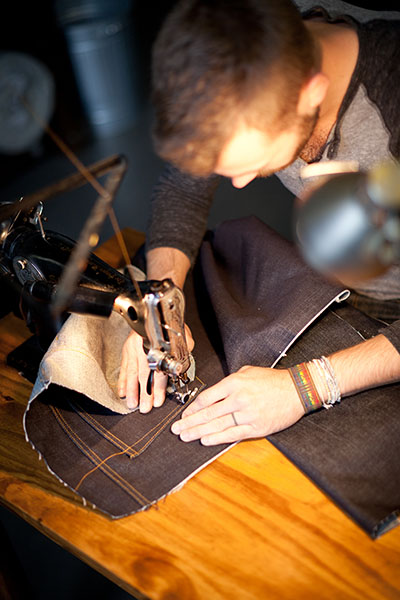
Looking for something "crafty" to learn, Chris Sutton took up jean-making nearly two years ago. "I wanted to learn how to make something with my own hands. I'd been doing a lot of tech endeavors, and wanted to get my hands dirty," says Sutton, whose background is in live event production. Once he began sewing jeans, Sutton found he had a real talent for it. He decided he wanted to make high-quality, American-made jeans, a rarity in today's clothing manufacturing sector. He sought out American sources for his material, thread, zippers and pocket materials. Yes, he found them all in the USA; and he created Noble Denim. "I wanted to make my own rules around what could and couldn't be done. I wanted to make my jeans in America, and make them as sustainably as possible," he says. Using his home in Over-the-Rhine as a sewing factory, Sutton began making and selling Noble Denim jeans. Twelve industrial sewing machines later, he moved the company into a space at Camp Washington. Designer in style and quality, they're meant to have a longer shelf life than your average mass-produced jean. Materials come from suppliers in Kentucky, Ohio, North Carolina, Colorado, Oregon and California. They're made from raw selvage denim, made through a time-consuming process that makes the material thicker and more durable. This type of denim is supposed to better fit the wearer's body and resist shrinkage. Sutton launched an online shop in November, where buyers can chose from two styles, Regular and Earnest Slim Straight. The jeans are pricey, $250 a pair, but all materials are 100 percent organic, reclaimed or responsibly produced. Currently Noble Denim sells jeans only for men; a women's line is planned for next fall. Noble Denim is a young company, and Sutton still does most of the sewing. He does have interns who are learning the jean-making craft. Within the next year, he hopes to hire three or four employees, who'll make 3,000 pairs of jeans a year. "I want to grow, but only as fast as I can stick to my philosophy," Sutton says. "So our mantra is grow slow, but do it well." By Feoshia H. Davis Follow Feoshia on Twitter.

ShareThis founder offers advice for entrepreneurs

Tim Schigel is the chairman and founder of ShareThis, a sharing and engagement platform. He served as the director of Blue Chip Venture Company and was involved with the growth of Nielsen Buzzmetrics, a leading platform for measuring blog sentiment and forums, and Third Screen Media, the first mobile advertising platform.   Schigel will be sharing his experience and tips with other entrepreneurs at the first Startup Grind event in Cincinnati, Dec. 6 at The Brandery.   What was your first startup in Cincinnati? My first job out of college (CWRU BSEE) was with Pharos Technologies. I was employee number 11. The company grew and became Digineer. I created a pioneering product for remote computer management for the Mac at the time. I also built P&G’s world-wide network. This was all in the early 90s.   Where did you get your idea for that first startup? I’ve always enjoyed pursuing new ideas. At Pharos, I grew and transitioned from a technical role into the VP of Sales and Marketing, and eventually left to do my own thing. I was also fascinated with venture capital and the fast-paced tech lifestyle of Silicon Valley. I come from a family of entrepreneurs, albeit mostly small business.   Why do you think startups are important to the community? Startups are the engine of innovation. There is so much freedom to explore technology, business management and business models. This creates a great environment for unanticipated results. Often great innovations are accidental. It takes the right environment, however, to let those accidents happen. The other factor that is a driving force for startups is time—they don’t have any. It forces the entrepreneur to adapt quickly in all respects.   Do you regularly attend Startup Grind meetings? No, this is the first one. I’m excited, and anyone who knows me knows that I love to help startups and explore new ideas.   Where do you draw your inspiration from when coming up with new ideas? Everywhere. I’m a big believer in the cross-pollination of ideas. The next answer to a software problem might come from biology or some other completely different domain. We should put everything on the table and encourage people to develop a natural curiosity and well-rounded perspective. I also think innovation comes from constraints. Some of the most interesting products have emerged from very constrained environments that act as a forcing function for creativity. Open-ended creativity is actually hard and doesn’t always lead to the most interesting solution. Finally, I like taking a contrarian point of view. If everyone thought about a problem the same way, you would lack new ideas. Sometimes the biggest disruptive ideas are viewed as out of touch, misunderstood or not even recognized until after they’ve become disruptive. This is an interesting balancing act for an entrepreneur because you need to be a good listener and respond to feedback, but also stay true to your convictions. The more informed those convictions are, the better. Some people stick to convictions regardless of overwhelming evidence to the contrary. Ultimately, the evidence should hopefully support your thesis and when that happens, you know you’ve done something new and special.   By Caitlin Koenig Follow Caitlin on Twitter
Our Partners

Taft Museum of Art
Warsaw Federal

Don't miss out!

Everything Cincinnati, in your inbox every week.

Close the CTA

Already a subscriber? Enter your email to hide this popup in the future.