Regionalism

Advocates for Youth Education help close funding gaps

Twenty-five years ago, a group of African American women in Cincinnati came together to begin Advocates for Youth Education.  “There were three ringleaders who decided, ‘You know what, ladies? We can do this,’ so they just invented AYE and got their friends to join them,” says Kathy Merchant, who serves as president and CEO of the Greater Cincinnati Foundation and who is also an AYE member.  Like the other 39 AYE members, Merchant’s role is completely voluntary, and it involves donating money out of her own pocket each year to help fund scholarships for minority students who excel in academics and community service. Through her work with GCF, Merchant says she studies how to eliminate or reduce racial disparities in a community. “It’s one of the things we’ve studied hardest,” Merchant says. “Making scholarship money available is absolutely one of the ways, so it’s a full circle type of experience for me.”  This year, AYE's group of 40 women was able to donate $50,000 dollars to assist 17 students.  “Even after you’ve pieced together absolutely everything that exists, from government loans and the myriad of checkerboard things available to students, there’s still a gap,” Merchant says. “Data shows that the gap on average is about $4,000 if you’re just talking about the cost of public universities. These grants don’t quite get that high, but they go a long distance toward that make-or-break last dollar between what it takes to go to school and actually being able to do it.”  Merchant sees evidence of the program's value on the faces of parents at the annual awards dinner. “It’s hard not to go there and cry,” Merchant says. “A lot of these kids are from single-parent houses, and their parents go to the dinner and are choked up because of how happy they are that someone would want to help their child.”  Do Good:  • Contribute to a larger scale scholarship fund, such as the Cincinnati Scholarship Foundation. • Connect with an organization like the Cincinnati Youth Collaborative to find a student to mentor.  • Serve as a volunteer tutor at a nearby school. By Brittany York Brittany York is a professor of English composition at the University of Cincinnati and a teacher at the Regional Institute of Torah and Secular Studies. She also edits the For Good section of SoapboxMedia. 

Latest in Regionalism
Relive the glory days with Legit Vintage

Miami University graduate has dedicated most of his spare cash to financing his retail venture.

Engaging diverse communities at Kennedy Heights Arts Center

Ellen Muse-Lindeman, who has served as executive director of the Kennedy Heights Arts Center since 2008, says the work she does to help build community through the arts is the essence of why she loves the neighborhood in which she works and where she’s chosen to raise her family. Muse-Lindeman, who moved to Cincinnati in the ‘90s and now lives in Pleasant Ridge, lives within walking distance of the arts center and says she values her diverse and active neighbors.   “The folks are really involved,” Muse-Lindeman says. And that’s evident through the center’s origin story. It was founded by residents who came together to save the historic Kennedy Mansion from demolition. They not only succeeded, but they turned it into an engaging enterprise for the community and others to enjoy. “That kind of spirit is the foundation of the arts center and still is a big part of what it’s about in terms of bringing people together,” Muse-Lindeman says. “Arts and culture build a stronger community and make a neighborhood a better place to live.”  Each year, the KHAC engages the public in a variety of ways from exhibitions, classes, camps and even an annual artist-in-residence program. “We are really looking to not only present a wide range of media and different subject matter through our galleries, and to feature both regional artists and artists from outside of the region,” Muse-Lindeman says. “But in particular, we have a goal of presenting exhibits that create dialogue and that build connections between artists and communities.”  The center’s current exhibition, Visible Voices, merges visual art with poetry.  “We’ll be successful in this exhibit if we engage people in terms of not only experiencing the artwork, but also in connecting with one another,” Muse-Lindeman says. “That’s ultimately what we’re aiming to do, and to also really nurture that relationship between artists and their community and to provide opportunities to work and to encourage that ongoing collaboration.”  Do Good:  • View the current exhibition, Visible Voices, and attend an artist talk or poetry reading.  • Donate to the Kennedy Heights Arts Center. • Volunteer at the center.  By Brittany York Brittany York is a professor of English composition at the University of Cincinnati and a teacher at the Regional Institute of Torah and Secular Studies. She also edits the For Good section of SoapboxMedia. 
Cincinnati Zoo’s restaurant greenest in United States

The Cincinnati Zoo, which calls itself the Greenest Zoo in America, now also has the greenest restaurant in the country. Read the full story here.

UpTech informatics business accelerator chooses 22 semi-finalists

UpTech, Northern Kentucky’s business accelerator, has chosen its top 22 semi-finalists for UpTech II. Read the full story here.

My Soapbox: Aaron Rubinstein, artist

One artist has been a part of Cincinnati's Summerfair since its inception. This year, Aaron Rubenstein's daughter, also an artist, joined him to continue the family tradition.

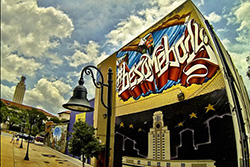
Locals set off on #besomebody world tour

What does it take to #besomebody? Three locals set off to share an international message of self-determination and positivity, fueled by branding expertise and creative street cred. 

Jobs available: Chill Shaved Ice expands

Alia Ali’s business venture, Chill Shaved Ice Bar, began in June 2011 at Findlay Market. Her shaved ice stands out among the rest because the syrups are all natural.   “I’ve always been in business,” says Ali. “I flipped cars in undergrad and imported jewelry after I graduated. I’m interested in health and wellness, and decided to marry business and healthy with Chill.”   In order to expand her business, Ali looked at local organizations that offer business support to entrepreneurs. She was one of 10 finalists in Bad Girl Ventures last fall. And in November, she participated in business classes at Xavier, and then applied to Xavier X-Lab, which pairs businesses with MBA students. That session just wrapped up, but Ali plans to participate in the summer session as well.   “I hope Chill continues to show people that natural and delicious can be in the same sentence,” says Ali.   As of May 23, Chill added to its location options with a Smart car, more like a food car than a food truck, that currently sits outside Kenwood Towne Center's food court entrance, near Forever 21. This makes Ali's second year with a cart outside the Butterfly Show at Krohn Conservatory.   The expansion means that Chill is currently hiring. If you’re interested, contact Ali via Facebook or Twitter (@ChillShavedIceBar), or email her at chillshavedice@gmail.com or give her a call at 513-602-1697.   By Caitlin Koenig Follow Caitlin on Twitter

Wine country comes to CVG with Vino Volo

Frequent flyers can now enjoy a bit of wine country at the Cincinnati/Northern Kentucky International Airport. Vino Volo, a San Francisco-based company, opened a tasting lounge, restaurant and wine shop in Concourse B near the airport’s Starbucks and Outback.   Vino Volo offers wines by the glass and by the bottle, plus flights of three wines for those who want to sample different options before purchasing a glass or bottle. The CVG location features a flight of Kentucky wines that aren’t offered at the other Vino Volo locations.   “We try to bring something to the table that guests might not have tried before,” says Sarah Evans, marketing specialist for Vino Volo. The wine lists at Vino Volo feature a selection of whites and reds from around the world.   Doug Tomlinson, a former consultant who traveled a lot for his work, founded Vino Volo in 2004. He saw that airports didn’t offer quiet places for people to catch their breath between flights, so he combined his personal passion for wine with his business idea. Vino Volo now has 27 locations in 18 airports across the country, with one opening soon in Cleveland and another in LAX’s new terminal this summer. There’s also one city store in Bethesda, Md., with another scheduled to open in Virginia this summer.   Vino Volo has been called an “airport oasis” because it offers travelers the chance to escape the craziness of the airport and enjoy a glass of wine.   Staff members are also available to answer any questions guests may have about the wine selections, including suggesting wines. Vino Volo has won 25 Airport Revenue News awards, including “Food Operator with the Highest Regard for Customer Service” seven years in a row.   “We’re excited to be bringing a little bit of wine country to the Tri-State area,” says Evans.   By Caitlin Koenig Follow Caitlin on Twitter

Covington’s parking meters ‘save the change’

ABM Parking Services, the national facility management company that manages the parking meters in Covington, recently adopted the Park-by-Phone program to make parking more convenient for customers.   Park-by-Phone eliminates the need for coins and cash to pay for parking. Users can extend their parking sessions by calling the Park-by-Phone telephone number or by downloading a mobile app for Android or iPhone. Parking history and receipts are available online, and users can even pay with a mobile phone at any parking meter that offers PassportParking.   Credit card machines are expensive to purchase and use, and every time the public charges on a credit card machine, the company that rents out the meter gets charged.   The City of Cincinnati has invested in credit card machines, but Covington looked for a different answer. And they found it with Park-by-Phone, which charges an annual fee of $5.95, regardless of the number of uses. The fee is less than getting a parking ticket, and the city pays 100 percent of the total parking fees with the company that rents out the meter charging an additional convenience fee of 10 percent to the customer on top of the annual fee.   But Park-by-Phone isn’t for the average Covington resident or occasional visitor—it’s geared toward companies that utilize the city’s parking meters, says Natalie Bowers, marketing and communications director for the City of Covington's Department of Development. For example, companies that make deliveries around Covington can give each employee an account and receive itemized monthly statements to keep track of parking expenses. That way, businesses can expense parking costs rather than pay for parking tickets.   By Caitlin Koenig Follow Caitlin on Twitter

Our Partners

Taft Museum of Art
Warsaw Federal

Don't miss out!

Everything Cincinnati, in your inbox every week.

Close the CTA

Already a subscriber? Enter your email to hide this popup in the future.