Smartfish Studios selling Drunk Music Reviews prints
Back in 2011, Cincinnati drinking buddies Caitlin Behle and John Sebastian decided to make use of their opinions by critiquing musicians with both words and illustrations.
Back in 2011, Cincinnati drinking buddies Caitlin Behle and John Sebastian decided to make use of their opinions by critiquing musicians with both words and illustrations.

Clarence Elkins has now spent the past seven and a half years in his home and around those he loves, which is as much time as he spent behind bars for crimes he did not commit. About 15 years ago, Elkins was arrested and taken to county jail, and was later convicted and sentenced to life in prison for murder and rape. On Dec. 15, 2005, almost eight years later, Elkins was exonerated by DNA testing, thanks in large part to the countless hours of work invested by the University of Cincinnati’s Ohio Innocence Project—a team of students that fights for the wrongfully imprisoned. When Elkins first heard the guilty verdict read, he says it took some time to sink in because he kept trying to convince himself that he was trapped in a nightmare or a horrible dream. “I just thought that it would be over soon, but that wasn’t the case,” Elkins says. “After I was sent to prison, it dawned on me that it was for real, and it wasn’t a nightmare and how tragic the injustice was—not only on me but on my entire family.” In hopes of helping to alleviate that burden on other innocent individuals and their families, Elkins and his wife, Molly, donate $5,000 per year to the OIP. In the past 10 years, OIP has helped 16 individuals like Elkins remember what it’s like to be free. The gift, which helps top-performing OIP students further their educations, is more than just a scholarship. For Elkins, it’s a token of his appreciation. “The students were always—they’d give me hope, and they were so kind—they do great things for people, and not only the people that have the injustices upon them, but their families as well,” Elkins says. “They cared enough about me to look into the injustice that happened to me. I was raised in believing you get what you give—and I always believe that, and that’s what I want to do. I just want to give back to those that give to me—that help me.” Do Good: • Like the Ohio Innocence Project on Facebook. • Keep up with OIP's work through their newsletter. • Support organizations like the OIP by giving. By Brittany York Brittany York is a professor of English composition at the University of Cincinnati and a teacher at the Regional Institute of Torah and Secular Studies. She also edits the For Good section of SoapboxMedia.
Every summer, ArtWorks Cincinnati unleases a fleet of young art apprentices into the city—they build murals, create theater scenery and spread public art across the region. This year's projects include Random Snacks of Kindness, a new kind of entrepreneurial training program that quite literally feeds the work of non-profits. Video courtesy Golden Hour Moving Pictures.
The Children’s Home of Cincinnati is taking the steps needed to become a national leader in health care integration. “There are more examples of policies that say we need to do health care integration than there are of actual examples of organizations that have done this and done this well, which tells you The Children’s Home is pretty cutting-edge,” says Barbara Terry, vice president of health care integration at The Children’s Home. Terry, who says she is passionate about health from a holistic standpoint, has 35 years of experience and recently joined The Children’s Home to help the organization introduce physical health care to its already existing mental health care programs. But she says she is not the only one responsible for the idea of health care integration. “They’ve certainly been reading the tea leaves and saying, ‘We should think about systems—plural—in this community,’” Terry says. “So you think about mental health, education and human services as systems. We really need to figure out how we integrate systems so that vulnerable children get the care they need—the right care at the right place at the right time—and that becomes huge.” For Terry, education and prevention are key. “We know that individuals who face challenges in the mental health arena—typically as they get older—they have tremendous chronic health problems,” says Terry, who attributes the issue to a difficulty in navigating an array of disconnected systems. To address that issue, Terry envisions a system that recognizes that the mind and body cannot be separated. And while the idea might begin with The Children’s Home, she says the effort needs to span across the community. “This isn’t just The Children’s Home—it’s about children and adolescents in our larger community,” Terry says. “They’ve been willing to invest in me and invest in this approach, but my vision would be that we need to work with the community. We need to help share successes with the community so that we can say, ‘How can this spread?’ I don’t want the work to be insular. We have to appreciate community here.” Do Good: • Get involved by contributing items on The Children's Home's wishlist. • Volunteer with The Children's Home. • Assist The Children's Home by donating or supporting a classroom. By Brittany York Brittany York is a professor of English composition at the University of Cincinnati and a teacher at the Regional Institute of Torah and Secular Studies. She also edits the For Good section of SoapboxMedia.
When Will Hillenbrand was growing up in College Hill, he spent a lot of time reading picture books at the library, which would make him late for his baseball games at next-door Crawford Field. “You may wonder, ‘How do we encounter art in our lives?’" Hillenbrand says. "And actually, it’s all around us. We might not realize it; however, the art that engaged me was through storytelling.” The library was critical in Hillenbrand’s journey as an illustrator and writer, but his journey actually started at his father's barber shop, where he spent time listening to “big fish stories." “One way I’d kind of disappear in the background easily would be during the summer because my mom would make my dad a hot lunch, and I’d walk it up to the barber shop,” Hillenbrand says. “I’d walk the lunch up there and put it in the hall closet and then sit under the air conditioner and try to become part of the wallpaper.” Hillenbrand says he remembers one of the other barbers talking to a customer about his other job, which was cutting down trees, and how it was similar to cutting hair. “So if I were hearing something in that little synopsis, I might end up going home and drawing a person with a forest on their head and a barber cutting it, but it’s comical,” Hillenbrand says. As a child, Hillenbrand had the exposure and opportunity to not only fall in love with his craft, but also to practice it. And it’s this same opportunity that he’s now offering to other children. From now until the end of August, children have the chance to submit artwork that depicts their heroes for consideration in Hillenbrand’s e-book, which is entitled Everyday Heroes: Local Children and the People Who Inspire Them. “What we’re interested in are characters that fall and get up and show us how they manage their challenges and struggles,” Hillenbrand says. “And we cheer for them and want them to do it, and for children, we want to be able to give them opportunities to share.” Hillenbrand has hosted two workshops at the Public Library of Cincinnati and Hamilton County thus far, and children have been able to not only brainstorm, but also to dabble in digital media. “There was a bridge that the children and I kind of walked back and forth across—it wasn’t a podium—it’s not that kind of thing,” Hillenbrand says. “And the library’s a great context because around the walls, you’ve got idea people—ideas that might be a first story—and when they participate, their ideas are validated, and they can feel like, ‘I’m an idea person, too,’ and isn’t that a good feeling?” Do Good: • Check out Hillenbrand's library workshop about digital drawing on YouTube. • Children ages 12 and under are encouraged to submit their artwork to the library for consideration in Hillenbrand's e-book. • Learn about the variety of ways you can support the library. By Brittany York Brittany York is a professor of English composition at the University of Cincinnati and a teacher at the Regional Institute of Torah and Secular Studies. She also edits the For Good section of SoapboxMedia.
Petra Cuisine, a Mediterranean sandwich shop, opened June 1 at Newport on the Levee. Petra is housed in the space formerly occupied by Smoothie King, near Saxbys Coffee on the Riverwalk level. “Petra” is a lost city in Jordan that is considered one of the Seven Wonders of the World. Owner Al Alsheyyab thought it would be a unique, authentic name for his restaurant that also ties into the food he serves. Alsheyyab, a Cincinnati native, has a background in restaurants—he worked for Skyline Chili for six years, then at a few other eateries before deciding it was time to open one of his own. Petra Cuisine’s specialty is the gyro, but his falafel has also been popular, he says. “The Levee has a great atmosphere,” he says. “Lots of people come to see the river or go to the aquarium or the movies. I’m hoping Petra will be able to provide something quick to eat before people go on to the next thing.” Petra is open from 11 a.m. to 9 p.m. weekdays and 11 a.m. to 11 p.m. weekends. By Caitlin Koenig Follow Caitlin on Twitter
From growlers of fresh beer made to last for a month to Skype tasting sessions with the nation's top brewers, the new Party Source Campus is custom designed to offer expansive exposure to American artisanal spirits.
Kathy Merchant and Amy Neyer, local wine enthusiasts, recently launched their wine education blog, Vino Ventures. The pair designed the blog to provide a creative environment to share their passion for wine, as well as provide educational content and information about events happening in the area. “We want to tell stories in a verbal and visual manner,” says Neyer, who has written about wine for the Cincinnati Enquirer and CityBeat. Merchant, the president and CEO of The Greater Cincinnati Foundation, became interested in wine a business trip to California in the summer of 1994. “I visited Napa Valley, and it felt like coming home,” she says. After that, she pursued her wine education informally, and then decided to become more serious about it about 10 years ago. She holds a diploma level accreditation from the Wine and Spirit Education Trust, and is a Society of Wine Educators Certified Specialist. Neyer’s love for wine began in 1990, when a friend, who was a great cook, exposed her to different types of wine and food pairings. “Over time, I visited San Francisco and became more interested in wine, and I met people who were like-minded,” she says. “I learned as much as I could, and decided to take it to the professional level a few years ago.” Neyer holds an Advanced Certified designation from WSET and like Merchant, is a SWE Certified Specialist in Wine. The pair actually took the exam for that certification together last fall. “Wine can be intimidating if someone doesn’t take the time to simplify it and make it fun,” says Merchant. “We want to offer that to people through education and our blog.” Along with their blog, Merchant and Neyer are also launching a new independent credentialed wine education program in the area. Starting in July, they’ll be offering a Level One certification course on behalf of the Cleveland-based American Wine School. “We see this as an opportunity to provide something that no one else is doing,” says Neyer. “If people want to learn about wine, there are wine tastings of different forms, which can be fun. But some people want to learn more and immerse themselves more deeply than an hour at a wine store or smaller event. We’re hoping to provide that—an independent perspective that was born out of getting smart about wine. And we’re passionate about getting people to enjoy it and learn more about it.” The classes will be held at the Metropolitan Club in Covington, and founders describe them as perfect for wine novices and enthusiasts who are looking for a formal education or a credential in wine. Register for the class here. By Caitlin Koenig Follow Caitlin on Twitter
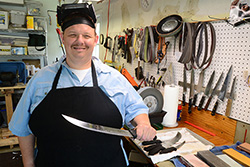
Like a surgeon with his scapels, chef Chris Weist knows the value of a well-sharpened knife. His business, Cincy Sharp, caters to the city's top chefs as well as any food enthusiast in search of the perfect blade.
Jack Wood Gallery, a vintage poster gallery, recently moved to Over-the-Rhine from O’Bryonville. The gallery features vintage posters and graphic art from the late 19th century and early to mid-20th century. Jack Wood opened his gallery at 2039 Madison Road in O’Bryonville in Oct. 1998; in Feb. 2003, the gallery moved to the space next door. And exactly 10 years later, Wood found himself looking for a new location because his landlord decided to move her business into the gallery’s space. “When I first opened the gallery, I thought O’Bryonville was a good place for it,” Wood says. “But when I came to OTR, I knew it was the perfect place for it now.” From the middle of the late 1800s, Cincinnati was home to some of the most highly regarded printing companies in the world. The Strobridge plant used to be on Central Parkway, four blocks from Jack Wood Gallery’s new OTR home, which made it a perfect location for Wood's one-man operation. “The latter half of the 19th century was a significant time for the Cincinnati poster industry,” Wood says. “The neighborhood was alive, and 50,000 people lived in a 15-block area in OTR. Now, we’re getting the same kind of energy and activity here. It’s a real renaissance.” The new space, at 1413 Vine Street, has a similar layout to the old space, with two large windows that face the street and plenty of wall space inside to display posters. Jack Wood Gallery also offers archiving, photography, framing and matting and appraisal services. The gallery features a variety of prints for sale, including Ringling Brothers and Barnum & Bailey circus images, the most significant collection of Strobridge posters in the United States, and World War posters from around the world. By Caitlin Koenig Follow Caitlin on Twitter
Our Partners