From Cincinnati to New Orleans, riverboat style
Kyle Rouse and his best friends, Bill and Alex Ross, set out on a river adventure in October 2011 traveling on a pontoon boat named the “Rosemarie.”
Kyle Rouse and his best friends, Bill and Alex Ross, set out on a river adventure in October 2011 traveling on a pontoon boat named the “Rosemarie.”

For most 13-year-old girls, vacations to the beach are sources of fun and relaxation, but for Abbey Keith, now 15, this was far from the case. “I felt absolutely terrible within the last couple days, so we went home early,” Keith says. “That morning I woke up at about 8:30, awaiting my doctor’s appointment my mom set up, but I felt absolutely awful. It was like that feeling right before you pass out—but all the time.” Keith says she doesn’t remember the car ride to the doctor, but when she woke up, she was in his office awaiting what would soon become a life-changing diagnosis. “He could smell—some people can smell diabetes," Keith says. "It’s a fruitiness on their breath, and he immediately called the ambulance. I had a blood sugar of almost 700.” The last thing Keith says she remembers was riding in the ambulance and seeing all the cars on the highway split, but after that, she was in a coma. “It was really—it was stressful because I could hear how scared my mom was in her voice,” Keith says. “I was in the ICU for three days, and it was stressful for my family, especially because my little sister couldn’t see me.” Keith now manages her Type I diabetes, but life is far from easy. She dances and plays field hockey, but not without struggling to fit her pod into her costume or stopping in the middle of practice because of blood sugar fluctuation. “I can’t imagine what it would be like without having to deal with—not having to keep my PDM Meter with me all the time—and not having to worry about it every second of every day and managing how I feel and stopping myself in the middle of practice whenever we’re working really hard,” Keith says. “I’m one to always push and go, and when I have to stop and take care of myself and watch everyone else work their butts off, it makes me really—it makes me sad that I can’t do that anymore.” More than anything, Keith says she wants to do everything she can to help make sure others don’t have to go through what she does on a day-to-day basis. Next month, she’ll join the Juvenile Diabetes Research Foundation’s Children’s Congress in Washington, D.C., to share her story and try to urge Congress to increase support for diabetes research. “It’d be nice to not have to wear a pump anymore," Keith says. "It’d be nice that my family doesn’t have to worry about me. It’d be nice that I don’t have to explain why everything happens the way it does to all my friends—make my boyfriend less worried about me all the time. If there was more funding, and we were closer to getting a cure, I feel like we’d have so much more hope for becoming normal again, which I would like because I’d love to get rid of this. My mom has told me a million times—she’s like, ‘You could have mine,’ but it doesn’t work like that. It’s just one burden that I wish I did not have—that I didn’t have to worry everyone around me.” Do Good: • If you know anyone with diabetes, provide them with support. • Get involved with JDRF Advocacy. • Support the JDRF by donating. By Brittany York Brittany York is a professor of English composition at the University of Cincinnati and a teacher at the Regional Institute of Torah and Secular Studies. She also edits the For Good section of SoapboxMedia.
The old cardboard document storage box is getting a makeover, complete with ergonomic design, through the work of a Cincinnati startup. Blegalbloss founder and president Will Scott has created a line of office products that make document storage, organization and use easier. The company's signature product, BOXIE, is an ergonomic, lockable file box. The tough, rip-resistant boxes have a handle that is curved and slanted to make the box easy to pick up and carry. The box also has a locking feature, is made from 65 percent recycled materials, and is 100 percent recyclable. Scott, a Northern Kentuckian, previously owned a record management company, and had worked in the financial service industry in sales and accounting. "When I was in the record management industry, I had some time to think about how people use these storage items, and had a little black book of ideas," Scott says. "Looking at the boxes themselves, I realize they hadn't changed in nearly 100 years." That's when he went to work and began making the boxes better through design. "I went about the task to redesign these sorts of things, and to make them stronger," he says. "It wasn't until I watched someone carrying the box that I realized that had been designed totally wrong." Blegalbloss (pronounced Blee-guhl-bloss) was launched in early 2011, and the BOXIE was first delivered in January. In addition to boxes, the company sells Roo brand document organizers and DominoTwin office supply organizers. The products are sold through 2,700 retailers. The company's goal is to be in 4,000 retail stores by year's end and 10,000 by 2014, Scott says. Blegalbloss is working to expand the brand globally, and launch other products. Among Blegalbloss retailers are GoEvolved.com, Amazon, eBay and Office Depot. Since most of the innovation is in the products' design, their costs are competitive with traditional storage boxes, Scott says. His company currently has about 45 patents pending and 10 already issued. "We've built a better mousetrap," Scott says. "We're selling this at the same pricing (as competitors) in the marketplace, with better value and features." By Feoshia H. Davis
Sherman Bradley, CEO and founder of Consider the Poor, understands what it means to live in poverty. “I’m what you would consider the first generation to move from poverty,” Bradley says. “Both my parents grew up in poverty. My grandparents grew up in poverty. My great-grandparents were shipped off as slaves—so I understand a lot about what has been going on in our environment, in our country.” At the age of 5, Bradley and his parents, who put their money together from years of hard work and the assistance of the G.I. Bill, moved from inner-city Cincinnati to suburbia, which Bradley says enabled him to learn what was possible beyond what most of his family had experienced and been exposed to. Education and a desire to help others transition out of poverty led Bradley to community-based roles. For 10 years, he served as vice president of City Gospel Mission, where he oversaw components like the shelter and the recovery program; and in 2011, he started a business called Green Recycling Works, which enabled CGM to employ the men who graduated from its rehab program. “We prepare them to get back into society as viable tax-paying citizens, as opposed to individuals who find themselves on the wrong side of the law,” Bradley says. It was six years ago, however, and on the two-year anniversary of Hurricane Katrina, when Bradley traveled to New Orleans and experienced first-hand the conditions in which the poor were living. “I was able to learn information that was necessary to educate City Gospel Mission’s volunteer base on how to interact and really understand the poor,” Bradley says. “To build empathy and respect and give them meaning and value, then work with them toward transitioning out of whatever their particular situations are.” Bradley then founded Consider the Poor—an organization whose mission is to break the cycle of poverty by advocating, consulting, training and serving others. By hosting elementary and health education events like HopeFest and providing training to businesses and community action agencies, individuals—regardless of their economic situations—come together and see each other as community members, as people who look out for, and who care for, one another. “We want to educate organizations so that they can create cultures inside their programs, businesses or institutions that would offer people a greater opportunity to succeed,” Bradley says. “But in order to do that, we’ve got to understand where they’re at. Oftentimes, we want to take a lasso and pull them out of their city and put them in a suburban place and say, ‘Now fend for yourself,’ but there’s so much more involved in the process of transformation, and at the very root of it, it requires significant relationships with people who aren’t in that same class with them who can help teach them the hidden rules of the new environment that we’re asking them to succeed in.” Do Good: • Attend HopeFest on June 29 in Washington Park, and share the event with your friends. • Like Consider the Poor on Facebook, and encourage your business or organization to educate their staff and encourage a more welcoming environment for all individuals. • Contact Consider the Poor if you'd like to donate or volunteer, and take the time as an individual to learn more about those living in poverty. By Brittany York Brittany York is a professor of English composition at the University of Cincinnati and a teacher at the Regional Institute of Torah and Secular Studies. She also edits the For Good section of SoapboxMedia.
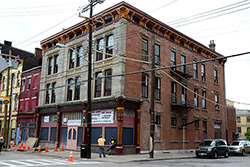
The renovation of the much-admired but long-neglected Crown Building on the edge of Findlay Market is more than a story of timely real estate development. It's the tale of a creative and determined couple with a dedication to historic preservation and a deep belief in the value of living and working in the heart of Cincinnati.
Mainstrasse Village in Covington has seen a handful of new businesses open in the past few months, including Main Bite, which opened May 28. Main Bite’s menu features seasonally-inspired small plates made from the freshest ingredients owner Margie Potts can get her hands on. Potts, a cooking instructor and media personality, sources her ingredients from the restaurant’s on-site garden and a plot she has in a community garden. Her vendors are all local, even her bank and payroll. “When you establish yourself in a community, you do as much as you can for the community, and they’ll support you too,” says Potts. Potts owned a restaurant a few years ago—MJ’s on Main—but it was more of a bar and was hard to change, she says. It wasn’t exactly what she wanted, so she sold it, and started looking for another space in Covington to open her new restaurant. She chose was a white building that needed a lot of TLC. It’s now painted different colors and boasts an outdoor courtyard with window boxes and flowers everywhere. Potts plans to string lights in the courtyard for a glowing effect at night. “My goal with Main Bite is to present healthy food options in a way that makes them beautiful and delicious, and creates a fun dining experience,” she says. Main Bite is now open for lunch during the week from 11 a.m. to 2 p.m; dinner is served Tuesday-Friday from 4 to 11:30 p.m.; expanded weekend hours are Saturday and Sunday from 11 a.m. to 11:30 p.m. By Caitlin Koenig Follow Caitlin on Twitter
Zooted Delivery brings food to your front door from restaurants around the city that don’t typically deliver.
Independent media agency Empower MediaMarketing recently created a new Disruptive Media Fellowship at The Brandery, Cincinnati's consumer brand business accelerator. The $10,000 fellowship will go to a Brandery startup whose idea is most disruptive to the media landscape. The fellowship recipient will be announced later this month, as The Brandery's incoming 2013 class begins, says Empower MediaMarketing's Director of Content Strategy Kevin Dugan. "It seems that disruptions are taking place almost every day as consumer habits change," Dugan says. "We feel that for companies reacting to that is really more of an opportunity than anything else. If you are helping create the disruptions, it can become a competitive advantage." Empower MediaMarketing is an independent media agency that plans, buys, creates and proves media impact for its clients. Dugan and CEO Jim Price are also Brandery mentors. The Brandery launched in 2010 to offer funding, mentoring and partnerships for consumer marketing businesses. Brandery companies receive $20,000 in startup funding, and pitch their companies to potential investors at a Demo Day at the end of the four-month program. The Brandery is a member of the Global Accelerator Network, and companies from across the country apply to the emerging accelerator. It is annually recognized as one of the elite startup accelerators in the country. More than 60 mentors work with the companies, which each receive $20,000 in seed money. Leading Cincinnati-based agencies offer free marketing and media guidance to each of the startups. "As a company, we have been mentoring startups since 2010," Dugan says. "We really enjoy the process and wanted to increase our support (of The Brandery). This allows us to increase commitment and help startups." By Feoshia H. Davis
When James Fayal and Ricky Ishida moved to Cincinnati last summer to focus on start-ups, they had given little thought to launching their own. But, before a year has passed, the Milton Street housemates have embarked on one of eight national Venture for America initiatives (two from Cincinnati) that demonstrate just how much they have come to embody the entrepreneurial spirit. As members of the inaugural Venture for America class of fellows, the Zest Tea founders exemplify the essence of the national, startup-generating project designed to attract top collegiate talent to and retain them in “flyover” cities like Cincinnati. Both moved to Cincinnati to work for start-ups that intrigued them. Fayal, a University of Maryland grad, chose to work with CincyTech, while Ishida of Cornell landed at ZipScene. Given the intense work schedules of start-ups, it’s no surprise that their idea for their own start-up grew out of a blend of personal experiences and frustration. Both preferred tea to coffee—Ishida based on experience dating to his childhood in Japan and Fayal from his high school days. Still, neither could locate traditional teas with enough caffeinated punch to help them get through the extended days of the start-up world. Instead of complaining, they started on a search for a coffee-caffeine alternative. They found no tasty tea product on the market that provided coffee caffeine levels. That's when Fayal and Ishida knew they were on to something. They just didn’t know what. “We started developing our own [tea] blends,” Fayal says. There was Cinnamon Apple Black Tea and Pomegranate Mojito Green Tea; Blue Lady Black Tea and Moroccan Mint Green Tea. “We started playing around with some tea extracts, with additional antioxidants, and caffeine,” Fayal says. By blending tea extracts with high quality teas, they focused on good (read: not bitter) taste while boosting caffeine levels. What began as a beverage born of personal interest became a business plan very quickly over the last month thanks to another VFA innovation. The non-profit launched a national awareness campaign through RocketHub aimed at nurturing their young Fellows’ community involvement and start-up aspirations. Members of the first class of VFA fellows were encouraged to enter a start-up competition of their own, with cash prizes awarded to the top three already crowd-funded ideas. They created a RocketHub site for “Zest Tea - Bold Teas With An Energizing Kick,” and started raising money. To sweeten the pot, they turned the very funding process into a bit of a game—folks who donate get to help decide which teas will make it to market first. "We figured we’d let the funders make the final decision on the first four," says Fayal, who enjoys all eight of the blends on the ballot, but admits to a particular fondness for Pomegranate Mojito and Cinnamon Apple blends as well as the more traditional Earl Grey. By Elissa Yancey Follow Elissa on Twitter.
For children at the Clovernook Center for the Blind and Visually Impaired, Discovery Youth Summer Day Camps allow them to further their own skills and knowledge while also bettering the community. From technology and art activities to life skills and neighborhood involvement, campers can engage their senses while tapping into areas that they might not have otherwise had the opportunity to explore. Participants at art camp, which ended this past week, have no vision, limited vision or are losing their vision. They created pieces that sparked dialogue about what it means to be part of a larger community. One project involved the campers creating wind chimes made of cat and dog clay cutouts. The kids then donated them to the SPCA of Cincinnati to sell. “They enjoyed it, but it was very sad,” Art Instructor Scott Wallace says of the children’s visit to the SPCA. “It gave me an opportunity to go into this whole thing about art in terms of how some of the greatest art is not the world’s prettiest, and some art talks about issues and things that are going on and some things that are not great, so it gave us the chance to talk about what’s important.” Campers also worked together to create a colorful heart made from recycled bottle caps—which can be dangerous if left as trash—as a statement about healthy communities. “What’s happening is—wild birds are eating them—and they can’t digest them,” Wallace says. “So it’s killing them. It’s so much about recycling. You can take the most insignificant material and make great art.” Two of the children who worked to create the bottle piece project are totally blind, but by working together with other campers, they were able to create a beautiful display. It's what Wallace enjoys the most because he’s not so much an instructor as he is a facilitator. “For people who have never had vision—their approach is totally different—because they have a certain way of working and a certain level of expectation for their work, and they’re completely cool with it,” Wallace says. “The blind community and the people who’ve never had vision are fine. I think they get tired of us trying to instill our beliefs, but what I like to do is make the best of the vision they have left. And I just sit back and let them do their thing, but it really shows what community can do.” Do Good: • Like the Clovernook Center on Facebook, and keep an eye out for photos of campers' art work. • Support the Clovernook Center by donating. • Get invovled by volunteering. By Brittany York Brittany York is a professor of English composition at the University of Cincinnati and a teacher at the Regional Institute of Torah and Secular Studies. She also edits the For Good section of SoapboxMedia.
Our Partners