
Art Museum hires Danis for renovation
The Cincinnati Art Museum awarded the contract for the renovation of its former Art Academy building to Dayton-based Danis Building Construction Company Read the full story here.
The Cincinnati Art Museum awarded the contract for the renovation of its former Art Academy building to Dayton-based Danis Building Construction Company Read the full story here.

Students from war-torn Afghanistan are hoping to find solutions to that country's social and economic problems with help from a southwest Ohio university's business school. Read the full story here.
Our Bodies, Ourselves was the kind of book that libraries banned and women stashed under their beds like pornography—a fixture of college dorm rooms that shocked conservatives with its candid discussion. UC's Wendy Kline even wrote a book about its influence. Read the full story here.
FotoFocus, a nonprofit arts organization, announces the October 2012 launch of its first biennial month-long regional celebration of historical and contemporary photography and lens-based art. On Friday, Oct. 14, 2011, 7 to 10 p.m., in collaboration with 3CDC’s Fountain Square Rocktober Series, FotoFocus will preview highlights of the October 2012 upcoming event with video works and still images from featured exhibitions. Read the full story here.
At the latest gathering of 140 local sustainability advocates, members of the newly forming group known as the Green Umbrella shared best practices, brainstormed ideas for the future and experienced fellowship in the first Gold LEED certified Red Cross headquarters in the country. Located in Keystone Park in Evanston, and clearly visible from I-71, the Red Cross headquarters has a rooftop garden that, along with a bioswale, helps the nonprofit reuse 90 percent of the water that falls on the property. “They also add beauty to our building,” says Sara Peller, CEO of the Cincinnati Area Chapter of the American Red Cross. The building, which came in $1 million under budget, was a joint project between the Red Cross, Neyer Properties and emersion DESIGN. “It’s functioning extremely well for us,” says Peller, who notes that 120 volunteers helped with the building design process. In addition to energy-efficiency elements and minimizing construction waste, the building allowed for the Red Cross to incorporate a Disaster Operations Center, a long-time community need that could not be met at the old headquarters downtown. Now the Cincinnati area Red Cross, which services 36 counties, can serve as the information hub in case of emergency or disaster. “Many ills have been cured by this building,” Peller says. As for the Green Umbrella, the ongoing initiative to create a comprehensive network of sustainability initiatives around Greater Cincinnati and Northern Kentucky continues to gain steam and support. Working groups focus on areas as diverse as urban agriculture and corporate sustainability. The ultimate goal, to create a single resource from which all sustainability-minded residents can learn, moves ever closer to reality with website development and continued cooperation between local businesses, nonprofits and educational institutions. By Elissa Yancey
Jan Rosenbaum creates bioscience matches made in heaven. As an executive-in-residence with Cincinnati-based seed-stage investor CincyTech, Rosenbaum matches up physicians with medical-device engineers, therapeutics companies with molecular pharmacologists, and diagnostics makers with target markets. Rosenbaum’s role is to look for opportunities to create companies – or commercialize research – out of health care and biotechnology work being done at local research institutions. For the last 12 months, that work has included three trips to Israel to form connections with its dynamic and prolific medical research and biotechnology industries. Rosenbaum’s work comes as the Cincinnati USA Regional Chamber makes a big push to create strong business relationships with Israel. A delegation of about 30 business leaders led by the Chamber traveled to Israel last November to learn how the Israelis fund, promote and advance high-tech startups. Rosenbaum’s trips have provided a deeper dive into medical technology and biotech. Among other things, she has found a potential distributor for a CincyTech portfolio company’s product and helped form a medical device development and commercialization program between Cincinnati Children’s Hospital Medical Center and Ben Gurion University in Israel. She also has helped create a collaboration with a medicinal chemistry company based in Israel. The goal is to further develop compounds that have been identified by one of Children's leading oncology researchers, who has taken a novel approach in the treatment of leukemia and Crohn's disease. “All of these are examples of opportunities that lead to economic development in both Israel and Cincinnati through creation of startup companies, driven by the attraction of Cincinnati Children’s,” says Rosenbaum. “The impetus for relocation to our region occurs once the company reaches the point of needing clinical development, market penetration, and sales and marketing distribution through a U.S. presence.” Rick Schottenstein, the managing director for the state of Ohio’s Eastern Mediterranean Regional Office in Tel Aviv, calls Rosenbaum “an extraordinary asset to the state”. “It takes someone of Jan’s caliber to analyze these very sophisticated opportunities,” he says. “She has the business background and the scientific background to do that.” A native of Buffalo, New York, Rosenbaum came to Cincinnati in 1986 after a post-doc fellowship at Stanford University School of Medicine doing cardiovascular research and clinical pharmacology. For 23 years, she worked as a principal scientist at Procter & Gamble Pharmaceuticals, evaluating licensing opportunities, helping to take internal research to the marketplace, and conducting and coordinating internal and external pre-clinical research. Since joining CincyTech in January 2009, Rosenbaum has worked closely with Nicole Robinson, executive director of the Center for Technology Commercialization at Cincinnati Children’s, and Dr. Dorothy Air, associate vice president of entrepreneurial affairs and technology commercialization at the University of Cincinnati. Rosenbaum delves into research underway at both institutions and pairs researchers and opportunities with strategic partners. She has been instrumental in the formation of a number of CincyTech client companies, including Airway Therapeutics, which is based on 10 years of research at Cincinnati Children’s and will develop surfactant proteins to help premature infants’ lung development; and CardioCeption, a University of Cincinnati spinout that is creating non-traumatic heart therapies. In Israel, Rosenbaum finds cultural affinity as well as professional affinity: prolific researchers aggressively looking for Ohio expertise on taking products to market. “They are hungry to create and eager to innovate,” she says. “It is an extremely entrepreneurial culture. I absolutely love the work we are doing there.” By Sarah Blazak for CincyTech
With two new joint degrees, Northern Kentucky University leads the country in connecting law students with the digital age. The Chase Law and Informatics Institute at NKU held its first classes in August. “We want to pull together the study of informatics with the legal analysis of the contractual practices which are shaping business and commerce,” says Jon Garon, inaugural director of the Chase Law and Informatics Institute. The institute offers two joint degrees; a Juris Doctor/Masters of Business Informatics and a Juris Doctor/ Masters of Health Informatics. No other law school in the country has these kinds of degrees. “There are a few schools that have law and technology programs,” Garon says. “With the convergence of the law school and the College of Informatics, we are really at a unique position. Our students will be fully immersed in the both the informatics world and the world of law ” This means studying the rapidly changing field of law in the age of enormous amounts of data and ever-changing technology, including disruptive technologies. “A disruptive technology is something that is changing the way businesses interact with their customers,” Garon says. “For example, digital photography came around and completely reshaped the industry.” With analog photography, ownership was simple. But, with digital files and the Internet, there are more questions about ownership and fair use than ever before. The technology fundamentally rewrote the social contract between the parties, so there has to be new law to govern that. Garon is a perfect candidate to run the new institute because of his background in law and teaching. “Each step in my career has been a hands-on approach to how data and media and how they are reshaping the way we think, as well as the way we do business,” Garon says. He worked with companies as the Internet grew and worked with companies to hel them deal with the security of online health information. As technology continues to evolve, there is an increasing need for companies, even at the small, family-owned level, to understand what they need to protect and how to do that. Garon hopes that the NKU institute will produce lawyers who understand how the worlds of law and information work together. “We are developing a much more strategic lawyer. One who understands not only the technical aspects of a contract, but also is able to advise a company on their internal practices and their approach to legal issues,” Garon says. “Our graduates will be the most flexible and most ready to develop processes to deal with the new world we live in.” By Evan Wallis
Silicon Valley. Boston. Austin. When it comes to technology jobs, those familiar locations top the list. Unless you consider a report issued in February by Dice.com, a career site with more than 8,000 customers who advertise or post their tech jobs nationwide. Based on the number of job postings that month, three Ohio cities -- Cincinnati, Cleveland and Columbus -- ranked second, third and fourth, respectively, in the percentage increase in job opportunities over the previous year. Silicon Valley ranked 10th. While those Ohio cities dropped out of the Dice.com top 10 this summer, similar reports by those like Monster.com and BusinessWeek indicate that one or all are consistently in the mix for new IT job opportunities. And with average salaries ranging from $66,000 in Cleveland to $74,000 in Columbus -- at least among employers posting on Dice.com -- those opportunities are significant, say those who follow Ohio's economy. Alice Hill, Dice.com's managing director, says part of the surge is related to a recovery that has not yet come to many other economic sectors. "A lot of jobs were on hold due to the recession," she says. "Hiring managers are now more confident. We saw that start in California, spread to New York and then we started to see the recovery happening in technology segments in smaller cities." The Northeast Ohio Software Association (NEOSA) notes in its 2010 IT report that both 2008 and 2009 were difficult for tech firms in the region because of the economy. That turned around last year, when nearly 60 percent of firms surveyed said they planned to increase staff. And NEOSA's report for the second quarter of 2011 found that 66 percent of IT firms surveyed plan to hire in the next 12 months. "The fact that we're seeing growth in IT jobs is really not surprising at all because there's this pent-up demand for the new equipment, new software," says Bill LaFayette, a former economic analyst for the Columbus Chamber who recently launched his own economic consultancy, Regionomics, LLC. "But in terms of why Ohio, the important thing to understand is that IT jobs are not simply in IT companies, they are pervasive. " By Gene Monteith
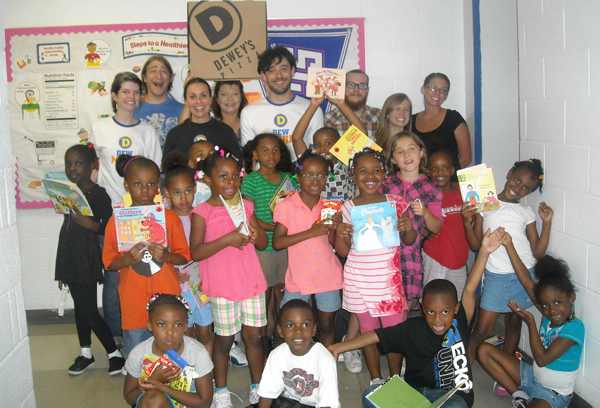
Dewey’s doesn’t offer delivery for pizzas, but non-profits can call and order volunteers and donation drives thanks to their non-profit initiative. Dewey’s non-profit, DewMore, started in early 2009 as an effort by employees and managers to give back to the community. “Dewey’s isn’t a business that spends its profits on advertisements or PR,” says Melanie Pugh, coordinator of the Greater Cincinnati branch of DewMore, “Our business has come from word-of-mouth referrals, so we try to give back to the community that has given us so much.” Pugh, who runs DewMore for eight stores in the region, started as the DewMore rep for the Crestview Hills store and in March of 2010 she started running the program for the region. Pugh, who has a love of volunteering and community work, had already expressed interest in playing a bigger role in the program. As coordinator, Pugh and her team of cooks, servers and dishwashers strive to create or attend one volunteer or fundraising event a month. “Sometimes we’ll contact, or one of our employees will know about, a non-profit that needs volunteers,” Pugh says. “Other times we create entire events ourselves to benefit a specific cause.” Most of the time, those causes are close to an employee’s heart. For example, November is Diabetes Awareness Month, and in May, the staff of Dewey’s lost a member due to complications of diabetes. So, in November, DewMore hosts a diabetes walk at Great American Ball Park. Since the employee being honored also created the Dr. Dre pizza, a chicken, bacon and ranch pizza with peppers, onions and jalapenos, the company also donates a percentage of that particular pizza’s sales to support diabetes research. Other events, including a kickball league with a team from each store, benefit causes like Autism Speaks. An employee who already volunteered for the non-profit suggested that the annual league benefit the cause. Each team member paid a $30 fee to play, and the kickball league raised more than $1,600 for Autism Speaks. “Now that we have DewMore, it gives us a chance to give back the community and get our name out there in a positive way,” Pugh says. “We would much rather be helping out a worthy cause than putting our logo on a billboard.” Do Good: Eat: A Dr. Dre pizza in the month of November and help further diabetes research . Contact: Melanie Pugh if you have an event where you could use volunteers. By Evan Wallis
Some complex chemical work at UC may some day lead to better smells around your house. The research by Dr. Anna Gudmundsdottir, UC chemistry professor, revolves around radicals, which are atoms, molecules or ions that are trying to change into something else. They have a lifetime of only fractions of seconds, which usually occurs during other chemical reactions. Gudmundsdottir focuses on triplet nitrenes. They are somewhat more stable than normal radicals, and can be turned into organic magnets that can trap a fragrance and slowly release it over time. While this kind of idea has been applied to heat-released fragrance, think dryer sheets, this may well be the first time light will be used as a trigger to release fragrance. “When you mop a floor, it only smells clean for a few minutes,” Gudmundsdottir says. “If this research was applied, a cleaning solution could slowly release once contacted by light and release a pleasant fragrance over an extended period of time.” The fragrance will be kept from full release by photoprotectant, which is created by the nitrenes. They act as a cap that is slowly taken away when contacted by photons. Gudmundsdottir is now working on how to time that release and control how much fragrance is released each time photons make contact. The research may also play a part in medicine. If a drug is tethered to the nitrenes, then put in a patient’s veins, it can then be targeted with light and released exactly where, and only where, it needs to go. “Light is one of the few things you can actually control in space,” Gudmundsdottir says. “You can’t control where you have the fragrance or drug molecules, but you can pinpoint where you penetrate with light. That is why it is so useful.” By Evan Wallis
Our Partners