Cincinnati

Routing Djokovic, Federer Rolls On

Well over a decade into his career, Roger Federer has achieved the rare sort of successes that surpass even childhood dreams. “When I was a kid, I wasn’t thinking of winning five Cincinnatis,” Federer said after his semifinal win Saturday over his Swiss compatriot Stanislas Wawrinka. “But then again, here I am in this great situation being able to do it — the first man ever.” Read the full story here.

Latest in Cincinnati
Cincinnati Innovates’ winners collect $100K in awards

One is a soccer dad tired of suffering on the sidelines. Another is a savvy entrepreneur with a plan to help professionals who have said “yes” to one too many find a safe and convenient way home. Still another is a mom inspired by healthy living. This year’s Cincinnati Innovates winners encompass an impressive range of ideas and strategies to improve quality of life and health. Rick Pescovitz of Under-the-weather.com won one of the top awards, the $25,000 CPG Strategies Award, for his all-purpose tent built to fit soccer chairs and protect fans from extreme weather. The other $25,000 winner, Brooke Griffin of Skinny Mom, has built a network of more than 70 mom-bloggers around the world. She won investment help from CincyTech. Another winner, Jon Amster of 321RIDE.com, received a $5,000 Taft Legal/Patent Award for his innovative approach to his membership-based designated driver service already used by the Cincinnati Reds and Dunhumby USA. In its third year, the Cincinnati Innovates competition awarded $100,000 in funding and in-kind services to entrepreneurs representing 12 business ideas. Since its inception, the competition has sparked millions of dollars of investments in companies with local connections. More than 200 entries vied for support this year, with awards given in a variety of categories. Commercialization award winners were selected by their sponsors (CincyTech, LPK) with help from a team of judges; in-kind services awards were chosen by sponsors with help from judges; community choice award winners were chosen by the public. Browse this year’s innovative entries here.  By Elissa Yancey Follow Elissa on Twitter.

West McMicken shows off ‘streetcar suburb’ history

Tucked at the bottom of the Clifton hillside, the West McMicken neighborhood features historic housing stock in an isolated area easily overlooked by passersby. But its well-maintained greenspaces and award-winning beautification programs offer a glimpse of the dedication of its neighbors, which will be on full display during the Cincinnati Preservation Association’s first “Fall into Restoration” series next month. “It’s absolutely beautiful,” says Margo Warminski, CPA’s restoration director.  The program features a tour of a restoration-in-progress—an 1885 Queen Anne that once served as the home of a streetcar conductor, is in the process of being restored to its original state.  “It’s a glimpse of late Victorian middle-class life,” Warminski says of the house, which was part of the neighborhood that grew up along Cincinnati’s original streetcar line. “We are very excited to be able to do this program.” She notes that members of the West McMicken Improvement Association will be on hand to discuss their work to keep their community green and flourishing. In addition to reclaiming abandoned buildings in the University Heights neighborhood, members have also fought off an intrusive highway plan and are currently working with Spring in our Steps volunteers to beautify the Warner Street steps. For more information about the neighborhood and the Sept. 22 tour, visit the Cincinnati Preservation Association. By Elissa Yancey Follow Elissa on Twitter  

Park[ed] creates permanent food truck venue in OTR

As crowds soak up free concerts, performances and movies in the new Washington Park, starting this Friday night, they’ll be able to soak up their favorite food truck fare there, too. That’s when, during the Friday night concert, the parking lot for the non-profit Emanuel Center on Race Street will transform into the inaugural Park[ed], by The City Flea, starting at 7 pm.  Located just across the street from the Park’s main stage, the lot typically sits empty after business hours and on weekends. During Park[ed], local food truck vendors will set up shop there and sell menu items perfect for taking right back to the park. “There’s huge demand for something to eat,” says organizer Nick Dewald, half of the dynamic duo behind The City Flea  (with his wife Lindsay). Once he learned that Emanuel staff was interested in finding new ways to connect more with Washington Park and the community, he set out to create Park[ed]. While he loves the restaurants on Vine and Main streets, he notes the lack of “grab and go” foods that would be ideal for park events like the Over the Rhine concert that drew thousands of fans to the Park. “This is giving people a quicker option,” he says. “If you leave the park to go find food, there’s a decent chance you won’t come back.” Since he was already connected with nearly all of the city’s food truck vendors through The City Flea, he asked owners what they thought of the idea. “Everybody was on board,” he says.  From staples like Café de Wheels and Turophilia to newcomers like C’est Cheese, Queen City Cookies and Eat Mobile, the options will vary from event to event and night to night. “We’re open to having every mobile vendor in the city take part in some way or another,” says Dewald. Offerings will vary based on the occasion, the size of crowd expected and the availability of vendors, Dewald says, but high demand could dictate more hours and more options.  “It could turn into a nightly thing,” he says. “It’s all about making it work for the vendors as well.” For his part, Dewald will set up a calendar for the space and publicize it, using a new Twitter handle to announce which trucks will be on site for specific events. Plans also include adding some atmosphere—some lighting, a couple of tables, music and maybe even a cornhole set or a ping pong table to keep patrons occupied while they wait for their orders.  “We’re not looking to become a place to come and hang out,” Dewald says. His goal is to provide a consistent space for food trucks to vend while satisfying the hunger of Park guests and neighbors in Over the Rhine.  “We like this proximity to the park so much,” he says. Since alcohol sales in the park help pay for its operations, he has no plans to add alcohol to Park[ed]’s offerings. Dewald says the trucks will be set up and serving by 7 pm, and plans to keep them running till 10 pm on nights when events occur in Washington Park. Find out the schedule and day-by-day options by following @eat_PARKED on Twitter. By Elissa Yancey Follow Elissa on Twitter.

NKY Community Action Commission ‘Rekindles’ micro-enterprise development

By its very definition, entrepreneurship involves personal and financial risk. But it doesn't take millions to make every entrepreneurs' self-employment dreams come true. An emerging program of the Northern Kentucky Community Action Commission (NKCAC) aims to support entrepreneurship and small business ownership: the Rekindle Micro-Enterprise Development Program. NKCAC supports micro-enterprise -- generally a business with five or fewer employees -- by offering technical, financial, marketing and other resources to Northern Kentuckians who want to create their own economic opportunities. "We started the program about a year ago, with a focus on low-income people," says Robert Yoder, NKYAC Micro-Enterprise/Small Business Development project director. "This is a place where they can test their ideas, understand what it means to run a business and see the challenges they could face ahead of time." The program is free for those who meet income eligibility requirements, with a $35 material fee for others. After an assessment, applicants go through a six-week business development course that includes training in entrepreneurship skills, obtaining financing, learning about accounting and tax issues, financial literacy and marketing and writing a business plan. Program graduates can apply for $5,000 in low-interest loans to start or expand their businesses. Potentially, grads can access up to $500,000 in financing though Rekindle financing partners. The program has worked with new and existing businesses, Yoder says. He mentions the success story of barber Devin Pinkelton, who came through the program after first cutting hair in his home, then moving to a 10-foot by 12-foot space that held a single barber chair. "We worked with Devin to update his business plan, develop cash flow projections and provided advice on site selection for his new location that had excellent visibility and parking. Once everything was in place, Devin applied for $5,000 from the Rekindle Micro-Enterprise Revolving Loan Fund to remodel and purchase fixtures for the barber shop," Yoder says. In June, Pinkelton opened a three-chair shop in Florence. "His new location has much better visibility and his business is really growing," Yoder says. New Covington eatery WhackBurger, fast becoming a local favorite, is also a Rekindle graduate, Yoder adds. The next class starts Aug. 16. Find out more at the Rekindle website. By Feoshia H. Davis Follow Feoshia on Twitter.

Video Cincinnati growing Cincinnati

Find out how a new generation of entrepreneurs, from farmers and artisans to digital app developers, are making history as they build the future of Cincinnati, one idea at a time. Video courtesy of The Queen City Project.

Second Sunday on Main

From chocolate chili popsicles to handmade shoes, from art galleries to sustainability-focused retailers, Main Street in Over-the-Rhine continues its latest renaissance. Soapbox photographer Scott Beseler offers a visual 411, with images captured during an idyllic Second Sunday on Main celebration. 

SoMoLend, CircleUp investment sites team to extend reach

Two innovative online investment startups, one in Ohio and one in California, are teaming to expand each other's reach. Cincinnati-founded SoMoLend (short for Social Mobile Lending) and CircleUp, based in San Francisco, are among the newest places where smaller investors and company owners can meet to do business. They both offer alternative financing and investment opportunities outside of traditional banking and investment arenas. Through SoMoLend, a peer-to-peer lending site, entrepreneurs can borrow up to $35,000 through the secure, patent-pending platform. Borrowers create a profile and loan application through the SoMoLend site. SoMoLend is the brainchild of Cincinnati attorney Candace Klein, also founder of Bad Girl Ventures, a micro-financing organization geared toward women-owned businesses. CircleUp is a similar platform, but for businesses willing to also offer equity in their companies. Co-founders Ryan Caldbeck and Rory Eakin, who have backgrounds in finance and business consulting, launched CircleUp in April. CircleUp focuses on retail and consumer businesses. "We work with companies that have tangible products on the shelf, and are looking to scale their businesses," Eakin says. The companies' founders met through their mutual work in supporting the recently approved federal JOBS Act. Among other things, the law allows non-accredited investors to invest or spend small amounts of money to businesses with some restrictions. The legislation was vital to the growth of sites like SoMoLend and CircleUp. "CircleUp is one of the first players in this space," Klein says. "We found ourselves in the same places; we were approached by some of the same investors. When 30 people tell you tell you should be talking to someone, you start to listen."  Initially the partnership will be more informal and consist of both companies referring potential investors and companies to one another, depending on which funding mechanism works best. "We have complementary services, and want to work with SoMoLend because we were looking to partner with a great company with similar technology and services," Eakin says. Eventually, the companies plan to serve investors and business owners through a single site, sharing resources on the back end. "We have a strategic alliance, with an eye toward aligning as many products and services as possible," Klein says. By Feoshia H. Davis Follow Feoshia on Twitter.

Share the road: A bike-friendly guide for non-bikers

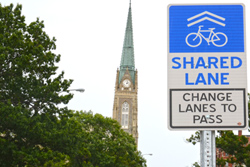
Did you know that in the state of Ohio, bicycles are considered vehicles and are supposed be treated as such? Or that cyclists can be given tickets for riding on the sidewalk, and are urged, for safety reasons, to take up the entire lane while riding? As Cincinnati's bicycle infrastructure grows, it's more important than ever for everyone on the road to know how to share it safely. Soapbox cyclist-in-chief Evan Wallis shares some basic tips.  

Fashion design project includes medical innovation

When you think “compression garments,” you normally think “grandma hose,” not “high fashion.” But a team of fashion designers at UC have joined with medical professionals that treat a genetic disease that affects connective tissue to change not only those perceptions, but the lives of those suffering from the condition.  Ehlers-Danlos Syndrome (EDS) affects hundreds of thousands of Americans, limiting their mobility and endurance. The multi-system disease creates joint instability, dizziness and unrelenting severe pain. Even pulling on jeans can cause someone with EDS to dislocate a shoulder. When physical therapists approached Margaret Voelker-Ferrier, of UC’s College of Design, Architecture, Art and Planning, with the problems that people with EDS experience when simply putting on clothes, she knew she could put her 30 years of bodywear design experience to good use. "I started as bra designer," says Voelker-Ferrier. "That has always been a passion for me, engineering things to solve a problem. Making things that are both beautiful and functional." She gave the project to fashion design students in her bodywear class, explaining the challenges of EDS sufferers as well as the basics of clothing design. "The students loved the project and I think they did a marvelous job," she says. Voelker-Ferrier worked with Brooke Brandewie on design solutions, which have been highlighted as part of the Cincinnati Innovates competition. The clothes they designed – from dresses and pants to an evening gown -- support and stabilize body joints and ligaments. Made from high-tech materials, they provide comfort and style simultaneously. One shirt, for example, has adjustable straps that help hold shoulders in place.  “The fact that they are designing clothing that is functional and therapeutic and beautiful and doesn’t look like a medical device is exciting,” says Candace Ireton, MD, who suffers from EDS. She saw the clothes during the Ehlers-Danlos National Foundation Learning Conference, which was held in Cincinnati this month.  Both Brandewie and Voelker-Ferrier attended the conference to gather measurements of EDS patients and collect data as they continue to develop their designs. While designed for EDS, the same fashions could be adapted for use by people with autism, MS and arthritis.  "It was really wonderful to be able to meet people and talk with them about this," Voelker-Ferrier says. "It’s kind of amazing."  For now, she's working on collecting more data, finding some popular sizes to work with and eventually leading an interdisciplinary studio at UC to design prototypes. Eventually, the design maven hopes to turn her problem-solving fashion sense into a small business that will target the needs of people with chronic medical conditions as well as Baby Boomers.  Fashion, after all, can provide a mental, as well as physical, boost, says EDSer Ireton. “Some of the clothing is sexy,” she says. “You can feel better, keep your ribs in place and look cute, too.”   For more information about the design project, visit their Cincinnati Innovates submission. By Elissa Yancey Follow Elissa on Twitter


Our Partners

Taft Museum of Art
Warsaw Federal

Don't miss out!

Everything Cincinnati, in your inbox every week.

Close the CTA

Already a subscriber? Enter your email to hide this popup in the future.