Uptown

Uptown includes all the neighborhoods around the University of Cincinnati including Avondale, Clifton, Clifton Heights, Corryville, Fairview, Mt. Auburn and University Heights, so it's a diverse mix of students and residents in one of the city's most distinct and eclectic group of neighborhoods. Uptown is the home of the Cincinnati Zoo as well as multiple hospitals and the Ludlow shopping district where you can find trendy and unique shops as well as any scent of incense you need. Ethnic restaurants, including a curiously high concentration of Indian eateries, multiple taverns, coffee houses, music venues and the Esquire — one of Cincinnati's finest independent art house movie theaters all make Uptown a one-stop walkable bazaar of exciting entertainment options.  

Elkins returns gift to Ohio Innocence Project

Clarence Elkins has now spent the past seven and a half years in his home and around those he loves, which is as much time as he spent behind bars for crimes he did not commit. About 15 years ago, Elkins was arrested and taken to county jail, and was later convicted and sentenced to life in prison for murder and rape. On Dec. 15, 2005, almost eight years later, Elkins was exonerated by DNA testing, thanks in large part to the countless hours of work invested by the University of Cincinnati’s Ohio Innocence Project—a team of students that fights for the wrongfully imprisoned. When Elkins first heard the guilty verdict read, he says it took some time to sink in because he kept trying to convince himself that he was trapped in a nightmare or a horrible dream.  “I just thought that it would be over soon, but that wasn’t the case,” Elkins says. “After I was sent to prison, it dawned on me that it was for real, and it wasn’t a nightmare and how tragic the injustice was—not only on me but on my entire family.”  In hopes of helping to alleviate that burden on other innocent individuals and their families, Elkins and his wife, Molly, donate $5,000 per year to the OIP. In the past 10 years, OIP has helped 16 individuals like Elkins remember what it’s like to be free.   The gift, which helps top-performing OIP students further their educations, is more than just a scholarship. For Elkins, it’s a token of his appreciation.  “The students were always—they’d give me hope, and they were so kind—they do great things for people, and not only the people that have the injustices upon them, but their families as well,” Elkins says. “They cared enough about me to look into the injustice that happened to me. I was raised in believing you get what you give—and I always believe that, and that’s what I want to do. I just want to give back to those that give to me—that help me.”  Do Good: • Like the Ohio Innocence Project on Facebook. • Keep up with OIP's work through their newsletter.  • Support organizations like the OIP by giving. By Brittany York Brittany York is a professor of English composition at the University of Cincinnati and a teacher at the Regional Institute of Torah and Secular Studies. She also edits the For Good section of SoapboxMedia. 

Economics Center teaches biz basics, philanthropy

For the past seven years, elementary students from local schools have been learning about personal finance and the ways a market functions.  “A lot of adults don’t understand how a market works, and these kids can tell you exactly how a market works,” says Julia Heath, director of the Economics Center at the University of Cincinnati. “A lot of people think the government controls prices or the sellers control prices and nobody else controls it, but that’s not true—it’s a market that determines the prices—and these kids know that.” The students know the principles of a market because each year, they get to participate in the Student Enterprise Program’s Market Madness, where they’re given the opportunity to create and sell products.  This year’s theme was based on recyclable materials and re-use, so students created things like bookmarks, bracelets, stress balls, notebooks and magnets. “Some have their products laid out and are walking around with sandwich boards marketing their products, while others are buyers," Heath says. "Then halfway through the round, an air horn sounds, and the sellers then have an opportunity to change their price. So they see a market at work, and they know that if they’re selling things like crazy off their table, then they need to raise their price. If nobody’s coming by, they need to lower their price or increase their marketing.”  Students also have the opportunity to take a college tour at UC, which Heath says is important because it allows them to envision themselves on a college campus and see if it’s the right fit for their own futures. Market Madness is an annual event, but throughout the year, StEP’s director, Erin Harris, is busy with the program’s student-run businesses within their own classrooms.  “They can earn money through their business by good behavior, good attendance and good grades,” Heath says. “And then four times a year, we go to the school with a truck that’s got a bunch of stuff in it, and students then make a decision about whether they want to spend their money, save their money or donate their money.”  For Heath, it’s wonderful that students are learning economics principles, but the most gratifying aspect of StEP, she says, is students’ willingness to donate rather than save their money for a big purchase like an mp3 player or digital camera at the end of the year. “Our most economically challenged schools are often our highest donators,” Heath says. “The class suggests the organization that will get their donations, and often it’s something they’ve had direct contact with—like they’ll choose the Alzheimer’s Association because one or two of the kids has had a grandparent that’s been stricken, or they choose Children’s Hospital because they had a classmate who spent a lot of time there, or they’ll choose the March of Dimes because their sibling has been affected. It’s really quite remarkable.” Do Good:  • Contact Erin Harris if your school could benefit from StEP activities. • Volunteer in a StEP school store or classroom.  • Support the Economics Center by donating.  By Brittany York Brittany York is a professor of English composition at the University of Cincinnati and a teacher at the Regional Institute of Torah and Secular Studies. She also edits the For Good section of SoapboxMedia. 
Cincinnati Zoo’s restaurant greenest in United States

The Cincinnati Zoo, which calls itself the Greenest Zoo in America, now also has the greenest restaurant in the country. Read the full story here.

University of Cincinnati joining with Chinese university to open medical school there

The University of Cincinnati says it is partnering with another university in China to open a medical school there as the school looks to increase its links to China. Read the full story here.

CincyMusic Spotlight hits airwaves

The show’s format provides a much-needed outlet for local musicians.

Community-based arts involvement with PAR Projects

When Jonathan Sears was 16 or 17, he says he was introduced to his saving grace: the idea that he could make a living by doing what he loved. “I wasn’t the most well-behaved student growing up, but I was always in to art,” Sears says. “I was always drawing and getting into trouble that way.”  When his mother introduced him to graphic design, he says his interest was piqued. And that’s what he now wants to do for others with Professional Artistic Research Projects, which he co-founded in 2010.  “There’s only elementary schools in Northside—there’s no middle school or high school programming—so things are kind of wide open,” Sears says. “A lot of the budding adults really don’t have good resources to tap into that can help further their education, help further their creativity. So the idea is to teach practical arts training—we’ll delve into things like website building, blog maintaining—things of that nature that can maybe spark some interest in creative fields, but aren’t necessarily only painting classes or only drawing classes.”  PAR Projects consistently finds new and creative ways to engage the public in fine arts (for example, there is an “urban-sculpture-maze-of-corn-discovery-experience” in the works), with the ultimate goal being to secure funds for an Art and Education Center for Northside.  Sears says the organization hopes to break ground, or at least have all funds secured by the end of the year. But construction will begin in September on a mobile facility, which will be part of the education center. It will function as a portable classroom and a gallery space.  “For me, I see myself as one of those people who directly benefited from what I’m trying to give back,” Sears says. “There’s so many ways you can engage people with the arts—coordinating galleries and events or working in a museum—just different creative outlets we’re hoping to inspire.”  Do Good: • Sign up for PAR Projects' email list. • Attend Brass Meets Bronze June 7-9 to support PAR Projects, the Constella Festival and the MainStrasse Village Association. • Support PAR Projects. By Brittany York Brittany York is a professor of English composition at the University of Cincinnati and a teacher at the Regional Institute of Torah and Secular Studies. She also edits the For Good section of SoapboxMedia. 

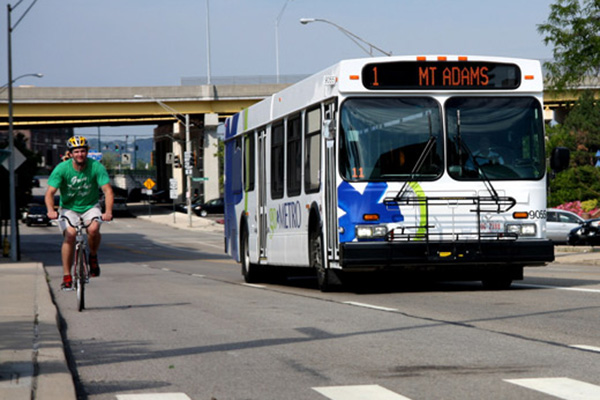
Metro blazes new trails with green efforts

Metro has been "going green" for more than 25 years, but partnerships with progressive organizations have helped it broaden sustainability efforts.

NEW mentorships promote female leadership

Amy Armstrong Smith, national account manager at Brown-Forman, says she knows what it’s like to be the only woman in the room.  “I’m in an industry that’s male-dominated,” Armstrong Smith says. “I’m the only woman nine times out of 10.” When Armstrong Smith first attended an event for the Cincinnati chapter of the Network of Executive Women nearly three years ago, that all changed.  “Never had I been in a room with that many professional women,” Armstrong Smith says. “It reinvigorated me.”  Since Armstrong Smith became involved with NEW—whose mission, she says, “is to attract, retain and develop women for the field of consumer products from a manufacturer and retail perspective”—she’s engaged in a variety of outreach activities for high school and college students. She's also served as a mentor, both for women interested in pursuing a career in the field, and for those already immersed in it.  “I’m mentoring a woman at NEW who just told me she got the promotion that we’ve been talking about and working on with how to position it,” Armstrong Smith says. “And it was so great because when she told me—her success is my success.”  According to Armstrong Smith, the mentorships work both ways because the college students she assists reenergize her.  “They look at the world in a whole different perspective,” she says. “And they’re giving me a new perspective too—a new way to look at the business—a new way to approach it through technology.”  Armstrong Smith says she’s appreciative of the networking opportunities NEW offers because when she graduated from college in the ‘80s, you had to do it on your own. “I’m with other professional women," Armstrong Smith says. "I’m stimulated—we’re talking about the industry. But the number one reason I do this is because I have a daughter, and I want her to be able to walk into a room when she starts her first career in 20 years as Rosie Smith, just like Tom Smith would walk in the room.”  That’s what Armstrong Smith says drives her.  “I’m so appreciative of the women who went before me, and if I don’t turn around and help Rosie and the generations behind me, women are never going to move the needle,” she says. “We won’t get to our full potential that we know we all can get to.”  Do Good: • Like the Cincinnati chapter of NEW on Facebook. • Contact NEW if your business would like to become a sponsor.  • Become an individual member. By Brittany York Brittany York is a professor of English composition at the University of Cincinnati and a teacher at the Regional Institute of Torah and Secular Studies. She also edits the For Good section of SoapboxMedia.   

Area high school students earn college credit with video distance learning

Students at 10 Cincinnati area high schools are earning college credit through a new dual enrollment program at the University of Cincinnati's College of Engineering and Applied Science. It's the first step in a wider plan that will allow incoming UC engineering majors to complete their freshmen year of college before high school graduation. The dual credit program grew out of a longer collaboration between CEAS and area schools that started in 2007. That's when CEAS began offering an introduction to engineering course to high school seniors. The course is offered through an educational video platform called Mediasite, which is designed specifically for educational use. That collaboration started with four schools—Harrison, Mother of Mercy, Mt. Notre Dame and Princeton high schools—and now more than 13 participate (howerver, not all offer the dual credit option). The 2012-2013 school year was the first that students could take courses for credit at UC, says College of Engineering Academic Director Eugene Rutz. Not all students take the class for dual credit, but out of the 500 who did, about 140 of them earned credit, Rutz says. UC faculty and the high school teachers work together to deliver the course. UC provides lessons via videos, which students can watch from home. In the classroom, high school teachers assign projects that require students to find solutions to questions by creating an engineering-based solution that builds on what they learn in the videos. "They build a prototype for the solution, test it, report it and defend," says Rutz. "There's a verbal presentation of it as well." During the school year, students complete several projects—some could take a week, some could take a month. The focus is on applied learning. "This is a course that helps students see and appreciate why they learn math and science," Rutz says. "They are also learning critical thinking, and that there are multiple ways to solve problems." CEAS plans to add more high schools to the program next year, and add an additional engineering course, says Rutz. By Feoshia H. Davis Follow Feoshia on Twitter

GO Cincinnati engages community, serves nonprofits

About seven years ago, Crossroads began a transformation that positioned it as more than just a church. Its vision was to focus on ways in which it could serve others—in not just the community, but across the world.   Crossroads’ work with GO South Africa was making an impact in the lives of those battling poverty and HIV/AIDS, but at the same time, volunteers began to think about their roles in their own community.   Modeled after GO South Africa, a team of volunteers initiated GO Cincinnati. It's an outreach activity that started out with about 1,200 volunteers who completed 65 projects throughout Greater Cincinnati in a single day for nonprofits.   “People really connected with the idea of serving their city, and on the front line serving those in need,” says Kelley Kruyer, director of Cincinnati ReachOut projects and leader of GO Cincinnati. “They’re doing the hard work every single day, so we thought it would be cool to thank them for the work they do in our community.”   This year, 7,000 volunteers will combine forces on May 18 to complete 400 projects that range from painting and landscaping to putting up drywall and serving meals.   According to Kruyer, the best parts of GO Cincinnati are the long-term relationships Crossroads has formed over the years with the organizations it serves.   “We know their buildings, their properties, their needs, and we know how to best help them, so sometimes we put together a multi-year plan, and it gives them the peace of mind and helps them to budget so they don’t have to spend money on things that we’re happy to help with,” Kruyer says. “It’s just a really special day.”   Kruyer, who grew up in Northern Kentucky, left her hometown in the ‘80s. During that 10-year period of her life, she says she wondered what she was doing because everyone and everything she loved was here. She says that's the kind of passion for the city that drives Crossroads to engage and reach out.   “We love our city—and by Cincinnati, we mean all of it—from Burlington to Middletown to Amelia to Cleves—the whole Greater Cincinnati and Northern Kentucky area,” Kruyer says. "We’re just totally committed to making it one of the best places in the country to live.”  Do Good: • Find a nonprofit that interests you and lend a helping hand. • Assist Crossroads in its volunteer efforts throughout the year. • Like Crossroads on Facebook. By Brittany York Brittany York is a professor of English composition at the University of Cincinnati and a teacher at the Regional Institute of Torah and Secular Studies. She also edits the For Good section of SoapboxMedia.  

Our Partners

Taft Museum of Art
Warsaw Federal

Don't miss out!

Everything Cincinnati, in your inbox every week.

Close the CTA

Already a subscriber? Enter your email to hide this popup in the future.