Mt. Adams

One of Cincinnati's most charming neighborhoods, this winding hilltop community hosts trendy residents, diverse retail businesses and a hot collection of nightclubs and restaurants. Featuring some of the most spectacular river and city views, Mt. Adams boasts an array of the city's most diverse and interesting examples of architectural styles, including five sites currently listed on the historic register.

Cincinnati in top 30 most wired cities

Cincinnati has ranked as the 28th most wired city in the United States, according to an annual evaluation conducted by Forbes.com.Forbes measured cities' "wired quotient" by computing the percentage of Internet users with high-speed connections, the number of companies providing high-speed Internet, and the number of public Wi-Fi hotspots.Placing between Philadelphia and Columbus, Cincinnati received top 20 marks for broadband adoption and Wi-Fi hotspots, but lost ground due to the number of service providers available. Ohio has invested heavily in providing 100 percent broadband access throughout the state, and the Obama administration and House Democrats have proposed including $6 billion for broadband infrastructure as part of the economic stimulus package.Read the full article here.

Cincinnati ‘doing good, and getting better’

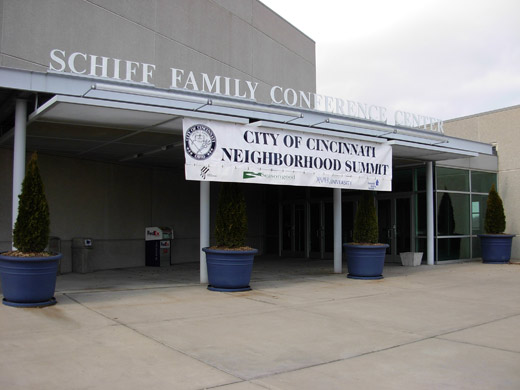
"Doing good, and getting better."With those words, Cincinnati city councilmember and chair of the Vibrant Neighborhoods Committee Laketa Cole opened the seventh annual Cincinnati Neighborhood Summit at Xavier University's Schiff Conference and Banquet Center."That's going to be my motto for this year," Cole said.  "And that's what we're doing here in the City of Cincinnati."Hundreds of residents, community leaders, and local officials spent the day attending breakout sessions on such topics as housing, economic development, crime prevention, and community building."It really does speak to the passion that you have for this city, and the effort that you want to put into transforming this city," said Cincinnati Mayor, Mark Mallory.The biggest news of the day may have been the official launch of the city's new comprehensive master plan, the first for the city since 1980."We are working on a plan for the plan," said Charles C. Graves III, director of the Department of City Planning.  "We'll be holding an in-house retreat with city staff over the next couple of weeks."At this year's summit, Hamilton County leaders were on hand to share their programs and services with community stakeholders.Hamilton County Commission president David Pepper took the opportunity to remind Cincinnatians that they are part of the county, too."You guys don't call the county enough," he said.  "Sometimes we don't see nearly as many of you [at commission meetings] as I know show up at council meetings.  You're welcome to come!"Planning for next year's summit has already begun."This job does not end today," Cole said.  "It actually begins.  Because once this summit is over, they take all of the survey results, they compile them, and they start talking about them and planning for the next year."Writer: Kevin LeMaster Photography by Kevin LeMaster

Seventh annual Neighborhood Summit focuses on ‘Growing Cincinnati’

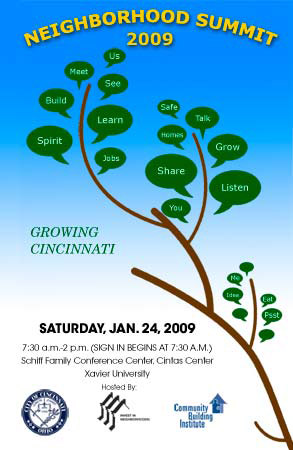
The 7th annual Cincinnati Neighborhood Summit 2009 will be held January 24 from 8 AM to 2 PM at Xavier University's Schiff Banquet and Conference Center."Growing Cincinnati" will give citizens and community leaders the opportunity to interact with elected officials from the city, county and state and to learn how their colleagues are addressing community challenges in the areas of housing, economic development, and community building.Laketa Cole, Cincinnati councilmember and chair of the Neighborhoods Committee, will open the summit with an introductory greeting, followed by Mayor Mark Mallory, who will lead a session on the importance of the Census to the community.Breakout session topics will include: Housing: Section 8 and CMHA, reuse of foreclosed and abandoned properties, promoting homeownership, organizations addressing the foreclosure crisis, and the Neighborhood Stabilization ProgramEconomy and Work Force Development: 2010 Census and Shop 52, Agenda 360, the upcoming 2009 Comprehensive Plan, the future of transportation, and work force developmentCommunity Collaboration and Best Practices: Developing a neighborhood art center, community collaboration, form-based codes, reducing violence, and making your neighborhood more green Registration for the Neighborhood Summit is required by January 16.On January 23, Congressman Steve Driehaus will speak at a kickoff dinner about the promising changes on the horizon for the City and how we can all play a role in its growth.Community volunteers also will be presented awards for their efforts.Reservations are also required for the dinner, at a cost of $20.The Cincinnati Neighborhood Summit 2009 is sponsored by Invest in Neighborhoods, Inc., the Community Building Institute, and the Cincinnati Department of Community Development.  Support is provided by Xavier University and the Murray & Agnes Seasongood Good Government Foundation.Writer: Kevin LeMasterSources: Jason Barron, City of Cincinnati; Laurel Bauer, media relations coordinator, Xavier University

Recommendations for Mount Adams plan up for review
Soapdish: 52 Card Pickup

Cincinnati is the home of 52 individual and unique neighborhoods that, some say, serve as the the "key to city's success." But how did we come to have such a rich, quilted patchwork of localities and how will these 52 different personalities work to create a charged and united region? Soapdisher turned explorer, Casey Coston takes us on a quick tour...

Coalition formed to apply for up to $1M in brownfields funds
SoapDish: YP Worry?

Every major American city is looking for ways to attract and retain the much sought-after and elusive “Young Professional,” but it takes a lot more than happy hours and catchy names to secure change-inducing talent. This week, Soapbox columnist Casey Coston takes a look at how the Cincinnati USA Regional Chamber of Commerce's HYPE initiative as well as a number of other similar organizations are taking a new approach to plugging the proverbial brain drain.

New regional transit agency in the works

Cincinnati and Hamilton County have reached an agreement on a new regional transit agency that could give more say to suburban governments - if they are willing to pay.The Greater Cincinnati Regional Transit Authority would consist of a 13-member board, with seven being appointed by the City of Cincinnati and six from Hamilton County.Butler, Clermont and Warren counties would be able to directly appoint board members if they formally join the new agency, and could gain a majority of the board seats if they contribute more than 50 percent of the agency's budget.Both the City of Cincinnati and the Hamilton County Commission are likely to consider resolutions on the matter this month.Read the full article here.

Duke Energy hosts regional forum for economic development stakeholders

Duke Energy sponsored a forum yesterday at the Queen City Club that was an opportunity for consultants and governmental leaders to network and to learn the latest strategies in economic development in Ohio and Kentucky.J.R. Wilhite, commissioner in the Department of New Business Development for the Kentucky Cabinet for Economic Development, says that regardless of all of the innovations and new technologies on the horizon, it still comes down to "blocking and tackling"."Economic development is changing," he says.  "But just like football has changed with its many rule changes, so must we."Wilhite says that one of his state's strategies has been a greater focus on Europe, where the Kentucky has contracted with ROI to research the continent's firms and to make initial contact.Steve Schoeny, director of the strategic business investment division of the Ohio Department of Development, says that Ohio not only needs to do a better job of telling its story, but of developing its workforce as well."Our services are of a national caliber," he says.  "However, the system for delivering those services is not."Schoeny says that Ohio economic development will improve by attracting and retaining young talent through initiatives such as Ohio Means Home and the Ohio Young Talent Network, properly training state staff to focus on clients rather than individuals, and setting up a culture of customer service.Marti Bremer, senior manager of state and local tax for KPMG, LLP, gave an overview of some of the domestic trends in economic development, including the targeting of industries, benchmarking, giving monetary incentives, public/private partnerships, entrepreneurship programs, development of shovel-ready sites, and workforce development.Managing director Greg Burkart, of the Novi, Michigan office of Duff & Phelps, provided some insights on economic development websites from the client point of view."You may be ruled in or ruled out long before you know it just based upon what information is publicly available," he says.The final speaker, vice president and director of Austin Consulting Don Schjeldahl, says that alternative energies such as photovoltaic, concentrated solar, and wind power are poised to make significant gains in the next 10 to 15 years, and the geographical pattern for how those industries will be defined has not yet been set."If you don't have your act together, you're going to miss the window," he says.Schjeldahl says that there are still opportunities for Ohio, if they can create market demand for the new technologies and can create awareness of and preparedness for sustainability in the state's communities.Writer: Kevin LeMasterSources: J.R. Wilhite, commissioner in Department for New Business Development, Kentucky Cabinet for Economic Development; Steve Schoeny, director of Economic Development Division, Ohio Department of Development; Marti Brenner, senior manager of state and local tax, KPMG, LLC; Greg Burkart, managing director, Duff & Phelps, LLC; Don Schjeldahl, vice president and director, Austin Consulting

Cincinnati’s library system earns top 10 ranking

For the third year in a row, the Public Library of Cincinnati and Hamilton County (PLCHC) has ranked in the top 10 nationally.Cincinnati placed 10th among 79 library systems in the "Over 500,000 population" category in Hennen's American Public Library Ratings.The ratings are based on statistics such as circulation, customer visits per hour, and number of volumes owned per capita.While PLCHC executive director Kim Fender is pleased with the ranking, she tells WLWT.com that "our Library is much more than the number of items on the shelves".Read the full article here.

Our Partners

Taft Museum of Art
Warsaw Federal

Don't miss out!

Everything Cincinnati, in your inbox every week.

Close the CTA

Already a subscriber? Enter your email to hide this popup in the future.