Madisonville

Offering an eclectic array of businesses, Madisonville is home to deeply rooted residents and newcomers attracted by unique homes in a reasonable price range. This family-friendly neighborhood offers hike/bike trails, an emerging arts scene and a burdgeoning CBD that's just months away from a complete overhaul, thanks to the Madisonville Community Urban Redevelopment Corporation.

Demand Better: Architecture’s impact on Cincinnati’s economy

As election day approaches, we'll be re-running our four-part Demand Better series in an effort to spark conversations and provoke thought about how we can demand more from our city's leaders. This week, we take a look at the topic of architecture.

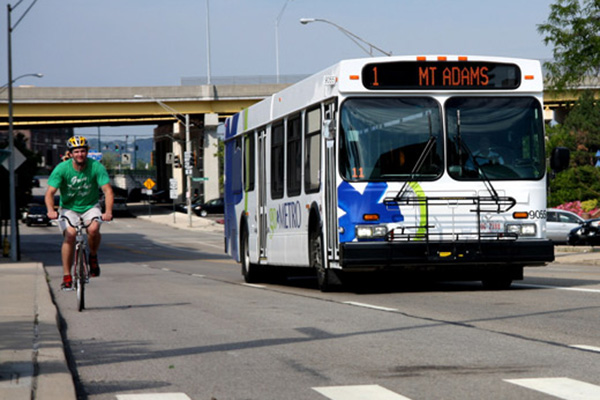
Metro now offers stored-value cards to riders

Many city-dwellers are continuously faced with the arduous task of budgeting their quarters between two priorities: bus fare and laundromats.

The Happy Maladies want YOU to write their next album

The project is titled “MUST LOVE CATS,” and it will be an album of five compositions.

Talbert House and ESCC combine efforts to help nonprofits

After a combined 120 weeks of courses geared toward nonprofit leadership and development, Talbert House and Executive Service Corps of Cincinnati have decided to join forces and combine their programs into one.  Beginning in September, the two nonprofits will begin the Executive Curriculum for Emerging Leaders through the newly created Nonprofit Leadership Institute of Greater Cincinnati.  “I think the fact that we were two organizations in similar spaces in the marketplace trying to do similar things as it relates to leadership education and development—it got to a point of is there a way for us to really work together on this?” says Andy McCreanor, executive director and CEO of ESCC.  The goal is to offer services to other nonprofits—large or small—so they can gain the skills and education necessary to position their organizations for community-wide success.  “The true value of The Nonprofit Leadership Institute of Greater Cincinnati will be shown by how well nonprofits perform in the community, whether you’re a nonprofit, someone receiving services from a nonprofit, a community investor or a corporate partner looking for a socially responsible way to impact the lives of people,” McCreanor says. “The Institute offers great potential for participants and partners to receive a solid return on their time and investment.”  McCreanor says the most enjoyable part for him is graduation. It's a day when he gets the chance to hear class participants talk about their growth and increased expertise when it comes to successfully operating their nonprofit. And come May 2014, he says he hopes to hear of many more success stories. “The idea is that nonprofits would essentially see what we call a no-wrong-door approach to leadership education and development—that whether you’re a large or small nonprofit, that coming to the nonprofit leadership institute, you’d be able to find the subject matter, the program, the course that suits your needs,” McCreanor says. “Not all nonprofits are created equally, so the idea is that the institute would allow a nonprofit to find the program or development that is important to them.” Do Good:  • Sign up for EXCEL by August 1 if you are a nonprofit interested in education and leadership development.  • If you are interested in partnering with The Nonprofit Leadership Institute and the EXCEL program, contact Tom Monaco or Carol Leigh.  • Like Talbert House and ESCC on Facebook. By Brittany York Brittany York is a professor of English composition at the University of Cincinnati. She also edits the For Good section of SoapboxMedia. 

Library teaches teens finance basics

Graduating high school students of the class of 2014 will be the first group in Ohio that is required to learn financial literacy. “So many teens were graduating high school without basic knowledge of financial literacy, like avoiding high-interest credit cards—scams that are so present on college campuses,” says Jennifer Korn, TeenSpot manager at the Public Library of Cincinnati and Hamilton County. “And there have been a number of studies that say students who don’t have the basic knowledge are likely to end up in serious debt as very young adults and are unable to get ahead and unable to save money as they go into adulthood.”  To fill that void and to encourage more teens to be conscious of their finances, the library is offering a series of workshops for teens between the ages of 12 and 18. The workshops will teach the students how to create a budget and open a savings account.  Thanks to a grant from the Financial Industry Regulatory Authority Investor Education Foundation, PLCHC is one of just 14 public libraries nationwide to offer the workshop. “I think a majority of teens across the board don’t have a very good understanding of the importance of saving or of budgeting your money, so maybe they get an allowance or have a job or babysit, but it’s mostly for entertainment purposes,” Korn says. “But there’s not a lot of consideration for the future and the long term—that if you start saving your money now and that money starts to build, then in 15 or 20 years, you can be in a much better position than if you would not have started saving.”  Korn says all the activities in the series are teen-focused and engaging, so students might be given a sample scenario where they have a set amount of money and want to go to the movies, but also need to consider the fact that their best friend’s birthday is coming up.  “Anything that reinforces what they’re doing in an interactive or a social way,” Korn says. “The hope is that once they graduate high school and enter their postsecondary education or the real world, they feel confident, can handle their money and are savvy consumers and savvy savers.”  Do Good:  • Learn about the financial literacy workshops, and sign up to attend.  • Keep up with teen programs at the library, and attend an upcoming event. • Like the PLCHC on Facebook. By Brittany York Brittany York is a professor of English composition at the University of Cincinnati. She also edits the For Good section of SoapboxMedia.   

Cincinnati Children’s Home leads health care integration efforts

The Children’s Home of Cincinnati is taking the steps needed to become a national leader in health care integration.  “There are more examples of policies that say we need to do health care integration than there are of actual examples of organizations that have done this and done this well, which tells you The Children’s Home is pretty cutting-edge,” says Barbara Terry, vice president of health care integration at The Children’s Home. Terry, who says she is passionate about health from a holistic standpoint, has 35 years of experience and recently joined The Children’s Home to help the organization introduce physical health care to its already existing mental health care programs. But she says she is not the only one responsible for the idea of health care integration. “They’ve certainly been reading the tea leaves and saying, ‘We should think about systems—plural—in this community,’” Terry says. “So you think about mental health, education and human services as systems. We really need to figure out how we integrate systems so that vulnerable children get the care they need—the right care at the right place at the right time—and that becomes huge.”  For Terry, education and prevention are key.  “We know that individuals who face challenges in the mental health arena—typically as they get older—they have tremendous chronic health problems,” says Terry, who attributes the issue to a difficulty in navigating an array of disconnected systems.  To address that issue, Terry envisions a system that recognizes that the mind and body cannot be separated. And while the idea might begin with The Children’s Home, she says the effort needs to span across the community.  “This isn’t just The Children’s Home—it’s about children and adolescents in our larger community,” Terry says. “They’ve been willing to invest in me and invest in this approach, but my vision would be that we need to work with the community. We need to help share successes with the community so that we can say, ‘How can this spread?’ I don’t want the work to be insular. We have to appreciate community here.”  Do Good:  • Get involved by contributing items on The Children's Home's wishlist.  • Volunteer with The Children's Home. • Assist The Children's Home by donating or supporting a classroom. By Brittany York Brittany York is a professor of English composition at the University of Cincinnati and a teacher at the Regional Institute of Torah and Secular Studies. She also edits the For Good section of SoapboxMedia.   

CincyMusic Spotlight hits airwaves

The show’s format provides a much-needed outlet for local musicians.

Engaging diverse communities at Kennedy Heights Arts Center

Ellen Muse-Lindeman, who has served as executive director of the Kennedy Heights Arts Center since 2008, says the work she does to help build community through the arts is the essence of why she loves the neighborhood in which she works and where she’s chosen to raise her family. Muse-Lindeman, who moved to Cincinnati in the ‘90s and now lives in Pleasant Ridge, lives within walking distance of the arts center and says she values her diverse and active neighbors.   “The folks are really involved,” Muse-Lindeman says. And that’s evident through the center’s origin story. It was founded by residents who came together to save the historic Kennedy Mansion from demolition. They not only succeeded, but they turned it into an engaging enterprise for the community and others to enjoy. “That kind of spirit is the foundation of the arts center and still is a big part of what it’s about in terms of bringing people together,” Muse-Lindeman says. “Arts and culture build a stronger community and make a neighborhood a better place to live.”  Each year, the KHAC engages the public in a variety of ways from exhibitions, classes, camps and even an annual artist-in-residence program. “We are really looking to not only present a wide range of media and different subject matter through our galleries, and to feature both regional artists and artists from outside of the region,” Muse-Lindeman says. “But in particular, we have a goal of presenting exhibits that create dialogue and that build connections between artists and communities.”  The center’s current exhibition, Visible Voices, merges visual art with poetry.  “We’ll be successful in this exhibit if we engage people in terms of not only experiencing the artwork, but also in connecting with one another,” Muse-Lindeman says. “That’s ultimately what we’re aiming to do, and to also really nurture that relationship between artists and their community and to provide opportunities to work and to encourage that ongoing collaboration.”  Do Good:  • View the current exhibition, Visible Voices, and attend an artist talk or poetry reading.  • Donate to the Kennedy Heights Arts Center. • Volunteer at the center.  By Brittany York Brittany York is a professor of English composition at the University of Cincinnati and a teacher at the Regional Institute of Torah and Secular Studies. She also edits the For Good section of SoapboxMedia. 
My Soapbox: Aaron Rubinstein, artist

One artist has been a part of Cincinnati's Summerfair since its inception. This year, Aaron Rubenstein's daughter, also an artist, joined him to continue the family tradition.

Metro blazes new trails with green efforts

Metro has been "going green" for more than 25 years, but partnerships with progressive organizations have helped it broaden sustainability efforts.

Our Partners

Taft Museum of Art
Warsaw Federal

Don't miss out!

Everything Cincinnati, in your inbox every week.

Close the CTA

Already a subscriber? Enter your email to hide this popup in the future.