Ludlow

It doesn’t get much more quaintly picturesque than the quiet riverside town of Ludlow. Located along Highway 8 in northwestern Kenton County, Ludlow offers ample opportunities for enterprise and fun on the river, which factors prominently in the town’s history and economy. It's easily accessed from Cincinnati via I-75/Covington and the nearby Anderson Ferry.     Taverns and eateries that once provided respite for traveling boatmen are experiencing a renaissance as revelers from all over Greater Cincinnati flock to more offbeat spots like the popular Ludlow-Bromley Yacht Club.   Affordable cost of living and plentiful green spaces make Ludlow an increasingly attractive option for families. On summer nights the air is thick with barbeque smoke and the crack of baseball bats from nearby parks, which range from untouched nature to fully outfitted playgrounds. Available real estate includes historic homes, multi-unit buildings, condos, townhouses and commercial properties with substantial acreage.  

Architecture firm engages Covington students to add graffiti to Pike Street

Ben Eilerman says he realized his love of architecture during his adolescent years at Covington Catholic High School.  As a professional in the field at Hub+Weber, he has the opportunity to engage in educational outreach with other students who have that same appreciation for art at the same age he did. Hub+Weber’s latest venture, which not only engaged students in artmaking but also gave them real-world experience, involved Holmes High School’s graffiti club and visual communications class.  Located in Covington since the firm’s founding nearly 40 years ago, Hub+Weber relocated for the first time last year. Though it maintained its roots in the area, the firm moved from its old home on Greenup Street to the city’s former train station on Pike Street.  “Behind it are the old passenger stairs up to an elevated rail line, and that area is largely abandoned,” Eilerman says. “[It had] that kind of urban decaying aesthetic to it that we were drawn to, and we wanted to use that space and address it from our standpoint, and then also to start to make the city aware of it.”  So Hub+Weber reached out to the Center for Great Neighborhoods, who put the firm in touch with Donny Roundtree, the visual communications teacher at Holmes.  “We talked to him and saw that this was a great opportunity to bring his students down and do a real-life project and build it into something bigger, as far as his curriculum goes,” Eilerman says.  So the two joined forces to provide students with the opportunity to create an eight-foot by 16-foot graffiti art mural.  “The students explored different techniques so each of the panels read as an individual panel, and as it draws into the center, it starts to be defined more as a singular mural,” Eilerman says. “It has the background of the Covington skyline across the back, and then it has two trains coming out of the center from a tunnel with the word ‘Pike’ in the middle.”  Eilerman says the area surrounding Pike has undergone a renaissance over the past few years, so the firm wanted to find a way to contribute by livening up the area while also reaching out to a local school district.  The mural is currently on display inside the building, and a week ago, the students showed off their work at a gallery opening hosted by Hub+Weber. They received feedback from local designers who gave advice about what it means to “take the arts into a profession,” Eilerman says.  This month, the mural will inhabit its permanent home—below the underpass where it will be visible from the sidewalk and street for all to see.  “They spent about six months or so on this,” Eilerman says. “We really acted as a client—they brought the sketches and they talked about what their vision was, and we talked about what ours was, and they had to mesh that. They had to provide a proposal for their work—and I think it was a big benefit to the students.”  Do Good:  • Support the arts in your local school district.  • Support Holmes High School's Nordheim Gallery. • Like Hub+Weber on Facebook.  By Brittany York Brittany York is a professor of English composition at the University of Cincinnati and a teacher at the Regional Institute of Torah and Secular Studies. She also edits the For Good section of SoapboxMedia. 

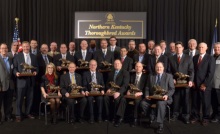
Northern Kentucky recognizes 2013 Thoroughbreds

Twenty-four new companies and expansion projects in 2012 are projected to create nearly 6000 jobs in Northern Kentucky and add $438M in value to the region's economy. Tri-ED's annual report shares more about these engines of growth. 

NKY celebrates educational leaders

When it comes to preparing students to become future leaders and contributors to society, schools have a huge responsibility. And while their work is often recognized from within, it’s not often enough that it's honored on a community-wide basis.   The Northern Kentucky Education Council and the Northern Kentucky Chamber of Commerce seek to remedy that, however, with their 2013 Excellence in Education Celebration—though it’s not just the work of students and educators that they plan to recognize.   “We started thinking about the awards dinner and others in the community who are also driving action in the excellence in education besides our educators, and realizing it goes beyond the scope of the school day,” says Polly Page, NKYEC’s executive director. “It’s the responsibility of our entire community to make this happen for our children.”   According to Page, students, teachers, administrators, school board members, mentors and businesses within the community all play a role in the education of younger generations, and it’s important to come together to let those individuals and organizations know that their work does not go unnoticed.   Students will be recognized in various categories for academic performance and leadership skills. And this year, there’s a new award that recognizes one’s ability to overcome obstacles and succeed in school, despite barriers that may have occurred along the way.   “Those stories were really very heartwarming, and folks don’t really think about Northern Kentucky having students with a lot of trials and tribulations,” Page says. “But these were really pretty poignant about what the students have experienced in their lifetimes.”   With educators, businesses and community members, it’s all about what they’re doing “to go beyond the requirements” at their positions, Page says.   “There are many companies in Northern Kentucky that have a solid partnership and are really thinking about ways they can make a difference in the classroom,” says Page. “Employees are working in the classroom and teaching side by side with instructors and working with students.”    Kentucky was ranked 10th in the nation in Quality Counts this year, which Page says is huge because the state was more than 30 positions behind that ranking in past years. But it’s all about moving forward and making sure “students and young adults are prepared for college.”   “We want to take it up and meet national standards,” Page says. “It’s a time for everybody to just hit the pause button and take some time to celebrate what’s going on in our community—who is driving action?”  Do Good:  • Register to attend the 2013 Excellence in Education Celebration, which takes place March 28. • Volunteer as a mentor or literacy coach in the One to One program. • Encourage your business to partner with its local school district in the B.E.S.T (Business Education Success Teams) program. By Brittany York Brittany York is a professor of English composition at the University of Cincinnati and a teacher at the Regional Institute of Torah and Secular Studies. She also edits the For Good section of SoapboxMedia. 

NKY students make blankets, support cancer victims

When two White’s Tower Elementary School teachers were diagnosed with cancer in the same week, teachers were at a loss for words when discussing the issue with their students. After a letter went home explaining the situation and notifying parents that the two teachers would be taking a leave of absence, students had a lot of questions, according to Jessica Blust, a fourth grade teacher and co-sponsor of the White's Tower student council.  “I had to personally regain composure and really think through my thoughts before giving that information to the kids,” Blust says.  After discussing the issue, however, Blust says the first things that came to the students’ minds were ways in which they could help.  “We realized that there wasn’t a whole lot we could do for them as far as raising money,” Blust says. “But they wanted to do something for them, and not knowing what to do, they said, ‘Can’t we do something for kids? Can kids get cancer?’ And that whole discussion came up, which led to research, and that’s when they found Project Linus.”  Project Linus is a nonprofit that provides homemade blankets as a source of comfort to children who have been diagnosed with cancer.  So White’s Tower's student council set the goal of raising enough money to make five blankets. The group of 18 third-, fourth- and fifth-graders decided to sell cotton candy to raise enough money for supplies to start making the blankets.  “The kids got order forms and then sent them in, and we as a student council took the opportunity to teach some economics concepts,” Blust says.  The group created a marketing team that advertised the cotton candy by going to the morning classes and talking about the sale and why they were doing it—the kids also got on the morning announcements and talked about the sale. They have a sales team who delivers the orders, a production team who creates the blankets, and a distribution team who is going to help the student council deliver the blankets. Instead of delivering five blankets, however, the students exceeded their goal and raised enough money to create 25 blankets, which they have been crafting after school for the past few weeks at their student council meetings. One of those blankets will be given to one of White’s Tower’s own—a young girl, who no longer attends the school, but is still part of the White’s Tower family, Blust says.  “We just wanted her to know that even though she’s no longer at White’s Tower—her brother still is—the love we still have for her is in that blanket,” says Blust. “And we just want to bring her some comfort as she’s going through treatments, and even though she’s suffering, maybe this brings her just a little bit of happiness.” Do Good:  • Make a donation to your local chapter of Project Linus. • Become a volunteer with your local chapter of Project Linus. • Order a blanket kit through Project Linus so that you, too, can help to provide comfort to a child with cancer. By Brittany York Brittany York is a professor of English composition at the University of Cincinnati and a teacher at the Regional Institute of Torah and Secular Studies. She also edits the For Good section of SoapboxMedia. 

Intern in Ohio program launches today, connects students with internships

Today, Detroit-based Digerati launches its Intern in Ohio program to the public, which is sponsored by the University of Toledo. Like eHarmony, the program uses an advanced matching algorithm to match students with internship opportunities.   Intern in Ohio is free to both students who are looking for internships and businesses who want to post internships. To register, students and employers visit Intern in Ohio’s website to sign up and create a profile or post internship opportunities. Students fill out a short questionnaire about their preferences, and employers share information about the position. The system then identifies the top seven matches for each student, as well as for each position. When the match is made, both the student and employer are notified, and they must show interest before any contact information is shared.   “We encourage diverse companies—large and small, for-profit and nonprofit, government and corporate,” says Wendy Pittman, director of Digerati’s Classroom to Career. “It’s a great chance for employers to broadcast their company and internship program across the state and reach a larger pool of applicants.”   Only companies in Ohio can post opportunities to the Intern in Ohio website, but all types of internships are welcome. There are posts for marketing, engineering and social media, among others, says Pittman.   The program is open to all students who live in Ohio, whether they’re in-state or out-of-state students. Research shows that not only do internships often lead employment offers after graduation, but that students are more likely to remain in an area where they held and internship.   “This is the first replication of the Classroom to Career technology from Michigan to Ohio,” says Pittman. “Experiential learning is a game-changer; and we’re looking forward to working with smaller communities to make a difference.”   In 2011, Digerati launched its Intern in Michigan program, which has resulted in more than 127,000 matches and introductions between students and employers. Over 1,000 Michigan businesses have posted 4,824 internship opportunities, and 1,049 colleges and universities in the state use the site.   Full disclosure: Soapbox’s parent company, IMG, supplies content to Intern in Ohio on a contractual basis.   By Caitlin Koenig Follow Caitlin on Twitter

Cincy playwright aims to enrich national theatre scene

Mike Hall, 34, says he fell in love with theater at the age of 16 when he began attending Loveland High School and knew he had to make friends.  He says he grew up as an “Army brat” who moved around a lot, though most of his family was based in or around the Cincinnati area; and when he moved to Loveland to finish high school, he first turned to “theater people,” who “are for the most part, pretty embracing.”  Hall started acting in school productions and never turned back. He attended Northern Kentucky University as a theatre major, then went on to spend his time performing with various theatre companies in the area.  Acting, Hall says, was his primary endeavor. That is, until he had a conversation backstage with Josh Steele in 2009, as the two were waiting to begin the night’s production of “Angry Housewives” at New Edgecliff Theatre.  “We both wanted to see ‘Ghostbusters’ the musical happen,” Hall says. “We figured big budget movies and musicals like that are successful, and it’s usually the cult classics that make it, so we decided to try to write it.”  After talking to a copyright lawyer, however, the idea for “Ghostbusters” had to be scrapped, but all was not lost.  “He told us that was the worst idea ever, unless we wanted to be poor the rest of our lives,” says Hall. “But we still wanted to write something based around it, so we decided to turn it on its ear and write about what we know, which is the world of theater—so we decided to write about a group of actors who want to do ‘Ghostbusters’ the musical. They get told that they can’t and still decide to do it by changing the process around completely.”  So Hall and Steele did just that and became first-time playwrights with “Don’t Cross the Streams: The Cease and Desist Musical,” which became a hit after its debut at both the Cincinnati and Indianapolis Fringe festivals last year.  The two writers didn’t want to stop there, however. According to Hall, they’re “kind of hooked,” so the two recently formed their production company, Hugo West Theatricals; and the first major goal is to produce “Don’t Cross the Streams” as a two-act show, get it published and performed in cities across the country.  Hugo West Theatricals, in conjunction with Falcon Theater, will start with a week-long run beginning Friday at Monmouth Theatre.  Hall says he and Steele have added a few songs and expanded on the script to create a comedic piece they both feel good about.  “I think the audience will be entertained, and that’s probably the most important thing theater can teach—is that we’re really supposed to entertain people—we can’t get too much on our high horse and make it a message all the time,” Hall says. “We have to keep the audience in mind—and when the audience comes to see it, I think they’ll know that we’ve kept them at the forefront.”   Do Good:  • Support "Don't Cross the Streams" by purchasing tickets to a performance at Monmouth Theatre, March 15-23. • Join and share the Facebook event page with your friends to spread word about the upcoming run of "Don't Cross the Streams."  • Like "Don't Cross the Streams" on Facebook. By Brittany York Brittany York is a professor of English composition at the University of Cincinnati and a teacher at the Regional Institute of Torah and Secular Studies. She also edits the For Good section of SoapboxMedia.     

Service learning engages NKY students, promotes literacy

Service learning is an integral part of the curriculum for Cathy Kappes, who teaches sixth grade language arts at Summit View Middle School.  Kappes, who has taught in the Kenton County School District in Northern Kentucky for the past 23 years, says it’s a way for students to take what they learn in the classroom and apply it to real-world situations.  Her most recent project allowed students to learn the elements of a short story, while also promoting literacy to preschoolers and kindergarteners.  “I know from my own experience that students who are read to from a very young age are more likely to read later on for pleasure,” Kappes says. “It fosters that literacy idea at a very early age, and it fosters the idea of reading for fun and not because you have to.”  Kappes’ idea to promote literacy started years ago when her class adopted a classroom of first graders with whom they became reading buddies. “I used my kids who were struggling in reading, and they’d go next door and read easy books to those kids, so it gave them practice and expression,” Kappes says. “And it evolved out of that—not just for those kids who became better readers—but also for the kids over at the elementary school who got to listen to the stories.”  She took that idea and turned it into a service-learning project.  She says plot, conflict and character development are essential elements to any short story, and that it’s worked well for her in years past to teach students those elements in a simplified language. So her students write short stories for an audience of 4-, 5- and 6-year-olds.  “They still have to have those techniques no matter how simple the story is,” Kappes says. “And the kids get very excited about it because, wow, they’ve become published authors.”  Kappes' students started the project by talking about concepts like audience and purpose, and they discussed the interests of the preschoolers and kindergarteners for whom they were writing in great detail. From trucks and princesses to lost toys and even lollipops who didn’t fit in because they were a different flavor than the others, Kappes’ students understood what would appeal to their readers’ interests.  “A lot of it was about learning to get along because we talked about how we wanted each one to have a message," says Kappes. "What was a child supposed to figure out from reading or listening to this? So that was awesome. They really had good ideas.”  Once the students’ ideas had taken shape, they created a storyboard, then drafted and illustrated their hardbound books, which they then read aloud and gave to younger students this past Valentine’s Day. “They really did have those smiles from ear to ear," says Kappes. "They were just so proud of their books. And when they got to tell the little kid that he or she got to keep it, they’d take my students by the hand and walk them over to their little cubbies where they put it in their backpacks. I don’t know who was more excited—my kids or the little guys.”  Some of Kappes’ students got so excited about their books that they even wanted to create space on the back covers to serve as “about the author” pages, she says. “I love doing this kind of stuff with my kids,” Kappes says. “This gives me the opportunity to branch out to something that isn’t quite as structured. They had that interest and really learned something because of it.”   Do Good:  • Contact Summit View Middle School to donate to the PAWS for a Cause program. • Contact the school at 859-363-4800 to volunteer.  • Contact the school to donate money or supplies to its Family Resource Center. By Brittany York Brittany York is a professor of English composition at the University of Cincinnati and a teacher at the Regional Institute of Torah and Secular Studies. She also edits the For Good section of SoapboxMedia. 

City Hall launches app as a community-organizing tool

The City of Cincinnati has taken out the back-and-forth that can occur when residents try to reach them to report issues in their neighborhoods. At the Neighborhood Summit on Feb. 16, Vice Mayor Roxanne Qualls announced that the Cincinnati City Hall mobile app is available to the public.   With the app, residents can look up trash, recycling and street sweeping days, and set reminders; locate and report problems by address; bookmark locations for quick reporting; and track the status of reports. City Hall mobile also has GPS, so users can report issues, even without an address. There’s even a searchable map with property owner information, which enables residents to see if a property is occupied or vacant.   A few years ago, residents had to use the Yellow Pages to look up the number for city departments to file complaints, says Kevin Wright, executive director of Walnut Hills Redevelopment Foundation. The city then implemented a hotline for all complaints, but residents never knew the status of their reports.   “It’s amazing how comprehensive the app is,” Wright says. “If you see a broken window, pothole, graffiti, hanging gutter or anything else that is physically wrong with your neighborhood, street or community, you can report it in an instant. It’s a great tool for neighborhood redevelopment.”   The app can also be used as a community-organizing tool, Wright says. For example, if there is a property owner who historically hasn’t taken care of his or her property, social media can help organize a community and target the property to enforce codes until the property is fixed, which is what neighborhood councils and organizations like WHRF do.   “We’re really putting power in the hands of the citizens of the neighborhoods,” he says.   As with most tech programs, the app has room to grow, too. In the future, it could be linked with Facebook or Twitter, so your friends and followers will know who reported problems and where they are.   Cincinnati residents can download the app in the Apple App Store or download it through Google Play.   By Caitlin Koenig Follow Caitlin on Twitter

Hands-on experiments with nature at Environmental Education Center

Aubree Forrer runs a one-woman show at the Campbell County Environmental Education Center. From maintaining taxidermy displays, fish tanks, birding areas and trails, to coordinating and leading free activities to engage the public and educate them about the environment, she does it all.  Forrer started working at the Center about two years ago, and ever since, she’s kept busy by immersing herself in nature and sharing her love of the outdoors and all of the living things that inhabit it with others.  In the past few weeks, she’s led night hikes and activities where people have had the opportunity to build birdhouses and bird feeders.  “Little kids and adults both enjoy it,” Forrer says.  While leading night hikes, Forrer says she uses experiments and hands-on activities to engage children and get them excited about nature.  “I do one activity where I blow up balloons, and you have to guess the color of it, and most times, you get the color wrong,” she says. “I shine a light in it, and that teaches you about rod cells and cone cells in your eyes and how it’s different from humans to nocturnal animals, and you see that the color of your prey—like an owl trying to capture a mouse—isn’t as important as seeing the shape or shadows of that mouse.” Then participants sit in a group and actually watch the owls in action. Forrer says owls are just one of the many animals in the area. Those involved in the hiking program get to see bats, badgers and possums, among other wild animals.  One of Forrer’s favorite activities, and perhaps one of the most popular at the Center, is coming up in March, when people come together to make a nesting wreath for birds. At this event, Forrer provides the public with twigs, wheat, feathers, fur and other materials that they can piece together, which birds can later pick apart, as they gather supplies for a nest. “So if you put it by your house or on the side of it, you can watch the birds gather that material from your wreath,” Forrer says. “It’s a lot of fun because you can use your own creativity in terms of making it as colorful as you want and decorating it.”  While Forrer prepares for events, she also puts together educational supplies so she can provide people with a PowerPoint, for example, so they can take it home and see pictures of birds in the area and know how to identify them as they gather material from the nesting wreaths. Forrer says activities like this are nice—especially for the kids who live in the city who don’t have as much involvement with nature.  “A lot of kids in the city areas that don’t really get to go outside and be in the woods, they can come out here and see things they normally don’t get to see, and they can ask questions—normally they’re always full of them,” says Forrer. “Sometimes it sparks their interest and they want to come out here all the time, every other weekend or so, and their parents are making the trip out here to just take a walk outside or come in our building and look at our different animals and our fish tanks.”  Forrer says she’s fallen in love with teaching kids about nature and that she's living her dream job. Though she has quite the responsibility, as she’s the only employee at the Center, she loves every minute of it and couldn’t be happier to be achieving her mission. “My ultimate goal is to educate the public, especially kids, about what the environment has to offer and how they can help preserve it, help it and use some of the things that natures provides us with to learn from.”  Do Good:  • Like and share the Center's page on Facebook to keep up with events and fun facts about nature. • Sign up for Shape Up and Go Green!, an event focused on physical fitness and environmental awareness for adults. Sessions will take place Monday mornings beginning in April. Call 869-572-2600 to register.  • Volunteer to help Aubree Forrer maintain the Center's trails and bird feeders. Contact her if you're interested in helping. By Brittany York Brittany York is a professor of English composition at the University of Cincinnati and a teacher at the Regional Institute of Torah and Secular Studies. She also edits the For Good section of SoapboxMedia.
Community opportunity through Carnegie’s Call to Artists

For nearly 40 years, The Carnegie has strengthened the Northern Kentucky community as a venue that displays, fosters and inspires creativity in both the visual and performing arts. One way it fulfills that mission is through its annual Call to Artists, which is now underway. Call to Artists provides a means for the nonprofit to expose the work of local and regional artists, as it selects enough pieces to fill its six galleries for the 2014 season with more than 30 solo and group shows.  Gallery director and curator Bill Seitz says he’s fine-tuned the process behind the Call to Artists by ensuring that the work chosen is based solely on artistic merit, as all of the artists are juried anonymously.  “Each artist is equal; it doesn’t matter," Seitz says. "I tell artists, ‘I don’t care if you’re in the Museum of Modern Art. The only way you’re getting a show here is because your work’s good.' I have friends who have never gotten a show here because they haven’t made the cut. Give me the best art and artists, and they’ll give me the best shows.”  Seitz says the fact that work is chosen anonymously is part of the beauty of the process. “I know in the world, you can get a lot of things on who you know, but here, I put everyone—especially the artists—on equal playing turf.”  When Seitz says he puts everyone on equal playing turf, he means it, because The Carnegie’s galleries are meant for everyone in the public to enjoy—not just art aficionados who seem to understand and connect with every piece they see. “I think a lot of people get intimidated coming to galleries because you have that elitism stereotype attached to it, and we try to break that down," Seitz says. "We try to make that personal. When you come in, you’re family. If you don’t like something, that’s okay.”  According to Seitz, It’s not expected or even fair to assume that one particular show will capture the attention of everyone. There are some pieces in the gallery that he says even he doesn’t like, and he wants the public to know that that’s okay and perfectly normal.  “You’ll run into somebody who’ll say, ‘Well, all he showed was contemporary artwork, and it’s not my thing,’" he says. "So I’ll say, ‘You didn’t see the glass show or the basket show or the craft show.' I do 30 to 40 shows a year. We try to put a little bit of everything in there. You cant like it all—because I don’t like it all—but you’re going to come and hopefully find something you like or find something that maybe enlightens you about something you didn’t know you like.”  There are all kinds of art, and variety is something the Call to Artists prides itself on finding. From photography, to art made from paper, food or even hair, the exhibitions don’t place value on one type of art over another, but instead encompass a wide array of work, from as many artists of differing abilities as is possible.  “You’ve got to put everything in perspective," Setiz says. "The biggest thing I tell people is I’m happy that you came, happy that you showed up, that you looked at art, that there was something there that you enjoyed that made you happy, that you looked at something and communicated with it." “That’s what art is—visual communication. It’s like sitting down with a book—that’s written communication. You can put on a CD or go to a movie or a theatrical performance—there are different art forms, but see the talent that’s basically in your own backyard. The fun part of it is that this is your own; they’re your own talent; these are people that live right in this area.”  Do Good: • Visit The Carnegie's current gallery exhibition "Pulp Art." • Submit your artwork for review with the Call to Artists. • Support The Carnegie by becoming a member. By Brittany York Brittany York is a professor of English composition at the University of Cincinnati and a teacher at the Regional Institute of Torah and Secular Studies. She also edits the For Good section of SoapboxMedia. 

Our Partners

Taft Museum of Art
Warsaw Federal

Don't miss out!

Everything Cincinnati, in your inbox every week.

Close the CTA

Already a subscriber? Enter your email to hide this popup in the future.