
From waste to resource: Cincy Carbon looks to reshape Ohio manufacturing
The idea for the company came from a shift in how entrepreneur Molly Rizkallah viewed carbon itself.
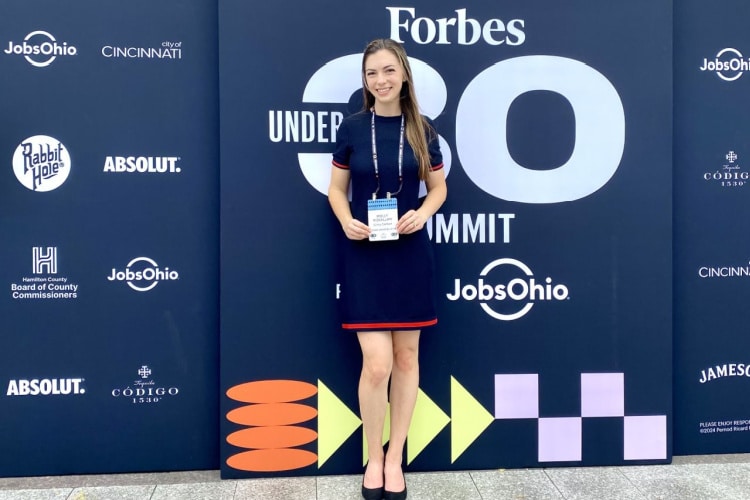
For many companies, carbon emissions are a cost of doing business. For Molly Rizkallah, they represent an opportunity.
That perspective led her to launch Cincy Carbon, a Cincinnati-based startup focused on converting carbon dioxide into usable industrial materials. With a background that spans both engineering and business, Rizkallah said her work has long centered on solving complex problems in ways that balance environmental impact with economic value.
“My background blends both engineering and business, which has shaped how I approach solving complex, real-world problems,” Rizkallah said. “I have always been drawn to building solutions that create both economic and environmental value.”
The idea for the company came from a shift in how she viewed carbon itself.
“The idea for Cincy Carbon came from recognizing that carbon emissions are often treated purely as waste, even though they have the potential to be repurposed,” she said.
A new way of thinking
At its core, Cincy Carbon is built around a simple concept: treating carbon dioxide not as a byproduct to eliminate, but as a resource that can be reused.
The company captures CO₂ emissions and processes them into industrial chemicals that can be used across a range of applications, from fuels to materials.

“We take carbon dioxide, which is a major contributor to climate change, and convert it into useful, sustainable chemicals,” Rizkallah said.
That process focuses on producing foundational inputs such as carbon monoxide and syngas, both of which Rizkallah says play a role in manufacturing everyday products.
“We focus on producing foundational industrial chemicals like carbon monoxide and syngas, which are used to make fuels, plastics, and other materials,” she said.
Those materials ultimately show up in products people encounter every day, including packaging, household goods, and cleaning products. By producing them from captured carbon rather than fossil fuels, the process reduces both emissions and reliance on traditional inputs.
“In practice, we capture CO₂ emissions and process them through our technology to convert them into stable, usable chemicals,” Rizkallah said. “This is a big deal because it reduces the amount of greenhouse gas in the atmosphere while also replacing the need to produce these chemicals from fossil fuels.”
Built for existing industry processes
One of the key challenges in advancing sustainability, Rizkallah said, is practicality.
“It is critical because most companies cannot realistically afford to completely change how they operate,” she said.
Rather than requiring companies to overhaul their systems, Cincy Carbon is designed to integrate with existing industrial processes. That approach allows manufacturers to reduce emissions while continuing to operate efficiently.
“We integrate into existing systems so companies can reduce emissions without major disruption,” Rizkallah said.
That approach also strengthens the business case for adoption. In addition to lowering emissions, the process creates value from materials that would otherwise go to waste.
“We help lower emissions, reduce reliance on fossil-based inputs, and create value from something that would otherwise be wasted,” she said. “Sustainability solutions only make an impact if they are actually used,” she said. “It is important to design them in a way that works for both the environment and the business, and that combination makes it both achievable and economically attractive.”
The regional advantage
Rizkallah said Cincinnati and the broader Ohio region provide a strong foundation for this type of work, particularly because of the area’s deep manufacturing base.

“Cincinnati and the broader Ohio region have a strong manufacturing foundation, which makes it an ideal place to develop and scale sustainable industrial solutions that are both practical and accessible,” she said.
That proximity allows the company to work directly with manufacturers and partners who have been looking for ways to meet sustainability goals while maintaining operational efficiency.
“We are actively engaging with contract manufacturers and partners, especially in the region,” Rizkallah said. “The response has been very positive.”
As environmental expectations continue to evolve, she sees an opportunity for the region to take a leadership role.
“This creates an opportunity for Ohio to be a leader in sustainable manufacturing,” she said.
But bringing new technology into established industries comes with its own challenges, particularly when it requires companies to rethink long-standing processes.
“One of the biggest challenges is bringing new technology into established industries,” Rizkallah said. “It takes time to build trust and demonstrate that a solution is both reliable and beneficial. “
As Earth Day highlights the urgency of environmental challenges, Rizkallah sees an opportunity to shift how industries think about carbon and its role in the broader economy.
“I see a future where carbon is no longer viewed only as a problem, but as a resource that can be reused in a sustainable way,” she said.
Through that lens, Cincy Carbon is focused on helping build a stronger system, one where emissions are reduced and materials are continuously repurposed.
“Our goal is to help create a more circular industrial system where emissions are reduced and materials are continuously repurposed,” Rizkallah said.
Rizkallah has also begun sharing that perspective beyond Cincinnati, speaking at industry events and forums focused on technology and sustainability and earning a spot in Ohio’s Next25 class of 2025.
In those settings, she has emphasized the importance of rethinking how carbon is used within industrial systems, positioning it not only as an environmental challenge but as an opportunity for innovation.
Hear Rizkallah’s next talk about Cincy Carbon and its mission to create more sustainable solutions at the Women in Tech Global Conference.
What: Women in Tech Global Conference 2026When: May 12-15, 2026
Where: Virtual with in-person satellite events
Focus: Climate innovation, sustainability entrepreneurship, and emerging approaches to environmental technology
Molly Rizkallah’s session is May 15, 2026, at 10:30 a.m. EST titled: “The Next Generation of Climate Innovation: Why Gen Z Is Rewriting the Sustainability Playbook”
Registration: Learn more about the event and secure your spot here.
Author

Related Articles
Interfaith coalitions drive sustainability across region with climate action
Cincinnati initiative “Faith Communities Go Green” allies with houses of worship to put diverse religious teachings into practice.

Greater Cincinnati Society of Professional Journalists and Ohio’s Best Journalism recognize Soapbox for excellence in 2025
Solutions journalism reporting about health, social justice and environment earn top honors.

Beyond the runway: Goodwill and UC DAAP explore fashion’s circular future
A cross-sector collaboration between Cincinnati organizations turned discarded textiles into a conversation about fashion’s future.