Beyond the hype: Where Cincinnati businesses and residents can learn to put AI to work
From everyday tools to workplace training, learning to use artificial intelligence means understanding where it can help and where human judgment still matters.

Some business owners have asked whether AI technology could replace their teams. According to Anthony Di Fino, the answer is “No, it shouldn’t replace your team. It should make it stronger.”
Di Fino, founder of Union, Kentucky-based Rockbeach, LLC., is a business owner, not an AI specialist. After more than 20 years in college athletics, including a role at the University of Cincinnati, he launched his consulting business in late 2025 and began using AI for research and to build new parts of the company.
“I do think more people are using it in their daily life than they even know,” Di Fino said. He points to AI-generated responses in Google searches and tools such as Alexa as examples of how the technology has become part of everyday routines.
Knowing AI is there and understanding how to use it are two different things. For individuals and businesses, the challenge is finding reliable guidance amid a growing number of tools and companies promising to make work easier.
At work, adoption can be less straightforward. Businesses set their own rules, particularly when sensitive information is involved, and employees may be unsure which tools are appropriate.
“I think employees want to be using it, but kind of told, in a way, on how to use it,” he said. With companies pitching products and warning about what could happen if businesses do not adopt AI, it can be difficult to know who to trust.
Start with a practical use
Di Fino’s first step was using AI as a research tool. While consulting with businesses, colleges, and technology companies, he found AI could help him get up to speed on unfamiliar subjects and turn ideas into written plans.
“I think AI for research is significant,” he said, describing how it can help someone understand a topic quickly and get what is in their head onto paper. Research still needs to be reviewed and refined.
Around April 2026, he began learning how tools worked together and used Claude Code to build the Rockbeach website and training platform. He estimated that hiring a developer to build his website could have cost $5,000 to $6,000. Instead, he said, he was able to work through the process himself, with hard costs for the domain and tools costing around $20 per month.
Rockbeach Training was built without an outside developer, but the first versions were not ready to release and required significant revision.
“There’s a lot of hours of refinement that people don’t see, and don’t expect, when you get into it,” he said.
For Di Fino, the ability to research, build and test ideas has changed what he can take on. “While running a business solo, it is the single greatest tool I have to grow,” he said.
Practice before the customer interaction
Rockbeach Training grew out of Di Fino’s experience in ticket sales and his interest in helping entry-level employees prepare for customer-facing roles. At 21, he was making 100 calls a day in New York City with little more than a binder and a phone. A mentor eventually helped him develop his sales skills.
He wants new employees to practice before handling difficult conversations on their own, particularly in busy sales and service environments where managers are not always available.
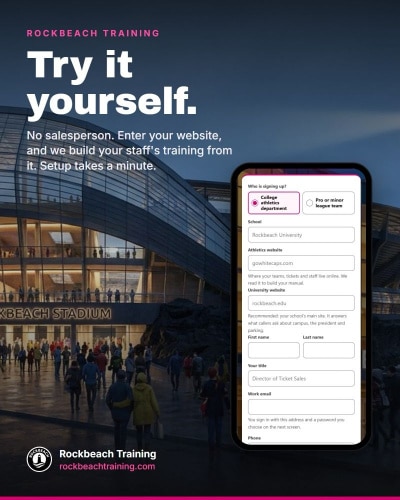
The platform uses AI to simulate customer interactions, focusing on situations employees are likely to encounter rather than general sales techniques.
“So, what we try to do is keep it more situational and put the rep or the learner in a position where we’re going to teach you the basics of sales, but we want you to apply more of a customer service situational hat,” Di Fino said. That can mean practicing how to respond to objections, complaints or an angry customer.
For an organization, Rockbeach Training can use existing materials such as customer surveys and training manuals to shape its modules. A restaurant, for example, could use customer feedback about a menu item to create practice scenarios. In ticket sales, Di Fino points to familiar complaints about warm beer, cold hot dogs or parking.
Employees can practice responses before speaking with an actual customer. “You’re able to just say it out loud, five, six, seven, eight times on practice calls before you could go back and address it live with a real customer,” he said.
The platform began with ticket sales and is expanding to other customer-facing settings, including restaurants, auto dealerships, hotel front desks, and fundraising calls. The goal is to help new employees learn a role’s language, expectations, and common challenges before they are on the floor.
Keep people in the process
Di Fino sees a difference between using AI to train employees and using it to replace them.
He sees value in giving employees more opportunities to learn while leaving customer relationships in human hands. “People still want to talk to people to solve their problems. People trust other people,” he said.
That approach also shapes a planned job-matching component of Rockbeach. Learners can upload resumes, and Di Fino wants participating organizations to review them with a person rather than an automated screening tool. The matching tool is an upcoming feature, Di Fino said.
“Humans want humans,” he said. “I want a human to log in from that organization and the recruiting organization to actually take time and look at those resumes.”
Rockbeach Training has built in a bot blocker and does not allow APIs for that process. The platform focuses on training, not AI avatars making sales calls or handling customer conversations.
“We want the focus to be on helping humans find jobs, learn, train, develop, and get stronger in the sales process,” Di Fino said. For customer-facing work, he believes listening, empathy and trust remain central.
Di Fino learned by experimenting, making mistakes and applying AI to problems he already understood. For people who prefer a more structured introduction, organizations throughout the Cincinnati region offer training that ranges from basic skills to business applications in a mix of online courses, workforce training and hands-on workshops. Some programs are free, while others are designed for businesses looking for more individualized instruction.
UC Center for Business Analytics and AI
The University of Cincinnati’s Center for Business Analytics and AI offers “Generative AI in Business: Applications, Challenges, Ethics and Governance,” a live online course open to the public. The upcoming course dates are Nov. 30 and Dec. 2, 7, and 9. No prior experience is required, and participants can earn a certificate.
Learn more
AI Ready Ohio
AI Ready Ohio offers free, self-paced online training, in-person workshops, and access to approved training partners. Its learning resources include courses from major technology providers and are intended to help Ohioans build practical AI skills. Some courses may be available through LinkedIn Learning for Ohio public library cardholders.
Explore training options
Clustr AI workshops
Clustr is offering hands-on Claude workshops for people who want to move beyond introductory AI use. An upcoming workshop is scheduled for Dec. 2, at SparkHaus in Covington, with another Cincinnati-area session Dec. 9. The five-hour format includes instruction and practical exercises. Participants need a Claude account and a laptop.
Workshop details and registration
Start AI Cincy
Start AI Cincy provides in-person training for small and medium-sized businesses. Its sessions are built around real business tasks, with participants working through practical applications and leaving with reusable prompts and processes. The listed group option is designed for five or more participants.
Explore training
Per Scholas Greater Cincinnati
Per Scholas offers no-cost technology career training in the Greater Cincinnati region. Its programs include AI-related coursework and training that incorporates AI tools into areas such as IT support, cybersecurity, and business intelligence.
View Greater Cincinnati programs
As AI becomes more common in both personal and professional settings, learning how to use it well may be less about keeping up with every new tool and more about knowing what problem you’re trying to solve. For individuals, that could mean building confidence with everyday applications. For businesses, it could mean giving employees the guidance and practice they need to use the technology responsibly while continuing to put people first.
Author

Related Articles

Companies may be held liable when AI harms their clients and customers
AI errors are often hard to detect without independent verification.
StartupCincy Week marks a decade of building Cincinnati’s startup community
The event returns in October with a bigger footprint, more programming, and proof that Cincinnati’s startup ecosystem has grown without losing community-driven spirit.

May We Help is solving everyday mobility challenges one person at a time
Three guys named Bill had an idea.