
Author

Evan Wallis

Evan Wallis's Latest Articles

NKU brings home entrepreneurship awards

In a recent entrepreneurial competition, Northern Kentucky University brought home four of the nine total awards.  The fifth annual Idea State U, which is hosted by the Kentucky Cabinet for Economic Development, showcased 24 new business ideas, which were competing for a total prize purse of $100,000. More than 70 students made up the 24 teams, all from Kentucky public universities. The reason for NKU's success, Fifth Third Entrepreneurship Institute director Eileen Weisenbach says, is the work the students do outside the classroom. "We're an institute, which means we have a lot of things outside the curriculum that we use to develop students into entrepreneurs," Weisenbach says. "We include our students in the development of things like school-wide competitions. These kinds of events create the spokes that make an environment that is energetically pursing innovation."   Three out of the four teams that represented NKU were given awards. Social Circles was awarded the second largest prize of $24,711 for their social networking platform that provides recommendations based on past activities and interests. Inxpression, a business that allows customers to design their own shirts in a matter of minutes, was awarded the third largest prize of $11,533. Inxpression also took home the Governor's Innovation Award, a prize that goes to the most innovative thinking in a business plan. Line Scout, a cloud-based software application that streamlines restaurant management, was awarded $1,583. "It's easy to get stuck in a rut as a student," Weisenbach says. "This kind of competition allows students to get that external validation and really work for something."  The prize money must be used for business expenses and to incorporate businesses in the state of Kentucky. Inxpressions has already used their prize money to hire a patent attorney and get a design patent for their unique machine.  Weisenbach contributes much of the success of the students to the staff at NKU. "We have a faculty that really tries to connect with students on a one-on-one basis," she says. "Everyone invests in their students, and it really shows."  While Weisenbach believes the success at Idea State U will bring recognition and attention to NKU, she also knows the competition is good for students throughout the state.  "This kind of success really helps us in three ways," she says. "We can recruit more students, get more state funding and get more lenders and employers to come check out our school when they see the caliber of students we have."  By Evan Wallis 
Plan, Build, Live encourages community feedback

City and neighborhood leaders, led by Vice Mayor Roxanne Qualls, have been building support for a new approach to development regulations for more than four years. Much of that has been developed through the program Plan, Build, Live. Plan, Build, Live is a program driven by community feedback and discussion, all gathered  via the project's website. The website encourages people to share their ideas about how a city should be designed. This weekend, instead of just online, Cincinnati residents and business leaders will come together to shape our future through a citywide Urban Design Workshop. The Workshop takes place from April 28 to May 2 to help create a "form-based code" that can be used by neighborhoods all over Cincinnati -- and help shape how development happens in Cincinnati in decades to come.    "Traditional zoning focuses on the use of the building and how far the building is off the street or how large the building is," says Della Rucker, public engagement office for Plan, Build, Live. "Form-based code flips that around and focuses on how a property contributes to the experience people have in the area. How it creates a vibrant, walkable community."  Plan Build Live is funded by a $2.4 million grant from the U.S. Department of Housing and Urban Development (HUD). Local funding is provided by the City of Cincinnati, the Metropolitan Sewer District of Greater Cincinnati, the Cincinnati Health Department, and the Mill Creek Restoration Project. One of the Plan Build Live tools, a form-based code, encourages strong neighborhoods, business districts, and downtowns by focusing on the shapes of buildings, streets and sidewalks. Form-based codes can helps maintain or enhance a mixed-use, pedestrian-friendly environment that offers a mix of residential options, transportation methods, workplaces, shopping and more. Traditional zoning codes encourage patches of similar use, forcing long distances between work, home and play. Form-based codes allow different uses to cluster – restaurants, apartments, drug stores and grocery stores, for instance – as long as they stick to rules that address the ways they relate to the neighborhood.   Form-based codes are not planned to replace other types of zoning in Cincinnati, but they are intended to give neighborhoods a more flexibility. A key difference of form-based codes is that even people who are not trained planners help put them together. Participants only need to be willing to share their ideas. During the Workshops, citizens will meet with planners, architects and engineers to talk about what they like and want to see -- both in Cincinnati's neighborhoods and on several "special opportunity" sites.  The preliminary Workshop focuses on creating a city-wide form-based code that will serve as a framework for the fall workshop, which will focus on four neighborhoods: Westwood, College Hill, Madisonville and Walnut Hills.  The estimated completion date is 2013, but feedback and participation from residents and business owners is critical to helping the city implement the program. By Evan Wallis

Bike Month events celebrate city’s progress, potential

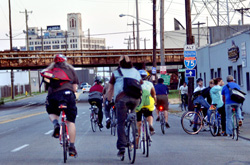
Grease up your chain, pump up your tires, roll up your right pant leg and hop on your bicycle--it's nearly Bike Month in Cincinnati. Get ready to roll.

Global 2 Local blends translation, technology

A Cincinnati-based interpreting company has been providing translations and interpreting service to companies worldwide, and recently won a contract from the City of Cincinnati to provide interpreter services for all of the Health Department locations in the city.  Global 2 Local Language Solutions was founded by Grace Bosworth in 2009, but she didn't really start working on her company full-time until November 2010. G2L specializes in technical document translation, which is possible through its database of more than 300 to 400 interpreters and translators.  After helping another woman start a language service business out of a house, and eventually broke off of the company to travel for a year, and upon returning to Cincinnati, she founded G2L. With previous experience starting a similar type of business, Bosworth was able to hit the ground running.  G2L provides service including everything from website localizations, meaning the website is designed and programmed in several different languages to technical document translations to in-person interpreting.  "Translators and interpreters are special people," Bostworth says. "They have to have a complete grasp of both languages they area working with as well as a background in the specific matter they are translating."  Besides the translation and interpreting services, G2L also provides web design, graphics and database administration. This blend of technology and translation is a departure from what many language service businesses offer. One major hurdle G2L faces is finding new clients. Bosworth started 2012 with the goal of gaining 25 new contracts, a large number for a company with only four full time employees.  "Finding new clients is one of our biggest challenges," Bosworth says. "Gaining contracts like this one with Cincinnati is a great way for us to bridge the gap to bigger contracts. You can't get experience until someone let's you have it."  With the momentum of winning the contract from the City of Cincinnati, G2L is now in the running to win a larger contract to provide interpreter services for all of the hospitals in Dayton.  Business will continue to grow for G2L as they obtain more clients and Bosworth believes more people will see the need for providing their services to a non-English speaking customer base. The Ohio Department of Development has a grant right now that gives companies money towards developing their website and marketing materials into other languages in an effort to increase exports from Ohio. "Sometimes people don't think about it, but if you want to get your product out to other languages you need to make marketing materials in other languages as well as get your website available in other languages," Bosworth says. "We are able to do all of that for companies."  By Evan Wallis 

Global 2 Local blends translation and technology

A Cincinnati-based interpreting company has been providing translations and interpreting service to companies worldwide, and recently won a contract from the City of Cincinnati to provide interpreter services for all of the Health Department locations in the city.  Global 2 Local Language Solutions was founded by Grace Bosworth back in 2009, but she didn't really start working on her company full-time until November of 2010. G2L specializes in technical document translation, which is possible through their database of over 300-400 interpreters and translators.  After helping another woman start a language service business out of a house, and eventually broke off of the company to travel for a year, and upon returning to Cincinnati, she founded G2L. With previous experience starting a similar type of business, Bosworth was able to hit the ground running.  G2L provides service including everything from website localizations, meaning the website is designed and programed in several different languages to technical document translations to in-person interpreting.  "Translators and interpreters are special people," Bostworth says. "They have to have a complete grasp of both languages they area working with as well as a background in the specific matter they are translating."  Besides the translation and interpreting services, G2L also provides web design, graphics and database administration. This blend of technology and translation is a departure from what many language service businesses offer.  One major hurdle G2L faces is finding new clients. Bosworth started 2012 with the goal of gaining 25 new contracts, a large number for a company with only four full time employees.  "Finding new clients is one of our biggest challenges," Bosworth says. "Gaining contracts like this one with Cincinnati is a great way for us to bridge the gap to bigger contracts. You can't get experience until someone let's you have it."  With the momentum of winning the contract from the City of Cincinnati, G2L is now in the running to win a larger contract to provide interpreter services for all of the hospitals in Dayton.  Business will continue to grow for G2L as they obtain more clients and Bosworth believes more people will see the need for providing their services to a non-English speaking customer base. The Ohio Department of Development has a grant right now that gives companies money towards developing their website and marketing materials into other languages in an effort to increase exports from Ohio. "Sometimes people don't think about it, but if you want to get your product out to other languages you need to make marketing materials in other languages as well as get your website available in other languages," Bosworth says. "We are able to do all of that for companies."  By Evan Wallis 

OTR Kickball back for season three

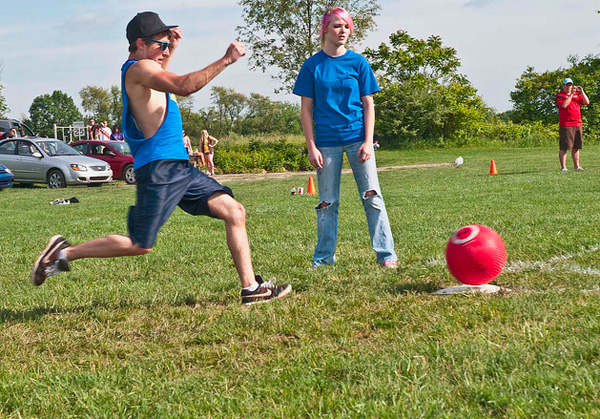
This summer, the third season of the OTR kickball league will return to Cutter Field, this time, with a little more organization. The kickball league was started two years ago by Jenny Kessler, who, until now, has found sponsors, rounded up teams, organized referees and scheduled the 22 teams who have competed during the first two seasons. At the end of last season, Tom Hodges, an OTR resident and lawyer, asked Kessler if she was planning on planning a third season. After a short discussion, Hodges and Kessler, along with Joe Yoo, decided to form Urban Sports Cincinnati (USC), an LLC which will help govern the kickball league, and other downtown games like bocce ball at Neons and ping pong at the Drinkery.  "The idea is to have something in place so once the person who started doesn't want to run it anymore, it still continues," Hodges says. "It's about the neighborhood. We want it to continue to thrive, and small things, like kickball, contribute to why people want to live here." USC will create an infrastructure, complete with a website, to help in the planning of sports in the downtown area.  "When I decide I don't want to run kickball anymore, someone won't have to build it from scratch again," Kessler says. "I can give someone the contacts, the set-up and all the other information they need to keep it going." USC will also help keep the funds in one place. Soapbox contributor Casey Coston started ping pong at the Drinkery last year, but it has since stopped because of a lack of functioning tables. Hodges hopes that with USC, gathering the money needed will be easier, and better than having one person invest in the equipment alone. The third season kicks of in late June and runs through August with a cost of $15 per person. The low cost has always been a goal, and is aimed at making the league more relaxed and all-inclusive, rather than ultra-competitive. It was a goal of Kessler's to bring the community together. Neighborhood children have always been encouraged to join teams when substitutes are needed, and those children have since become welcomed members of some teams.   "I think the organization will give these games legitimacy, so people won't mind paying the $15," Hodges says. "But it's also cheap enough to keep the feeling that this is for fun and to make the community a more vibrant place."  Sign your team up here. By Evan Wallis 

VisuaLingual’s Seed Bomb biz blooms

Tucked into the third floor of a warehouse on W. 15th Street, right above Harvest Gallery, Maya Drozdz and Michael Stout, the duo that comprises VisuaLingual, have been busy stuffing muslin bags full of Seed Bombs for everything from baptisms to orders for Williams-Sonoma. The Seed Bombs are gumball-sized brown balls made out of a cookie dough-like substance that encases different seeds. The bombs break on impact with the ground and eventually start to grow in almost any environment. Seed Bombs are completely hand-made and the bags are screen-printed by the couple in Over-the-Rhine. One of their recent, larger developments is a contract with Williams-Sonoma. At the beginning of April, Drozdz put together two exclusive products for the new "Agrarian" line of products. The two products are cocktail garnishes that include cinnamon basil, lemon mint and lime basil, and culinary herbs, which include parsley, basil and cilantro.  "It's been in the works for a long time," Drozdz says. "Once our products get featured in one national store, people start to see it and then contact us about getting it in their store."  In the midst of stuffing bags, tying knots and packing up boxes for national retailers like Anthropologie and Williams-Sonoma, Drozdz and her two after-school employees and three part-time helpers work on custom orders for people and businesses around the country. Right now, the team is stuffing 10,000 bags of parsley seed bombs, which is a digestive-aid for dogs, for the all-natural dog food company, The Honest Kitchen. The Seed Bombs will be sent out as gifts to the dog food company's customers.  Seed Bombs were also featured at an Etsy event in New York that showcased one-of-a-kind Etsy products for wedding favors. In the past year, VisuaLingual has experienced much growth, which will allow Drozdz's partner, Stout, to join the team full-time in May.  "We've had to learn a lot of things as we go," Drozdz says. "But I feel like I always have a challenge and am learning and doings things I never thought I would."  Next up, Drozdz is already thinking about the holiday season and making their Blooming Briquettes, a creative stocking-stuffer that looks like a piece of coal but is actually a Seed Bomb By Evan Wallis 

UC students take stroke detection device global

A team of UC students that has won several awards for their stroke-detection device, Ischiban, are in the hunt for bigger awards and more recognition.  The team includes biomedical and computer engineers and an industrial designer: Pooja Kadambi, Joe Lovelace, Scott Robinson and Alex Androski. They developed the device, comprised of an elastic headband connected to an electronic diagnostic device, which can quickly determine the type of stroke a patient is suffering from. This allows for quick diagnosis and faster treatment for better recovery rates, according to the developers. Currently, such stoke differentiation is done by a CT scan, which is costly and time-consuming. Ischiban can be used by EMTs at a patient's home or during an ambulance ride. Early detection is important because patients whose stoke is caused by a blood clot who are treated within three hours of symptoms are significantly more likely to survive and recover. Most recently, the team took first place at the Oregon New Venture Championship, which included a $3,000 prize. Teams are judged on their ideas, business plans and pitches, as well as how quickly they can adjust to feedback from various judges, says Charles H. Matthews, executive director of UC’s Center for Entrepreneurship Education and Research, professor of management and a team adviser. “The NVC is one of the best, but also one of the toughest competitions,” Matthews says. “Everyone was talking about their innovative approach to early stroke detection.”  The other prizes the team have won for their device include first place at the Innov8 Health Idea Expo at GE Aviation Learning Centre and runner-up in the Spirit of Enterprise Competition. After winning the Oregon competition, the group is on its way to the Venture Labs Investment Competition in Texas, May 3-6, which only allows 40 teams from around the world to compete.  Prizes include $135,000 in seed funding, feedback from investors and faculty and an opportunity to gain interest about their product or business. The competition is designed to mimic the real world process of garnering venture capital.  By Evan Wallis & Feoshia Henderson

Smale Park grand opening highlights Black Brigade Monument

After over a decade of waiting, on May 18, Smale Riverfront Park will open with a bang, literally.  A firework display and local bands will commemorate the first phase of construction opening to the public. Phase 1 includes the Schmidlapp event lawn and stage, the Black Brigade Monument, the Bike, Mobility and Visitor's Center, The Smale Tree Grove and the first section of the bike trail. Other Phase 1 features, including the labyrinth, are expected to be open by the fall.  The 45-acre, $120 million park, which, once finished, will house a boat dock, will be in construction for the next couple years, but the grand opening is a important timestamp for the park because the plans have been approved since 1999.   The first piece of commissioned art in Smale park, the Black Brigade monument, pays tribute to the often overlooked group of 700 African-American men who volunteered to build a barricade to defend Cincinnati from a confederate attack during the Civil War in 1862. This marked some of the first black males to be employed by the North. Originally, the men were forced into constructing the barricades, which led to protests of the inhumane treatment of the men and an outcry by local media. The protests led to an intervention by Union officers, who freed the men from the forced labor and returned them to their homes. After returned home, the men were invited to volunteer their services and become a part of the team of 8,000 Cincinnatians that constructed the barricade to protect Cincinnati from attacks. Mayor Malloy's father, William Mallory Sr. was a leader in the development of the monument, saying that it is a important story that pertains to the history of Cincinnati.  "It is a very significant moment in Cincinnati's and the country's social history," says Joyce Kamen, public information officer for Smale Riverfront Park. "Cincinnati was on the river that separated slavery from freedom and many of the men who volunteered ended up serving in the North's military." The sculpture will have three life-size bronze sculptures, interpretive panels of the monument and several relief panels. The monument will also show all 700 names of the men of the Black Brigade. Writer Tyrone Williams, graphic designer Erik Brown and sculptors John Hebenstreit and Carolyn Manto are all working on the development of the monument. The four artists were chosen out of a total of 40 artists who submitted applications to design the monument.  Future phases of Smale Park's development include an extension of the Ohio River Trail and the Women's Committee Garden, which are targeted to be completed by fall of 2013, and the Adventure Playground and Boat Dock,  on schedule to be completed by summer of 2014. By Evan Wallis 

Dog days abound at Fido Field

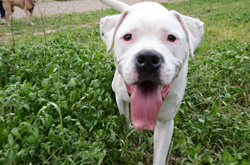
Fido Field is not a dog park, but it is a treat of a comeback story. Just east of downtown on the Ohio River, the Field is a labor of love for the enthusiastic dog owners who made it possible, through a combination of hard work, fundraising and, yes, doggone determination.

Our Partners

Taft Museum of Art
Warsaw Federal

Don't miss out!

Everything Cincinnati, in your inbox every week.

Close the CTA

Already a subscriber? Enter your email to hide this popup in the future.