Author

Evan Wallis

Evan Wallis's Latest Articles

Startup Such + Such builds collective design future in OTR

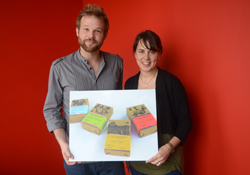
After graduating from DAAP and having experience co-oping with large design firms, three UC alums set an ambitious goal: start their own business and do it right here, in Cincinnati Starting out of Losantiville Design Collective at 1311 Main Street in Over-the-Rhine, the team at Such + Such is perfecting design and woodworking skills while working with neighborhood businesses and creating handmade furniture products. The company’s own line of products is available at Losantiville and on Such + Such’s Etsy site. Such + Such also provides design services – founders recently helped create the build-out for Sloane Boutique. The Losantiville Collective was formed to give creative types a place to share rent, tools and ideas. All the tenants pay rent, and the leftover money is invested in tools and an effort to  find a larger space than can hold more tenants. After graduating in June 2010, Alex Aeschbury, Zach Darmanan-Harris and Mike Nauman started Such + Such in March 2011. From clocks to tables to coat racks, all of Such + Such’s work is crafted in OTR. The trio’s eye for beautiful craftsmanship, along with their  manufacturing skills honed in years of DAAP studio work, allow them to make simple, but eye-catching, products. At Such + Such, every day offers a new learning opportunity. One day found the three start-up founders creating a four-foot-long spork to be used in an online video. “We wanted to be in charge. Between us, we had worked for 18 different companies while on UC co-ops. And we knew what we didn’t want and that was to have a small part of a task, product, branding or packaging project. We wanted to dictate the direction of an entire company, from capital investments to the finish on screws,” Aeschbury says. Such + Such founders want to expand their product line and find shops around Cincinnati and Colombus to sell them. The trio is working hard each day on learning business skills and handling a growing number of projects. But in the end, they are living their dreams and enjoying ever-changing workdays. By Evan Wallis

Su Casa helps immigrants feel at home

Formed in 1997 in response to an influx of immigrants from Latin America, Su Casa was the first organization in the region to focus on the needs of a new generation of Cincinnati newcomers. Originated at St. Charles of Borromeo Church, Su Casa entered under the umbrella of Catholic Charities of Southwestern Ohio in 2005; today it is recognized as one of the first places new immigrants go to help find their way in Cincinnati. Su Casa, a social service center, helps more than 100 families each month with everything from shelter, healthcare, employment and a place to feel welcomed. Through its 14 years in Elwood Place, Su Casa has adapted to the needs of every person who comes through the doors. Major areas remain providing information and referrals, health promotion and literacy education.  With a Hispanic population that has doubled in the past 20 years—local estimates now range from 30,000 to 40,000—the city’s residents have a growing need for Su Casa services. Workers at Su Casa assist clients in finding health care providers, obtaining food stamps and dealing with legal issues. Health services can include everything from finding a doctor to workshops about topics from domestic violence to asthma. Literacy education ranges from basic language classes to GED classes in both Spanish and English. “Everyone has different needs,” says Giovanna Alvarez, director of Su Casa. “We do our best to help everyone that comes to us.” Sustained through grants, donations and fees for some of their services, Su Casa’s social workers work with volunteers who even provide yoga and piano lessons. Their well-rounded approach enables immigrants to locate services and support, as well as establish a new and healthy life in Cincinnati. Do Good: Volunteer: With a wide variety of programs, there is a wide variety of volunteer needs. Donate: Every bit helps Su Casa to integrate new immigrants into the community. Attend: Su Casa’s annual banquet and silent auction and help support their mission. By Evan Wallis

Gateway trains energy auditors

In Northern Kentucky, a community college that overlooks Cincinnati gives students hands-on experience in conserving energy. Gateway Community and Technical College in Covington now offers an Energy Audtior class, which gives students the training they need to prepare for the Building Analyst Certification Exam trough the Building Performance Institute. Gateway pairs the course with its Air Conditioning Technology area of study. The energy auditing class is open to students and businesses that want to get employees certified in the process. The first class runs from Jan. 30 through Feb. 3. In eight hours per day, students and professionals can get a quick boost to their skill sets, and salaries. Employers that send employees to the class may be eligible for state funding to offset costs as part of an effort to boost enrollment.   Energy Auditors can work for energy companies, building contractors or air conditioning companies to help homeowners reduce their consumption of energy. By having mock houses on campus, the staff at Gateway gives students specific training that mimics what they will be doing once in the field. They use tools like thermal imagers to locate areas of heat loss and duct blasters to find leaks and bad seals. After an energy auditor inspects a home, they will be able to advise homeowners on how to lower utility bills. “Our facility really gives people an opportunity to try what they are going to be doing,” says Ric Bowen, associate professor at Gateway. “We have all the equipment right here. In the future, Gateway hopes to expand its Energy Auditor program to provide commercial energy auditor training and attract even more enrollment. By Evan Wallis

Condo conversion: Bellevue church attracts suburban buyers

A new generation of Cincinnati workers is foregoing suburban lifestyles and finding unique, urban living spaces — and not just in Over the Rhine. At St. Anthony Lofts in Bellevue, Kentucky, buyers praise the stunning architecture and proximity to downtown.

Yelp’s scavenger hunt leads to local businesses

Inspired by Willy Wonka’s Golden Tickets and a love for unique, local shops in Cincinnati, Alex Shebar, Cincinnati community manager at Yelp, created a scavenger hunt to highlight local businesses and stimulate the local economy. Yelp is a web-based service that allows users to check-in, write reviews and share their opinions about any business in the area and already a main source for people searching out new businesses to explore. The hunt includes more than 80 independent shops from Bellevue to Farfield to Milford and everywhere in between.  Shebar’s hunt, which focuses on six golden tickets randomly placed in the businesses, does more than include discounts and coupons. Each participating business donated an item worth at least $25 worth of prizes; donated items were split into six gift baskets worth hundreds of dollars each. Clues will be added on social media each day, getting more and more specific as Christmas draws nearer. Running from now until Dec. 26, the hunt gives patrons plenty of time to explore old and new favorite stores. The idea came from last year’s Totally Bazaar event that Yelp’s Shebar planned. He updated the idea from a one-day shopping bonanza to a citywide hunt. “The idea is to support local shopping,” Shebar says. “The Bazaar last year was a good introduction to the products stores have, but it didn’t get people in the stores. It can be intimidating to go in somewhere for the first time, and I think this will help.” Shebar looked for neighborhoods, like Bellvue, OTR and Milford, with multiple local stores to help hunters drive less. Each ticket was placed randomly, so there could be several in one neighborhood, or none in a particular neighborhood. All aspects of the hunt urge people to explore new stores. “I have nothing against chain stores, but we wanted to get people away from those stores and check out more unique, interesting shops,” Shebar says. “You can find gifts you wouldn’t find anywhere else.” By Evan Wallis

YMCA honors Latino advocate at NKU

Growing up in the most biodiverse country in the world gave Miriam Kannan a love for biology. In her work at Northern Kentucky University, that passion has led to an award with for her work in academia and the Latino community. Kannan, a native of Quito, Ecuador, started at NKU in 1979. In her time teaching microbiology, Kannan has received numerous awards for her academic work, She was named a Regents’ Professor at NKU, and Nov. 14, she received one of YMCA’s Black and Latino Achievers of the Year Award. For Kannan, the award reinforced the work she has been doing for decades in Cincinnati’s Latino communities. The past president of Kentucky’s Academy of Sciences currently serves as director of NKU’s Latino Center for Excellence, and in 2004, she started a Fun with Science summer camp. The Fun with Science camps was started with NKU’s Latino Student Affairs Director as a way to reach out to Latino and multicultural middle and high school students to engage them in a week filled with chemistry, physics, geology and microbiology. The camp started as volunteer work for Kannan and some fellow faculty, but now, they have received funding and attract students from all over the world. “Our camp has metamorphosed into an English language learner’s camp,” Kannan says. “Much of this work is why I was nominated for this award.” The YMCA also serves as a perfect place for Kannan to find ambitious students to attend and help with her summer science camp. She pairs one undergraduate with every four camp attendees, giving them chances to interact with people from different backgrounds and opening their eyes to the diversity of plant and human life in the world. “This award means a lot since it came from the community I work in,” Kannan says. Do Good: Contact: Miriam Kannan and see how you can help with the Fun with Science Summer Camp. Volunteer: at the YWCA and give back. Donate: to the YWCA and provide financial support to families who can afford things such as summer camp By Evan Wallis  

Science, nature highlighted in UC playground

With the cold, grey winter months already upon us, a partnership between UC and the Cincinnati Nature Center is planting seeds of nature education that will take root next year. Final plans ensure that Sigma Sigma Commons on UC’s Clifton campus has some extra green come early summer. Focused towards children aged three to five, the new PlayScape is a nature-centric playground for children who attend the Arlitt Center as well as kids from the surrounding community. The 10,000-square-foot environmental haven includes a tree house, a stream and a bird-watching hideaway. Play elements are all focused on giving children places to learn about the world around them. Through a log fort, a stream that children can turn on and off and a sculpture with gardening tools and science equipment, the PlayScape allows children to develop skills that urban young people often never come across. The Arlitt Center not only provides childcare, it also provides opportunities for future educators to get hands-on experience in early childhood education. The PlayScape features an observation deck so that educators-in-training can watch children develop their motor skills and play in a much different setting from most urban playgrounds. The PlayScape also allows researchers to watch and learn how children develop skills and interest in sciences as children will be able to plant, cultivate and harvest food in the vegetable garden. The PlayScape is the second of its kind in Cincinnati – the first is the Marge & Charles Schott Nature PlaceScape at Cincinnati Nature Center. It was made possible through a  $330,000 grant from the National Science Foundation. The grant will be funded over two years. Do Good: By Evan Wallis

Design Impact grows local social innovation roots

At Design Impact, Ramsey Ford and Kate Hanisian take their design and community development skills around the world, building sustainable social solutions that combine creativity and mutual respect.

PWC employs volunteers to help thousands

For more than 30 years, one local non-profit has been working to make local homes more comfortable and livable. With a team of 120 employees, many licensed and trained, People Working Cooperatively relies on thousands of volunteers to help repair and weatherize homes of the disabled, elderly, injured or unemployed. With a coverage area of 20 counties in Greater Cincinnati, PWC serves around 15,000 people a year. Recruiting from corporations, church groups, scout groups and individuals, PWC has one of the largest volunteer corps, placing more than 5,000 volunteers per year. Since its inception in 1975, PWC has offered assistance to more than 200,000 people. Homeowners apply to receive assistance from PWC. Many are referred by social workers, or by word of mouth from others who have been helped by PWC. Most of the people who receive help make, on average, less than $13,000 a year and are in desperate need of home repairs. Repairs can include fixing water and heating systems, minor repairs, lawn work, installing wheelchair ramps and weatherizing homes. These improvements are not cosmetic repairs. PWC’s goal is to make homes safer and more livable for those they service, which sometimes includes installing wheelchair ramps, grab bars and other features to support people with disabilities. Some elderly and disabled only need help with routine housework, which is completed by volunteers One of PWC’s main renovations is to conserve energy in homes in order to reduce utility bills, or offer people a percentage of income payment program, which is an extended payment arrangement that requires regulated gas and electric companies to accept payments based on a percentage of the household income. PWC also hosts two annual events, the Prepare Affair and the Repair Affair. Their largest volunteer day consists of winterizing and raking leaves for hundreds of homes in late fall, and fixing up damages that have been sustained through the winter months once spring comes around. Do Good: Attend: the Prepare Affair and help prepare homes for winter. Volunteer: to help with home repairs or daily household tasks. Donate: to help PWC continue their needed work in Cincinnati. By Evan Wallis

From woodworking to local music concerts, SpringBoard grads build new business

After eight weeks of workshops and lessons from professionals, 11 entrepreneurs gave five-minutes pitches about their businesses—some starting from scratch, others refining and perfecting. The second graduating class of ArtWorks’ Springboard program featured art studios, food delivery and music workshops. Once again, the eight-week course gave entrepreneurial hopefuls from many different phases of life chances to gain insights on their ideas and the know-how to write sound business plans. De Stewart, owner of Colonel De Gourmet Herbs & Spices at Findlay Market, gave a keynote at the event. He urged SpringBoarders to hold onto their dreams and told them that passionate breeds possibility. After their presentations, every presenter thanked SpringBoard. One presenter, Caitlin Behle, started SpringBoard without a clear direction. Eight weeks later, Behle plans on launching the Cincinnati Music Initiative next year, which will host workshops for musicians to talk about the industry, as well as develop a website that gives venues, bands and fans a place to find out everything about Cincinnati music. She also has a full five-year plan in the works. Matt Anthony of Losantiville Collective, an artist workshop on Main Street, already has a growing clientele and group of artists who rent space and share tools in his studio-salesroom hybrid. With SpringBoard, though, Anthony wants keep more artists in Cincinnati by being able to purchase more tools and more space for the handcrafting details that Losantiville promotes. With the second class now graduated, SpringBoard has launched 30 entrepreneurs into the world with more business expertise and the confidence to run a successful business. With the third class already in session and the fourth planned for 2012, Sarah Corlett, SpringBoard coordinator, needs more experts to help enhance the collaborative learning experience. Also in the works is more space for SpringBoard classes. ArtWorks plans to create a workshop space in the place the current Secret ArtWorks gallery. With more room and the ability to hold more classes, SpringBoard can help and inspire a new generation of creative entrepreneurs looking to build their businesses, and their futures, in Cincinnati. By Evan Wallis

Our Partners

Taft Museum of Art
Warsaw Federal

Don't miss out!

Everything Cincinnati, in your inbox every week.

Close the CTA

Already a subscriber? Enter your email to hide this popup in the future.