
An artist’s creative process is revealed beneath layers of paint
The discovery is part of an ongoing conservation project examining Robert S. Duncanson’s monumental mural cycle inside the Taft Museum’s historic foyer.
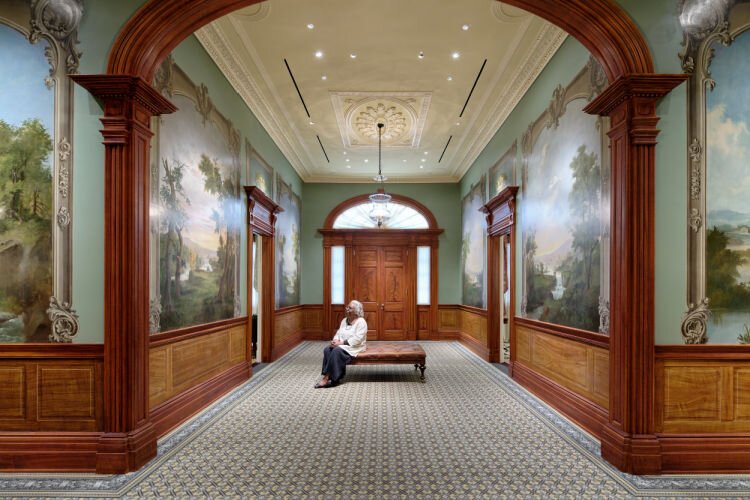
Robert S. Duncanson was still an emerging, self-taught Black artist when Cincinnati patron Nicholas Longworth commissioned him to paint the murals that would define his career. Nearly 175 years later, researchers are uncovering the first lines he drew beneath layers of paint that hid them from view for generations.
Hidden beneath layers of paint, they survived renovations, changing architectural styles and nearly two centuries of history. Visitors to the Taft Museum of Art walked past them every day without ever knowing they were there.
Then an infrared camera brought them back.
As researchers gathered around a monitor inside the museum, graphite lines began to emerge beneath the finished paintings. Flowers appeared with more detail than anyone had seen before. Buildings carefully sketched by hand became visible beneath landscapes where they had nearly disappeared in the finished work.
“I started sweating,” Taft Museum curator Angela Fuller said. “I almost started crying. I hugged someone. I gave someone a high five.”
For the first time since Duncanson painted the murals in the early 1850s, researchers weren’t simply studying the finished artwork. They were catching a glimpse of the artist’s creative process.
The discovery is part of an ongoing conservation project examining Robert S. Duncanson’s monumental mural cycle inside the Taft Museum’s historic foyer. Supported in part by funding from the National Park Service, the project combines conservation science, archival research and historical analysis to better understand one of Cincinnati’s most significant artistic treasures.
While visitors admire the eight sweeping landscape murals that surround the room, another story has remained hidden for decades.
Two overdoor still-life paintings have been concealed beneath layers of paint since the early 1930s, when architectural renovations altered the room. Doorways were filled in, portions of the original murals were destroyed, and the remaining sections were painted over. Museum staff knew they existed only through grainy black-and-white photographs taken when wallpaper was removed nearly a century ago.
Now, conservators are carefully uncovering what remains.
“We’re really excited to reveal more of Robert Duncanson’s original painting and his original plan for that space,” Fuller said.
The work requires patience as much as technology.
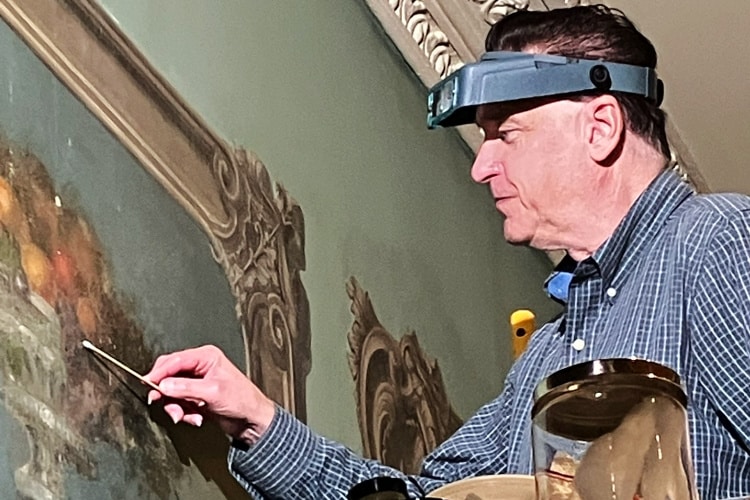
Leading the conservation treatment is architectural conservator Michael J. Ruzga, a Cincinnati-based conservator and former chief conservator at the Taft Museum of Art who has spent more than two decades preserving historic murals and paintings. Over the course of his career, he has conserved works by artists including Rembrandt and Renoir, along with large-scale murals and historic paintings throughout the region.
Researchers are using infrared reflectography, which shines infrared light through the upper paint layers to reveal sketches hidden beneath the finished artwork. The technique allows conservators to see Duncanson’s original pencil drawings without touching or damaging the murals. They are also using X-ray fluorescence (XRF), which identifies the chemical elements in the paint, helping researchers determine which pigments Duncanson used and compare them with materials known to have been sold in Cincinnati during the 1850s.
Preservation is only part of the story.
By looking beneath the painted surface, researchers are uncovering clues about how Duncanson approached his work, what he revised along the way and what time has erased from view. Already, the technology has revealed details no one has seen since the artist himself stood before these walls.
Beneath finished paintings, Duncanson’s original sketches remain remarkably clear. In some places, flowers were drawn with far more detail than survives today, evidence that later cleaning likely removed portions of the artist’s original work. Buildings that appear faint in the finished landscapes were carefully outlined beneath the paint. Trees were often indicated with loose, confident marks, suggesting Duncanson planned the composition while allowing himself room to improvise as he painted.
“You can see where he changed his mind,” Fuller said. “Some elements are very carefully planned, while others are much looser.”
For Laura Stewart, Taft Museum registrar who has coordinated the many moving pieces of the project, one of the most rewarding aspects has been bringing together specialists from different fields.
Conservators, historians, imaging experts, researchers and museum staff all contribute different perspectives, each adding another layer to the story the murals tell.
“It’s the collaborative nature of this,” she said. “Bringing all these experts together.”
Collaboration extends beyond the museum’s walls.
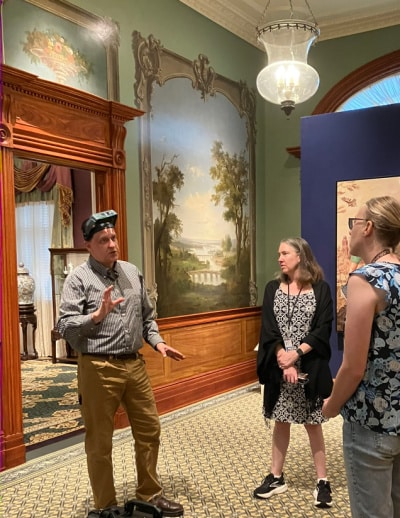
The infrared imaging was conducted in collaboration with independent researcher Chris Debow, whose specialized equipment allowed the team to examine the murals in ways rarely possible for large-scale wall paintings.
Educational materials are being developed to help visitors understand both the conservation process and Duncanson’s work, while additional publications documenting the project are already underway.
For Fuller, one of the biggest lessons is that museums are never finished telling their stories.
“I think it’s important for people to understand that there’s still more to learn,” she said. “It’s not a static place.”
That idea may be the project’s greatest contribution.
Rather than simply preserving artwork, the conservation effort is recovering evidence. Every image captured, every layer carefully uncovered, and every scientific analysis brings researchers closer to understanding not only what Robert S. Duncanson painted, but how he conceived it before the first brushstroke ever touched the wall.
The murals continue to yield new discoveries. Not because they have changed, but because the questions we can ask of them have.
Museums preserve the past. At their best, they also invite us to see it differently.
For Angela Fuller, Laura Stewart, conservator Michael J. Ruzga, and the many researchers, historians, scientists and museum staff who have devoted years to this work, those faint pencil marks are more than a remarkable discovery. They are the first visible traces of an artist making decisions, changing his mind and finding his composition nearly two centuries ago.
History is often imagined as something fixed behind museum walls. This project suggests otherwise.
Sometimes history isn’t waiting in an archive. Sometimes it’s waiting beneath the paint.
Taft Museum of Art is a supporter of Soapbox Cincinnati.
Author

Related Articles
Cincinnati’s independent film scene enters new chapter with unified Cindependent Festival
Two longtime film festivals are joining forces, bringing together independent filmmaking, accessibility and a broader vision for the city’s film community.
Summermusik Festival’s second half features Puerto Rican music, a fan-favorite guitarist and “Sin”cinnati
Music director Eckart Preu welcomes cuatro virtuoso Fabiola Méndez, Victoria Okafor, and chamber rock guitarist Roger Klug to Cincinnati stages.
Summermusik Festival provides something unique for everyone’s musical tastes
Meet Victoria Okafor, whose Summermusik performances include Kurt Weill and Bertolt Brecht’s boundary-pushing ballet chanté, “The Seven Deadly Sins.”