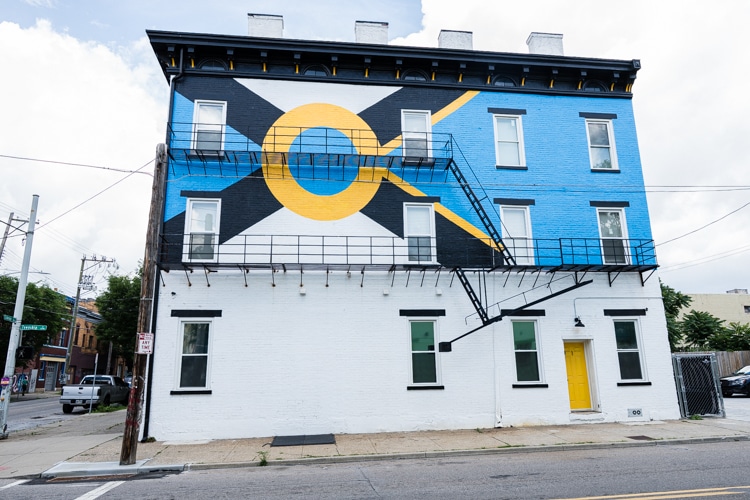
The first mural was on Harrison Avenue. A group of neighbors in Westwood wanted it painted. The community council said no. So, the neighbors did what people do when institutions refuse to move with them: they organized, incorporated, and did it themselves.
That mural became the founding moment of Westwood Works. It also became a template.
“They said, well, what do we need to do to become an official group?” said Stephanie Collins, who now leads the organization. “And they went through those steps to make that happen.”
What those neighbors understood, perhaps before they had language for it, was that the act of making something visible in a place is also an act of claiming it. A mural is not just art. It is a declaration that someone still lives here, still cares, still intends to stay.
That same instinct is driving neighborhood organizations across Cincinnati, from Camp Washington to Lower Price Hill, from Westwood to Northside. Artists, organizers, and residents are building survival infrastructure, the overlapping systems of trust, ownership, and cultural belonging that determine whether communities survive development pressure intact.
The question is no longer whether investment is coming to these neighborhoods. It is. The question is whether the people who built them will still be there when it arrives.
In Price Hill, that question lives in the story of a vacant lot on Considine Avenue that sat empty for thirty years while the neighborhood moved around it. It lives in a homesteading program that turns neglected houses into owned homes rather than speculative assets. It lives in the phrase Greg Robinson of Price Hill Will carries from post-Katrina New Orleans: you tried to bury us, but you did not know we were seeds.
Across the city, neighborhoods with different histories and resources are arriving at similar conclusions about what it takes to hold a community together when outside pressure mounts.
The answer almost always begins with the same thing. People who know each other’s names.
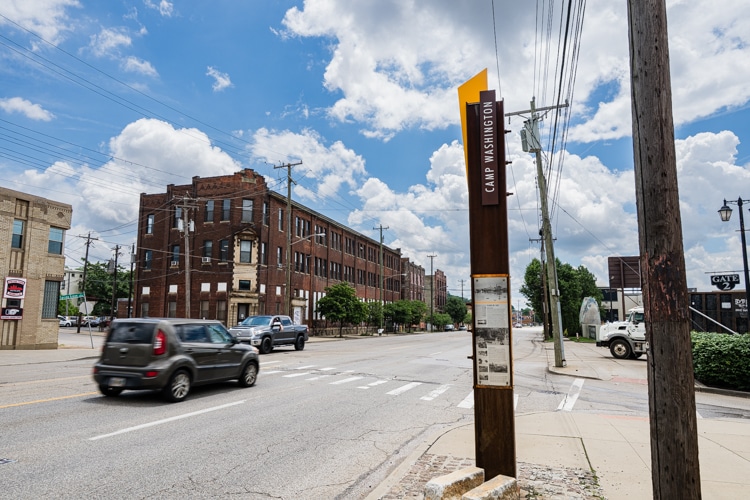
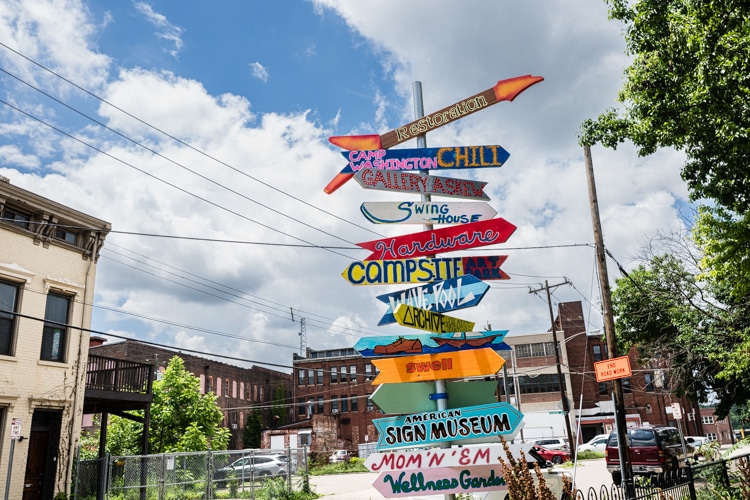
Boris Oicherman can usually be found at Swell Art Café in Camp Washington on Wednesday evenings.
Neighbors stop by to talk through funding ideas, community projects, art, politics, whatever surfaces. Some arrive with fully formed plans. Others come simply to be in the room.
“Making myself available is part of building community,” said Oicherman, executive director of Wave Pool, a Camp Washington arts organization that blends exhibitions, artist support, and community-centered programming.
A few nights later, that philosophy was visible across Wave Pool itself.
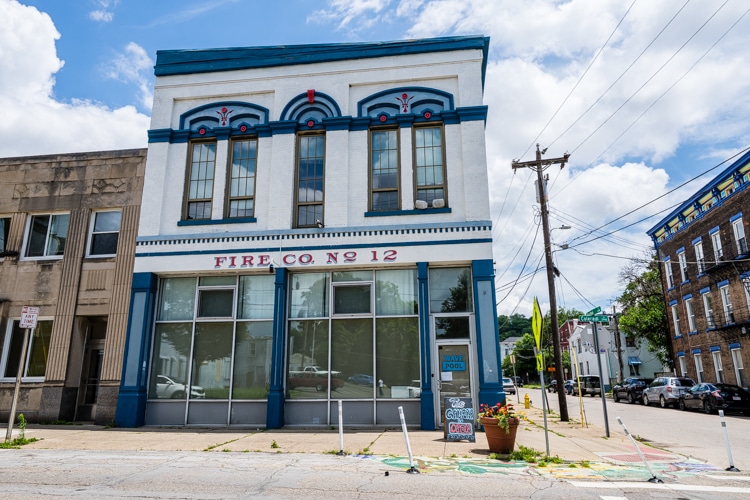
During Welcome Editions, a collaborative installation bringing internationally recognized artists together with refugee and immigrant artisans in Cincinnati, community members wandered in and out of conversations about the work hanging on the walls, neighborhood change, local politics, and whatever emotions the pieces happened to pull out of them that night.
The exhibition functioned as more than an opening. It became a temporary gathering place.
Wave Pool describes itself as a contemporary art fulfillment center, language that signals something deliberate. During the pandemic, the organization distributed food. Previous work included immigrant and refugee programming, public health collaborations, and community workshops.
“The byproduct is the artwork,” Oicherman said. “The ecosystem is the real thing.”
That ecosystem includes affordable studio space, employment pipelines, professional mentorship, and increasingly, conversations around cultural land ownership. Wave Pool has begun exploring land trust models designed to take property off the speculative market before rising values displace the artists and residents who shaped the neighborhood in the first place.
“The only way to beat market forces,” Oicherman said, “is to take land off the market.”
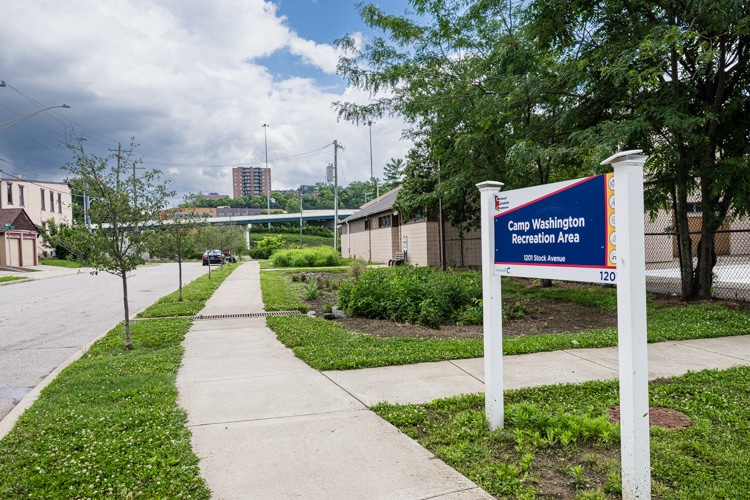
Camp Washington, long industrialized and overlooked, now sits in the path of significant development pressure tied to the Mill Creek corridor.
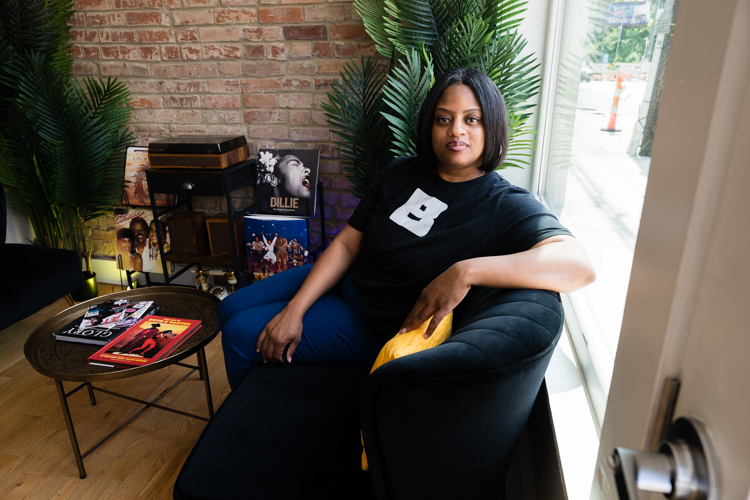
Daphney Thomas has spent decades thinking about what makes a neighborhood legible to the people who live inside it.
Thomas leads the National Commission for Black Arts & Entertainment, a Cincinnati organization focused on cultural programming, community engagement, and creative collaboration. She describes artists not primarily as makers of objects but as facilitators of something harder to name gathering, trust, and the slow reconstruction of belonging in communities that have learned not to expect it.
“Art is like leaving the porch light on,” she said.
The metaphor earned its place. A porch light signals presence. Safety. Someone still home. In neighborhoods shaped by decades of disinvestment, redlining, and broken institutional promises, that signal is not decorative. It is structural.
Thomas returned repeatedly to the idea that art creates openings for people to see one another differently. Not because it saves neighborhoods, but because it generates the conditions under which people stay in the same room long enough to rebuild trust.
“People want to feel needed where they live,” she said.
That need, she argues, is consistently underestimated in development models built around attracting outside capital. Economic growth does not automatically produce emotional investment.
“It’s not that these communities are empty,” Thomas said. “People have always been doing the work.”
Brookings Institution fellow Tracy Hadden Loh seconds that. Loh studies equitable development, housing, and neighborhood investment for the Washington, D.C.-based public policy research organization.
Loh did not approach Cincinnati as an abstract policy exercise. “I love Cincinnati,” she said. Last year, she toured the Mill Creek corridor with local leaders and the Port Authority, studying how infrastructure investment, neighborhood identity, and displacement pressures are colliding across the region.
The research points to something Cincinnati’s neighborhood leaders already seem to understand intuitively: neighborhoods do not survive development pressure through single transformative investments alone. They survive through overlapping systems of trust, ownership, local organizations, and community connection built long before outside pressure arrives.
In a Brookings study examining neighborhoods between 2000 and 2015, researchers identified 193 communities across the United States that significantly reduced poverty without displacing longtime residents. Those neighborhoods consistently shared several traits, including strong community-based organizations, higher rates of homeownership, lower vacancy rates, self-employment, and local economic growth.
“There’s this misconception that communities don’t want investment,” Loh said. “They do. They just want to still be included in the choices.” That distinction, between investment that happens to a community and investment that happens with one, is where many development models break down. Loh has seen it repeatedly: award-winning plans sitting on shelves, aesthetic interventions applied to structural problems, residents consulted only after major decisions had already been made.
In Lower Price Hill, the Community Matters staff plus many committed stakeholders including the board, donors, and neighbors, have built an organization around refusing that division.
Community Matters traces its roots to the 1970s, when neighbors began organizing around educational inequities. That commitment to staying in place has never changed. Staff know neighbors by name. They show up at community gardens, laundromats, meetings, and conversations that never become agenda items.
“We reject the idea that neighbors or the neighborhood are problems to be fixed,” said chief advancement officer Patty Lee. “We see our neighbors as people with ideas, talents, histories, relationships, and a real stake in the future of Lower Price Hill.”
When a grocery store on Eighth Street closed, Community Matters did not decide what the neighborhood needed. It asked residents what they wanted the space to become. What followed were conversations not only about food access, but ownership, affordability, and long-term stability.
The question itself became collective property.
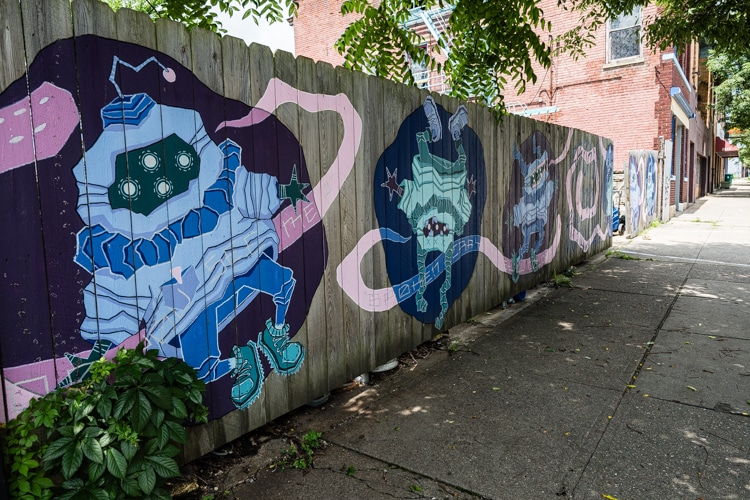
Outerspace, a community hub on State Avenue operated by Community Matters, began as a space for collaborative art projects and evolved into something harder to categorize. A coffee house. A little free library. A place to gather.
“Art is still central,” Lee said. “But the space now also supports civic engagement, youth leadership, neighborhood meetings, workshops, and informal connection.”
What surprised her was not that neighbors stepped into leadership once given space. It was what became possible after they did.
In Westwood, the logic of the first mural has compounded over decades.
Westwood Works now runs more than 45 community events per year. It administers a mini-grant program distributing up to $15,000 annually to neighbor-led projects. It acquired the Westwood Theater, an 11,000-square-foot art deco building that closed in 1996 and sat vacant for decades, with plans to convert it into an arts and cultural center at the heart of the Town Hall business district.
Second Saturdays, the organization’s flagship summer series, draws more than 20,000 people from across the region. The first public Pride event on Cincinnati’s West Side began there.
Collins describes the organization’s three pillars as people, place, and purpose.
“You see their eyes light up,” she said. “People feel the sense of community.” Some of them move there.
Collins is clear that none of this happened because someone from outside decided Westwood deserved it. “Neighborhoods don’t get better, they’re not thriving, they’re not vibrant, they’re not diverse and inclusive. They’re none of those things without their citizens getting involved,” she said. “No one’s coming to save you.”
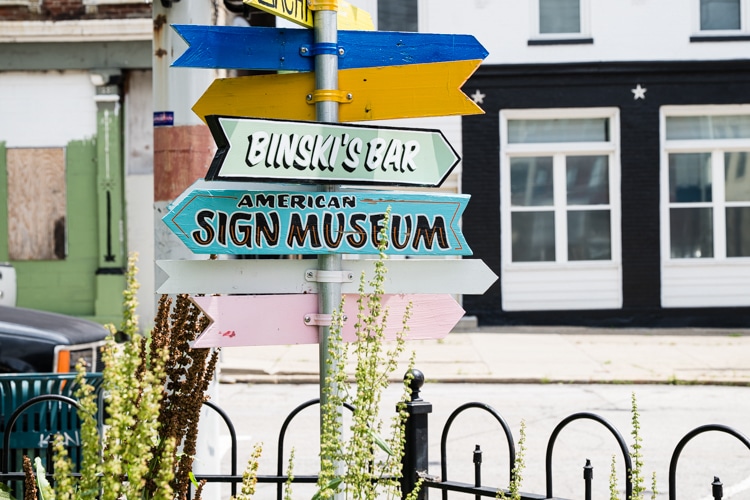
What connects these neighborhoods is not geography or demographics. Price Hill, Camp Washington, Lower Price Hill, Westwood, and Northside each carry distinct histories and face different pressures.
What connects them is the sequence. Community first. Infrastructure second.
The organizations working inside these neighborhoods understood before researchers confirmed it that economic investment alone does not stabilize a place. What stabilizes a place is the web of relationships that gives residents reason to stay, reason to fight, and reason to believe the neighborhood’s future belongs to them.
In Westwood, that web began with a mural someone said no to. In Lower Price Hill, it lives in sticky notes on vacant storefronts. In Camp Washington, it shows up on Wednesday evenings around a table at a cafe.
“The last remaining form of trust,” Loh said, “is physical proximity. You can trust what you can see with your own eyes.”
Inside Cincinnati’s resilient neighborhoods, that trust is being built through presence. Through organizations that stay. Through residents who keep showing up even when the work is slow, the resources are thin, and the outside world has already decided what the neighborhood is.
Although the mural on Harrison Avenue has since been painted over by new building owners, the impetus for Westwood community organizing by a mural that brought the neighborhood together to say yes is now neighborhood history.
The Resilient Neighborhoods series is made possible with support from a coalition of partners including The Port of Cincinnati, Warsaw Federal Bank, and the Common Good Alliance. Sustained Resilient Neighborhoods coverage will report on community-building in City of Cincinnati and Hamilton County neighborhoods spreading good ideas across the region.
Author

Related Articles
Why don’t we talk to our neighbors anymore?
In the latest reporter video, data indicates a downward trend for social interactions with neighbors. One Cincinnati neighborhood has a plan to address the issue.
Fort Wayne is rewriting the rulebook on rezoning to encourage development
Proactive rezoning removes some of the burden previously placed on residents, while helping shape and preserve neighborhood development.
Interfaith coalitions drive sustainability across region with climate action
Cincinnati initiative “Faith Communities Go Green” allies with houses of worship to put diverse religious teachings into practice.