
For Greg Landsman, the future starts in your neighborhood
The resilience in communities is proof the country still has capacity to come together.
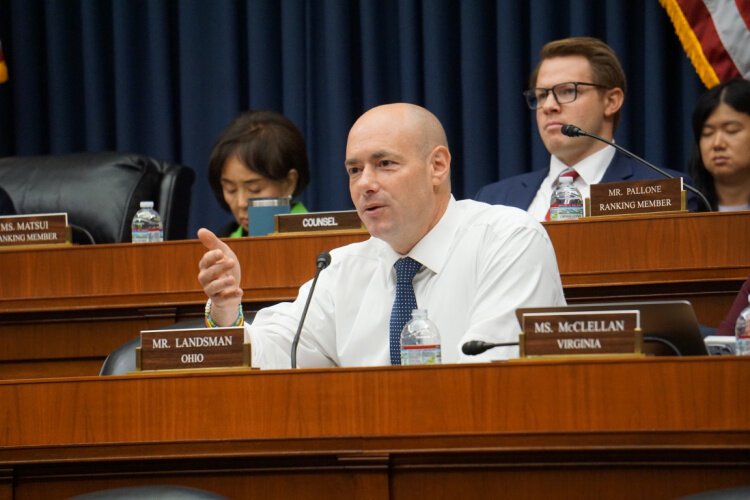
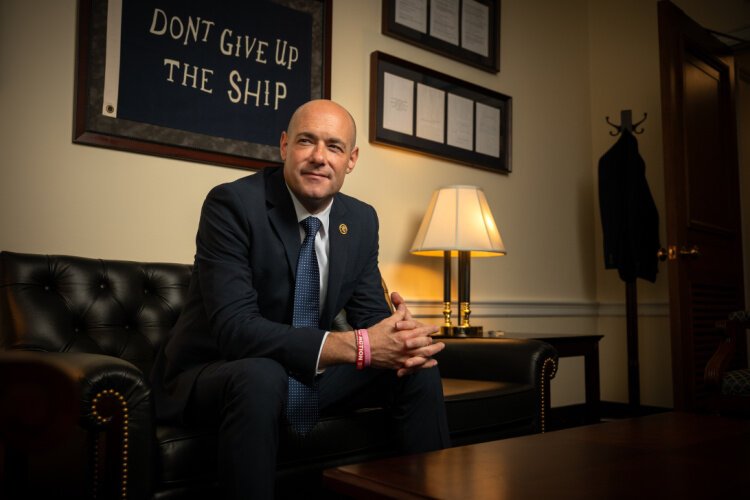
When Congressman Greg Landsman talks about politics, he rarely starts with Washington. He starts at home: the family struggling with rising grocery bills, the teacher trying to make up for pandemic learning loss, the worker whose health insurance no longer covers what it used to.
For Landsman, these are not abstract stories. They’re proof of what he calls “America’s affordability crisis,” and his answer is to lock into what makes communities strong.
Landsman built his political identity in Cincinnati, first on city council and now representing Ohio’s 1st District in Congress. He has positioned himself as a coalition-builder in a time of constant division, pushing for solutions that help families afford daily life, keep schools strong, and restore trust in government. The challenge, he says, is that too many people feel like they’re falling behind, even when the economy is technically growing. “No one says they’re in a better place when they’re denied care or when jobs disappear,” Landsman told Soapbox.
Education is central to Landsman’s message. He has pressed for more resources to address learning loss and to ensure schools are fully funded. He ties economic growth to basic protections like clean water, clean air, and safe workplaces, arguing none of these should be sacrificed for short-term profit. Job security is another focus. With companies slow-walking investments or pulling out altogether, families are left to absorb the costs. Landsman believes government has a responsibility to lock into neighborhoods so workers and communities aren’t left behind.
Landsman helped secure $12 million for 14 local projects in Southwest Ohio – from affordable housing to mental health crisis response to infrastructure upgrades – “investments in public safety, affordable housing, good paying jobs, and better infrastructure.” He also co-sponsored the Campus Housing Affordability Act, which would allow students to use Section 8 vouchers for on- or off-campus housing, a lifeline in a state where nearly half of college students face housing insecurity.
Health care, perhaps more than anything else, exposes the affordability crisis, as the number of denied claims rises and many Ohioans face higher premiums for less coverage. Landsman has been outspoken in defending protections for pre-existing conditions and against policies that weaken Medicare.
“Medicare was never meant to be a profit center,” he argues. “It was meant to be a promise.” That promise is why he’s skeptical of the WISeR pilot program, a federal initiative now being introduced in six states, including Ohio, that ties Medicare coverage to experimental cost-cutting measures. Supporters claim it will rein in spending, but Landsman argues it risks patient care. “Ohioans don’t want experiments with their health care,” he says, “they want security and peace of mind.”
Beyond affordability, Landsman warns about structural corruption. He insists that voter suppression undermines democracy at its roots. His “Pledge to America” lays out a blueprint of ten bills – from rewriting the tax code to favor workers, to making the largest housing investment in U.S. history, to banning dark money in elections and ending gerrymandering – all aimed at fixing what’s broken and not delivering for hard-working Americans. “If people don’t believe government works for them, then we can’t solve the bigger challenges,” he says.
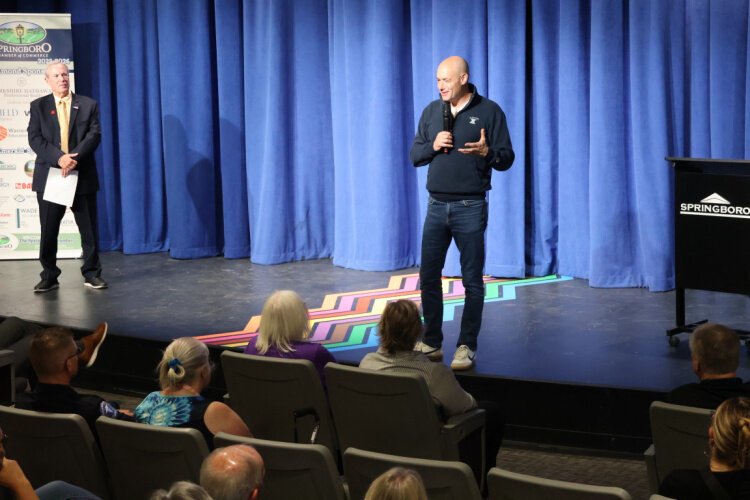
Landsman held a town hall in Springboro, OH, earlier this month.
Even as he names the crises – jobs, health care, corruption – Landsman leans into optimism. His belief is that the country can recover if leaders focus on practical solutions. “Lock into your community,” he urges, pointing to resilience in neighborhoods as proof the country still has the capacity to come together.
That call – to lock into your community – echoes the warning of Robert Reich, former U.S. Secretary of Labor and longtime public policy scholar, about the current federal administration: the real danger is getting consumed by spectacle while forgetting where democracy is actually lived. For Reich, the antidote is practical: lower drug prices, raise wages, expose corruption, organize locally – lock in protections that restore trust from the ground up. Landsman’s insistence on neighborhood resilience mirrors that ethos, binding national politics to the survival and strength of local communities.
That message lands close to home. Cincinnati is where Landsman built his career and where many of the challenges he describes – affordability, equity, trust in democracy – are felt most directly. Whether on Capitol Hill or back in his district, his message remains steady: America’s comeback starts one neighborhood at a time.
Author

Related Articles

Summermusik Festival provides something unique for everyone’s musical tastes
Meet Victoria Okafor, whose Summermusik performances include Kurt Weill and Bertolt Brecht’s boundary-pushing ballet chanté, “The Seven Deadly Sins.”
This northwest Hamilton County city is 18 minutes from everywhere
Nobody planned for North College Hill to start coming back together. But somebody had to say something about the leaves.

“Print Voices from Kenya: Social and Cultural Reflections” brings Kenyan art, film and culture to Cincinnati
SOS ART and Kennedy Heights Art Center partner on the fifth edition of a biennial series featuring an international art exhibition and Kenyan Movie Festival that encourage cross-cultural understanding and dialogue.