
First Student and CPS team up to provide new technology for students, parents
With ZPass, parents of Cincinnati Public School students can track when their children board and exit the bus, taking the guesswork out of the bus schedule.
With ZPass, parents of Cincinnati Public School students can track when their children board and exit the bus, taking the guesswork out of the bus schedule.

When senior citizens are able to stay in their homes, they’re better off, says Claudia Harrod, Cincinnati Area Senior Services’ development manager. “They can be more active, and they’re less depressed,” she says. “And it’s also more economical for seniors to be able to stay at home than be in a facility.” In order for seniors to stay at home, they need to be able to maintain their independence while having various needs of daily living met. Since 1967, CASS has worked to meet some of those needs, and has helped seniors with everything from nutrition and transportation to financial assistance and guardianship. “When you think about seniors, sometimes even opening a jar can be difficult,” Harrod says. Each week, CASS delivers about 2,000 meals to homebound individuals in Hamilton County, which helps provide healthy options to those who are unable to cook or visit the grocery store regularly, if even at all. “Nutrition is very important for everyone, but particularly for seniors, and these meals are balanced and meet one third of the daily recommended requirements for seniors,” Harrod says. “A lot of them have no way to get to the grocery store, and even if they could, they have to go up stairs and can’t carry the groceries, and some aren’t able to stand at the stove and cook, so this way, they always have one meal that’s easy for them to fix.” A few years ago, CASS started its Savory Selects program, a food delivery program that provides enough meals for the week, plus bread and milk. Area seniors choose from 31 different catered entrees and side items, and instead of receiving a frozen meal once a day, they receive all of their meals at the beginning of each week. “It’s nice for them because they can eat what they want that day and when they want it,” Harrod says. “Usually they would wait for the meal to arrive each day, and then it would have to be heated up, so it gives the seniors some dignity in being able to select what they eat.” Do Good: • Keep an eye out for CASS' new website, and look for ways you can get involved and help out. • Call CASS at 513-721-4330 if you are a senior or know of a senior in need of assistance. Needs are not based on one's financial capabilities, so do not hesitate to seek help. • Call CASS to make a donation. By Brittany York Brittany York is a professor of English composition at the University of Cincinnati. She also edits the For Good section of SoapboxMedia.
Many city-dwellers are continuously faced with the arduous task of budgeting their quarters between two priorities: bus fare and laundromats.
For three years, residents of the East End met with the Department of Transportation and City Council to come up with a plan for a safer, more pleasant neighborhood. And by the end of the month, the orange barrels throughout the East End will be gone, and the longest, flattest bicycle route in the city will be open. Construction has been done in stages, and everything from Delta Avenue to downtown has been redone as part of the plan. The length of bicycle lanes between Congress Avenue and St. Andrews was opened last year, and this year, the lanes between St. Andrews and downtown will be completed, says East End resident Jackie Weist. The bicycle lanes are, in part, an effort to reduce the noise coming from US-50 and US-52. There are now engine brake signs along the highways, but that hasn’t eliminated the noise. Residents hope the bicycle lanes will force drivers to slow down and reduce the amount of traffic through the neighborhood. The East End bicycle facility was part of the 2010 Bicycle Transportation Plan. The area is ideal because it’s flat, it connects to the Ohio River Trail where the East End ends, and it goes by Lunken Airport and along Riverside Drive. “We hope the new bicycle lanes will bring more bicyclists to the area and bring awareness to what’s going on down here,” says Weist. There’s a lot of history in the East End—a steamboat captain’s home has been remodeled, and rock walls and wrought iron are prevalent. It’s also home to Lunken Airport, the oldest commercial airport in the United States, and the oldest Yacht Club in Ohio. Prior to the official ribbon cutting, the neighborhood is planning a clean up of the area, and may be followed by dinner at BrewRiver Gastropub. Queen City Bike is working with the East End Community Council to plan the event. For more information on the ribbon cutting, check out the Bike Program calendar. By Caitlin Koenig Follow Caitlin on Twitter
When people travel, museums often become tourist attractions for those who hope to learn more about their surroundings and immerse themselves in the town and culture they temporarily inhabit. But museums don’t have to function solely in that capacity, nor should they, says Tiffany Hoppenjans, curator of exhibits and collections at the Behringer-Crawford Museum. “We don’t appreciate what’s in our own backyard and the rich heritage that’s a part of our lives and our culture,” Hoppenjans says. “So this is the place to come—we’re the biggest museum in Northern Kentucky and are trying to tell Northern Kentucky’s story. Not just who’s important and what they did or what groups settled here, but how we as a community fit into the Greater Ohio Valley and the country and the nation.” The museum, which is housed in Devou Park, was donated along with the surrounding land to the city of Covington in 1910. It later became a museum when William Behringer donated his collection of oddities and objects in the 1950s. Behringer-Crawford houses a variety of items—everything from a restored 1892 streetcar to a two-headed calf. “Many museums have their own oddities," Hoppenjans says. "it’s a throwback to how museums started—as curiosity cabinets. People were collecting weird things from their travels—interesting things they came by.” What began as a 5,000-square-foot space now has plenty of room to share—far more than one man’s collection. With four floors and an area that has now quadrupled in size, the museum tells the history of Northern Kentucky, using transportation as a mode to travel through time. “We’re not a transportation museum,” Hoppenjans says. “But we have some wonderful pieces, and you time-travel. You go from the rails to the rivers to the roadways to the runways, and have fun along the way.” Do Good: • Visit the museum, and check out the current featured exhibit, which honors Northern Kentucky musicians over the years. • Support the museum by contributing monetarily or by donating artifacts. • Become a museum volunteer. By Brittany York Brittany York is a professor of English composition at the University of Cincinnati. She also edits the For Good section of SoapboxMedia.
ABM Parking Services, the national facility management company that manages the parking meters in Covington, recently adopted the Park-by-Phone program to make parking more convenient for customers. Park-by-Phone eliminates the need for coins and cash to pay for parking. Users can extend their parking sessions by calling the Park-by-Phone telephone number or by downloading a mobile app for Android or iPhone. Parking history and receipts are available online, and users can even pay with a mobile phone at any parking meter that offers PassportParking. Credit card machines are expensive to purchase and use, and every time the public charges on a credit card machine, the company that rents out the meter gets charged. The City of Cincinnati has invested in credit card machines, but Covington looked for a different answer. And they found it with Park-by-Phone, which charges an annual fee of $5.95, regardless of the number of uses. The fee is less than getting a parking ticket, and the city pays 100 percent of the total parking fees with the company that rents out the meter charging an additional convenience fee of 10 percent to the customer on top of the annual fee. But Park-by-Phone isn’t for the average Covington resident or occasional visitor—it’s geared toward companies that utilize the city’s parking meters, says Natalie Bowers, marketing and communications director for the City of Covington's Department of Development. For example, companies that make deliveries around Covington can give each employee an account and receive itemized monthly statements to keep track of parking expenses. That way, businesses can expense parking costs rather than pay for parking tickets. By Caitlin Koenig Follow Caitlin on Twitter
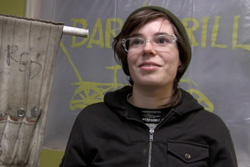
May is Bike Month, so what better way to celebrate than to share stories about local cyclists and why traveling on two wheels is their preferred method of travel? Video by Caroline Bozzi, Elese Daniel, Hunter Moore and Madison Schmidt of the University of Cincinnati.
Two weeks ago, Covington’s Department of Public Infrastructure hosted a tour and shared its best practice models. Many of DPI’s current projects focus on capital improvements related to problems such as street reconstructions and landslide concerns. Covington’s infrastructure developments keep things running, says City Manager Larry Klein. “When people see a fire truck, ambulance, police car or someone cutting grass, they’re all results of the city’s public works division,” he says. “Citizens see services such as snow removal or street repair, but they don’t see what goes on behind the scenes.” For example, the city’s fleet division does auto repairs in-house, rather than outsourcing those repairs. In 2009, the city contracted with KOI Auto Parts as its in-house auto parts vendor. The city used to spend $600,000-700,000 on parts, but by bringing KOI in-house, the cost is now about $350,000-400,000, says Tom Logan, director of public improvements. “The fleet division keeps everything running smoothly and gets the vehicles back out on the street,” Klein says. “We’re not only saving money but time as well.” DPI also recently replaced single-purpose trucks with dual-purpose models. Snow removal trucks, for example, were only used three or four months of the year. The dual-purpose trucks come with swap-loaders, which allows DPI to interchange the dump beds for other equipment. These trucks saved the city about $100,000, Logan says. DPI is currently also involved in storm water improvements, renovations to Devou Park, riverfront development and the replacement of the Brent Spence Bridge. “It’s guided by the Kentucky Transportation Cabinet and the Ohio Department of Transportation, but Covington has a strong stance and the ability to provide input in the decision-making process,” Logan says of the bridge planning. “It’s a very important project for the whole region because of the traffic that travels along I-71 and I-75. For Covington, we have to ensure that the connections to the bridge are maintained.” By Caitlin Koenig Follow Caitlin on Twitter
The Everybody Rides Metro Foundation, which is the first program of its kind, provides affordable transportation to about 30,000 low-income individuals each year. Metro subsidizes rides at $1 and has partnered with about 70 different social service agencies to cover the remaining 75 cents of fares for riders in need of medical or work-related transportation. “Many of our riders feel like this is the only way they can try and succeed—it’s somebody giving them a lift when they need it the most,” says Joe Curry, executive director of ERM. “The greatest outcome of this is that you’re getting people toward self-sufficiency. It’s something that stays with them forever—it helps them out until they earn money and start budgeting once they have a job; and self esteem is a large part of that overall package.” According to Curry, many of ERM’s riders are paroled into the Talbert House and have anywhere from $0 to $20 to their name after coming out of prison. Once they’ve been rehabilitated and have participated in job counseling, they may need to interview at up to 20 different businesses before they find work. “Once they land a job, the worst thing that can happen is not to show up during the first week of employment, so we give them additional money, if needed, to subsidize their rides during the first few weeks,” Curry says. “It’s to help them out temporarily so they can establish a budget—it’s not a lifetime pass.” In addition to helping riders get to job interviews and places of employment, ERM provides rides to medical-related destinations so individuals can receive preventive care. “Society of St. Vincent De Paul runs a free pharmacy on Bank Street in the West End, and if you can’t afford your meds, they’ll give you a 30-day supply for free so long as it’s not a narcotic, but you have to get to the location,” Curry says. “If you’re diabetic or are undergoing cancer treatment, meds are absolutely essential, but if you can’t get to a place where you can get your meds, you may get sicker. You may be one of those people who take that $1,500 ambulance ride, and that’s one of the things we’re trying to prevent.” Beginning in January 2014, 40,000 more individuals in the Cincinnati area will be eligible for Medicaid, and according to Curry, anywhere from 50 to 70 percent of those people will need public transportation to get to a healthcare provider or pharmacy. “Those are the people we’re worried about," Curry says. "If public transit isn’t available to them because of the cost, how are they going to get treated? More than 30 percent of our population lives in federally defined poverty—that tells you we really need to do something and think outside the box about how to solve some of these public transit issues.” Do Good: • Donate to the Everybody Rides Metro Foundation. • Like Cincinnati Metro on Facebook. • Follow the Cincinnati Metro on Twitter. By Brittany York Brittany York is a professor of English composition at the University of Cincinnati and a teacher at the Regional Institute of Torah and Secular Studies. She also edits the For Good section of SoapboxMedia.
Cincinnati has plans to privatize parking, but not everyone is happy about the idea. Read full story here.
Our Partners







Common Ground Is Brewing
Support local stories and receive our signature roast straight to your door when you join at the Standard level (or above).
Drink Better, Read Local
