Reuse / Rebuild

Kaze marks next phase in Gateway development

This fall, Jon Zipperstein and Hideki Harada toss their hats into Over-the-Rhine’s restaurant ring with Kaze, a gastro pub and sushi bar, to the Gateway Quarter at the corner of 14th and Vine streets. Zipperstein owns Embers, a Montgomery restaurant that serves steak, seafood and sushi; Harada was a sushi chef there when it first opened. Although he left after two years to sharpen his culinary skills, the pair remained in contact and eventually decided to open a restaurant together in OTR.  “We were just looking for a really dynamic part of town, and Over-The-Rhine certainly fit the bill,” Zipperstein says. They opted for the Color building because it offers more than 3,500 square feet of restaurant space, plus an outdoor area where they will put a beer garden that will be partially enclosed with a fire pit. Building owner 3CDC reports the $4.1 million renovation of the mammoth space will also feature 6,000 square feet of office space. “If you’ve been to the building a year ago, when it was first shown to me, it was an absolute wreck,” Zipperstein says. “You had to have a great imagination to think about what it could be. And you could say the same about just about any building they work on down there. They take buildings that are in complete disrepair, that are 100 years old or more, and turn them into little gems.” The atmosphere at Kaze will be comfortable yet urban, Zipperstein says. He and Harada like the idea of reclaiming the historic building, so they will be leaving a lot of exposed brick. Other restaurant plans include an open kitchen, so diners can take advantage of insiders’ views of meal prep. The menu will be about 50 percent sushi/50 percent izakaya, which is Japanese style pub food—lots of small plates, grilled meats and noodle soups. Kaze will use local produce. Their beverage selection will include traditional favorites, plus they will import Japanese beer, liquor and non-alcoholic drinks that have never before graced Cincinnati shelves. The plan is to open the bar first around the beginning of November. Shortly after, they will serve food in the bar and open the beer garden. In December, the dining room will be open for private parties exclusively. After these soft openings, Kaze plans a grand opening in January 2013. By Stephanie Kitchens

Latest in Reuse / Rebuild
Covington rehabs boost support for great neighborhoods

The 900 block of Banklick Street in Covington was an urban disaster.  Included in the historic area of Covington’s Westside, it had fallen into grave disrepair.  Despite its good location near an elementary school, the block was completely vacant and had been for years. Today, construction is nearing an end on the 900 block of Banklick, and the friendly streetscape is filled with new or rehabbed houses.  Two homes are already under contract for sale, and given the increasing need for moderate income housing, the others may sell quickly, too.    The entire transformation of a city block is the work of Covington’s Center for Great Neighborhoods (CGN).  This non-profit, neighborhood-based community development organization has been around for almost 40 years, beginning in 1976 as the Covington Community Center.   Its goals are to support neighborhoods and housing, youth development and financial education.   It was while working with the 18 different neighborhood associations in Covington that CGN heard residents voice their concern for more home ownership and neighborhood revitalization.    Following residents’ lead and funded by United Way, Place Matters and other granting sources like the federal Neighborhood Stabilization Program, CGN began to purchase structures a decade ago to rehab them for private sale.     Since that time, 33 homes have either been rehabilitated or newly constructed as in-fill housing. Adam Rockel, CGN’s community development specialist, praises the City of Covington for its ongoing support.   “Without them, we would not be doing the things that we do,” he says.  Over the years, the city had purchased many blighted properties that it has sold cheaply to CGN for rehabilitation, and it supports CGN’s work with grants and assistance to meet building standards for historic structures.  Rockel sees more good in CGN’s work than just repopulating blighted neighborhoods. “We’re…transforming them into really beautiful homes, raising appraisal rates, and giving people pride in their neighborhoods again.”     By Becky Johnson  

Boswell’s makes a comeback in Northside

Northsiders, and really anyone who ever visited Boswell’s before 2004, remember the Bousin Burger, a thick, juicy staple on the neighborhood restaurant/bar’s menu.  Beginning early September, the burger, along with an array of new vegetarian-friendly items, return to a fully renovated space once again owned and operated by Mike and Jan Beck, with business partners Walt and Debbie Schultz.  “It was just always such a fun and exciting place to run,” says Mike Beck, who also owns a rental property in the neighborhood. “We always had a tremendous business there. We enjoyed the community and the people.” Beck, who lives north of Ross, Ohio, first bought the space on the corner of Blue Rock and Boswell in 1983. In 2004, even though business was strong, he and his wife needed to take a break to help care for her ailing mother.  But Beck never forgot Northside, and Northside never forgot Beck. When the building was taken over by Northside Bank & Trust, the bank president hired Beck to renovate the restaurant space as well as four apartments upstairs.  Then the building went up for auction, and Beck and his friend Walt Schultz decided to go watch the sale. As they stood and talked, Beck couldn’t stop thinking about the building. He turned to his friend and said, “Northside is up and coming. I think we should do this.” After they informed their wives that they were once again building owners, they considered different business ideas. Should they open a wine and cheese shop? Maybe a small deli? Or pizza? But none of those ideas stuck. “The more we thought about reopening Boswell’s,” he says, “the more excited we got.” While Beck and his team have completely renovated the restaurant’s kitchen and patio, they were able to hire some of the former employees. He plans for music on the patio through the fall, just like the old days. “I think Northside has expanded,” Beck says. “We’re pretty impressed with the community again.” Depending on furniture delivery and other potential delays, Beck plans to have Boswell’s (now just Boswell’s, not Boswell’s Alley) open for Northside’s Second Saturday this Sept. 8.  By Elissa Yancey (who was always a big fan of the Boursin Burger) Follow Elissa on Twitter  

A Cincinnati park shifts the paradigm

Over-The-Rhine’s tipping point wasn’t in the form of an eco-friendly general store or gourmet popsicle shop (it now has both), but rather the renovation of the neighborhood’s cultural heart, Washington Park. Read the full story here.

Can the centers hold?

Ohio’s three largest cities—Columbus, Cincinnati, and Cleveland—are reinvesting in their urban cores, eager to capitalize on a renewed interest in city living. But is the deck stacked against them?  Read the full story here.

Second Sunday on Main

From chocolate chili popsicles to handmade shoes, from art galleries to sustainability-focused retailers, Main Street in Over-the-Rhine continues its latest renaissance. Soapbox photographer Scott Beseler offers a visual 411, with images captured during an idyllic Second Sunday on Main celebration. 

Keep Cincinnati Beautiful wins national kudos for green initiatives

Some might say that the City of Cincinnati gets more beautiful every day, what with the continued development of its urban core and riverfront, an ever-expanding “green” construction movement and a treasure trove of amazing parks and public spaces. Keep Cincinnati Beautiful (KCB) works to ensure that the surrounding environment keeps pace by creating innovative and award-winning programs that encourage recycling and conservation practices among schoolchildren, and make it easier for folks to save the old VCR in the basement from a landfill. KCB earned notable recognition in July when Keep America Beautiful recognized the organization’s Sustainability in Action and One Stop Drop programs at its annual assembly of Ohio affiliates in Columbus. While many public schools strive to set environmentally friendly “green” goals, KCB noticed that schools struggle to meet them. “There is a misperception out there that ‘green’ programs create more work for school staff and faculty,” says Brooke Romaniw, KCB public awareness and volunteer coordinator. “We wanted to find a way to reverse this perception and help Cincinnati Public Schools educate both students and adults.” As a result, Sustainability in Action (SIA) was born. Funded by partners including P&G, Hamilton County Recycling and Solid Waste District and the City of Cincinnati Office of Environmental Quality, SIA is a three-year program that engages students in hands-on activities that work to forge “green” habits. Launched in January 2012, the SIA program focused first on waste reduction in school lunchrooms. Each day at lunch, students were taught to sort the waste on their trays, identifying items that could be recycled or composted. Students at Dater High School, Rees E. Price Academy, Roselawn Condon, Rockdale Academy and Silverton Paideia were part of the pilot year. “The students saved tons of waste from landfills during the pilot and benefitted from hands-on experience,” says Romaniw. Some students took it a step further by creating their own compost bins and gardens. As the recipient of Keep America Beautiful’s Civic/Nonprofit Award, SIA is set to begin its second phase, focusing on energy conservation during the upcoming school year. The idea is that by year three, participating schools should be ready to take over the programs themselves. “We’ve found that schools really see the value in this program,” says Romaniw. “It is exciting to see children building sustainable habits that have the potential to change the future for the better.” KCB won more national recognition for its One Stop Drop event, which launched in November 2011. It won the America Recycles Day Award from Keep America Beautiful. Romaniw spearheaded the development of One Stop Drop to make recycling unusual items convenient. While curbside recycling saves many items from the landfill, it does not accept things like electronics and number 5 plastics. During the One Stop Drop, you can drop off these types of items, drive-thru style, with free refreshments available. By partnering with 2TRG, the Cincinnati Zoo, Hamilton County, the City of Cincinnati and Whole Foods, the One Stop Drop program reached hundreds of people in just a few hours. Items like old cell phones, batteries, dried-out pens and markers, plastic bags and number 5 plastics were collected. “We are pioneering the way for schools and our community, and are proud to lead the pack,” says Romaniw. What are you doing to keep Cincinnati beautiful? Do Good: •    Help students learn to sort recycling in the Sustainability in Action program. Email Brooke Romaniw. •    Mark your calendar for the 2012 One Stop Drop coming in November. •    Find out what Keep Cincinnati Beautiful has in the works; like the group on Facebook. By Deidra Wiley Necco

New single-family units coming to Pendelton District in OTR

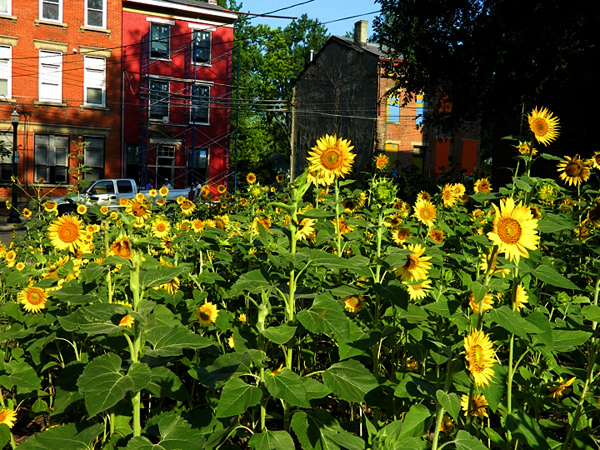
A year ago, Chris Lacey moved from Maderia to the Pendleton District of Over the Rhine to live in one of the six new single-family homes he built on Dandridge Avenue.  The town homes sold out within three months of completion and Lacey saw the opportunity to help turn the neighborhood. At the intersection of Pendleton Street and Dandridge, Lacey now owns six other buildings and is in the process of rehabbing them into single-family homes. Some will even have rental units in the building that when rented, will pay the mortgage of the home. The reason for creating single-family houses is to draw homebuyers to Over the Rhine, something that will ultimately help change the neighborhood.  "Homebuyers drive change," Lacey says. "Sure, just having people renting in a neighborhood and having a presence helps, but if a momma bear is somewhere, she is going to make sure her and her kids are safe. Families also have necessities they need nearby. If families are around, businesses will come in."  Lacey, who has been in development for over 30 years, says that many young professionals that move downtown after college or obtaining a job will likely move out once they have children, looking for better schools and safer neighborhoods. The new homes will have yards, parking, in-home washer and dryers and other amenities that are usual in suburbs, but not as often in urban areas.  Adjacent to the buildings Lacey owns is an acre and a half lot he also owns. Right now, the lot is filled with a community garden and the rest is filled with hundreds of sunflowers, which Lacey planted to brighten up the area.  "I've done it in other places it really helps liven it up," Lacey says. "I cleaned cars, sofas and tons of garbage out of the lot, now it's pretty much a community park."  Lacey plans on building  10 to 12 more homes in the lot within the next year or two. The units that are currently being worked on will open in October and continue through the next months. After all of Lacey's current land is developed, he will have 30 completed units within one block. Before moving downtown, Lacey and his wife contemplated moving out of town, but instead moved downtown and Lacey says they couldn't be more happy about the decision.  "It's rewarding to help fix something that is broken," Lacey says. "Both the buildings and the neighborhood are turning around."  Lacey says he has his eye on 14 other buildings in the Pendleton District. By Evan Wallis

Design Impact raises funds to fight child hunger

When a Northside couple, Ramsey Ford and Kate Hanisian, started Design Impact, they wanted to create a social design company that creates lasting change in low-income communities around the world. As they investigated existing social design companies, Hanisian and Ford learned that most similar non-profits do their work and then leave communities. They spend short periods of time on the ground and often create solutions that don’t take community needs and cultures into account. “If you’re designing the next Pantene bottle, our culture is similar enough that a lot of the assumptions made will be correct,” Hanisian says. “When you’re crossing economic and geographic borders, assumptions can be wrong, and it can alienate the community from the process.” Hanisian and Ford charted a new path for Design Impact. They wouldn’t arrive in a community with a pre-fabricated plan to “fix” it; instead, they would become a part of the community. By living and working with community members, they would find the best ways to help create deep and lasting change. The mission began with the couple spending 16 months in India and then sending six fellows into communities around India. Each community will be served in three phases and after six months, Anisha Shankar, has developed her plan to improve health for malnourished children. The solution is Ladoo, a low-cost snack packed with nutrition. Currently, Design Impact is running a fundraiser on indiegogo.com, a crowd-sourced fundraising website. The goal is to raise $10,000 to assist in phase two of the fellowship program. The next fellow will spend 10 months in Pune, India, creating a business plan to help local women create a sustainable business making the Ladoos, while simultaneously helping solve the problem of malnourishment. The long-term goal is to create a sustainable business model based around the ladoo and expand it exponentially with the goal of helping lower childhood malnourishment not just in Pune, India, but everywhere.  Do Good:  • Donate to the indiegogo campaign and help Design Impact raise $10,000. • Donate to Design Impact as a whole organization and help fund other programs. • Visit Design Impact's website and learn about the programs and help spread awareness.  By Evan Wallis 

Chicken, egg redevelopment process coming along in Cincy

Proof of Cincinnati’s resurgence is evident in its recent hosting of the World Choir Games, a competition that is considered the “Olympics of choral music.” Read the full story here

Our Partners

Taft Museum of Art
Warsaw Federal

Don't miss out!

Everything Cincinnati, in your inbox every week.

Close the CTA

Already a subscriber? Enter your email to hide this popup in the future.