
Cincinnati

Covington’s DPI improves infrastructure one project at a time

Two weeks ago, Covington’s Department of Public Infrastructure hosted a tour and shared its best practice models. Many of DPI’s current projects focus on capital improvements related to problems such as street reconstructions and landslide concerns.   Covington’s infrastructure developments keep things running, says City Manager Larry Klein. “When people see a fire truck, ambulance, police car or someone cutting grass, they’re all results of the city’s public works division,” he says. “Citizens see services such as snow removal or street repair, but they don’t see what goes on behind the scenes.”   For example, the city’s fleet division does auto repairs in-house, rather than outsourcing those repairs. In 2009, the city contracted with KOI Auto Parts as its in-house auto parts vendor. The city used to spend $600,000-700,000 on parts, but by bringing KOI in-house, the cost is now about $350,000-400,000, says Tom Logan, director of public improvements.   “The fleet division keeps everything running smoothly and gets the vehicles back out on the street,” Klein says. “We’re not only saving money but time as well.”   DPI also recently replaced single-purpose trucks with dual-purpose models. Snow removal trucks, for example, were only used three or four months of the year. The dual-purpose trucks come with swap-loaders, which allows DPI to interchange the dump beds for other equipment. These trucks saved the city about $100,000, Logan says.   DPI is currently also involved in storm water improvements, renovations to Devou Park, riverfront development and the replacement of the Brent Spence Bridge.   “It’s guided by the Kentucky Transportation Cabinet and the Ohio Department of Transportation, but Covington has a strong stance and the ability to provide input in the decision-making process,” Logan says of the bridge planning. “It’s a very important project for the whole region because of the traffic that travels along I-71 and I-75. For Covington, we have to ensure that the connections to the bridge are maintained.”   By Caitlin Koenig Follow Caitlin on Twitter

Latest in Cincinnati
Facebook-photo tapping Life Blinx looking for new hires

“This is digital scrapbooking meets the real world,” according to founder Darcy Crociata.

College Hill Gardeners partners with Historical Society for bicentennial event

This year is the 200th anniversary of the founding of College Hill, and to celebrate, the College Hill Historical Society and College Hill Gardeners are partnering for History in Bloom. The event includes a lecture by Ed Loyd, CHHS president, on May 14, and a tour of five College Hill gardens on June 15.   The lecture will include past and present photos of the gardens at the five homes, along with images of a few gardens that used to be in College Hill, Loyd says.   “College Hill is a natural fit to put history and gardens together,” he says.   College Hill got its name from Farmers’ College, which was founded in 1846. It was one of the first schools for agriculture in the United States, and was around almost a generation before other land-grant colleges were established. It was a research center for all types of scientific agricultural education, and predated the U.S. Department of Agriculture, Loyd says.   This year is the eighth year for the CHG garden tour, but the first year for the event to have a co-presenter.   “The agricultural significance in College Hill is noteworthy, and it provides a great backdrop for the gardens,” says Beth McLean, founder of CHG.   The gardens included on the tour are those of Twin Towers, Tanglewood, The Upson House, The Oaks and Laurel Court. All of the houses are along Hamilton Avenue, Belmont Avenue and Hillcrest Road (Old College Hill). The gardens feature beautiful landscaping and ornamental structures, plus a Japanese garden and parterre, which can be found at Laurel Court.   Tickets for the tour go on sale May 4 for $10. Tickets will be available at CHG’s plant sale May 4, at the College Hill Coffee Company and at the lecture. Day-of tickets are $12.   The lecture will be at the Campus Center at Llanfair Retirement Community; seating is limited. Please contact CHG at 513-681-1326 to reserve your seat.   By Caitlin Koenig Follow Caitlin on Twitter
DAAP grad embraces innovation, nurtures young Design Geniuses

Rebecca Huffman’s circuitous route to UC’s Fashion Design program both inspired and informed her non-traditional senior thesis, Design Genius. More methodology than consumer good, Design Genius is a learning module that teaches students the value of education and the building blocks of problem-solving as they design their own products. Unveiled at UC’s DAAPWorks, Design Genius takes a fresh approach to making learning relevant for kids of all ages, which is exactly what recent grad Huffman, 24, who works for LPK, wanted.  “I knew that I wanted to do something that would help kids,” says Huffman, who spent a year working as a preschool teacher before starting her design training at DAAP. As she considered what her culminating project for college would be, she thought back to a studio class in which she’d designed and created a real project, then put it up for sale in real life. Through that process, and its embrace of design-thinking, she saw the value of the disparate classes she’d taken through her academic career, from math to marketing and writing to psychology. And she felt empowered. Her work as an LPK co-op increased her experience with design-thinking, an approach to problem-solving more often seen in Fast Company than elementary schools.  “Design Genius is an attempt to solve the problem that our kids are facing by instilling a greater sense of educational purpose,” she says.  She describes Design Genius on her website as “the culmination of five years of study and extensive research on the Creativity Quotient, Design Thinking in education, the concept of ‘failing forward,’ sociocultural trends impacting Generation Z, and the educational and social development of Tweens.” What that looked like, in the end, were three, one-and-a-half hour sessions in two schools—St. Ursula Villa and Pleasant Ridge Montessori—in three different classes. Fourth and fifth grade students examined case studies in the form of fictional diary entries. Then, they ideated, revised and designed real products to help solve the problems of their fictional “customers.”  “They learned everything I was trying to teach them,” Huffman says. “It was amazing.” The students not only learned from the project, they loved it. Huffman received unprompted thank-you notes and testimonials when the students presented their products. She’s convinced that with a little tweaking, she can develop a fully functional learning module that can help young students not only design products, but create and sell them.  By Elissa Yancey Follow Elissa on Twitter

UC professor leads national PTSD treatment study

A University of Cincinnati professor is one of three leading investigators in a national study that is comparing two treatments for Post Traumatic Stress Disorder, or PTSD. The 17-site, $9 million study will take about three years to complete, and it will involve approximately 500 veterans at VA medical facilities across the country, says UC Clinical Psychiatry Professor Kathleen Chard. Researchers will compare two proven PTSD treatments: Prolonged Exposure (PE), which allows patients to work through painful memories by re-experiencing traumatic events in  safe and supportive environments, and to engage in activities they've avoided because of trauma. Prolonged exposure also emphasizes education about treatment, common reactions to trauma and breath retraining. Cognitive Processing Therapy (CPT), which focuses on patients' thoughts and feelings. This approach emphasizes how traumatic experiences changed the patients' thoughts and beliefs, and how those thoughts influence current feelings and behaviors. Patients identify and challenge unhelpful thoughts through structured therapy sessions and practice assignments. The Institute of Medicine and the health arm of the National Academy of Sciences have endorsed both PSTD treatments, which are used for both military and civilian patients. One of the study's goals will be to determine which treatment works better when a patient has other problems, like depression or substance abuse. Chard is co-author of the CPT military/veteran manual and the national CPT implementation director for the Department of Veterans Affairs. "Both are gold standard treatments, but what we don't know is, if I have patient 'X,' which one should I put them in," she says. "What we have now is informed patient choice. We tell them about the treatments and they can decide what to do. We don't have solid research about what works best." Chard is also director of UC's Department of Psychiatry and Behavioral Neuroscience PTSD division, which is based at the Cincinnati Department of Veterans Affairs (VA) Medical Center facility in Ft. Thomas. It likely will be one of the 17 testing sites. The findings of the study will have an impact that reaches beyond treatment for members of the military, as PTSD has been diagnosed in people who have never been in the miliary, but who have seen or lived through dangerous events, including survivors of physical and sexual assault, abuse, accidents and natural disasters. By Feoshia H. Davis Follow Feoshia on Twitter

Mason Tech Center opens in May to innovative startups

The City of Mason is part of a private-public partnership to house and grow tech-based startups in the Cincinnati suburb. In late May, the city will invite businesses and local media to an open house of the Mason Tech Center, a renovated office building just off the Mason-Montgomery Road corridor. Top Gun Sales Performance, a global sales support organization that provides consulting, training and personnel for Fortune 500 clients, began the $4 million renovation at 5155 Financial Way last February. The growing company, expected to create 500 new jobs in the next five years, occupies the first floor of the tech center. Through incentives offered by the City of Mason and Mason Port Authority, Top Gun renovated additional space to create the Mason Tech Center for startups in digital IT, biohealth IT and technology sectors. One company, ConnXus, has already moved into the center. The three-year-old company is an online service that connects diverse and small businesses with companies that are seeking to expand and diversify their supplier bases. "The Mason Tech Center is a unique alternative to a traditional startup incubator," says Sue Oswalt, vice president of operations and member services at Connxus. "By bringing together public and private resources, the City of Mason is building a location and community that is a great fit for a company like ours. We were excited to be the first startup company in the Mason Tech Center." The tech center has about 25,000 square feet of available space and can accommodate up to 20 companies. "Through an innovative partnership with Top Gun Sales Performance, these young companies can access energetic office space at below market rates, tap into a network of peer companies and an infrastructure of resources, which can propel them further, faster," says Michele Blair, director of economic development for the City of Mason. "To use an analogy, we aren't just planting a seed and waiting for it to rain. We've bioengineered the soil and are watering it regularly so the seed can grow faster, stronger." By Feoshia H. Davis Follow Feoshia on Twitter

Cincinnati baseball fans reap free pizzas

Cincinnati Reds pitchers are striking out batters at a sizzling pace, and their fans are eating it up. A local restaurant chain promises free pizza for ticket-holders any time Reds pitchers whiff at least 11 opponents.  Read the full story here.

New Nanowire Structure Has Potential To Increase Semiconductor Applications

There’s big news in the world of tiny things. New research led by University of Cincinnati physics professors Howard Jackson and Leigh Smith could contribute to better ways of harnessing solar energy, more effective air quality sensors or even stronger security measures against biological weapons such as anthrax. And it all starts with something that’s 1,000 times thinner than the typical human hair—a semiconductor nanowire. Read the full story here.

Solar-Powered Proteins Developed That Can Filter Antibiotics And Carcinogens From Water Read more at

A solar-powered nano filter capable of filtering antibiotics and dangerous carcinogens from large bodies of water has been developed by researchers at the University of Cincinnati. Read the full story here.

My Soapbox: Lucia Jackson, Kintimate Costumes, Etc.

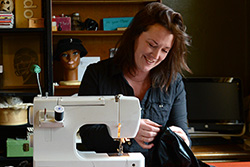
Need a kid's, guy's, marching band, Viking, witch doctor or Santa costume? Lucia Jackson has you covered, all from her Northside attic.

Our Partners

Taft Museum of Art

Common Ground Is Brewing

Support local stories and receive our signature roast straight to your door when you join at the Standard level (or above).

Drink Better, Read Local

Close the CTA

Don't miss out!

Everything Cincinnati, in your inbox every week.

Close the CTA

Already a subscriber? Enter your email to hide this popup in the future.