Startup News

StyleZen launches customizable “feed of fashion”

“To paraphrase Amy Scalia of CincyChic, StyleZen is like Pinterest and Pandora got married and started taking steroids,” says Michael Wohlschlaeger of StyleZen. A self-described “boring, successful corporate-finance junkie,” Wohlschlaeger left a thriving career to reconnect with his passions for analysis, style and startups. StyleZen’s website, which will launch in early April, offers a customizable feed of fashion, in the same way Pandora offers a customizable music feed. Users can add apparel to customizable collections, interact with products by “liking” or “disliking” them, and use the tool to get ideas or even plan purchases. Wohlschlaeger says that he and his wife, Megan, are somewhat shopping obsessed, if not traditionally stylish. “While we may not be described as quintessential fashionistas, we have always been voracious consumers of clothing and fashion,” he says. Collections consist of virtual pinboards, populated by clothing, shoes and accessories each user selects. For example, a user could create a collection of clothes suited to going out, hitting the gym or buckling down at work. Sound complicated? Don’t worry: StyleZen offers a quick tutorial for users and its almost-obsessive update schedule of new products means users are free pin, dream and, ultimately, strut their stuff.   By Robin Donovan

Latest in Startup News
VenueAgent trades cool spaces for hard cash

Jocelyn Cates wants your house and your office. But don’t worry, she’s willing to take it over when you’re away, and she might just pay your mortgage or rent in return. As the founder of VenueAgent, Cates is always on the lookout for unconventional spaces to turn into event venues. Cates’ company, VenueAgent, matches available spaces, including bridal shops, art galleries, design studios and coffee shops, with event hosts in the area. “Just about anything could work,” she says. So, if you have a house that overlooks the Ohio River, or a sweet loft downtown, or just a big office or warehouse space that’s frequently unused, VenueAgent wants your property as a listing. Cates herself is something of a networking wizard. She credits Joshua Johnson of Mindbox Studios, a local web design and development company, with helping her start thinking of herself as a web entrepreneur. She’s also participated in startup groups and incubators like Continuous Web, the Hamilton County Business Center, and has aligned herself with the startup-development powerhouses including the Brandery and CincyTech, a venture-development organization. Today, she’s using those network skills to find new spaces that could fuel the success of VenueAgent. “One of our listed venues, 915 Monmouth, told me just last week, ‘We don’t have to worry about our rent or other overhead from month to month now. The events that we are hosting in our off hours more than makes up for those expenses,’” she says. "That’s inspiring to me, and that sums up my vision for the future.” The site currently has 30 available venues.   By Robin Donovan

Bringing clean, haute cuisine to the streets

Jason Perkins would like to park in your neighborhood. His new truck, which houses EAT! Mobile Dining, is bringing fine dining to Cincinnati roadways. Perkins spent a number of years in working in the flavoring industry, developing those mysterious natural and artificial flavors added to so many foods. There, he says, he cemented his obsession with cleanliness. His website details food storage temperatures and checks, sterilization codes, and even his process for cleaning the basins he uses to wash produce. Along with this upscale attitude toward cleanliness, Perkins leans toward bistro-style appetizers and entrees; his menu lists pan-seared scallops, tamari almonds, grilled-paneer sandwiches, and a must-try, day-after-Thanksgiving turkey sandwich. EAT! takes requests, so you can contact Perkins and ask him to come to your office or near a favorite late-night venue. He’s still figuring out his regular schedule, but tends to be downtown Tuesdays and Thursdays, sometimes on Court Street. “I’m still looking at Blue Ash,” he says. “I’m trying to be in markets that are underserved as far as food-service options go, like Reed Hartman Highway.” While training clientele unused to food trucks is a challenge, Perkins points to a handful of already-loyal downtowners with hope. “Downtown’s nice,” he says, “because people get used to seeing you. Food trucks are still very new in this part of the country.”   By Robin Donovan

Solar Earth helps consumers cash in on energy credits

One thing Jennifer Wolford learned after about 10 years in the construction industry was if you’re not selling solar, you’re losing out. While putting together proposals for a construction company, she noticed more and more requests for solar-panel installation, a service her company didn’t offer.  Solar panels used to be too expensive for most consumers – except those willing to pay extra to spare the environment -- to justify. At least, that’s what Wolford’s friend, Julie Jones, told her. Jones worked for an alternative-energy department at Cinergy (which was later bought out by Duke Energy), where she figured out ways to use power more efficiently and sustainably. Wolford and Jones launched Solar Earth LLC last November to address the growing demand to retrofit homes and businesses with solar panels. The pair is planning their first installations as this article goes online. Today, plummeting upfront costs and increasingly efficient panels have made solar a worthy option for consumers. Government tax credits have helped, as has the fact that local energy companies are required to support or generate green and renewable power; if they don’t meet their requirements, they pay a penalty. One way to avoid this? Buying solar renewable energy certificates, or SRECs, from local solar consumers. There are even websites that have sprung up to help solar users sell their credits as soon as they accumulate them. In Ohio, buying solar panels will also net you a 30 percent government tax credit. By combining tax benefits, SREC sales and other savings, Jones estimates that her customers will earn a 6 to 8 percent return over the panels’ lifespan (they’re usually guaranteed for 25 years and last up to 40 years). A self-proclaimed “tree-hugger,” Jones couldn’t be happier: “I’ve always been a solar geek and always thought it was the right way to go.”

Leap app helps heath-minded competitors stick to goals

James Dickerson, Nick Cramer and Ryan Tinker live together, true startup style, near Ault Park. Right now, they’re tackling the Paleo diet, a tough-to-follow way to eat as our Paleolithic ancestors did, which basically means avoiding dairy, grains and processed foods in favor of produce, nuts, fish and meat. When one of the guys eats a meal -- say, baked fish, a handful of nuts and a salad -- they snap a photo and upload it to Leap, a mobile app they launched this year on Leap Day (Feb. 29). As competitors in their own challenge, the guys win points if their meal fits the rules they set, or get a foul if it includes a forbidden food. Challenges in the app are designed by participants and proven by photographs. “The idea was born from our own competitive nature and our interest in healthy habits,” Dickerson says. “I think all of us are really inspired by taking risks, doing really interesting things and not really going by the norms of society. We really want to do our own thing.” Leap was built through trial and error. Dickerson found that people wanted an app that let them define their own goals (healthy or not) and compete with friends. Recently featured by Apple’s app store, the free app was downloaded more than 3,400 times in the first 60 hours it was available. The Leap team hopes to monetize the app by allowing companies to sponsor a challenge. For example, Chipotle might challenge its Facebook fans to burrito-eating contest, handing out swag to whoever eats the most. Or, a Crossfit gym could sponsor a diet challenge for its athletes. “Leap is a product that people can use to try to push their friends to try new things and lead more interesting and fun-filled lives,” Dickerson says, explaining that the app can be used for any life-enriching goal, big or small. “I think our own goals and the lives we want to live are reflected in our product enabling others to do the same.” By Robin Donovan

Fashion-forward website connects bloggers, readers and brands

Erin Flynn is a fashionista on the mission. Starting as a fashion blogger herself, she quickly discovered a problem in the fashion blogosphere. Advertising and public relations firms were spending long hours trying to match their clients with fashion bloggers who could review products and increase brand awareness. Meanwhile, bloggers struggled to increase their readership. Erin found a solution for this problem and, in the process, co-founded Righting Style: Expose Yourself, an online fashion hub that forms a symbiotic relationship between fashion bloggers, readers, and brands. Perhaps the only thing Erin is more passionate about than fashion is the success of her company. She and her husband, Colin, moved to Cincinnati from Scranton, Penn. (yes, the fictitious setting of The Office) to take advantage of Cincinnati’s wealth of startup resources. Along with her husband and sister-in-law, Amy Flynn, she hopes to launch the website within the next few months. Erin explains, “Our democratic, online community identifies the best fashion blog content, which makes it easy for readers and brands to find blogs that match their style interests.  With top content gaining more and more exposure, fashion bloggers will finally have a way to get continuous feedback on their writing and will have an interested and engaged audience just waiting to read their best content.” Righting Style will host fashion blogs, using an algorithm to determine most popular and useful content, which will populate a leader board on its homepage. A paid subscription service will match advertising agencies and PR firms with interested bloggers. Finally, fashion-hungry readers who visit the site will be able to search the site’s content using tags and filters. Erin hopes the site will be just what its tagline promises: “A New Fashion Democracy.” By Robin Donovan

Founder Profile: Amanda Voss, Constance Depler and Friends

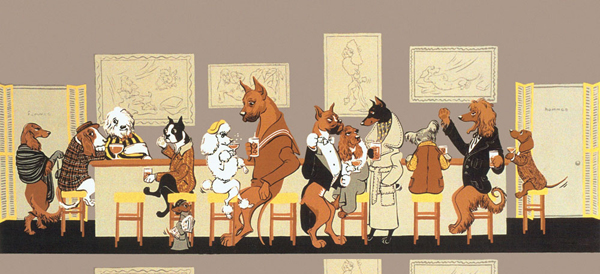
How did you start your business? The images I use are all my mother’s [Constance Depler’s] artwork. Her work had been reproduced in the past and I decided we could do it instead of just licensing it out. At first, I tried just starting a website, but I spent a lot of money, and it didn’t work great. Then, I took the Bad Girl Ventures classes and was a finalist. Ultimately, we decided to focus on my mother’s 1950s work, the bar hounds, reindeer and a lot more. Right now, we’re at the point of reconstructing the website and starting with web-based sales, with a plan of going into wholesale retail next year. How did you come up the idea for your business? It was a mutual decision between my mom and I; she’s thrilled and loved that I’m doing it. What resources here did you take advantage of and how did they help? Bad Girl Ventures helped me form connections with business people and mentors. It also forced me to to sit down and do the work I don’t like: financials, business plans, and just really studying what a business entails. Connections I made through Bad Girl have been great for finding people who would work with me on marketing and design; it helped me make my support team. Overall, I learned to go slower and really take the time so that things aren’t rushed and everything we put out looks great. That lesson helped me: slow down, think it out, you don’t have to do everything at once. What inspires you? When I tell people about the store and the artwork, they love it and they love the look of the pieces. Also, keeping a support system around me helps. My mother, who’s really interested, still lives on Milton Street here in Cincinnati. She’s 85, still painting, still working, and still doing the pet portraits she’s known for. Personally, I’m excited about getting more involved in the design aspect of what we’re producing, which is a part of myself I haven’t tapped into yet. What’s next for you and your company? We’ve switched our focus to the 1950s genre of my mother’s work. Our immediate next step is to have a new online store by April, and the next big goal is to have a new product line coming out. The first year we’re starting with products like purses and kindle covers – things with a flat image on them. Hopefully, by September, we’ll bring out barware and then develop into products like candlesticks, figurines, corkscrews and other items that we’d need to have molded. By 2013, we plan to have a full-fledged product line for the wholesale and retail market. By Robin Donovan

Founder profile: James Dickerson, Nick Cramer and Ryan Tinker, Leap

How did you start your business? I [James] first had an idea for a company called “Wellthy” based around corporate wellness challenges that I started about a year ago. I built the team and we took the company through the Brandery, which gave us some great resources to help us get going. What resources here did you take advantage of and how did they help? We built our first app and tested it with companies, but learned that people didn't want to do corporate wellness challenges. They wanted to compete with their friends around their goals and interests. So, with about a month before the Brandery demo day, we changed directions to Leap. Leap is the first mobile app for social group challenges. It lets users create challenges with their friends and compete by snapping photos from their phone. For example, you could create a challenge to see who could eat a healthy breakfast each day of the week, or meet the most people on a Friday night and prove your progress by posting pictures and earning points. What inspires you? The Brandery was a huge help to us. It helped us get connected to mentors that gave us some very valuable advice on topics from fundraising to product development. We were also one of five startups in the country invited to pitch at the 2011 Clinton Global Initiative in Chicago. We were able to validate what we were working on and it gave us a big confidence boost. Our vision is that challenges are the best way to push people to try new and interesting things in their lives and to capture fun experiences with the people that you care about. This has inspired our team to build Leap, and we hope people use our application in a really positive way. What’s next for your company? We launched our app on Leap day, Feb. 29. We're focused on gathering feedback from early adopters and using it to build the best possible product. We’re also talking to investors to raise a seed round for Leap. By Robin Donovan

Nurse offers compassion and clean-up to grieving families

Heidi Lamkin admits her work is “a job most people couldn't do.” She recently launched Absolute Bio-Recovery Service East, a small company that offers bio-recovery, or cleanup, of crime scenes and bio-hazards. “We do crime and trauma scenes like murders, and I've done some suicide cleanups," Lamkin says. "We also do hoarder houses and unattended deaths." By “do,” she means “clean-up after,” a job that can involve anything from carefully cleaning a car’s wiring to removing bloodstained floorboards. On the mundane side, she offers deodorizing services to families caring for a sick loved one at home or in a hospice setting. Because Lamkin is an ICU nurse, she’s not bothered by most jobs, many of which are no more stomach-turning than what she’s encountered in hospital settings. In addition, she and her husband have been trained through the American Bio-Recovery Association to safely clean up crime scenes, bio hazards and other waste that poses a health risk to the average person. They’re even certified in meth lab cleanup. Although some larger bio-recovery companies market and advertise heavily, Lamkin sees advantage in her experience. “They’re [some larger companies] not emotionally or technically trained to do the work,” she says. “To me, training in dealing with people, being compassionate and truly caring is huge. All of these situations are cases in which people have been devastated.”   Because a coroner would typically remove a deceased person before Lamkin arrives, she's not as directly exposed to death as she could be. However, she says that finding personal items -- glasses, a cane, dentures – is moving and saddening. Still, Lamkin takes comfort in knowing that she's sparing grieving families an unenviable task. She says her nursing background helps her relate to traumatized families. “I’m helping people achieve a new normal,” she says, “And I’m showing them that there are truly compassionate people out there.” By Robin Donovan

Scent of a cell phone offers new business opportunity

Any woman who has broken a bottle of perfume knows the headache: glass everywhere and, worse, a supercharged dose of scent that’s hard to shake. Rosalie Giesel, 26, took this “why me” experience and used it as motivation for scented cell phone accessories sold by 346 Stanley LLC, a company she launched with a trio of classmates from the University of Cincinnati. The company’s signature product, Akscentz, is a line of scented cell phone cases targeted to teen girls and young women. Akscentz is the outgrowth of a class project; when tasked with inventing a product and a business plan to sell it, the women wowed their professors, who encouraged them to make the product a reality. Giesel’s partners include Stephanie Albers, Breeana Dixon, and Krista Streckfuss.  Streckfuss, a biology major, graduated late last year. The others are on the cusp of completing the College of Business’ entrepreneurship program, but plan to stay in Cincinnati and collaborate on the launch. Giesel is unfazed by the possibility that her co-founders may move, pointing out that any relocation is just a chance to focus on a new market. While Giesel admits that the company’s youthful leadership is a challenge – she describes the business’ manufacturing side as “pretty terrifying.” Still, she says the group is well-aware of competing products marketed by well-established competitors.  And, she explains, “We’re starting out, we’re motivated, and we really want it, and our drive makes up for expertise. In the areas that we lack, we’ll learn or we’ll consult. I think being young, fresh, and motivated is one of our main advantages.” It doesn’t hurt that Giesel, Albers, Dixon and Streckfuss are part of the demographic they’ll target with Akscentz, either. Right now, Giesel says they’re focused on graduating so they can devote more time to the company. By Robin Donovan

Our Partners

Taft Museum of Art

Don't miss out!

Everything Cincinnati, in your inbox every week.

Close the CTA

Already a subscriber? Enter your email to hide this popup in the future.