Metro now offers stored-value cards to riders
Many city-dwellers are continuously faced with the arduous task of budgeting their quarters between two priorities: bus fare and laundromats.
This expansive neighborhood borders Over-the-Rhine in the shape of a sliver. Mostly residential, it has a rich history and diverse inhabitants, a beauty discovered by only the most discerning eye. The Dayton Street Historical District, a cluster of houses built mostly in the late 1800s, is on the National Register of Historic Places. City West, a mixed-income housing development just north of downtown in the neighborhood's southern-most point, is the biggest housing development in Cincinnati since World War II. The quiet streets have come alive with additions like the Mockbee across Central Parkway and a church renovation that will yield a climbing gym.
Many city-dwellers are continuously faced with the arduous task of budgeting their quarters between two priorities: bus fare and laundromats.
The project is titled “MUST LOVE CATS,” and it will be an album of five compositions.
Graduating high school students of the class of 2014 will be the first group in Ohio that is required to learn financial literacy. “So many teens were graduating high school without basic knowledge of financial literacy, like avoiding high-interest credit cards—scams that are so present on college campuses,” says Jennifer Korn, TeenSpot manager at the Public Library of Cincinnati and Hamilton County. “And there have been a number of studies that say students who don’t have the basic knowledge are likely to end up in serious debt as very young adults and are unable to get ahead and unable to save money as they go into adulthood.” To fill that void and to encourage more teens to be conscious of their finances, the library is offering a series of workshops for teens between the ages of 12 and 18. The workshops will teach the students how to create a budget and open a savings account. Thanks to a grant from the Financial Industry Regulatory Authority Investor Education Foundation, PLCHC is one of just 14 public libraries nationwide to offer the workshop. “I think a majority of teens across the board don’t have a very good understanding of the importance of saving or of budgeting your money, so maybe they get an allowance or have a job or babysit, but it’s mostly for entertainment purposes,” Korn says. “But there’s not a lot of consideration for the future and the long term—that if you start saving your money now and that money starts to build, then in 15 or 20 years, you can be in a much better position than if you would not have started saving.” Korn says all the activities in the series are teen-focused and engaging, so students might be given a sample scenario where they have a set amount of money and want to go to the movies, but also need to consider the fact that their best friend’s birthday is coming up. “Anything that reinforces what they’re doing in an interactive or a social way,” Korn says. “The hope is that once they graduate high school and enter their postsecondary education or the real world, they feel confident, can handle their money and are savvy consumers and savvy savers.” Do Good: • Learn about the financial literacy workshops, and sign up to attend. • Keep up with teen programs at the library, and attend an upcoming event. • Like the PLCHC on Facebook. By Brittany York Brittany York is a professor of English composition at the University of Cincinnati. She also edits the For Good section of SoapboxMedia.
The show’s format provides a much-needed outlet for local musicians.
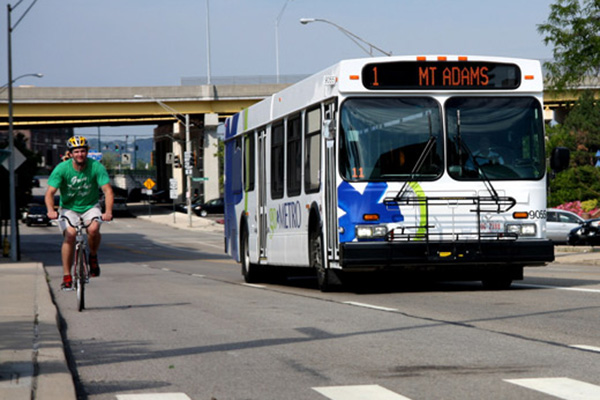
Metro has been "going green" for more than 25 years, but partnerships with progressive organizations have helped it broaden sustainability efforts.
About seven years ago, Crossroads began a transformation that positioned it as more than just a church. Its vision was to focus on ways in which it could serve others—in not just the community, but across the world. Crossroads’ work with GO South Africa was making an impact in the lives of those battling poverty and HIV/AIDS, but at the same time, volunteers began to think about their roles in their own community. Modeled after GO South Africa, a team of volunteers initiated GO Cincinnati. It's an outreach activity that started out with about 1,200 volunteers who completed 65 projects throughout Greater Cincinnati in a single day for nonprofits. “People really connected with the idea of serving their city, and on the front line serving those in need,” says Kelley Kruyer, director of Cincinnati ReachOut projects and leader of GO Cincinnati. “They’re doing the hard work every single day, so we thought it would be cool to thank them for the work they do in our community.” This year, 7,000 volunteers will combine forces on May 18 to complete 400 projects that range from painting and landscaping to putting up drywall and serving meals. According to Kruyer, the best parts of GO Cincinnati are the long-term relationships Crossroads has formed over the years with the organizations it serves. “We know their buildings, their properties, their needs, and we know how to best help them, so sometimes we put together a multi-year plan, and it gives them the peace of mind and helps them to budget so they don’t have to spend money on things that we’re happy to help with,” Kruyer says. “It’s just a really special day.” Kruyer, who grew up in Northern Kentucky, left her hometown in the ‘80s. During that 10-year period of her life, she says she wondered what she was doing because everyone and everything she loved was here. She says that's the kind of passion for the city that drives Crossroads to engage and reach out. “We love our city—and by Cincinnati, we mean all of it—from Burlington to Middletown to Amelia to Cleves—the whole Greater Cincinnati and Northern Kentucky area,” Kruyer says. "We’re just totally committed to making it one of the best places in the country to live.” Do Good: • Find a nonprofit that interests you and lend a helping hand. • Assist Crossroads in its volunteer efforts throughout the year. • Like Crossroads on Facebook. By Brittany York Brittany York is a professor of English composition at the University of Cincinnati and a teacher at the Regional Institute of Torah and Secular Studies. She also edits the For Good section of SoapboxMedia.
The Public Library of Cincinnati and Hamilton County is one of 10 recipients out of 140,000 libraries and museums across the country to receive this year’s National Medal for Museum and Library Service. The award recognizes outstanding service to communities. So, in appreciation of library users and as a way to celebrate, the PLCHC will offer a Fine Amnesty Day May 15. “We really wanted something to express our appreciation to the community, and we started thinking about what is it that people hate most about the libraries—we all know that—the fines,” says Kim Fender, Eva Jane Romaine Coombe director. “I’ve been here 25 years, and we haven’t done this in my time here at all, but our hope is that people who have not used the library because of their fines come in and have those fines removed and come back to the library and get their cards started up again.” Fender says the library most likely wouldn’t have received the award without the support of the community, because the library’s heavy usage was one reason the Institute of Museum and Library Services was so impressed. With more than 17.6 million items borrowed in 2011, the PLCHC is considered the eighth-busiest library in the nation, and its commitment to providing academic assistance and encouragement to both children and adults is evident through the variety of programs it offers and successfully implements through its partnerships with other community-based organizations. Last summer, for example, the library partnered with Cincinnati Public Schools and the Freestore Foodbank to serve about 7,000 meals to children. “That’s something people don’t normally think of libraries doing,” Fender says. “But when they were in there eating, they could sign up for summer reading or programs.” Fender says the library staff also goes out of its way to make sure children are learning by actually attending school. “If we see kids in the building during school hours and we think they might be truant, we check up and say, ‘What school do you go to?’ and look at the school calendar, and we call someone from the school to let them know because they have to be in school to learn,” Fender says. Fender will travel to Washington, D.C. with Amina Tuki, a local resident who came to Cincinnati from a small village in Ethiopia who was not fluent in her native language, but who learned English by picking up a small book called Coming to America at the PLCHC. “She says it took her all day, but she made her way through it, and she took it home and read it to her husband and children, and her older son started crying,” Fender says. Fender and Tuki will accept the award May 8. Library users can celebrate Amnesty Day May 15 by taking their library card to any local branch. Do Good: • Go to your local branch and have fines removed May 15 so that you can begin to use the library's resources. • Sign up for a library card if you don't already have one. • Support the library. By Brittany York Brittany York is a professor of English composition at the University of Cincinnati and a teacher at the Regional Institute of Torah and Secular Studies. She also edits the For Good section of SoapboxMedia.
Santa Maria Community Services’ Health and Wellness Program has served as a vital resource for uninsured and underinsured Price Hill residents and Cincinnati community members since 2001. About 30 percent of the organization’s clients are Spanish-speaking individuals who are new to the country and need assistance when it comes to navigating the healthcare system. “We have a pocket here,” says Laura Brinson, director of the wellness program. “Some of the Spanish speakers come from very rural pockets of Central American countries—Guatemala is a big one in this part of town. And a lot of the clients we serve need that extra helping hand to get access to needed medical services.” Brinson says clients are particularly grateful that there are individuals who are willing to help them—so much so that at the organization’s most recent health fair this month, two clients wanted to give back because of the services Santa Maria had provided them in the past. So they and their reggae band played for participants. Santa Maria provides two health fairs a year with free screenings and health-related information, but Brinson says the nonprofit tries to go above and beyond the typical format for a health fair. “We collect results for each person at the health fair, and then instead of sending them on their way and giving them a flier because their cholesterol may be high, we follow up with each and every one of the clients to make sure they understood their results and also help them get into a medical home,” Brinson says. “They might not have a primary care physician to go talk to about their results, so we follow up and help them enroll in a clinic, we provide education, answer questions—we try to work with them throughout the year and make sure they get the help they need to help improve their outcomes.” In addition to offering health fairs and providing general assistance with finding doctors and understanding transportation routes to clinics and pharmacies, the wellness program provides translators who can explain medical information to clients and help individuals fill out financial aid forms for treatment. They even offer cooking classes that emphasize healthy options. “Good health is essential to all things in life," Brinson says. "You can’t be a productive worker at your job if you’re not healthy—you can’t be a parent to the best of your ability if you’re not healthy yourself. So many people lack access to proper care, and I’m passionate about making sure they get the services they need so they’re able to take better control of their lives, their health and feel better so they can be more proactive and productive members of their society.” Do Good: • Take your family to Carnival the Day Away at Washington Park on May 11. All proceeds benefit Santa Maria Community Services. • Support the Wellness Program's efforts by registering to attend the Bienestar Recognition Luncheon. • Support Santa Maria by donating money or items to the organization. By Brittany York Brittany York is a professor of English composition at the University of Cincinnati and a teacher at the Regional Institute of Torah and Secular Studies. She also edits the For Good section of SoapboxMedia.
Fifty years ago, a group of parents who were passionate about Maria Montessori’s philosophy of education developed the first Montessori preschool in the area. And following the preschool’s inauguration, the group formed the Cincinnati Montessori Society, a nonprofit whose focus is to promote Montessori education while serving as a resource to countless schools, teachers, parents and students in the community. “One of my favorite quotes is, ‘Follow the child,’” says Heather Gerker, vice president of CMS. “We meet the child where they are developmentally.” Montessori classrooms, which are both child-centered and composed of mixed age groups, are set up so that children can learn through a multisensory approach that allows them to figure things out at their own speed—and the philosophy works, Gerker says. At CMS’s Annual Spring Conference and celebration of 50 years of success, neuroscientist Dee Coulter delivered the keynote address. “This work that Maria Montessori did over 100 years ago is now being proven through neurological work happening now,” Gerker says. “[Coulter’s address] was really affirming and validating to the teachers there.” Not only were teachers excited to go back to work on Monday after hearing Coulter’s presentation, Gerker says, but they also had the opportunity to participate in breakout sessions that were aimed at providing strategies and insight that lead to better education. Topics ranged from promoting mindfulness through music to strategizing ways of better assisting children with ADD and autism. Gerker says she’s particularly passionate about the resources that CMS provides because they’re based on a philosophy that’s now scientifically proven, and she’s seen it work in the lives of her own children. “It gives them a solid sense of self, that they’re so independent and happy, which I think is the ultimate goal,” Gerker says. “I just want to make sure it’s available to all children.” Do Good: • Become a member of CMS. • Check out the resources offered by CMS. • Connect with CMS on Facebook. By Brittany York Brittany York is a professor of English composition at the University of Cincinnati and a teacher at the Regional Institute of Torah and Secular Studies. She also edits the For Good section of SoapboxMedia.
The Everybody Rides Metro Foundation, which is the first program of its kind, provides affordable transportation to about 30,000 low-income individuals each year. Metro subsidizes rides at $1 and has partnered with about 70 different social service agencies to cover the remaining 75 cents of fares for riders in need of medical or work-related transportation. “Many of our riders feel like this is the only way they can try and succeed—it’s somebody giving them a lift when they need it the most,” says Joe Curry, executive director of ERM. “The greatest outcome of this is that you’re getting people toward self-sufficiency. It’s something that stays with them forever—it helps them out until they earn money and start budgeting once they have a job; and self esteem is a large part of that overall package.” According to Curry, many of ERM’s riders are paroled into the Talbert House and have anywhere from $0 to $20 to their name after coming out of prison. Once they’ve been rehabilitated and have participated in job counseling, they may need to interview at up to 20 different businesses before they find work. “Once they land a job, the worst thing that can happen is not to show up during the first week of employment, so we give them additional money, if needed, to subsidize their rides during the first few weeks,” Curry says. “It’s to help them out temporarily so they can establish a budget—it’s not a lifetime pass.” In addition to helping riders get to job interviews and places of employment, ERM provides rides to medical-related destinations so individuals can receive preventive care. “Society of St. Vincent De Paul runs a free pharmacy on Bank Street in the West End, and if you can’t afford your meds, they’ll give you a 30-day supply for free so long as it’s not a narcotic, but you have to get to the location,” Curry says. “If you’re diabetic or are undergoing cancer treatment, meds are absolutely essential, but if you can’t get to a place where you can get your meds, you may get sicker. You may be one of those people who take that $1,500 ambulance ride, and that’s one of the things we’re trying to prevent.” Beginning in January 2014, 40,000 more individuals in the Cincinnati area will be eligible for Medicaid, and according to Curry, anywhere from 50 to 70 percent of those people will need public transportation to get to a healthcare provider or pharmacy. “Those are the people we’re worried about," Curry says. "If public transit isn’t available to them because of the cost, how are they going to get treated? More than 30 percent of our population lives in federally defined poverty—that tells you we really need to do something and think outside the box about how to solve some of these public transit issues.” Do Good: • Donate to the Everybody Rides Metro Foundation. • Like Cincinnati Metro on Facebook. • Follow the Cincinnati Metro on Twitter. By Brittany York Brittany York is a professor of English composition at the University of Cincinnati and a teacher at the Regional Institute of Torah and Secular Studies. She also edits the For Good section of SoapboxMedia.
Our Partners