
Uptown

Uptown includes all the neighborhoods around the University of Cincinnati including Avondale, Clifton, Clifton Heights, Corryville, Fairview, Mt. Auburn and University Heights, so it's a diverse mix of students and residents in one of the city's most distinct and eclectic group of neighborhoods. Uptown is the home of the Cincinnati Zoo as well as multiple hospitals and the Ludlow shopping district where you can find trendy and unique shops as well as any scent of incense you need. Ethnic restaurants, including a curiously high concentration of Indian eateries, multiple taverns, coffee houses, music venues and the Esquire — one of Cincinnati's finest independent art house movie theaters all make Uptown a one-stop walkable bazaar of exciting entertainment options.  

UC researchers develop smarter, solar-powered water filter

Researchers at the University of Cincinnati have developed tiny, solar-powered water filters that target and remove carcinogens and antibiotics from lakes and streams. These protein-based filters are smaller in diameter than a human hair, and work differently than current surface water filters that are made of activated carbon. Those carbon filters work much like the ones in home water filtration systems. "In Cincinnati, we have one of the largest activated carbon treatment facilities in the United States," says David Wendall, a faculty researcher and environmental engineering professor at UC. "But what the current filters do is bind a lot of different [non-dangerous] compounds; it will will coat the filter very quickly." UC's research was published in the "Nano Letters" journal. It showed the new filters absorbed 64 percent surface water antibiotics, compared to 40 percent absorbed by current filtering technology. The research is important because there is growing scientific evidence of harmful effects of the hormones and antibiotics that work their way into our lakes and streams. "We're starting to understand that birth control is feminizing fish, and antibiotics promote resistance in certain organisms," says Wendall. "It's what is contributing to superbugs that resist to antibiotic treatment. We're learning more about what happens when we dump antibiotics into the environment." Generally, the contaminates arrive in waterways from runoff through farms or when we flush or trash our medicines. "The main sources are from farms," Wendall says. "They put antibiotics in animal feed so they will grow fast and stay healthy. But some of their waste ends up in the rivers as runoff, where [the antibiotics] don't break down, and it ends up contaminating our water." The filter at UC was developed in 2010. Testing has proven successful in specifically targeting antibiotics and other harmful materials. Wendall describes the filters as "selective garbage disposals." Filtering ability is fueled by sunlight, and the filters actually preserve antibiotics in a way that famers can reuse if filters are recovered. The university's research is continuing to be tested and refined, Wendall says. But current work could be used practically in three to five years. By Feoshia H. Davis Follow Feoshia on Twitter
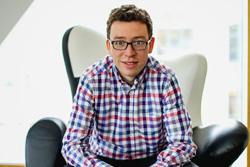
Rise of the rest: Creativity loves company

Startups aren't just for Silicon Valley anymore. As entrepreneurs find expected pleasures—and great quality of life—in cities like Cincinnati, a new kind of energy is building. Read about the rise of our startup sister cities, from Boston to Denver.

New Nanowire Structure Has Potential To Increase Semiconductor Applications

There’s big news in the world of tiny things. New research led by University of Cincinnati physics professors Howard Jackson and Leigh Smith could contribute to better ways of harnessing solar energy, more effective air quality sensors or even stronger security measures against biological weapons such as anthrax. And it all starts with something that’s 1,000 times thinner than the typical human hair—a semiconductor nanowire. Read the full story here.

Solar-Powered Proteins Developed That Can Filter Antibiotics And Carcinogens From Water Read more at

A solar-powered nano filter capable of filtering antibiotics and dangerous carcinogens from large bodies of water has been developed by researchers at the University of Cincinnati. Read the full story here.

Cincinnati University fashion student steps back in time

Loungewear and lingerie designs by University of Cincinnati senior fashion design student Emily Battisti look back to another century for detailing and inspiration. Read the full story here.

Executive Service Corps volunteer learns new lessons

For Fred Heyse, a local volunteer who has donated more than 400 hours this year to Executive Service Corps of Cincinnati, volunteering isn’t a way for him to “give back,” he says. It’s a way for him to simply do his part.  “In a community, we’re all in it together, and somebody’s got to do the work,” Heyse says. “If we always have the mindset to let somebody else do it, we’re not going to get as much done as we should. So we all have a responsibility to chip in and do a little bit.”  Heyse, 70, has volunteered with nonprofits since 1995, and he says he began because he didn’t do enough of it when he was younger, when life seemed to revolve around his work and family.  “My priorities were skewed,” Heyse says. “So, I’m doing a lot of it now—it’s to make up and give my share.”  Though Heyse has volunteered with countless nonprofits in the community, he says two of the more notable experiences came from the work he did for organizations he never even knew existed prior to his involvement: a resident camp for Jewish children and the Marva Collins Preparatory School.  “You don’t hear a lot about the nonprofits in our day-to-day activities that are really doing a lot of good things out there unless they’re really big,” Heyse says. “But there are a lot more of them out there, and ESCC finds them, and I get put to work on them.” ESCC volunteers work primarily in the field of business management, so Heyse, whose background is in information systems, helped the two organizations develop marketing strategies to reach more individuals. Heyse said the Marva Collins Preparatory School, for example, hadn’t had the opportunity to compile results of where their students were going after graduation, so he did the data analysis to show parents that the school was successful.  “It’s a school for troubled and underprivileged kids, and I never even knew they were effectively running boarding schools,” Heyse says. “But they made productive kids in society, and it was a good way of making sure no kid got lost. Many of them went on to excellent colleges, and so they’re not just surviving in society, but they’re really thriving—they’re very successful kids.”  It’s these types of success stories that Heyse says are important to share and to foster as a neighbor and community member. “At 70, I’m still learning and still growing—I not only get the thanks and appreciation from them, but I learn more about how things work and how people work, and so I’m still learning myself,” Heyse says. “That is a big part of my life. I don’t want to just sit around and stagnantly grow old. I’m able to contribute, and I’m also able to keep learning.” Do Good:  • Call 211 or visit the United Way's website to examine your interests and strengths, then choose an organization to volunteer for.  • If you are interested in business management and have business skills, volunteer through ESCC. • Donate to ESCC to help the organization assist other nonprofits in need. By Brittany York Brittany York is a professor of English composition at the University of Cincinnati and a teacher at the Regional Institute of Torah and Secular Studies. She also edits the For Good section of SoapboxMedia. 

A day in the life of a Cincinnati Rollergirl

If you’ve ever wanted to know what it’s like to live a day in the life of a Cincinnati Rollergirl, you’ll have your chance, should you bid on that prize and win the auction item at The Cure Starts Now Foundation’s sixth annual Once in a Lifetime Gala & Auction. Christina Kuhnhein, also known as “Ruthless Chris,” has been skating with the Rollergirls for two years, and she says the winner of the auction will experience first-hand how seriously the skaters take their sport.  “We’re confident, very focused," Kuhnhein says. "Everyone has their own thing in the locker room—some are quiet and listening to their playlist that’s going to pump them up, and some are very excited and yelling and trying to pump everybody else up. But it’s a very serious environment—we want to win. Our coach usually gives us a pretty good pep talk beforehand, and we just go over what we’ve been doing in practice—our strategy—remaining in control and confident and calm.”  The auction winner will sit in on pregame and halftime locker room sessions, in addition to receiving a private practice session, VIP tickets to the final home game of the season, a two-and-a-half hour standard practice session with the Girls, and what Kuhnhein says the team refers to as “lots of swag”—T-shirts and other gear.  Rumor has it there will even be a gift certificate for a tattoo included in the package. “Rollergirls have this reputation of having all these piercings and tattoos, and it’s such a tough sport,” Kuhnhein says. “And I will say that I’ve never seen so many tattoos since I’ve started hanging in this circle, but honestly, it’s just something fun.”   Kuhnhein says she remembers watching RollerJam back in the '90s. There was a “lot of fast skating and theatrics,” but the sport is much different now because “people aren’t as concerned with how they look.”  “It used to be about outfits and trying to show off, but now it’s much more athletic—it’s teams that are very serious about strategy, working together and really killing the other team," she says.  While Kuhnhein says she loves the aggressiveness and the stress relief she gets from skating, she’s just as passionate about giving back.  “It is an honor to go out and help other charities in our city, and helping local businesses—we have a lot of fans that have certain charities that are close to their hearts, and we try to help in any way we can,” Kuhnhein says. “We’re doing at least one if not two or three charity events a month.”  The Once in a Lifetime Gala is circus-themed and features live performers from the Cincinnati Circus, in addition to special guest and daredevil Nik Wallenda. The event takes place May 4 and helps fund pediatric brain cancer research.  Do Good:  • Support The Cure Starts Now Foundation by purchasing a ticket to the Once in a Lifetime Gala & Auction. • Check out and bid on available auction items.  • Like the Cincinnati Rollergirls on Facebook, and follow The Cure Starts Now Foundation on Twitter.  By Brittany York Brittany York is a professor of English composition at the University of Cincinnati and a teacher at the Regional Institute of Torah and Secular Studies. She also edits the For Good section of SoapboxMedia. 

Craft beer bar on tap for late summer at U-Square at the Loop

About a year ago, Cincinnati native Mic Foster started thinking about opening a craft beer and cocktail bar in town. In the end, he decided to open a Brass Tap franchise at U-Square at the Loop.   “Cincinnati is having a craft beer renaissance, and I felt Brass Tap was a good match, and this was a good place to start developing the bars,” says Foster.   Jeff Martin founded Brass Tap in Tampa, Fl., and traditionally, most of the bars are in Florida. But soon, a few of the beer and wine bars will start cropping up in the Midwest, Foster says.   Cincinnati’s Brass Tap doesn’t have an official opening date yet, but Foster hopes to have it up and running by the time the school year gets underway. He wants Brass Tap to be a destination for those who love craft beer, as well as a place for students to hang out with their friends.   Brass Tap will focus solely on craft beer—there will be 80 craft beer taps, with 20 of them designated for local brews. The bar will also offer 300 bottles of craft beer. While the menu doesn't include liquor, there will be a wine list for non-beer-drinking patrons.   The beer-centered bar will also have a limited food menu that includes pretzels and mini pizzas on pretzel crusts. Patrons can also catch live music at Brass Tap Thursday through Saturday.   “Brass Tap is a bar bar where people can go for happy hour,” says Foster. And if you want to catch a game, Brass Tap will have 25 hi-def TVs and a projector, he says.     Foster also wants to bring more beer education to Cincinnati. “There are lots of educated beer drinkers in town, but craft beer can be an intimidating situation for someone who doesn’t know what they’re looking for,” he says.   Foster is spending a lot of time educating his staff and hiring knowledgeable people who can help patrons learn more about craft beer in a relaxed environment.   By Caitlin Koenig Follow Caitlin on Twitter

DAAP grad embraces innovation, nurtures young Design Geniuses

Rebecca Huffman’s circuitous route to UC’s Fashion Design program both inspired and informed her non-traditional senior thesis, Design Genius. More methodology than consumer good, Design Genius is a learning module that teaches students the value of education and the building blocks of problem-solving as they design their own products. Unveiled at UC’s DAAPWorks, Design Genius takes a fresh approach to making learning relevant for kids of all ages, which is exactly what recent grad Huffman, 24, who works for LPK, wanted.  “I knew that I wanted to do something that would help kids,” says Huffman, who spent a year working as a preschool teacher before starting her design training at DAAP. As she considered what her culminating project for college would be, she thought back to a studio class in which she’d designed and created a real project, then put it up for sale in real life. Through that process, and its embrace of design-thinking, she saw the value of the disparate classes she’d taken through her academic career, from math to marketing and writing to psychology. And she felt empowered. Her work as an LPK co-op increased her experience with design-thinking, an approach to problem-solving more often seen in Fast Company than elementary schools.  “Design Genius is an attempt to solve the problem that our kids are facing by instilling a greater sense of educational purpose,” she says.  She describes Design Genius on her website as “the culmination of five years of study and extensive research on the Creativity Quotient, Design Thinking in education, the concept of ‘failing forward,’ sociocultural trends impacting Generation Z, and the educational and social development of Tweens.” What that looked like, in the end, were three, one-and-a-half hour sessions in two schools—St. Ursula Villa and Pleasant Ridge Montessori—in three different classes. Fourth and fifth grade students examined case studies in the form of fictional diary entries. Then, they ideated, revised and designed real products to help solve the problems of their fictional “customers.”  “They learned everything I was trying to teach them,” Huffman says. “It was amazing.” The students not only learned from the project, they loved it. Huffman received unprompted thank-you notes and testimonials when the students presented their products. She’s convinced that with a little tweaking, she can develop a fully functional learning module that can help young students not only design products, but create and sell them.  By Elissa Yancey Follow Elissa on Twitter

UC College of Law faculty teach in, fund scholarships

When the Office of Admissions expressed concerns about declining enrollment within the University of Cincinnati College of Law, faculty members decided to take a proactive approach.  “The thought was that because we’re small, it wouldn’t really take that much to make a difference in the composition of our class,” says professor Marjorie Aaron. Professor Christopher Bryant invited faculty members to talk about their concerns, and after a few meetings, the group proposed creating new scholarships that would be funded by faculty contributions. In order to raise funds, faculty would also host a teach-in, where local law professionals could receive continuing legal education, and in the process, ease the burden of financial debt for current and prospective students.  More than $50,000 has been raised since the creation of the College of Law Faculty Scholarship Fund—with $10,000 raised in a single day at the March teach-in.  “We went in with the focus to use what we do and what we like to do to help them, but there were a lot of unanticipated benefits, and maybe the most significant is that it really built a foundation for an ongoing relationship between the law school and what the needs are from the firms downtown,” Bryant says. “That was already happening, but I think we kind of institutionalized that in a way that gives real promise for the future. The mission of the university is to be a resource for the community—and there’s appetite for that.” And the verage student loan debt for UC Law’s 2012 graduates was about $84,140 per person, according to UC Law’s financial aid website. Student representatives were able to speak about the burden of loans at the teach-in.  Aaron says their words echoed issues common in legal education today. “If you had a dream to work in public interest, it becomes much harder to do that when you have an enormous debt burden,” she says. “So they did talk about that fact, but also the idea that no one wants to make a foolish financial move when they’re starting out.”  Since faculty members want their students to be able to pursue their passions, they’ve contributed $40,000 on their own to assist with funding.  “We’re a really tiny faculty—we don’t have 30 people,” Aaron says. “But we really know our students and we care about our students, and that was true before the debt issue and it’s even more true now. And the fact that we were able to raise as much money as we did and generate the willingness to volunteer is a testament to how strongly we feel about supporting our students.” Do Good:  • Support UC Law. • Volunteer your time and knowledge. • Like the University of Cincinnati College of Law on Facebook. By Brittany York Brittany York is a professor of English composition at the University of Cincinnati and a teacher at the Regional Institute of Torah and Secular Studies. She also edits the For Good section of SoapboxMedia. 

Our Partners

Taft Museum of Art
Warsaw Federal

Don't miss out!

Everything Cincinnati, in your inbox every week.

Close the CTA

Already a subscriber? Enter your email to hide this popup in the future.