
Northside

For those seeking an urban environment with a funky blend of Victorian homes, eclectic and traditional businesses, a long tradition of community activism and one of the most diverse neighborhoods in Cincinnati, you can't go wrong with Northside. Home to the legendary 4th of July parade, the Northside Farmer's Market, Shake It Records, the Gay and Lesbian Community Center of Cincinnati, popular watering holes like the Comet and Northside Tavern and an active community council, Northside is all about preserving its strong grassroots heritage. One of Cincinnati's most walkable neighborhoods, Northside also features multiple green spaces, including Hoffner Park, the central site of numerous festivals.

Cool art project announces ‘landing’ of Parker Woods Montessori

Three hundred birds will invade Northside this November, taking up residence in 14 local businesses, including Shake It, Happen Inc., Toy Lab, Taylor Jameson Hair Salon, Schaeper's Pharmacy, WordPlay, Tantrum and the library.  But rather than fear a Hitchcockian redux, neighbors and local businesses are welcoming the colorful new flock as symbols of the opening of Cincinnati Public Schools' Parker Woods Montessori in the neighborhood. As students in preschool through grade 6 prepare to move from their location on Winton Road and leave behind their identity as Winton Montessori, faculty and staff are working to facilitate and support the transition. While classes will begin at the former Schwab Middle School in Northside Nov. 14, birds decorated by the Montessori students land in local shops Nov. 1. The project is the brainchild of art teacher Suzanne Nall, a 12-year veteran at the school and former Northside resident. "I wanted the children to be participants in our move from one neighborhood to the next," she says.  On a summer trip to Cape Cod, Nall was inspired by public art displays that incorporated bird baths and birdhouses.  "It occurred to me that great public art didn't have to be a complicated endeavor to make a lasting impression," she says. She liked using the idea of birds as symbols of the move, with students setting them free and then having them find their way "home" to Northside.  She has been working with Northside businesses to determine where to hang the papier-mache birds, which will each dangle from 10-foot-long wire.  The bird project has been a two-month process, with students making each of their birds unique. "The birds themselves are as individual as the children," says Nall, 42, who is also the mother of twins second-graders Parker Woods. "Some are quite realistic, while others are elaborately decked out with patterns and gems."   Now that the students know which businesses will display birds, some are lobbying for placement. Nall appreciates their enthusiasm. "I hope many students experience the exhibition piece to the work, and get to see others reacting to the birds when they are hung in the shops." Though she now lives in Mt. Washington, Nall still considers herself a Northsider at heart, and hopes that the bird project is the first in a series of collaborations with her school's new community.  "Northside is rich in character, art and eclecticism," Nall says. "Reaching out to the neighborhood from the art classroom seems like a very natural extension of our creative process." Do Good:  • Visit Parker Woods Montessori parent organization website to find out more about the move. • Check out more about Cincinnati Public Schools facilities master plan. • Visit Northside Nov. 1 to check out the birds once they have landed in their new neighborhood homes. By Elissa Yancey Follow Elissa on Twitter DISCLOSURE: Elissa lives in Northside and is a co-founder of WordPlay, which will host some of the Parker Woods birds. In addition, one of her sons attends a Cincinnati Public School (not Parker Woods).

Westside chef creates ‘the Ben & Jerry’s of hummus’

Ethan Snider has been carrying out a love affair with food for nearly a quarter of a century. Raised on Cincinnati’s west side, he worked up through the ranks at Macaroni Grill, eventually becoming an executive chef. It was dream come true. Until he hated it. “The corporate stuff just did not appeal to me,” he says. “I was there for less than six months.” He ended up at the Culinary Institute of America in Hyde Park, N.Y., graduating with a bachelor’s degree in 2004. After that, he moved around, working at a tiny Batesville, Ind., restaurant run out of a three-car garage and, later, at a fine-dining restaurant in Boca Grande, Fla. That worked for a while, but Snider grew homesick. “I liked it a lot, but I started to miss being here; I always wanted to have a name for myself in Cincinnati because this is where I’m from,” he says. Local farmers’ markets with low overhead and a home-grown touch seemed like a good way to get started. With an eye toward the need for more locally sourced, vegetarian and vegan options, he launched Summuh (pronounced “SOU-mah”), a specialty hummus shop, first at a farmer’s market in Madeira and, later, in Northside and Hyde Park. Most recently, he joined Findlay Market, where he plans to weather the winter months. Snider calls his wares “The Ben & Jerry’s of hummus,” promising “you’ve never had hummus like this.” Three core flavors include a chickpea hummus with lemon and rosemary and a hummus spiced with cumin, coriander and cilantro, topped with red onions. There are also 12-15 seasonal flavors, including “Squashbuckler,” which features a butternut squash and navy bean base with ancho chili powder, garlic and a spicy black bean relish on top. Though his hummus is organic and local, Snider says he’s no food evangelist. “I’m not trying to convert anyone to what I believe in or change the world." he says. "I just feel that if I believe in something, other people will start to believe in what I’m doing, too.” By Robin Donovan

Big plans in the works for Cincinnati

As many areas of Cincinnati are being rejuvenated, including OTR and Washington Park, the City of Cincinnati approved a comprehensive approach to focus on development in the city as a whole, not just targeted neighborhoods.  Last Friday, the City Planning Commission approved and adopted Plan Cincinnati, which was designed with input from residents. The Plan is an opportunity to strengthen what people love about the city, what works and what needs more attention, says Katherine Keough-Jurs, senior city planner and project manager.   The idea is to re-urbanize suburbanized Cincinnati; in a sense, to return to the strengths of the city's beginnings. Cincinnati was established just after the American Revolution in 1788 and grew into an industrial center in the 19th century. Many of those industries no longer exist in the city, which is part of why Cincinnati has become more suburbanized in the past 50 years. One of the long-term goals of the Plan is to bring new industries to Cincinnati.   With a new approach to revitalization, Cincinnati is blazing the trail for other cities. With a focus on building on existing strengths rather than tearing down structures and creating new ones, the Plan aims to capitalize on the city's “good bones” and good infrastructure.   Cinicinnatians had a huge role in developing the Plan. The first public meeting for the Plan was held in September 2009, when residents offered their insights into “what makes a great city?" and "what would make Cincinnati a great city?” A steering committee of 40 people representing businesses, nonprofits, community groups, local institutions, residents and City Council helped develop the Plan. The Plan also got support from a grant from the Partnership for Sustainable Communities, which the City received in 2010. The grant allotted $2.4 million over three years to support the Land Development Code, which combines and simplifies Cincinnati's codes, reviews the development process, implements Form-based Codes and considers more creative uses for land. The grant allowed the city to start implementing some of the ideas voiced in public meetings.   Visionaries included youth, too. City staff worked with community centers and Cincinnati Public Schools to develop an art project for children. They were given clay pots and asked to paint their fears for the city on the inside and their dreams for the city on the outside. The children saw the big issue was quality of life, just like the adults did.   “It was an interesting way to get the kids involved and thinking about the future,” Keough-Jurs says.   The Plan aims to strengthen neighborhood centers—the neighborhoods’ business districts. It maps out areas that people need to get to on a daily basis and found that most are within about a half-mile of the business districts. But in some neighborhoods, residents can’t access their neighborhood centers. The accessibility of a neighborhood center is based on walkability—not just for pedestrians, but also about how structures address walking. For exampke, if a pedestrian can walk from one end of the neighborhood center to the other without breaking his or her pattern (the window shopping effect), the area is walkable; if he or she has been stopped by a parking lot or vacancies, it’s not walkable, Keough-Jurs says.   The neighborhood centers are classified in one of three ways in the Plan: maintain, evolve or transform. Some neighborhoods have goals to maintain levels of walkability, whereas others need to gradually change or evolve. Still others need to completely transform in order to strengthen their business districts.   “Cincinnati is at the heart of the region,” Keough-Jurs says. “If we strengthen Cincinnati, we strengthen a region.” The next step for the Plan is to go before the Cincinnati City Council, specifically the Livable Communities Committee, which is chaired by Vice Mayor Roxanne Qualls.   By Caitlin Koenig Follow Caitlin on Twitter

Chicks in the city: a snapshot of sustainable urban living

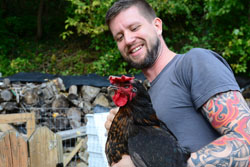
Boxed in the backyard of a stucco Northside home, 72 toes claw through straw and shredded compost. Nine clucking chickens are cooped up in chicken-wire-wrapped wood beams. Welcome to Chris Lamkin's world.

From hummus to nuts, Zaidan’s journey back to Findlay fueled by family

After a decade away from Cincinnati, Kate Zaidan has returned to reshape her family business, Dean’s Mediterranean in Findlay Market. She’s not just selling fresh-roasted nuts to other local businesses, she’s staking her claim on the family brand.

Environmental forum assesses ‘state of the city’

Green Cincinnati. It’s ubiquitous these days, with our civic progress appearing both in national headlines and at eye-level, in the bike-shares and local markets that seem to spring up almost daily. If you’re struggling to keep up with all this change—in a good way, of course!—or if you just have two cents to share, head to Northside Tavern at 6 p.m., Oct. 10 for the free, public “State of the City” environmental forum. The forum, organized by Cincinnati Green Group, hopes to recreate the success of last year’s event, which saw over a dozen city council candidates fielding questions—on everything from curbside recycling to fracking—from more than 150 attendees. This year will feature WVXU’s Ann Thomson as facilitator, with speakers Mark Fisher from the Cincinnati Zoo and Neil Seldman from the DC-based Institute for Local Self-Reliance. Cincinnati council members will be on hand once again for Q&A. Larry Falkin, director of Cincinnati’s Office of Environmental Quality, will deliver the State of the City address. Falkin plans to highlight recent strides in the areas of energy, green building and waste management, as well as a number of transportation solutions—such as the forthcoming Zip Car auto-share program—making Cincinnati debuts in 2012. Falkin points to the Green Cincinnati Plan, an 80-point sustainability blueprint officially adopted by the city in 2007. “We wanted to use less energy, more renewable energy, and we had a series of strategies for how to get there,” he says. “In five years, city government has done energy efficiency retrofits on 70 city buildings and installed solar energy systems on 20 city buildings. We’ve created a nonprofit organization and gotten funding for them to do work in the private sector, and that organization, the Greater Cincinnati Energy Alliance, has completed energy retrofits on more than 1,000 homes.” As a city, Falkin says Cincinnati reduced its greenhouse gas emissions by 8.2 percent, surpassing the goal outlined in the 2007 plan. Falkin also plans to discuss Cincinnati’s energy aggregation program, which now provides 100 percent renewable energy for 60,000 residents and small businesses. Despite recent progress, there is still room for improvement, particularly in recycling and adoption of zero-waste strategies that other cities use. “There are communities around the nation and around the world that have made zero-waste pledges,” says Melissa English, Development Director for Ohio Citizen Action, an 80,000-member coalition that canvasses the state promoting environmental consciousness. “[These cities] pledge to send as little as possible of their waste streams to landfills or incinerators, and instead recover those materials—which is essentially money, it’s resources that we’re choosing to bury in the ground—and put that back to work in our economies.” The environmental group leader points to the Rumpke landfill as an example of how much waste the region still discards ineffectively. “We have the nation’s sixth-largest landfill in our county, in Colerain Township, and it’s not just the city of Cincinnati that’s filling it up,” English says. “Any sort of zero-waste strategy will be much more effective and farther-reaching if it is [adopted as] a regional strategy.” Find out more: • Post questions in advance of the event. • RSVP for the State of the City environmental forum. • Download the city’s sustainability plan. By Hannah Purnell

CoSign unveils winning sign concepts for Northside

If you want to be incrementally better, be competitive. If you want to be exponentially better, be cooperative. In announcing the 11 Northside businesses who have won its CoSign signage design contest, the Haile U.S. Bank Foundation is proving that point. Collaboration between businesses and artists, non-profits and city zoning departments, fabricators and museum administrators has succeeded in producing imaginative new signage for Northside’s eclectic streetscape.  After a lively competition between more than 20 Northside locales, the Foundation upped its original plan to fund 10 signs and chose 11 for the project. Business selected are: Casablanca Vintage Northside Surplus Northside International Airport Fabricate Tone House Music WordPlay/Urban Legend Institute Django Western Taco Off the Avenue Studios Northside Tavern Market Side Merchatile Wirelessplus The new signs, now being fabricated, will appear first in the American Sign Museum before their unveiling on the morning of Black Friday, Nov. 23, in Northside. Signs were chosen by a jury who judged the designs based on concept, construction and context.   In five, short months, the Haile Foundation has taken the idea of supporting new neighborhood signage from concept to creation. Initially proposed on a grander scale for three Cincinnati neighborhoods, the Haile Foundation scaled back to just one when ArtPlace rejected its grant proposal last spring. Funding the project on its own with $150,000, the Haile Foundation found itself in a new situation. “This was a collaborative idea from the start, and a huge learning experience,” says Eric Avner, vice president and senior program manager in community development for the Carol Ann and Ralph V Haile Jr. U.S. Bank Foundation (and lead Soapbox provacateur).  “We were funding a project AND designing it, which is not normal for us.” The plan – to pair Northside businesses with artists, who would design signs that conformed to City of Cincinnati signage regulations – required building close relationships with city zoning departments, educating artists and businesses through workshops on those regulations, and working with the American Sign Museum to provide expertise and exhibit space for the signs before their installations on the street.   With its success, says Avner, “Haile plans to share this collaborative idea with granting agencies, other Cincinnati neighborhoods and other cities around the country.” Find out more: • Visit: the American Sign Museum now open at 1330 Monmouth Street for a sneak peek at the CoSign signage before it is installed in Northside. • Mark Your Calendar: For Nov. 23, Black Friday, when Northside will unveil its new signs at a “shop local” event for the start of the holiday season. • Watch for: Queen City Projects video documentation of the project, so that others may learn from and replicate this collaboration in different neighborhoods and cities. By Becky Johnson

FotoFocus featured in New York Times

FotoFocus, Cincinnati's month-long celebration of photography, gets a shout-out in The New York Times fall arts preview. Read the excerpt here.

Tacocracy opens for lunch, builds on Northside connections

Part taco shop, part neighborhood reunion, Tacocracy opened in Northside in August and has already created its own popular niche in the community's lively local food scene. Located in the new Northside International Airport and the former Jacob's nightclub space, Tacocracy sits in the center of the action, serving up airport-themed items, like a range of "taco flights" that include as few as two and as many as seven of the spot's primary menu items. Duck tacos, Korean beef tacos, "schmashed tater" tacos and chips baked with sea salt and lime juice round out the simple, tasty menu developed by owner Kevin "Pogo" Curtis. The Middletown native has called Northside home for the past six years, and has worked at nearly every restaurant in the neighborhood: Melt and The Comet as well as former venues The Hideaway, Northslice and Portofino.  "I'm always looking for how to make it better," he says of his dishes.  Curtis says that with his first foray as a restaurant owner, attention to detail is everything. He's proud of the duck taco—"It's so rich, it's like meat candy"—and looks forward to adding his soups to the menu.  But his investment doesn't stop there. He and friends worked for a year to transform the space into Tacocracy, a name he landed upon as he considered creating independent taco shop with no intention of being authentically Mexican.  They turned a hallway into a dish room and decorated creatively for a very DIY, Northside feel, he says. For example, the strings of LPs hanging in the patio were part of a "tacos for vinyl" exchange, explains Northside International Airport "queen mother," Aileen McGrath. Curtis, whose artwork hangs throughout NIA, has been overwhelmed by the positive response so far, and a friendly partnership with nearby Listing Loon has made life without a liquor license a lot easier. Tacocracy opens for lunch starting this week, and Curtis hopes to add late night hours during the weekends in the future.  "I love the hood," he says, "and I want to see if it can be even more awesome." By Elissa Yancey Follow Elissa on Twitter

Blinkies raise awareness, safety for cyclists

Cyclists in the Queen City don't want any more "ghost rides," to commemorate fallen peers like Ronald Richardson, who died after being hit by a Metro bus. So as they ride tonight to honor him, supporters will also launch a new version of a proactive program they hope will raise awareness of the importance of sharing our roadways. Queen City Blinkies, an initiative to provide free front and rear bicycle lights to riders, revives an effort started in 2008 by 7 Hills Racing. In its new incarnation, QC Blinkies, supported by Queen City Bike and the local cycling community, serves as a way to express the importance of safe riding, and safe driving, especially in the wake of recent deaths. "This has been a really trying time for bicyclists in Cincinnati," says Nern Ostendorf, executive director of Queen City Bike. "The urgency for safer roads has never been more apparent. Bicyclists across the city are grieving, organizing and supporting one another." Adding lights, often more than one or two, is one way cyclists can make their presence known on city streets. But no matter how conspicuous the rider, a sense of conflict remains. (Just read the comments section of any story about cyclists and drivers and you will see it.) She notes that while Queen City Blinkies and other educational efforts, such as billboards, are important, the bigger issue involves how we, as a community, want to live. "Right now, most of our streets are designed to move cars across the city as fast as possible, with the greatest volume possible," Ostendorf says. "Of course that will create problems between cars and cyclists." That speed-focused design, she contends, does little to increase quality of life for any citizen. "I want my city, my neighborhood, and my street to be a place to visit and enjoy rather than somewhere to move through, and I believe that most people, cyclists or not, want those things for their communities, too," she says. One simple, though challenging, answer is to lower speed limits—as with pedestrian accidents, high-speed collisions with cyclists tend to be more serious and more often fatal. And it turns out that slowing down may help more than cyclists. A pilot project study in Philadelphia showed that lowering speed limits not only made streets safer for motorists and cyclists to co-exist, it lowered the rate of car accidents overall. "We need to be creative and experimental even in how we understand and move traffic," Ostendorf says. She advises neighborhood groups to take action on their own, to request lower speed limits and speed bumps when necessary to make streets and sidewalks safer for all residents, whether they are 8 or 80. Do Good: • Support Queen City Blinkies by donating to buy lights. • Obey the law. Driving a car? Remember, it is illegal for cyclists to be on the sidewalk, so give them time and space as they share the road. Cycling? Remember, if you coast through a red light, you're reinforcing the kind of stereotypes that can hurt your riding peers. • Enjoy good food and conversation at the Hyde Park Farmers Market Bikegarten. By Elissa Yancey Follow Elissa on Twitter

Our Partners

Taft Museum of Art
Warsaw Federal

Don't miss out!

Everything Cincinnati, in your inbox every week.

Close the CTA

Already a subscriber? Enter your email to hide this popup in the future.