North College Hill

In 1905, sawmill owner John Meyer used surplus lumber to build a subdivision of small homes north of Galbraith Road and west of Hamilton Avenue and called it Meyerville. Within the next 10 years, two other groups of homes were started and the three subdivisions were incorporated as the village of North College Hill in 1916. The village's affordable housing attracted a growing population, and 21st century North College Hill has matured into a diverse community. It is home to the Clovernook Center for the Blind and Visually Impaired, a center that provides education and employment to people with blindness or low vision, as well as Clovernook Country Club, one of the region's finest golf courses.  

Honoring veterans year-round at Arlington

On the day Sue Slusher married her husband, he was drafted.     “He left 16 days later—he had orders for Vietnam, and they were changed at the last minute, so he went to Germany for a year,” Slusher says. “I did join him there, so I feel pretty much like I was drafted. That was 1966, and if you walked and talked, you were drafted.”   Slusher, who serves as a family service advisor at Arlington Memorial Gardens, has a personal connection with many who have served in the Armed Forces. It's a connection that she builds upon at Arlington with the various offerings and opportunities for veterans.   One of those offerings is a seminar that helps veterans learn about and sign up for the Aid and Attendance Pension, which entitles them and their spouses to receive income to cover things like nursing or private home care when they reach the age of 65.   “Very few people know about this benefit,” Slusher says. “And to find out that there’s something out there—that’s most seniors’ big worry. What will happen? How will I pay for this? It can keep them from going on Medicaid, and it’s just a great service to them.”   In addition to helping vets sign up for their pensions, Arlington also hosts Memorial Day and Veterans Day activities, where the organization brings in the Cincinnati VA Medical Center Mobile Unit to provide easier access to benefits and preventive care.   “I had one man a year ago that’s been trying for 16 years to get signed up for his benefits—somehow he could never get signed up,” Slusher says. “He walked in, walked out, and was so happy.”   Sometimes it’s the simple things, like giving veterans the opportunity to open up and share their stories with one another, that leave lasting impacts.   “A lot of the veterans can’t talk about the war for a long, long time,” Slusher says. “So we do other programs where a veteran can tell their story, and we have a historian who will come to our seminars and she writes novels, biographies and does videographies about their lives.”   Slusher says the organization is proactive in helping veterans because they’ve helped us ove the years; it’s just the right thing to do.   “Honoring their service—that’s what we’re here for,” Slusher says.  Do Good:  • Keep up with upcoming events and activities at Arlington.  • Like Arlington's Facebook page, and follow the organization on Twitter. • Attend the next Second Sunday Concert Series on July 14. By Brittany York Brittany York is a professor of English composition at the University of Cincinnati and a teacher at the Regional Institute of Torah and Secular Studies. She also edits the For Good section of SoapboxMedia.   
Clovernook campers explore community, depth of art

For children at the Clovernook Center for the Blind and Visually Impaired, Discovery Youth Summer Day Camps allow them to further their own skills and knowledge while also bettering the community.  From technology and art activities to life skills and neighborhood involvement, campers can engage their senses while tapping into areas that they might not have otherwise had the opportunity to explore.  Participants at art camp, which ended this past week, have no vision, limited vision or are losing their vision. They created pieces that sparked dialogue about what it means to be part of a larger community. One project involved the campers creating wind chimes made of cat and dog clay cutouts. The kids then donated them to the SPCA of Cincinnati to sell.  “They enjoyed it, but it was very sad,” Art Instructor Scott Wallace says of the children’s visit to the SPCA. “It gave me an opportunity to go into this whole thing about art in terms of how some of the greatest art is not the world’s prettiest, and some art talks about issues and things that are going on and some things that are not great, so it gave us the chance to talk about what’s important.”  Campers also worked together to create a colorful heart made from recycled bottle caps—which can be dangerous if left as trash—as a statement about healthy communities.  “What’s happening is—wild birds are eating them—and they can’t digest them,” Wallace says. “So it’s killing them. It’s so much about recycling. You can take the most insignificant material and make great art.”  Two of the children who worked to create the bottle piece project are totally blind, but by working together with other campers, they were able to create a beautiful display. It's what Wallace enjoys the most because he’s not so much an instructor as he is a facilitator.  “For people who have never had vision—their approach is totally different—because they have a certain way of working and a certain level of expectation for their work, and they’re completely cool with it,” Wallace says. “The blind community and the people who’ve never had vision are fine. I think they get tired of us trying to instill our beliefs, but what I like to do is make the best of the vision they have left. And I just sit back and let them do their thing, but it really shows what community can do.”  Do Good:  • Like the Clovernook Center on Facebook, and keep an eye out for photos of campers' art work. • Support the Clovernook Center by donating. • Get invovled by volunteering. By Brittany York Brittany York is a professor of English composition at the University of Cincinnati and a teacher at the Regional Institute of Torah and Secular Studies. She also edits the For Good section of SoapboxMedia. 
Hillenbrand creates illustrating, publishing opportunities for children

When Will Hillenbrand was growing up in College Hill, he spent a lot of time reading picture books at the library, which would make him late for his baseball games at next-door Crawford Field. “You may wonder, ‘How do we encounter art in our lives?’" Hillenbrand says. "And actually, it’s all around us. We might not realize it; however, the art that engaged me was through storytelling.”  The library was critical in Hillenbrand’s journey as an illustrator and writer, but his journey actually started at his father's barber shop, where he spent time listening to “big fish stories." “One way I’d kind of disappear in the background easily would be during the summer because my mom would make my dad a hot lunch, and I’d walk it up to the barber shop,” Hillenbrand says. “I’d walk the lunch up there and put it in the hall closet and then sit under the air conditioner and try to become part of the wallpaper.”  Hillenbrand says he remembers one of the other barbers talking to a customer about his other job, which was cutting down trees, and how it was similar to cutting hair.  “So if I were hearing something in that little synopsis, I might end up going home and drawing a person with a forest on their head and a barber cutting it, but it’s comical,” Hillenbrand says.  As a child, Hillenbrand had the exposure and opportunity to not only fall in love with his craft, but also to practice it. And it’s this same opportunity that he’s now offering to other children.  From now until the end of August, children have the chance to submit artwork that depicts their heroes for consideration in Hillenbrand’s e-book, which is entitled Everyday Heroes: Local Children and the People Who Inspire Them. “What we’re interested in are characters that fall and get up and show us how they manage their challenges and struggles,” Hillenbrand says. “And we cheer for them and want them to do it, and for children, we want to be able to give them opportunities to share.”  Hillenbrand has hosted two workshops at the Public Library of Cincinnati and Hamilton County thus far, and children have been able to not only brainstorm, but also to dabble in digital media. “There was a bridge that the children and I kind of walked back and forth across—it wasn’t a podium—it’s not that kind of thing,” Hillenbrand says. “And the library’s a great context because around the walls, you’ve got idea people—ideas that might be a first story—and when they participate, their ideas are validated, and they can feel like, ‘I’m an idea person, too,’ and isn’t that a good feeling?”  Do Good:  • Check out Hillenbrand's library workshop about digital drawing on YouTube. • Children ages 12 and under are encouraged to submit their artwork to the library for consideration in Hillenbrand's e-book. • Learn about the variety of ways you can support the library.  By Brittany York Brittany York is a professor of English composition at the University of Cincinnati and a teacher at the Regional Institute of Torah and Secular Studies. She also edits the For Good section of SoapboxMedia.   

CincyMusic Spotlight hits airwaves

The show’s format provides a much-needed outlet for local musicians.

Metro blazes new trails with green efforts

Metro has been "going green" for more than 25 years, but partnerships with progressive organizations have helped it broaden sustainability efforts.

City Council adopts form-base code

For five years, Vice Mayor Roxanne Qualls has been working with the City of Cincinnati to develop form-based code for the city. Last Wednesday, City Council officially approved the Cincinnati Form-Based Code.   “Cincinnati now joins hundreds of cities that are using form-based code to build and reinforce walkable places that create value and preserve character,” Qualls says.   Cincinnati’s neighborhoods originally developed so residents could easily walk to restaurants, shops and grocery stores in and around business districts. Form-based code will allow neighborhoods to return to that original ideal and reinforce or create places where residents can live, work and play, Qualls says.   Current zoning code makes creating mixed-use neighborhoods difficult—the new code will help streamline the development process. To start, form-based code will be applied to business districts and adjacent residential areas in four pilot neighborhoods that volunteered for the chance—College Hill, Madisonville, Walnut Hills and Westwood.   The code is a result of six Neighborhood Summit training sessions; five years of neighborhood working group meetings, neighborhood walks and training sessions; five delegations to learn about Nashville’s form-based code; a five-day citywide urban design workshop; a four-day neighborhood urban design workshop; and more than 600 public comments on the draft from residents, stakeholders, neighborhood groups and city departments.   By Caitlin Koenig Follow Caitlin on Twitter

Library garners national attention, celebrates with Amnesty Day

The Public Library of Cincinnati and Hamilton County is one of 10 recipients out of 140,000 libraries and museums across the country to receive this year’s National Medal for Museum and Library Service.  The award recognizes outstanding service to communities. So, in appreciation of library users and as a way to celebrate, the PLCHC will offer a Fine Amnesty Day May 15.  “We really wanted something to express our appreciation to the community, and we started thinking about what is it that people hate most about the libraries—we all know that—the fines,” says Kim Fender, Eva Jane Romaine Coombe director. “I’ve been here 25 years, and we haven’t done this in my time here at all, but our hope is that people who have not used the library because of their fines come in and have those fines removed and come back to the library and get their cards started up again.”  Fender says the library most likely wouldn’t have received the award without the support of the community, because the library’s heavy usage was one reason the Institute of Museum and Library Services was so impressed.  With more than 17.6 million items borrowed in 2011, the PLCHC is considered the eighth-busiest library in the nation, and its commitment to providing academic assistance and encouragement to both children and adults is evident through the variety of programs it offers and successfully implements through its partnerships with other community-based organizations.  Last summer, for example, the library partnered with Cincinnati Public Schools and the Freestore Foodbank to serve about 7,000 meals to children.  “That’s something people don’t normally think of libraries doing,” Fender says. “But when they were in there eating, they could sign up for summer reading or programs.”  Fender says the library staff also goes out of its way to make sure children are learning by actually attending school.  “If we see kids in the building during school hours and we think they might be truant, we check up and say, ‘What school do you go to?’ and look at the school calendar, and we call someone from the school to let them know because they have to be in school to learn,” Fender says.  Fender will travel to Washington, D.C. with Amina Tuki, a local resident who came to Cincinnati from a small village in Ethiopia who was not fluent in her native language, but who learned English by picking up a small book called Coming to America at the PLCHC.   “She says it took her all day, but she made her way through it, and she took it home and read it to her husband and children, and her older son started crying,” Fender says.  Fender and Tuki will accept the award May 8. Library users can celebrate Amnesty Day May 15 by taking their library card to any local branch.  Do Good:  • Go to your local branch and have fines removed May 15 so that you can begin to use the library's resources.  • Sign up for a library card if you don't already have one. • Support the library. By Brittany York Brittany York is a professor of English composition at the University of Cincinnati and a teacher at the Regional Institute of Torah and Secular Studies. She also edits the For Good section of SoapboxMedia. 
Being the Somebody at Lighthouse Youth Services

There are more than 850 children in Hamilton County who are currently placed in out-of-home care, according to Jami Clarke, program director of Lighthouse Youth Services' foster care division. That means there is an ever-growing need for foster parents within our community. To raise awareness about the need for foster parents, and to celebrate National Foster Care Month and the local successes LYS has seen during the past year, the nonprofit will host its second-annual Be The Somebody March May 11.  “On a daily basis, we’re getting calls for sibling sets of two and three children at a time who are being displaced from their homes and who are in need of temporary care for six months to four years,” Clarke says. “And we’re trying to match them so it’s possible within their same school district—within the same community—so they can continue to have visitation with their family members, and we can work toward reunification.”  Clarke says the separation of siblings is often even more traumatic for children than being separated from their parents, so it’s especially important that the organization find foster parents who are willing to take on the responsibility of not just one child, but two, three and sometimes four or five children at a time.  Tasha Boyd, 33, is a North College Hill resident, who is one of those more-than-willing foster parents. She has been with LYS since 2007, and has been a foster parent for about eight years.  Boyd, who initially thought about running a daycare because she says dealing with kids is her "specialty," started to look into foster care instead. She says she understands that there are many children in our community “who need love.” “A lot of homes are broken, and there are a lot of homes out there that can help,” Boyd says. “We need foster parents out here. It’s a hard thing to do, but at the same time, you’re rewarded every day—it’s a blessing.”  Boyd, who has a soon-to-be 14-year-old son of her own, says she loves what she does and that her son has “no problem sharing his mother” with the 10 children she has brought into their home over the past five years.  She currently has a sibling set of two girls in her home, and for the first time in her life, Boyd will transition from foster care to adoption. The mother of the two girls has decided to release her rights because she can no longer care for them due to mental health issues.  “The two have been in the house since they were nine months old and three days old," Boyd says. "I’m all they know. I was not going to turn my back on them.”   Do Good:  • Sign up for the Be The Somebody March and picnic lunch.  • Learn more about becoming a foster parent. • If foster parenting is not for you, but you would like to help, consider becoming a mentor. Contact Jami Clarke for more information. By Brittany York Brittany York is a professor of English composition at the University of Cincinnati and a teacher at the Regional Institute of Torah and Secular Studies. She also edits the For Good section of SoapboxMedia. 

Cincinnati Montessori Society celebrates 50 years

Fifty years ago, a group of parents who were passionate about Maria Montessori’s philosophy of education developed the first Montessori preschool in the area.  And following the preschool’s inauguration, the group formed the Cincinnati Montessori Society, a nonprofit whose focus is to promote Montessori education while serving as a resource to countless schools, teachers, parents and students in the community. “One of my favorite quotes is, ‘Follow the child,’” says Heather Gerker, vice president of CMS. “We meet the child where they are developmentally.”  Montessori classrooms, which are both child-centered and composed of mixed age groups, are set up so that children can learn through a multisensory approach that allows them to figure things out at their own speed—and the philosophy works, Gerker says.  At CMS’s Annual Spring Conference and celebration of 50 years of success, neuroscientist Dee Coulter delivered the keynote address.  “This work that Maria Montessori did over 100 years ago is now being proven through neurological work happening now,” Gerker says. “[Coulter’s address] was really affirming and validating to the teachers there.”  Not only were teachers excited to go back to work on Monday after hearing Coulter’s presentation, Gerker says, but they also had the opportunity to participate in breakout sessions that were aimed at providing strategies and insight that lead to better education. Topics ranged from promoting mindfulness through music to strategizing ways of better assisting children with ADD and autism.  Gerker says she’s particularly passionate about the resources that CMS provides because they’re based on a philosophy that’s now scientifically proven, and she’s seen it work in the lives of her own children.  “It gives them a solid sense of self, that they’re so independent and happy, which I think is the ultimate goal,” Gerker says. “I just want to make sure it’s available to all children.”  Do Good:  • Become a member of CMS. • Check out the resources offered by CMS. • Connect with CMS on Facebook. By Brittany York Brittany York is a professor of English composition at the University of Cincinnati and a teacher at the Regional Institute of Torah and Secular Studies. She also edits the For Good section of SoapboxMedia. 

Everybody Rides Metro Foundation ensures available transportation to all

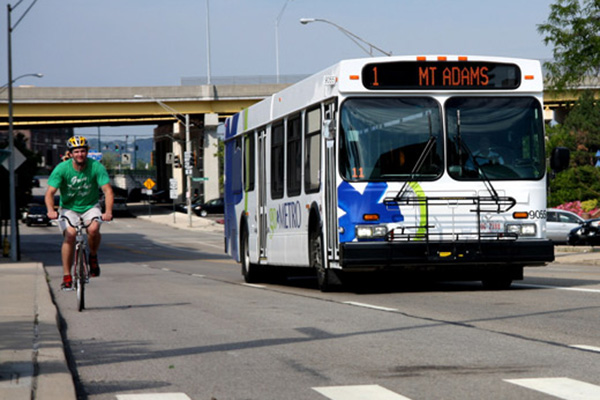
The Everybody Rides Metro Foundation, which is the first program of its kind, provides affordable transportation to about 30,000 low-income individuals each year.  Metro subsidizes rides at $1 and has partnered with about 70 different social service agencies to cover the remaining 75 cents of fares for riders in need of medical or work-related transportation.  “Many of our riders feel like this is the only way they can try and succeed—it’s somebody giving them a lift when they need it the most,” says Joe Curry, executive director of ERM. “The greatest outcome of this is that you’re getting people toward self-sufficiency. It’s something that stays with them forever—it helps them out until they earn money and start budgeting once they have a job; and self esteem is a large part of that overall package.”  According to Curry, many of ERM’s riders are paroled into the Talbert House and have anywhere from $0 to $20 to their name after coming out of prison. Once they’ve been rehabilitated and have participated in job counseling, they may need to interview at up to 20 different businesses before they find work.  “Once they land a job, the worst thing that can happen is not to show up during the first week of employment, so we give them additional money, if needed, to subsidize their rides during the first few weeks,” Curry says. “It’s to help them out temporarily so they can establish a budget—it’s not a lifetime pass.”  In addition to helping riders get to job interviews and places of employment, ERM provides rides to medical-related destinations so individuals can receive preventive care.  “Society of St. Vincent De Paul runs a free pharmacy on Bank Street in the West End, and if you can’t afford your meds, they’ll give you a 30-day supply for free so long as it’s not a narcotic, but you have to get to the location,” Curry says. “If you’re diabetic or are undergoing cancer treatment, meds are absolutely essential, but if you can’t get to a place where you can get your meds, you may get sicker. You may be one of those people who take that $1,500 ambulance ride, and that’s one of the things we’re trying to prevent.”  Beginning in January 2014, 40,000 more individuals in the Cincinnati area will be eligible for Medicaid, and according to Curry, anywhere from 50 to 70 percent of those people will need public transportation to get to a healthcare provider or pharmacy. “Those are the people we’re worried about," Curry says. "If public transit isn’t available to them because of the cost, how are they going to get treated? More than 30 percent of our population lives in federally defined poverty—that tells you we really need to do something and think outside the box about how to solve some of these public transit issues.” Do Good:  • Donate to the Everybody Rides Metro Foundation. • Like Cincinnati Metro on Facebook.  • Follow the Cincinnati Metro on Twitter. By Brittany York Brittany York is a professor of English composition at the University of Cincinnati and a teacher at the Regional Institute of Torah and Secular Studies. She also edits the For Good section of SoapboxMedia. 
Our Partners

Taft Museum of Art
Warsaw Federal

We want to know what's on your mind.

Close the CTA

Don't miss out!

Everything Cincinnati, in your inbox every week.

Close the CTA

Already a subscriber? Enter your email to hide this popup in the future.