
Old kids on the block: Calhoun cornerstones offer alternatives
As U Square at the Loop looms large, long-standing Calhoun Street businesses in Clifton hope for a long-awaited resurgence.
Often lumped in with Clifton, Corryville has its own special mix of residential and retail built along a business district that runs the length of Short Vine. Home to music fan favorites like Bogart's live concert hall and Mike's Music's collection of vintage guitars; the Public Library's branch in the handsomely renovated Carnegie building; and UC's Niehoff Urban Studio headquartered in a turn-of-the-century dance hall across the street.
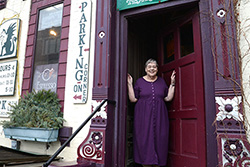
As U Square at the Loop looms large, long-standing Calhoun Street businesses in Clifton hope for a long-awaited resurgence.

Utilizing the Public Library of Cincinnati and Hamilton County’s resources just got easier. At the beginning of February, the library released its latest service: Zinio. It enables anyone with a library card to download free magazines as soon as they hit the newsstands. “It’s really wonderful to be able to download magazines from the comfort of home,” says Sandy Bolek, Internet site coordinator for PLCHC. “We’re trying to meet the changing interests and needs of our customers, and there’s a tremendous interest in downloading everything out there.” With more than 650 titles, users will now be able to download as many magazines at a time as they wish. Plus they never have to return them. “I think there will be people who download maybe 20 magazines at a time, because how often can you walk into a library and have every single issue available for the taking that you can hang on to?” Bolek says. “So I expect that our interest and usage in magazines will go up significantly.” In the past month alone, PLCHC users have downloaded 16,396 magazines through the new service. Magazines aren’t the only downloadable materials the library offers, however. Free e-books, audio books and even music are all available to patrons as well. “You’re able to sit at home in your jammies at 11 at night and download music, e-books, an audio book or a magazine,” Bolek says. “We talk about being able to use the library any time, anywhere now, and I think people are increasingly expecting that in just about every service area.” According to Bolek, the library is on track to reach one million downloaded items by October, which is a huge accomplishment in terms of achieving its mission of “connecting people with the world of ideas and information.” “The nature of information has of course changed over the years and the decades," Bolek says. "Our collection has significantly expanded, but it’s still information. We’re supporting people’s reading interests, connecting them with books, connecting them with information, and the variety of ways we’ve been able to do that has really expanded.” Do Good: • Learn about Zinio, download the app for your smartphone or tablet and show your friends and family how to start downloading free magazines. • Sign up for a free library card so you can take advantage of the many resources the library has to offer. • Promote literacy by joining a book club, reading to children or taking them to library events. By Brittany York Brittany York is a professor of English composition at the University of Cincinnati and a teacher at the Regional Institute of Torah and Secular Studies. She also edits the For Good section of SoapboxMedia.

Cincinnatian Tyler Witte, 25, drives his car hard. UC Electronic Media alum Doug Horton captures Witte's passion on film. Video courtesy Doug Horton.
Students from the University of Cincinnati and the Indian Institute of Technology developed Humble Commode, a sustainable sanitation solution that won gold in a national business challenge competition. Read the full story here.
Jean-François Flechet opened Taste of Belgium in Findlay Market in 2007; four years ago, he expanded his restaurant venture to Columbus’s North Market, and a year and a half ago, he opened a full-service Belgian bistro on Vine. In the next few months, there will be two new Taste of Belgiums in the Cincinnati area—a full-service restaurant on Short Vine near UC, and a waffle counter at Friendly Market in Northern Kentucky. The Short Vine location is on the first floor of a brand new building that includes 120 apartments. The waffle counter at Friendly Market is the only food vendor in the first phase of the market. It’s right on the edge of phase 2, which is ideal for future expansion, Flechet says. Taste of Belgium on Short Vine will have a menu very similar to the one on Vine Street, says Flechet. But it will have more affordable options at dinnertime, such as chicken and waffles and bar food. “There will be a bigger focus on the bar, with both Belgian and Belgian-style beer sourced from local breweries,” he says. Flechet wants to attract the college students who live around Short Vine, which is a different demographic than his customers at the bistro and Findlay Market. Taste of Belgium is slated to open in early May at Friendly Market, and on Short Vine during the first week of July. Flechet isn’t going the traditional route for financing his new business ventures. Instead, he’s working with local crowd-sourcing start-up SoMoLend to raise a portion of the funds for the restaurant. He wants to promote crowd-sourced funding as a viable alternative source of financing for small businesses. “When I opened Taste of Belgium on Vine, it was hard to get financing,” says Flechet. He wasn’t able to obtain a loan from the bank, but the building’s landlord got one through 3CDC. In turn, the landlord charges high rent to recover the loan. The North Market location was financed by a loan from a small business lender who Flechet has been working with for four years. SoMoLend connects small business owners who are in need of a loan with investors who are looking to make a return on their investments. The organization allows borrowers to get loans from customers, friends and family members. It allows lenders to make a difference on a more local level. “SoMoLend has been promoted on a national level, but not much on a local level,” Flechet says. He’s trying to get the word out to his customers that he’s using SoMoLend and bring more users to the lending service. The Taste of Belgium crowd-sourcing campaign launches March 11. If you want to contribute to the campaign and are a customer, friend or family member, sign up on SoMoLend’s website. By Caitlin Koenig Follow Caitlin on Twitter
The City of Cincinnati has taken out the back-and-forth that can occur when residents try to reach them to report issues in their neighborhoods. At the Neighborhood Summit on Feb. 16, Vice Mayor Roxanne Qualls announced that the Cincinnati City Hall mobile app is available to the public. With the app, residents can look up trash, recycling and street sweeping days, and set reminders; locate and report problems by address; bookmark locations for quick reporting; and track the status of reports. City Hall mobile also has GPS, so users can report issues, even without an address. There’s even a searchable map with property owner information, which enables residents to see if a property is occupied or vacant. A few years ago, residents had to use the Yellow Pages to look up the number for city departments to file complaints, says Kevin Wright, executive director of Walnut Hills Redevelopment Foundation. The city then implemented a hotline for all complaints, but residents never knew the status of their reports. “It’s amazing how comprehensive the app is,” Wright says. “If you see a broken window, pothole, graffiti, hanging gutter or anything else that is physically wrong with your neighborhood, street or community, you can report it in an instant. It’s a great tool for neighborhood redevelopment.” The app can also be used as a community-organizing tool, Wright says. For example, if there is a property owner who historically hasn’t taken care of his or her property, social media can help organize a community and target the property to enforce codes until the property is fixed, which is what neighborhood councils and organizations like WHRF do. “We’re really putting power in the hands of the citizens of the neighborhoods,” he says. As with most tech programs, the app has room to grow, too. In the future, it could be linked with Facebook or Twitter, so your friends and followers will know who reported problems and where they are. Cincinnati residents can download the app in the Apple App Store or download it through Google Play. By Caitlin Koenig Follow Caitlin on Twitter
Going on maternity leave changed Gail Yisreal’s life in more ways than having a new baby to take care of. When she returned to work, Yisreal says she learned her position was no longer there, so she began to look for a different job. As wife and mother to a blended family of nine children, she might bake up to 11 birthday cakes in a year. But she hadn’t considered turning her knack for kneading dough into earning dough until she baked a wedding cake for a couple from her family’s place of worship. Not only did they like the cake, they suggested she start selling them. Listening to her fans, Yisreal founded A “Mother’s Touch” Cakes with the nurturing tagline, “Making fresh homemade cakes when you don’t have the time.” Celebrating her two-year anniversary as a registered business in August 2012, A “Mother’s Touch” features signature and custom made flavors of fresh, savory gourmet, organic and vegan cakes and cupcakes that are good—and good for you. “I didn’t know anything about decorating, so I took a class to learn more decorating skills," Yisreal says. "And I was shocked to find out that 95 percent of the cakes you buy are box cakes—because everybody wants the decoration. I started doing some research about the trans-fats and artificial ingredients, and I vowed that everything I baked would always be natural and from scratch.” After working as a waitress for two years and in management at Starbucks for six years, Yisreal developed a love for coffee. She jokes that most ex-Starbucks managers feel they know enough about coffee to create their own line, which she actually did for A “Mother’s Touch.” Having tried organic coffees with weak flavor profiles, she researched and found Dean’s Beans, a fair-trade pioneer that allowed her to design her own custom blends. Her signature A “Mother’s Touch” blend is made with Mexican and Indonesian beans and pairs with her carrot cake as an after-dinner coffee. “I’m really proud of my coffee and the fact that it really was custom blended for what I wanted to complement my desserts,” Yisreal says. And, true to her mission to serve natural, sustainable goods, she says that her blends are 100 percent organic, fair-trade certified and are shade grown. Being on the scene without a storefront hasn’t stopped Yisreal. Instead, she’s building her brand as the “cupcake lady” who networks everywhere and invites people to taste samples of her creations. Yisreal also tapped into hidden markets by hosting deals through social media. “I did a Living Social promotion last year, which was huge,” Yisreal says. “That first day, I think I got 1,500 hits on my website, and probably about 85 deals, which I thought was really good for people who didn’t know who I was.” And even though she sells more cakes today, the ease of transporting cupcakes built her clientele. “When I first came out, because of my financial situation, literally, cupcakes were paying my rent,” she says. After she and her husband separated, she remembers what it was like to go from making an annual salary of $60,000 to less than $20,000 a year. But she doesn’t do it all alone. “I have three almost-teenage girls; 12, soon to be 15 and 17, so they are my preppers,” Yisreal explains. “It’s hilarious because we’ll be in the kitchen and everybody has their big bonnets on, and they’re scraping carrots, mashing fruit, lining the liners. I have a girlfriend who I’ll sometimes sub-contract out to do deliveries. And if it’s a huge event—like for the Autism Foundation, I had to knock out 40 dozen cupcakes—I have two sisters, and at the time I had just split up with my husband so we were in literally an 800-square-foot apartment. The kitchen was all of maybe 150-square-feet, we put out six-foot tables and we were like an assembly line! It was hilarious, but we got it done. It was like an I Love Lucy episode!” By Mildred Fallen
The European notion of car sharing has found broad appeal around the world because of its environmental and economic sustainability. In December, the City of Cincinnati brought Zipcar to downtown to make commuting easier. Metro and Zipcar then formed a partnership. It's an ideal selling point because using one or both of the transportation services is environmentally conscious, saves money and gives people the freedom to get up and go. It’s a win-win for Metro and Zipcar. Zipcar, a business with a mission to create a future where car-sharing members outnumber car owners, offers a self-service alternative to car rental. Intended for the technologically savvy commuter, Zipcar members log in online or through the mobile app, see where vehicles are located, choose one and unlock the car by holding their Zipcard against the windshield. Its successful rollout on the University of Cincinnati’s campus last year prompted Larry Falkin, director of the City’s Office of Environmental Quality, to bring the program to Over-the-Rhine and downtown. Kim Lahman, Metro’s ridership development manager, says that using both Metro and Zipcars eliminates excuses that not owning a car limits commuters’ ability to travel when and where they need to. “We thought this was a great opportunity to say, ‘If you ride the Metro downtown and don’t have to worry about parking or the hassle of traffic, and you need a car to use during the day, all you would need to do is take a Zipcar,’” Lahman says. “You would have it out for an hour or a couple of hours, and then take it back to the lot and go back to your office. How convenient would that be?” Walking from your downtown apartment or office to somewhere close by, like Garfield Place, would be very convenient for many urban dwellers. According to Falkin, 20 percent of Cincinnati households do not own a car, or own less than one car per licensed driver. “More and more of us are choosing a sustainable lifestyle, in which we walk or bike first, use transit as the second choice and drive as a last resort,” Falkin explains. “Using Metro and Zipcar, a person can go anywhere, anytime, without being burdened by car ownership.” “It can also save money,” says Jill Dunne, Metro public affairs manager. “If you’re riding Metro, you’re saving money, versus the gas and the parking expenses you would pay if you had your own car. And then if you’re able to give up that car payment and you pay per trip the fee for a Zipcar, that could really save you a lot.” The partnership also means that Metro riders get a special incentive to register and become “Zipsters.” Besides already saving money on gas and parking, Metro riders can expect to see interior advertisement cards in February from Zipcar with a discount code redeemable for up to $60 worth of free Zipcar rental. Zipcars are parked next to blue signs that say “City of Cincinnati Car Share Parking Spots.” Current locations are: NW corner of 12th and Vine (on the north side of 12th Street)Court Street between Walnut and Vine (angled parking spaces)NW corner of Garfield and Race (on the north side of Garfield Place)To join or for more information, visit Zipcar's website. By Mildred Fallen
This holiday season, I started believing in Santa...Dr. Santa Ono, the new president of the University of Cincinnati. In just a little more than four months as president at UC, Ono has captured the attention of an entire city. Read the full story here.
In 1995, a small group of retired business executives came together with the intent of giving back to their community by investing their time and talents in work that would assist nonprofits. Now, nearly 18 years later, Executive Service Corps of Cincinnati is the recipient of an $85,000 award that will help more than 130 volunteers provide low-cost, high-quality strategic thinking, planning, training and coaching to other nonprofits in need. The recent funding will help the ESCC implement its Community Benefit Business Model, which, according to Andy McCreanor, executive director and CEO of the organization, is a model that has essentially always existed within the nonprofit, but has now been refined and strengthened. The model helps nonprofits maximize results so that they may receive additional funding to better fulfill their missions, which ultimately works to improve the communities they serve. “It enables investors to get more out of the nonprofits that they’re investing in, and secondly, it helps the nonprofits because we’re affordable," says McCreanor. "We’re merely a vehicle so that the community gets the benefit that they’re trying to get." The ESCC has worked on long-term projects with more than 500 nonprofits in Cincinnati, Northern Kentucky and Southeast Indiana since 1995, including most recently the Jewish Federation of Cincinnati. ESCC also offers a 10-month program at its Nonprofit Leadership Institute each year; and at its culmination in June, more than 100 nonprofit leaders from Cincinnati will have graduated. McCreanor says that because of the recent economic downturn, nonprofits have suffered and organizations are reevaluating and assessing their goals and missions. “We’re here to help,” he says. “If you’re struggling out there, it really doesn’t cost anything to talk about what you’re dealing with, and if in fact there is a way for us to help, it’s going to be done at a very low cost, so it’s kind of the best of all worlds.” Do Good: • Sign up to attend classes at the Nonprofit Leadership Institute. • Volunteer your business skills and experience to serve other nonprofits. • Reach out to the ESCC if you are a nonprofit that could benefit from its services. By Brittany York Brittany York is a professor of English composition at the University of Cincinnati and a teacher at the Regional Institute of Torah and Secular Studies. She also edits the For Good section of SoapboxMedia.
Our Partners









We want to know what's on your mind.

