Columbia Tusculum

Canopi fashions new web channel for style bloggers

There literally are millions of blogs with hundreds of thousands created dailcy. As any avid blogger already knows, not all blogs are created equal. Some are as professional, well-written and relevant as any glossy magazine. Others are, well, not. Social media channels like Youtube, Facebook and Twitter can help somewhat cull the best content, but it's still not a great way to find good content about specific topics. A small group of Cincinnati entrepreneurs are working to do their part to make the fashion blogging space more manageable and efficient for bloggers, readers and brands. The Canopi startup is aimed at the fashion blogging community and billed as an "An All Access Pass to Top Blog Content." It's working to amass the best content, help readers and bloggers connect, and better match bloggers and brands. Erin Flynn, a blogger who lives in Columbia Tusculum, started Canopi in July 2011. Formerly known as Righting Style, Canopi is just launching the site in Beta, and seeking blogger content. The site will have a system that divides content by specific topics, and allows bloggers to use the platform to grow their influence. Readers can vote up their favorite content, and brands can tap into a system that sets pay rates for bloggers based on influence and content. Flynn, who has a background in marketing, started Canopi in response to problems she saw as a style blogger. She's the author of Reality Chic, devoted to real-world style tips for young women transitioning to work from college. "I graduated from college in 2009, and the economy crashed. I decided I wanted to do something for myself. I was passionate about fashion, and started a fashion blog. I was addicted," she says. But she saw problems. It was hard to cut through the blog noise to reach readers, and difficult for brands to quickly identify great bloggers to partner with. "I was finding brands were spending 25 hours per campaign looking for bloggers," she says. Canopi is in its early stages, but will soon be contacting brands. The company is also seeking angel investors, and Flynn's husband is leaving a job at Procter & Gamble to work full-time for the company. "We're open to all opportunities," Flynn says. By Feoshia H. Davis Follow Feoshia on Twitter.


Big plans in the works for Cincinnati

As many areas of Cincinnati are being rejuvenated, including OTR and Washington Park, the City of Cincinnati approved a comprehensive approach to focus on development in the city as a whole, not just targeted neighborhoods.  Last Friday, the City Planning Commission approved and adopted Plan Cincinnati, which was designed with input from residents. The Plan is an opportunity to strengthen what people love about the city, what works and what needs more attention, says Katherine Keough-Jurs, senior city planner and project manager.   The idea is to re-urbanize suburbanized Cincinnati; in a sense, to return to the strengths of the city's beginnings. Cincinnati was established just after the American Revolution in 1788 and grew into an industrial center in the 19th century. Many of those industries no longer exist in the city, which is part of why Cincinnati has become more suburbanized in the past 50 years. One of the long-term goals of the Plan is to bring new industries to Cincinnati.   With a new approach to revitalization, Cincinnati is blazing the trail for other cities. With a focus on building on existing strengths rather than tearing down structures and creating new ones, the Plan aims to capitalize on the city's “good bones” and good infrastructure.   Cinicinnatians had a huge role in developing the Plan. The first public meeting for the Plan was held in September 2009, when residents offered their insights into “what makes a great city?" and "what would make Cincinnati a great city?” A steering committee of 40 people representing businesses, nonprofits, community groups, local institutions, residents and City Council helped develop the Plan. The Plan also got support from a grant from the Partnership for Sustainable Communities, which the City received in 2010. The grant allotted $2.4 million over three years to support the Land Development Code, which combines and simplifies Cincinnati's codes, reviews the development process, implements Form-based Codes and considers more creative uses for land. The grant allowed the city to start implementing some of the ideas voiced in public meetings.   Visionaries included youth, too. City staff worked with community centers and Cincinnati Public Schools to develop an art project for children. They were given clay pots and asked to paint their fears for the city on the inside and their dreams for the city on the outside. The children saw the big issue was quality of life, just like the adults did.   “It was an interesting way to get the kids involved and thinking about the future,” Keough-Jurs says.   The Plan aims to strengthen neighborhood centers—the neighborhoods’ business districts. It maps out areas that people need to get to on a daily basis and found that most are within about a half-mile of the business districts. But in some neighborhoods, residents can’t access their neighborhood centers. The accessibility of a neighborhood center is based on walkability—not just for pedestrians, but also about how structures address walking. For exampke, if a pedestrian can walk from one end of the neighborhood center to the other without breaking his or her pattern (the window shopping effect), the area is walkable; if he or she has been stopped by a parking lot or vacancies, it’s not walkable, Keough-Jurs says.   The neighborhood centers are classified in one of three ways in the Plan: maintain, evolve or transform. Some neighborhoods have goals to maintain levels of walkability, whereas others need to gradually change or evolve. Still others need to completely transform in order to strengthen their business districts.   “Cincinnati is at the heart of the region,” Keough-Jurs says. “If we strengthen Cincinnati, we strengthen a region.” The next step for the Plan is to go before the Cincinnati City Council, specifically the Livable Communities Committee, which is chaired by Vice Mayor Roxanne Qualls.   By Caitlin Koenig Follow Caitlin on Twitter

Downtown on the farm

You can find Dylan Tennison's rainbow chard, French breakfast and cherry belle radishes, six varieties of lettuces, arugula, fresh garlic and Tot soy—all grown in a plot in Over the Rhine—in groceries, markets and restaurants throughout the city. The Cincinnati native bikes and harvests his way to a sustainable, and inspiring, life filled with delicious benefits.

Eli’s BBQ named best in Midwest

Food & Wine Magazine knows where to find the best BBQ—Cincinnati's Eli's BBQ. After selling his signature pulled-pork sandwich at local markets, Elias Leisring opened this bare-bones spot. His signature move: using a pizza cutter to chop the pulled pork extra-fine. See the full list here.

Bike Month events celebrate city’s progress, potential

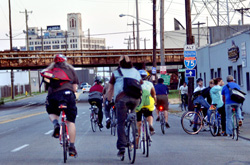
Grease up your chain, pump up your tires, roll up your right pant leg and hop on your bicycle--it's nearly Bike Month in Cincinnati. Get ready to roll.

The Newcomer: Colin Flynn
Mile High Club booming in Cincinnati

At $425 a pop, what may be the nation's only Mile High Club has been quietly operating for more than 20 years at Cincinnati Municipal Lunken Airport. Business hit warp speed after Valentine's Day stories featuring Flamingo Air in local and national media. Read the full story here.

East End Center offers GED hope for dropouts

Every single day in this country, 7,000 students drop out of high school.   Whether that is due to a lack of family support, health issues, learning disabilities, low basic skills or the constant stress of poverty, these drop-outs cost their communities, their states and the country billions of dollars in potential earnings. If the pattern continues, 13 million students will drop out of school in the next decade, at a national cost of $3 trillion.   East End Adult Education Center is determined to put the brakes on that trend. In its 38-year history, the learning center has served more than 7,600 students. Despite these students’ academic and social challenges and the poverty that permeates the East End, around 700 students have received their GED (General Educational Development) certificate through this program.   Requirements to sign up are few. Anyone, of any age, is accepted. The center accepts students who aren’t working, although attaining a job is encouraged. Once they are evaluated and given a learning plan and materials, students can come anytime that the center is open to study and get help from teachers and tutors. Best of all, everything is free, from the evaluations and class time to the books and materials.   The demographics have changed, says Adele Craft, executive director of this private, non-profit organization. “We used to have mostly older adults, but now we see a lot more teens. We had 125 students last year, and 55 were teens.” Perhaps teens who drop out aren’t waiting until adulthood to go back to school, as they realize how valuable a high school diploma is in today’s workforce. “And a lot of it is word of mouth,” Craft adds. “Teens are talking to each other” and encouraging each other to get back to school.   Do Good:   • Donate: Where there once were 40 programs in Cincinnati that offered GED preparation services, now there are fewer than 10 because of funding cuts.   • Volunteer: your time and talents to tutor one of the many East End students.   • Encourage: your business or corporation to support the work of the East End Adult Education Center. By 2018, more than 60 percent of jobs will require some education beyond high school.   By Becky Johnson

Irish Heritage Center adds to lively calendar

From monthly sing-songs to geneaology lessons, visitors to Cincinnati’s Irish Heritage Center discover a new world of learning. Since it opened in the former McKinley School on Eastern Avenue, the Center has grown through much more than the luck of the Irish. Grassroots efforts continue to fuel a growing roster of programs and services, including a custom-made exhibit from the Dublin Library. Heritage Center Founder Maureen Kennedy credits the dedication of volunteers determined to share their love of all things Irish. “The Center was imagined by many many people over the past 50 years,” she says. After purchasing the former Cincinnati Public School in 2009, the new non-profit discovered the power of grassroots support. “The school has been lovingly restored by a team of volunteers, room by room.” The Center, which encompasses the space of a city block, includes a theater, tea room, social room, library, music room and dance room. There are also plans for a museum. Additional space is available for artist studios, club meetings, events and concerts. “They have done an unbelievable job,” says Margaret McGurk, a supporter of the Center. She ticks off a list of regular events and activities, plus future plans that define “ambitious,” especially considering the group’s youth and limited resources. “They have done all of this with no paid staff, no public relations. They have grown so fast.” A recent coup for Kennedy took shape while she was out of town. The Irish American Theater Company  artistic director had implored Ireland's National Library in Dublin to share a piece of its renowned W. B. Yeats exhibit with the Cincinnati Center. When she finally received an answer last month—an answer that confirmed that a custom version of the exhibit was already on its way to Cincinnati--she was on vacation. In true grassroots fashion, Kennedy immediately set to work sharing the news with educators and members. But the exhibit is just part of what the Center offers to visitors. In addition to monthly Mick & Friends gatherings for fun and story-sharing, programs range from dancing lessons to concerts. “This spring, we begin instruction in sports--Gaelic ?games for 7 to 10 year-olds--Irish Football and hurling,” Kennedy says. “We strive to be a vibrant Center for all things Irish so our children and grandchildren can ?know from whence they came.” But she stresses that when it comes to programs and activities, everyone is blessed with a touch of the Irish. “Membership is open to anyone with any tie whatsoever, including wondering why the grass is so green,” she says. “In other words, it is inclusive of all ethnicities, religious persuasions, political affiliations and so on, but is focused on?telling the story of the Island of Ireland, through entertainment in all its ?dimensions.” Do Good: • Visit the W. B. Yeats exhibit while you can—the run is limited. • Like the Irish Heritage Center on Facebook to keep up with the latest news. • Go to a Rockin and Readin concert by a Larry Kirwan, member of punk-inspired, New York City Irish rock band Black 47. By Elissa Yancey/Follow Elissa on Twitter

BenePhoto shares profits from photos

A Cincinnati-based print company is taking the term “creative fundraising” literally.   BenePhoto – a mix of the words benefit and photograph - is the brainchild of Brian Frank, one of the owners of the Cincinnati-based family business Print Management. Having purchased his share of school fundraising products over the years, Frank wondered if people would rather support their chosen non-profit organization while buying products they actually wanted or were planning to purchase anyway. Given the popularity of creative photo products like greeting cards, photo books and calendars, Print Management created BenePhoto. Instead of uploading photographs, customers download one, easy-to-use software program from Benephoto and then work off of their own computer’s photo files. At check-out, customers designate which non-profit they would like to support and BenePhoto donates 10 percent of the product sales to that organization.   With its “Making Everlasting Memories” book, Print Management had already established a niche photograph book product within the funeral industry and a graphics department to support it and, now, BenePhoto’s products, too.   “There’s no cost to the non-profit,” says Alexia Workman, account relationship manager at BenePhoto. The company provides a marketing toolkit for nonprofits to use while explaining the photo service to supporters and donors. That way, the nonprofit helps BenePhoto market its services and products.   Since BenePhoto was launched mid-summer, seven nonprofits have signed up and more are in the works.     “The company’s owners and the people who work here are already involved in the community, keeping people employed here, helping nonprofits, and giving people a product that they already wanted. We’re only asking folks to switch vendors," Workman says. “It’s a win-win.” Do Good: Learn: More about BenePhoto, its products and services and the nonprofits it is supporting. Contact: Alexia Workman if a nonprofit is interested in learning more about this kind of fundraising. Look: At your own photo files to see if you need to organize them with the help of BenePhoto! By Becky Johnson

Our Partners

Taft Museum of Art

Common Ground Is Brewing

Support local stories and receive our signature roast straight to your door when you join at the Standard level (or above).

Drink Better, Read Local

Close the CTA

Don't miss out!

Everything Cincinnati, in your inbox every week.

Close the CTA

Already a subscriber? Enter your email to hide this popup in the future.