
Uptown

Uptown includes all the neighborhoods around the University of Cincinnati including Avondale, Clifton, Clifton Heights, Corryville, Fairview, Mt. Auburn and University Heights, so it's a diverse mix of students and residents in one of the city's most distinct and eclectic group of neighborhoods. Uptown is the home of the Cincinnati Zoo as well as multiple hospitals and the Ludlow shopping district where you can find trendy and unique shops as well as any scent of incense you need. Ethnic restaurants, including a curiously high concentration of Indian eateries, multiple taverns, coffee houses, music venues and the Esquire — one of Cincinnati's finest independent art house movie theaters all make Uptown a one-stop walkable bazaar of exciting entertainment options.  

Launch Werks prototypes help inventors attract funding

With big names in branding hovering in an around Cincinnati, it can start to seem like the brand is everything, and intangible products are the only thing that can really sell – and scale. However, two industrial designers pairing up in Over-the-Rhine are challenging that assumption, combining their skills in design, engineering, and budding knowledge of manufacturing and sourcing materials at a start-up they call “The Launch Werks.” As the name implies, The Launch Werks not only offers its own, tangible products, but helps small businesses and innovators create prototypes from their ideas. That means doing everything from helping to design prototypes that consumers will rush to engage with to planning the look of the final object, imagining how people might interact with it, and even specifying the materials it should be manufactured from and where to purchase them. Co-founders Noel Gauthier and Matt Anthony met as industrial design students at the University of Cincinnati’s School of Design, Architecture, Art and Planning (DAAP) and quickly realized a shared interested in what happens after the design phase of a new product. “The leap it takes to to go from an idea to a real product fascinates us," Gauthier explains. "So much happens when an idea is translated into a made thing. … Having worked in various product design firms around the country, we never had a close connection with where and how the products we designed were being made.” So he and Anthony began to connect Cincinnati-area product development with high-quality manufacturing, filling a niche for companies that weren’t ready for large-scale production, but needed something to show potential investors. Anthony says he sees an opening right now for foodie-friendly items. “I think we’re going to see more local stores and products follow developments in the food movement: making unique products and doing it well. But we want to see some of them scale the way that Jeni’s Ice Cream or Taste of Belgium has.” For a city already big on branding, it might just be a tasty step in the right direction. By Robin Donovan


Launch Werks prototypes help inventors attract funding

With big names in branding hovering in an around Cincinnati, it can start to seem like the brand is everything, and intangible products are the only thing that can really sell – and scale. However, two industrial designers pairing up in Over-the-Rhine are challenging that assumption, combining their skills in design, engineering, and budding knowledge of manufacturing and sourcing materials at a start-up they call “The Launch Werks.” As the name implies, The Launch Werks not only offers its own, tangible products, but helps small businesses and innovators create prototypes from their ideas. That means doing everything from helping to design prototypes that consumers will rush to engage with to planning the look of the final object, imagining how people might interact with it, and even specifying the materials it should be manufactured from and where to purchase them. Co-founders Noel Gauthier and Matt Anthony met as industrial design students at the University of Cincinnati’s School of Design, Architecture, Art and Planning (DAAP) and quickly realized a shared interested in what happens after the design phase of a new product. “The leap it takes to to go from an idea to a real product fascinates us," Gauthier explains. "So much happens when an idea is translated into a made thing. … Having worked in various product design firms around the country, we never had a close connection with where and how the products we designed were being made.” So he and Anthony began to connect Cincinnati-area product development with high-quality manufacturing, filling a niche for companies that weren’t ready for large-scale production, but needed something to show potential investors. Anthony says he sees an opening right now for foodie-friendly items. “I think we’re going to see more local stores and products follow developments in the food movement: making unique products and doing it well. But we want to see some of them scale the way that Jeni’s Ice Cream or Taste of Belgium has.” For a city already big on branding, it might just be a tasty step in the right direction. By Robin Donovan
Sisson, Ohs tell of transformation in ‘I Send You This Place’

A fashion design Fulbright scholar and a computer scientist met in Cincinnati, married, then traveled to Iceland on a journey to make a film. The result is as spiritual as it is cinematic. "I Send You This Place" premieres in Cincinnati Nov. 29 at the Emery Theatre.

Faces Without Places founder wants to see homeless program expand

Karen Fessler has a message she wants you to hear loud and clear: Faces Without Places is alive, well and kicking.  For years, the nonprofit, grassroots organization that has provided nearly $1.5 million in educational support for homeless children in Greater Cincinnati was affiliated with the Cincinnati Public Schools. But about two years ago--and for a variety of reasons--the organization split with the school system, says Fessler, who is a board member and a founding member of the 17-year-old group.   But its mission remains intact, says Fessler.  “The most important part of the program is that we get kids out of shelters, we get kids off the streets and we show them that education is a way to experience a larger world,’’ says Fessler. “We want to broaden our reach. We want to broaden our horizons.”  Fessler declines to discuss what led to the parting of ways, but adds the founders of the program all left their jobs at CPS as well.   “But none of us lost our passion for the kids and the mission of Faces Without Places,’’ she adds. “I want people to know that we are here, and we are committed to providing services. We are toughing it out through thick and thin--for the kids.”  The nonprofit helps about 3,000 school children annually in Greater Cincinnati. Last year, the group provided 7,702 services to 3,013 children, according to its website. Those services included providing taxi services to school for 112 students, uniform vouchers for 777 students, backpacks and supplies for more than 839 students and Payless gift cards for 320 students so they could get a new pair of shoes, a luxury for many, Fessler says.  The nonprofit is best known for its Yellow Bus Summer Camp, which completed its 15th year this past summer. Last year, 152 children attended the eight-week camp that focuses on reading and day trips.  Earlier this month, the group’s biggest fundraiser--the Yellow Bus Ball--raised more than $23,000, most of which will go to fund the camp.   “The ball is critical because we have to have money to pay teachers and buy supplies,’’ Fessler says. “We can get grant money for field trips, but the fundraiser really helps us be able to put on the camp to the degree we have always done it.”  Fessler has worked with thousands of homeless children over the years, and she readily admits she is biased toward teens.   “A lot of people don’t realize this, but these kids are completely out on their own; they are either staying at friends' or living eight, nine, 10 kids piled up in an apartment,’’ she says. “They are squatting and some are living on the streets trying to negotiate life … they are all living life on the edge. I am most impressed by their sheer tenacity and their desire to find a better life.” Do Good:  • Register for the Mt. Adams Yellow Bus Pub Crawl on Saturday, Nov. 17.  • Attend the 5th annual Chili Taste Off on Dec. 9 at Northside Tavern.  • Contribute to Faces Without Places' wishlist of school and personal hygiene supplies.  • Sign up for the monthly email newsletter.  • Give back while you shop.  By Chris GravesChris Graves is the assistant vice president of digital and social media at Powers Agency

Festival reaches ‘Heights’ with untapped local talents

In its third year, the Heights Music Festival reaches deeper into the local music scene to highlight lesser known, hard-working local bands. This fall's version, which takes place this weekend (Nov. 9-10) includes new names and innovative collaborations with artistically focused Cincinnati non-profits.  "We actively sought out bands that have not had this kind of opportunity," says festival found Rome Ntukogu, of Far-I-Rome Productions. For example, Oui Si Yes, a seven-piece band that rarely plays out because of complicated performance schedules, will be part of the Heights this weekend. What started as a once-a-year, one-night/four-venue event evolved into a biannual celebration of bands across a wide range of genres. This fall, one all-ages venue (Rohs Street Cafe) will feature collaborations with student artists from the Music Resource Center in Evanston and Elementz of Over-the-Rhine. "I'm really excited about the Music Resource Center showcase we are doing," Ntukogu says. "They are going to create a small lineup of five of their students to perform."  Some will be MCs, some poets. All will perform at Rohs Friday.  Elementz offers its own showcase at Rohs Saturday. "We like to bridge the gap between scenes," Ntukogu says. "We're trying our best to reach out into different pockets in Cincinnati." His goal is to expose young musicians to each other, allow them to become fans of one another, and together, build a stronger and more connected music and arts community in Cincinnati. The fall Heights Festival features just four venues, down from previous festivals' higher club count. Ntukogu explains it's part of his plan for "surprises" for the spring 2013 festival. "We want to expand and add a few venues outside of the Clifton Heights business districts," he says. "I would like to double our venues by next spring." By Elissa Yancey Follow Elissa on Twitter

Rinto’s life a testimony to advocacy, support for women

Barbara Rinto has made supporting women’s health issues her lifetime mission. The 61-year-old advocate’s inspiring story is a highlight of the latest issue of The Women’s Book, an annual collection of women-focused news and information. As a child of the 50s and 60s, Rinto traces her activist roots to her college days, when supporting women’s reproductive rights opened her eyes to a wide range of related issues. “I think I was always a feminist,” says Rinto, who has been director of the Women’s Center at the University of Cincinnati since 2002. As an undergraduate at Kent State, she volunteered at a local health clinic to talk with women and girls about their contraceptive options. After getting her master’s degree in public administration, she began a long career of working with Planned Parenthood before moving into a leadership role in academia. She spent 28 years at Planned Parenthood, including an eight-year stint as the Cincinnati office director. Today, she remains at the forefront of women’s issues in the Cincinnati region. She chairs the Women’s Fund, an offshoot of the philanthropic Greater Cincinnati Foundation that is focused on helping women achieve economic self-sufficiency. At UC, her mission is to ensure that all women have a safe and equitable environment, particularly by preventing sexual violence and supporting the victims of violence. Working first-hand with survivors, developing programs to support understanding and share knowledge and supporting those around her have become hallmarks of Rinto’s leadership style. For Rinto, though, it’s all about empowering women to use their voices to spark change and growth. “It really has informed my life and my work,” she says. Do Good: • Like the UC Women’s Center on Facebook. • Learn more about the Women’s Book. • Find out how you can get involved with The Women’s Fund. By Stephanie Kitchens    

Public Interest Design Institute to educate attendees in community design

On Nov. 9 and 10, the Public Interest Design Institute will offer a two-day course in public interest design at the University of Cincinnati. Attendees of the conference will receive SEED® certification and learn ways to get involved with public interest design projects.   The course will feature speakers who will talk about specific public interest design projects and funding for those projects. Bryan Bell, founder of Design Corps and the Public Interest Design Institute, will be certifying attendees in SEED, or Social Economic Environmental Design. SEED helps guide, evaluate and measure the social, economic and environmental impact of design projects.   Public interest design enhances the existing design practice by putting design skills to use in the community. Many public interest design projects are for nonprofits and are funded through grants, foundations and collaborations with other organizations.   But public interest design isn’t just for designers or planners. The workshop is open to anyone, including students, interested in public interest design, specifically those in the development, government development, planning, urban design, landscape, interiors and industrial design fields.   “There’s an ever-growing recognition of both the need and opportunity for public interest design,” says Michael Zaretsky, associate professor in the School of Architecture and Interior Design at DAAP. “We know that in the past, design was really just for those that could afford it, but there are now so many examples of work that is for communities, and everyone benefits from it.”   In recent years, more and more large design firms are beginning to require that their employees donate a portion of their time to public interest design projects, some through organizations like theonepercent.org. The One Percent Project links nonprofits that need design projects with firms and individuals who want to donate one percent of their time to a project.   “It’s not just volunteering, but a chance to use our skills and knowledge to benefit a community,” says Zaretsky.   The speakers at the workshop include Maurice Cox, an urban designer and architecture professor at the University of Virginia; Ramsey Ford, co-founder and director of design for Design Impact; Emilie Taylor, design build manager at the Tulane City Center; and Zaretsky.   Zaretsky will be talking about a project he worked on in Tanzania with the Village Life Outreach Project. He serves as director of the Roche Health Center Design Committee, which, along with a nonprofit, helped build a health center in a rural Tanzanian village that has no power or running water. Zaretsky worked with students and engineering and architecture firms to complete the project.   There’s still time to sign up for the Public Interest Design Institute’s workshop. The cost for the course is $450; it’s $350 for AIA members and $250 for students.   By Caitlin Koenig Follow Caitlin on Twitter

UC part of education collaboration with Iraqi universities

A group of University of Cincinnati faculty and students will go to Iraq in November as part of a collaboration between U.S. and Iraq university to strengthen educational and economic opportunities in the Middle East county. Starting Nov. 2, representative from UC's College of Education, Criminal Justice and Human Services (CECH) and the UC Career Development Center (CDC) will go to Salahaddin University-Hawler in Erbil, Iraq. It's the latest in a series of trips between the two universities, which are in the third year of a U.S. State Department-sponsored linkages program geared toward undergraduate Iraqi students. Originally scheduled to end this year, the collaboration was given a six-month extension, says Laura Dell, academic director of distance learning for the UC School of Education. "I'm going to be teaching a two-week long seminar on education research. We'll also be observing teaching in classrooms and providing peer feedback," Dell says. The universities will also plan a joint spring conference. UC faculty will lead career development workshops, providing feedback on research courses, discussing literature and exploring future opportunities for post-doctoral students. Theresa Aberle, adjunct instructor and program coordinator for the UC Career Development Center, will help lead a conference on creating career centers. "I'll be there with four Iraqi universities and four U.S. universities. We'll be sharing information on how to set up career centers, how to do presentations and marketing, and all the different pieces of what a takes to get a career center working," Aberle says. As Iraq is transitioning into a more democratic government form, privates businesses are moving in and looking for a workforce. It's a cultural shift for the country that encompasses many important topics, including career development. "They've never had to have a career center before; it's a whole new venture for them," Aberle says. UC is among only five U.S. institutions picked to partner with five Iraqi universities. The partnership fits in with UC's 2019 strategic plan to expand international partnerships and overseas research collaborations. "It's part of the mission to help wherever we can," Dells says. Salahaddin University-Hawler is in the Kurdish region of Iraq, where many natives speak English as a second language, Dell says. That's made it much easier for each side to communicate and work together. Located in the Northern part of Iraq, it's also not as subject to ongoing violence. This is Dell's second trip there. "What we see of Iraq on the news is violence, and upheaval. It's been really nice to see the other side of the Middle East. People are excited to talk to Americans and very nice," she says. By Feoshia H. Davis Follow Feoshia on Twitter.

‘That Cortnie girl’ adds voice to feminist perspectives

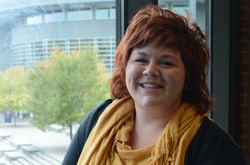
Cortnie Owens wants to make a difference. Whether she's in a class at UC, working on social media for the Women's Center on campus or writing on her own blog, the young feminist preaches the power of positive body acceptance.

UC study reveals two native plants suited for green roofs

It would appear that not all native Ohioans dread the scorching summers typical in our region. In fact, members of UC’s biology department recently identified two plants that thrive under the same conditions that send humans running for air-conditioned shelter. A pilot study conducted by UC biology student Jill Bader and assistant professor of biology Ishi Buffam found that of four native Ohio plants tested, the nodding wild onion (Allium cernuum) and a European sedum (Sedum acre) are particularly well suited for the vegetated roofs becoming increasingly common—and which the pair hope to help popularize even further—in local green building practices. Green roofs have been utilized in many cities to address environmental issues, from air pollution and street noise to excess stormwater runoff. According to Buffam, however, most of the plants currently used on green roofs are not native to the region. “We aim to help inform policy and details of green roof construction and implementation by increasing the knowledge base,” Buffam says. The results of the study, which Buffam and Bader presented earlier this month at the CitiesAlive 2012 conference in Chicago, confirm earlier studies which have found the nodding wild onion to be a successful green roof plant. “It was exciting to see everyone coming together to share research data, case studies and ideas for increasing green roof adoption as a solution for the environmental issues created by urbanization,” Bader says. “In order for green roof installations to become more widely adopted in the region, more guidance supported by research data is needed,” says Buffam. “Especially as it relates to the selection of green roof plants and the ecosystem services they provide. [Such research] is extremely important to the efforts of municipalities, businesses and environmental agencies who utilize green roofs in their efforts at reducing stormwater runoff and protecting the quality of our surface waters.” Buffam and Bader direct those interested in learning more about green roofs to the Civic Garden Center’s Green Learning Station, a roundup of  “…responsible methods to grow gardens anywhere and everywhere: yards, rooftops, walls, patios, driveways and parking lots.” By Hannah Purnell

Our Partners

Taft Museum of Art
Warsaw Federal

Don't miss out!

Everything Cincinnati, in your inbox every week.

Close the CTA

Already a subscriber? Enter your email to hide this popup in the future.