Northside

For those seeking an urban environment with a funky blend of Victorian homes, eclectic and traditional businesses, a long tradition of community activism and one of the most diverse neighborhoods in Cincinnati, you can't go wrong with Northside. Home to the legendary 4th of July parade, the Northside Farmer's Market, Shake It Records, the Gay and Lesbian Community Center of Cincinnati, popular watering holes like the Comet and Northside Tavern and an active community council, Northside is all about preserving its strong grassroots heritage. One of Cincinnati's most walkable neighborhoods, Northside also features multiple green spaces, including Hoffner Park, the central site of numerous festivals.

Blinkies raise awareness, safety for cyclists

Cyclists in the Queen City don't want any more "ghost rides," to commemorate fallen peers like Ronald Richardson, who died after being hit by a Metro bus. So as they ride tonight to honor him, supporters will also launch a new version of a proactive program they hope will raise awareness of the importance of sharing our roadways. Queen City Blinkies, an initiative to provide free front and rear bicycle lights to riders, revives an effort started in 2008 by 7 Hills Racing. In its new incarnation, QC Blinkies, supported by Queen City Bike and the local cycling community, serves as a way to express the importance of safe riding, and safe driving, especially in the wake of recent deaths. "This has been a really trying time for bicyclists in Cincinnati," says Nern Ostendorf, executive director of Queen City Bike. "The urgency for safer roads has never been more apparent. Bicyclists across the city are grieving, organizing and supporting one another." Adding lights, often more than one or two, is one way cyclists can make their presence known on city streets. But no matter how conspicuous the rider, a sense of conflict remains. (Just read the comments section of any story about cyclists and drivers and you will see it.) She notes that while Queen City Blinkies and other educational efforts, such as billboards, are important, the bigger issue involves how we, as a community, want to live. "Right now, most of our streets are designed to move cars across the city as fast as possible, with the greatest volume possible," Ostendorf says. "Of course that will create problems between cars and cyclists." That speed-focused design, she contends, does little to increase quality of life for any citizen. "I want my city, my neighborhood, and my street to be a place to visit and enjoy rather than somewhere to move through, and I believe that most people, cyclists or not, want those things for their communities, too," she says. One simple, though challenging, answer is to lower speed limits—as with pedestrian accidents, high-speed collisions with cyclists tend to be more serious and more often fatal. And it turns out that slowing down may help more than cyclists. A pilot project study in Philadelphia showed that lowering speed limits not only made streets safer for motorists and cyclists to co-exist, it lowered the rate of car accidents overall. "We need to be creative and experimental even in how we understand and move traffic," Ostendorf says. She advises neighborhood groups to take action on their own, to request lower speed limits and speed bumps when necessary to make streets and sidewalks safer for all residents, whether they are 8 or 80. Do Good: • Support Queen City Blinkies by donating to buy lights. • Obey the law. Driving a car? Remember, it is illegal for cyclists to be on the sidewalk, so give them time and space as they share the road. Cycling? Remember, if you coast through a red light, you're reinforcing the kind of stereotypes that can hurt your riding peers. • Enjoy good food and conversation at the Hyde Park Farmers Market Bikegarten. By Elissa Yancey Follow Elissa on Twitter
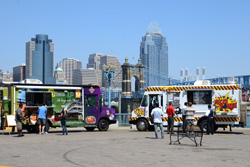

Entrepreneurs on a roll: Food trucks navigate complex elements

In Cincinnati’s gritty food truck subculture, there are few avenues of support and even fewer guarantees. Tom Acito of Cafe de Wheels and his food truck brethren have chips on their shoulders, real skin in the game and a cult-like following.

Boswell’s makes a comeback in Northside

Northsiders, and really anyone who ever visited Boswell’s before 2004, remember the Bousin Burger, a thick, juicy staple on the neighborhood restaurant/bar’s menu.  Beginning early September, the burger, along with an array of new vegetarian-friendly items, return to a fully renovated space once again owned and operated by Mike and Jan Beck, with business partners Walt and Debbie Schultz.  “It was just always such a fun and exciting place to run,” says Mike Beck, who also owns a rental property in the neighborhood. “We always had a tremendous business there. We enjoyed the community and the people.” Beck, who lives north of Ross, Ohio, first bought the space on the corner of Blue Rock and Boswell in 1983. In 2004, even though business was strong, he and his wife needed to take a break to help care for her ailing mother.  But Beck never forgot Northside, and Northside never forgot Beck. When the building was taken over by Northside Bank & Trust, the bank president hired Beck to renovate the restaurant space as well as four apartments upstairs.  Then the building went up for auction, and Beck and his friend Walt Schultz decided to go watch the sale. As they stood and talked, Beck couldn’t stop thinking about the building. He turned to his friend and said, “Northside is up and coming. I think we should do this.” After they informed their wives that they were once again building owners, they considered different business ideas. Should they open a wine and cheese shop? Maybe a small deli? Or pizza? But none of those ideas stuck. “The more we thought about reopening Boswell’s,” he says, “the more excited we got.” While Beck and his team have completely renovated the restaurant’s kitchen and patio, they were able to hire some of the former employees. He plans for music on the patio through the fall, just like the old days. “I think Northside has expanded,” Beck says. “We’re pretty impressed with the community again.” Depending on furniture delivery and other potential delays, Beck plans to have Boswell’s (now just Boswell’s, not Boswell’s Alley) open for Northside’s Second Saturday this Sept. 8.  By Elissa Yancey (who was always a big fan of the Boursin Burger) Follow Elissa on Twitter  

Filmmaking in Cincinnati: A Wide Angle

Local filmmakers don't wait for George Clooney and Ryan Gosling to come to town to practice their craft. From skateboarding movies to one-woman-show YouTube channels to high-end commercial productions, Cincinnati's film scene offers space, and support, for aspiring artists to grow.

WordPlay opens Urban Legend Institute in Northside

Got your zombie apocalypse survival kit yet? What about that alligator repellant? Better yet, how about some much-coveted, impossible-to-find water from the Fountain of Youth?  Look no further.  Those are the kind of items that will be available when the Urban Legend Institute, at 4011 Hamilton Ave., officially opens its doors Sept. 8. The family-friendly grand opening, from 5 to 10 pm, coincides with Northside’s Second Saturday celebration and will offer treats, music, word games and other surprises, promises Libby Hunter. But behind the tongue-in-cheek retail storefront is Northside’s newest and very serious nonprofit: WordPlay, a collaborative literacy group aimed at helping kids learn how to read, write and express themselves. It will offer free tutoring from 3 to 6 pm Mondays through Thursdays and from noon to 4 pm Saturdays. “It’s not just a store, the Urban Legend Institute will become our street-front personality, our interface with the community,” says Hunter, Wordplay’s executive director. “We want it to be a destination.  People will wander in not knowing about WordPlay, they'll enjoy the engaging experience they have at the Urban Legend Institute, learn about WordPlay, spread the word, come back to volunteer, enroll their kids or be inspired to donate.” WordPlay takes a page from the National 826 program based in San Francisco, with eight chapters across the United States. Each chapter offers free writing and literacy services to underserved children. Each are also fronted by whimsical retail outlets, including the Bigfoot Research Institute in Boston, which sells unofficial Yeti Hairballs;  The Boring Store in Chicago, which offers up all types of disguises; and the Museum of Unnatural History, which may be the only store in the world to sell unicorn tears. Hunter says she is encouraged about WordPlay after a highly successful pilot this summer, when WordPlay volunteers teamed up with Cincinnati Public  School’s Fifth Quarter to work with students from Chase Elementary School. “The biggest surprise is how well Fifth Quarter went; how quickly the kids become engaged,’’ she says, adding that two retired professionals also become just as committed. “I knew we were onto something.” One of those volunteers was Tom Callinan, retired editor and vice president of The Enquirer. Callinan, a WordPlay board member, was going to just drop by one or two days to observe. Instead, Hunter says he showed up every day for five weeks to work with the students. “It was rewarding this summer to watch students transform from reluctant learners to proud ‘authors’ of their work,’’ Callinan says, noting the approach of using fun and creativity to teach certainly enlivens the experience. The Urban Legend Institute follows the same path: “It’s an excellent example of a nonprofit using social enterprise to support its mission,” he says. Hunter says the store will also feature locally produced and sourced t-shirts, funky items of lore and crazy bits of Cincinnati history. And while the Institute began with a wholly quirky theme, Hunter says it has evolved so much that she hopes it will eventually become an archive of local lore. “We find that legitimate history is becoming a central piece to it,” she says. “We want it to serve as a sort of mini-children's museum, with fun, odd, curious things from the past for kids to explore—objects that might not be for sale but they can work with them, ponder them, use them for writing prompts.” Imagine a place, she says, where electronics are turned off. Instead, kids are turned on to actual hand writing, the art of letter writing, creating pieces of tactile art that is not crafted from tapping on a screen or moving a mouse.  “Funny enough, as we talk to people and gather information on local legends and history, we find we are becoming something of a repository for local lore and unusual objects,” Hunter says. “How cool to get to share all this with the kids.” Do Good:  • Volunteer.  Share your passion for the written word and creativeness. Teens and adults can both volunteer their time and talents. • Donate. As a 501c(3), donations are tax deductible. • Follow news and happenings on their Facebook or Twitter. Chris Graves is the vice president of digital and social media at the Powers Agency.  Editor's Note: Soapbox Managing Editor Elissa Yancey serves as vice chair of the board for WordPlay.

Plans for Northside Skatepark in motion

In 2000, after considering options for the empty space, Northside Community Council (NCC) members proposed turning the space between Colerain and Kirby into a skatepark as a way to welcome visitors to the neighborhood and reflect the interests of its residents. Backed by the City of Cincinnati and with grant funding, that never-forgotten project is now in motion. “The idea was that we had to come up with something that we wanted people to see when they come into the neighborhood,” says Tim Jeckering, former president of the NCC. “Whatever we decided on needed to set the tone for what we want this neighborhood to be.” The Council enlisted the help of the international consulting firm Action Sports Design, which has designed parks in Denver, Santa Fe and St. Cloud, MN. The company recently completed the initial designing phase of the Northside project. Next, members of the NCC plan to raise funds for park construction. The proposed skatepark will cover 2,300 square feet and will include a skating area, a community garden, a space for small children and a walking trail.  Action Sports Design constructed the layout of the new park with multiple uses in mind: the skate platforms can also double as stages for performances; hiking trails and a garden provide other outlets for visitors in and from the community. “We want it to be a positive place for youth for physical activities, exercise and recreation,” says Jeckering. “The idea is to make it a destination skating place; it’s something Cincinnati lacks.” Jimmy Love, who has been skating Cincinnati for 10 years, says he’s excited to see the project move forward. “I can't wait to have a spot with new ramps and rails to shred,” says Love. “As a local skater, I realize we damage a lot of the architecture in the city. Now that we’ll have a legitimate place to skate, it's a win-win situation." By Jen Saltsman Follow Jen on Twitter  

Soapdish: ‘Pop-up’ creativity sates local appetites

The term “pop up” has become quite fashionable in the cultural lexicon as of late, applying to everything from retail to restaurants to picnics. Soapbox columnist Casey Coston takes a tour of Cincinnati's "pop-up" scene.

Neighbor wish lists get chance of boost from PNC Bank

Mary Lazzari wasn’t quite sure what she was going to do when she retired from a life-long career in nursing.  She figured she’d volunteer; maybe spend some time helping out at the Mary Rose Mission Soup Kitchen, which will be the first and only one in Boone County when it opens this fall in Florence.  Instead this summer, she’s taught herself about Facebook, viral marketing and grassroots organizing as part of PNC’s Neighborhood Wishlist Challenge. The challenge is a voting contest that will give up to $500 to each of 100 finalists to help kick-start neighborhood-based programs.  “I figured I’d be chopping carrots and celery back in the kitchen. I didn’t think I’d be out hustling,’’ Lazzari jokes.  Lazzari’s submission, on behalf of the Mary Rose Mission, was one of four local entries chosen from 500 in the 17 states in which PNC Bank operates. To be fully funded, each finalist now has to receive the same number of votes for each dollar they requested. Lazzari asked for $500, so she has to get her friends, family and anyone else she can convince to vote for the soup kitchen. Voting ends Sunday, Aug. 26, at 11:59 p.m.   Peg Moertl, a PNC senior vice-president in community development banking based in Cincinnati, said the bank’s goal was to get 500 submissions in two weeks. They got more than that in 48 hours. “We know there’s a lot of really good stuff happening in our neighborhoods,” Moertl says. “And sometimes a small bit of capital can make a huge difference.”  That’s exactly what Jeni Jenkins is hoping for. Jenkins, an artist and educator, applied for the full $500 to pilot the Youth ArtBRIDGE project. The youth/artist printmaking collaborative is intended for low-income Northside youth, ages 8 to 18, to create socially conscious artwork.  “I’ve always known I’ve wanted to do this … to bring together all kinds of artists and kids with different skills and have them create art with a social justice bent,” says Jenkins, 32, who is the director of Education and Outreach for the Greater Cincinnati Homeless Coalition. Jenkins, whose project still needs a few hundred votes to secure funding, says she was excited to make it to the voting phase.  “Five-hundred dollars may not seem like a lot to many people, but it really is. This is about getting funds to do a small project, to provide a kind of jumpstart,” she says. “It’s about getting myself out there; about showing outcomes.”  Moertl was delighted to see the local submissions, which also include Bob Ashbrock’s $500 request to provide new landscaping in and around the Reading Veteran’s Memorial Plaza and Joshua Hanauer’s $500 request to buy balls to expand the burgeoning youth rugby program in Norwood. Each winner of the $500 will have 90 days to provide the bank with a project recap that provides outcomes, photos and videos, “so we can see the impact of these,’’ Moertl says. “I’m very eager to see the results,’’ she says. “For any project that really pops, I would think that one of our teams may reach out to these folks and see if we are supporting them.” For Lazzari, winning will likely mean paying for one of the first trips to the grocery store to stock the soup kitchen’s pantry. “Every little bit helps,” Lazzari says. “It may not seem like a lot, but it’s a beginning for us.” Do Good: • Vote on the local projects. • Watch Jeni Jenkin's video. • Contribute to the Mary Rose Mission.

Video Cincinnati growing Cincinnati

Find out how a new generation of entrepreneurs, from farmers and artisans to digital app developers, are making history as they build the future of Cincinnati, one idea at a time. Video courtesy of The Queen City Project.

Caracole’s new space in Northside offers room to grow

It only seems fitting, David White says, that Caracole Inc.’s offices are now at the former Charles Miller Funeral Home in Northside. The funeral home was one of only two in the entire Greater Cincinnati area that would accept the bodies of AIDS victims in the 1980s. “Back in the day, people thought you could catch it from a sneeze,” says White, Caracole’s Community Investment Coordinator. “But the folks at the Miller funeral home were not scared. You have to remember, this was back in the days when AIDS was a death sentence.” Caracole, the non-profit that that provides safe, affordable housing and supportive services for individuals and families living with HIV/AIDS, moved into the former funeral home at the corner of Hamilton Avenue and Knowlton Street June 29.  The move was necessitated after Caracole assumed the caseload from fellow local nonprofit Stop AIDS in April 2011. The shift increased Caracole’s clients from 200 in Hamilton County to nearly 1,000 clients served in eight counties, White says. “The best thing, my favorite thing, has been the community of Northside. They have been so welcoming,’’ he says. “The neighborhood is so excited a social services agency is here, let alone an AIDS group. It’s been amazing, really.” The move more than doubles their space to 9,400 square feet, centralizes their location and puts them directly on Metro routes. It is also close to hospitals and provides private offices for staff. The new location houses the group’s administrative and case management offices. Two transitional homes, each with 11 beds, did not move. Those homes provide housing and services for homeless residents who are HIV positive or suffering from AIDS. White is excited because the increased space means many like services are now under one roof. Caracole’s HIV/AIDS support groups can meet regularly, which was not the case at their former Roselawn location.  A local GLBT group will also hold meetings at the offices, and two employees from Planned Parenthood of southwest Ohio will administer anonymous HIV tests there. “We would not have been able to move without the donations—from paint, furnishing and the majority of the carpeting,’’ says White, who estimated that donations were worth tens of thousands of dollars. “This helps us save money on rent and is money we can put toward client services.” Two foundations provided more than $30,000 to move the group’s offices as well as for data installation. Matt Kotlarczyk, who bought the 15,000-square-foot building with a partner in late 2011 for $260,000, says redeveloping it with Caracole has gone extraordinarily well. Caracole signed a 10-year lease for first-floor offices. “It gives them a new home and us a good, solid investment,” says Kotlarczyk, a local sculptor who owns Refined Sugar Studio. Future Life Now LLC is leasing about 2,500 square feet on the second floor of the building. Another 3,500-square-foot space on the second floor and the 3,500-square-foot hearse garage, which is fully insulated, remain vacant, he says. Kotlarczyk has been told the building, originally built in 1875 and added onto numerous times, was the longest continuously operated funeral home in Cincinnati. And at least one woman thought it still was. The woman walked into Caracole’s offices a couple weeks ago, White says, and asked who she might talk to about funeral services. That wouldn’t be Caracole. They are too busy working on living. Do Good: • Attend Caracole’s open house celebration from 4 to 9 pm, Sept. 13, 4138 Hamilton Ave. There will be music, a photo booth and tours. It is not a fundraiser. • Call 513-679-4455 to schedule an anonymous HIV test, administered at Caracole through Planned Parenthood, Monday-Thursday from 9 am to 5 pm, and Friday from 9 am to 1 pm. • Email oracle@caracole.org to volunteer your time. • Donate cleaning supplies or toiletries to Caracole’s pantry to help residents. • Use your Kroger Plus card to give a percentage of your total spend to Caracole. By Chris Graves Chris Graves is assistant vice president of digital and social media at the Powers Agency.  

Our Partners

Taft Museum of Art
Warsaw Federal

Don't miss out!

Everything Cincinnati, in your inbox every week.

Close the CTA

Already a subscriber? Enter your email to hide this popup in the future.