Environment + Sustainability

AMP all-electric car available for demonstration

Advanced Mechanical Products, Inc. (AMP), makers of a 100 percent electric vehicle, took their product to Washington to demonstrate its performance.AMP builds all-electric Powertrains, using lithium phosphate batteries to convert GM Saturn Skys into zero-emissions vehicles.Online orders are now being filled, and the first deliveries are scheduled for 2009.During the trip, AMP president and CEO Jack Kuntz also submitted a Section 136 loan application to the U.S. Department of Energy, hoping to get funding from the $25 billion program to further develop the technology.Read the full release here.

Latest in Environment + Sustainability
Wind power meeting attracts local interest

Several Cincinnati area manufacturers interested in tapping the emerging wind turbine market took part in a workshop last week in Cleveland.Sponsored by the American Wind Energy Association and the Great Lakes Wind Network, the sold-out workshop gave companies the opportunity to find out how they can participate in a state grant program to further the development of renewable energy.According to the Enquirer, John Colm of the Great Lakes Wind Network says that, while the economy has slowed down some wind power projects, "there's a lot of demand out there for projects already committed."A four-year-old U.S. Department of Energy reports says that Ohio ranks only behind California in new job potential from wind farm projects due to its manufacturing expertise.Read the full article here.

SHP Leading Design reflects on productive 2008

Norwood-based SHP Leading Design (SHP) is celebrating several major accomplishments achieved during 2008.Early this year, SHP was recognized for the redesign of its 22,000-square-foot office space, a state-of-the-art environment that has achieved LEED Gold certification.The firm received three awards for the work, including Cincinnati Magazine's Interior Design Award and both an Interior Design Award and Local Favorite Award from the Cincinnati chapter of American Institute of Architects Committee on the Environment.In September, SHP and Cincinnati Public Schools celebrated the dedication of the new 75,000-square-foot Pleasant Ridge Montessori School, Ohio's first LEED-registered school.SHP incorporated many sustainable elements into the design, including solar panels, orientation to natural light sources, and raised access flooring that contains the building's mechanicals.These elements are expected to minimize the school's energy usage by 35 percent in the first year alone.And for its work in professional development, SHP received the 2008-2011 Intern Development Program Firm Award.In preparation for a big 2009, SHP's board has named Lauren Della Bella as the firm's president, effective January 1."I'm grateful to our diligent staff, as it is their hard work and dedication that helped make 2008 such a successful year for SHP," Della Bella says.  "Despite the economic challenges, we are looking forward to making even greater strides in 2009."Gerry Hammond, a 40-year veteran of SHP, will step down as president and CEO to become chairman of the board."With the new leadership in 2009, SHP can look forward to many more accomplishments," Hammond says.  "I'm extremely confident in Lauren and the abilities of the leadership team and know they will continue to build the firm's legacy for success and growth by connecting people and communities."Writer: Kevin LeMasterSource: Rachel Miller, HSR Business to Business LLC Illustration from SHP website

Beehive’s handcrafted products ‘sexy, stylish, and sustainable’

An Atlanta-based retailer has brought the "buy local" concept of handmade products from local designers to Pleasant Ridge.Beehive Co-op, founded in 2004 by Petra Geiger, showcases "sexy, stylish, and sustainable" clothing, jewelry, and accessories made by local design talent from its space at 6099 Montgomery Road.While designing her own line of handbags, Geiger noticed a lack of available outlets where independent designers could display and market their creations."I started Beehive because as a designer, I was frustrated at the lack of viable retail opportunities for my work, and met a lot of other designers who felt the same way," she says.  "I wanted to create a beautiful, modern, dynamic retail space for their handcrafted pieces, and in the process give the community a desirable alternative to mass-produced goods."The store rents space to local designers, who pay a low monthly rent in return for dedicated boutique space.Each cooperative member also must work four hours per week in the boutique, keeping overhead low and giving aspiring entrepreneurs experience in growing their businesses."A lot of artists want to take their business to the next level, and sharing space with other artists who are entrepreneurial is great for knowledge sharing," Geiger says.Additionally, Beehive presents a socially conscious shopping option."When you buy a handmade pendant or ceramic piece at Beehive, you get a chance to learn about the artist and form a connection that is personal and meaningful," Geiger says.  "You also know that your dollars are supporting independent artists and the local economy.  It's a totally different experience from the big box stores."Geiger opened her second store in New York last summer; the Cincinnati store is her third.Writer: Kevin LeMasterSource: Kate Powell, Beehive Co-op Cincinnati Illustrations courtesy Beehive Co-op website

Green Corner to be new Kennedy Heights ‘third place’
KZF returning to its roots

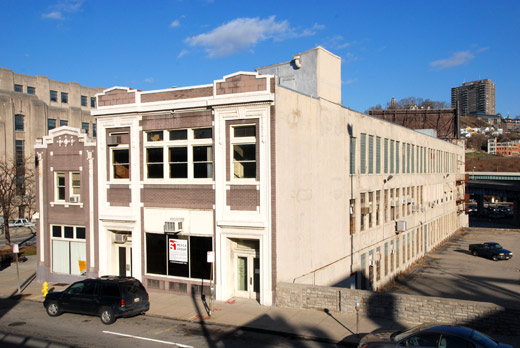
KZF Design Inc. has announced plans to renovate two connected structures at 700 Broadway for its new headquarters.The $6 million project on the 36,000-square-foot space is pursuing LEED Silver certification, and is expected to be completed by summer 2009.Architectural plans are still being developed, as are details on the sustainable features.Tim Sharp, vice president of KZF Design, says that the move Downtown is a return to the firm's roots."We have a long history with the Downtown area, beginning with our company's first Downtown offices being located in the Ingalls Building on Fourth Street back in 1956," he says.  "Downtown Cincinnati is important to KZF, and when the opportunity arose to purchase and renovate 700 Broadway, KZF Design couldn't pass up the chance to continue our investment in Downtown Cincinnati."As an architecture and design firm, the renovated building will show off KZF's abilities to potential clients."An added benefit is the opportunity for KZF Design to reuse an existing building and be able to showcase the beneficial aspects of a sustainable workplace to our clients and the Downtown community," Sharp says.Continuing growth led to the need for a new building, which will give the firm 30 percent more space than they currently have at the Baldwin Building in Walnut Hills."KZF Design is very diversified with deep expertise in multiple markets, which makes it adept at growing and prospering regardless of changes in the economy," says president and CEO William H. Wilson III in a media release.  "We are involved in a number of joint ventures and consulting arrangements and have projects in many states.   All of this keeps our business growing."Writer: Kevin LeMasterSource: Tim Sharp, vice president, KZF Design Photography by Scott Beseler

Emersion Design emerging

A relative newcomer to the architecture and design field, Norwood’s Emersion Design has been recognized with three awards for its work in sustainable design at the 2008 Cincinnati Design Awards.Perhaps the most exciting is the IIDA Honor Award for Built Work, recognizing their 1,700-square-foot collaborative workspace currently under review by the U.S. Green Building Council for LEED for Commercial Interiors Platinum certification.Chad Edwards, architect and urban designer, says that only two other firms in the country have headquarters certified LEED Platinum (New York and Seattle), and no other architecture and engineering firm in the nation has achieved it.The building is situated in a walkable neighborhood and uses lumber mill waste, bamboo, and glass walls reclaimed from a job at Naval Surface Warfare Center in Crane, Indiana.Emersion even has its own on-site worm farm."We selected the building for financial reasons, but also because it fit into the structure of LEED and what it tries to do," Edwards says.The entire construction project produced just 12 pounds of waste."This is our home, and the CDA recognized that," says Nikki Marksberry, who heads business development.  "It's very exciting for us to design the same space in which we spend so much time.  It's really a treat."In just 16 months, Emersion has expanded from four principals to 18 full-time employees.The firm has also reached 165 percent of its 2008 sales goal, or approximately what they were hoping to achieve in 2009."It was very humbling on awards night," Edwards says.  "It was our first year of submissions for the awards, and we won the most.”The other awards included AIA Honorable Mentions for Architectural Advancement for Greening Over-the-Rhine, a study conducted by several groups that showed that LEED and historic preservation standards and tax incentives can be applied to the historic neighborhood; and for a LE3D Social Sustainability Rating System that will be integrated into the next generation of LEED standards.Writer: Kevin LeMasterSources: Chad Edwards, architectural/urban designer, Emersion Design; Nikki Marksberry, business development, Emersion Design Photograph provided by Emersion Design


UC one of six universities selected for coal research

A University of Cincinnati project is one of six chosen by the U.S. Department of Energy (DOE) to take part in its University Coal Research Program.UC researchers will work to investigate and demonstrate two new types of doped-ceramic nanofilm-coated optical fiber chemical sensors that will only detect and interact with specific gas molecules.The Missouri University of Science and Technology will collaborate on the three-year project.The University Coal Research Program, which is the nation's longest-running student-teacher research grant initiative, is designed to "advance new ideas in coal research and to train a new generation of scientists and engineers in the investigation of long-term solutions for clean and efficient use of the nation's abundant coal resources", according to the DOE.Read the full article here.

More than 400 local high schoolers explore green careers

More than 400 high school students from 18 local schools attended the 2008 International Education Summit on "Emerging Careers in Global Sustainability" at Northern Kentucky University.Sponsored by the Global Center of Greater Cincinnati, the summit featured presentations from professionals in green industries and gave the students the opportunity to do some networking.Alternative energy is likely to be the kind of growth industry that will be courting these students as they enter the workforce."We think that this energy transition ... is going to become a huge engine of job creation," says Chris Flavin, keynote speaker and president of Worldwatch Institute.  "It's possible to have an interesting career, a reasonably lucrative career where your personal needs are met, but also to feel like you're part of solving a big global problem."Read the full article here.

Close the Loop’s Green Machine set to recycle 20,000 tons of printer related parts and employ 100

Our Partners

Taft Museum of Art
Warsaw Federal

Don't miss out!

Everything Cincinnati, in your inbox every week.

Close the CTA

Already a subscriber? Enter your email to hide this popup in the future.